A French Word to Live By
How to Conjugate Regréer in French
/ʁə.ɡʁe.e/
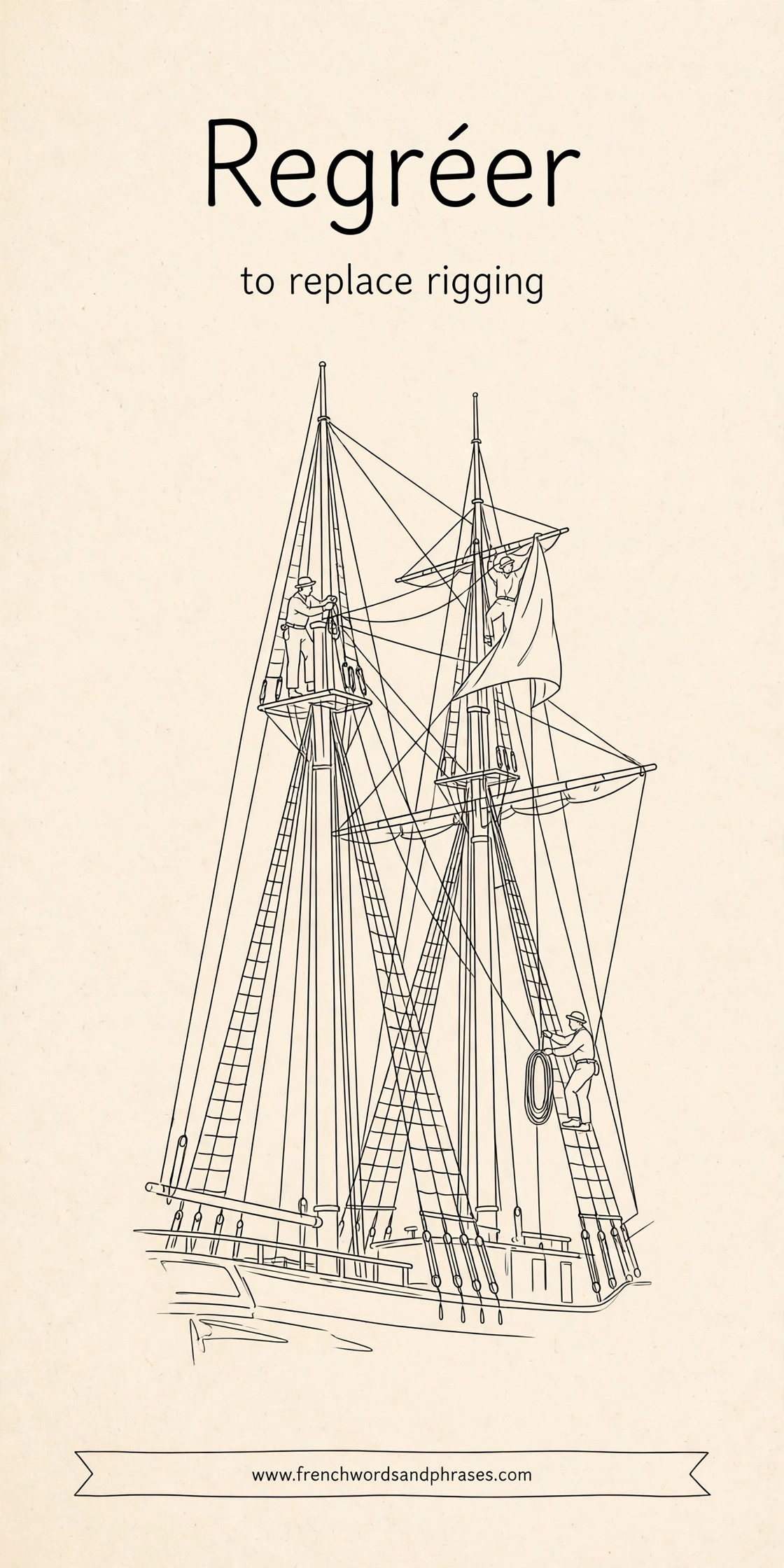
Regréer means to replace rigging — to fit a ship out again with new ropes, sails and masts after storm, battle or winter.
A three-master limping into Brest with her yards bare and her ropes in rags, a chandlery full of tarred cordage and patient men with splicing fids — regréer is the sailor’s verb for rigging a ship all over again: new standing rigging, new running rigging, until she can spread sail once more.
In this guide, you’ll learn how to conjugate regréer in all the major French tenses and moods. Explore complete conjugation tables, French examples, English translations, and practice quizzes.
Understanding the French Verb Regréer
Regréer is a regular French verb belonging to the first group of verbs, those ending in-er.
It means to replace rigging. It belongs wholly to the world of sailing ships and naval yards: a vessel is dégréée (stripped) for wintering, repairs or capture, and regréée when she is fitted out again. Modern yachtsmen use it too, for replacing worn standing rigging — regréer un voilier is a normal, expensive springtime decision.
Verb classification: First group (-er)
Auxiliary verb: Avoir
Past participle: regréé
Present participle: regréant
English equivalents: To re-rig, to fit out with new rigging; regréer un navire — to re-rig a ship; le gréement — the rigging; dégréer — to strip a ship of her rigging; un gréeur — a rigger.
One important detail: regréer is built on gréer (to rig, to fit out a ship) with re- in front, and it behaves like créer — the é stays put and the endings pile up their vowels: je regrée, nous regréons, ils regréent, imperfect je regréais, past participle regréé. Do not confuse it with its near-neighbours on the dictionary page: regreffer is to graft again, regratter is to scratch again. The family word to know is le gréement — everything above deck that holds the masts up: haubans, étais, drisses and voiles.
Experience the Word
Regréer is the verb of the bare masts made whole again — a ship with nothing above her deck but sky, dressed once more in rope and canvas.
Imagine a barque in a Brittany yard in 1880, home from the cod banks with half her rigging chafed through. For a week the riggers swarm aloft: new shrouds are tarred, blocks are rove, sails are bent on. On the eighth morning the captain looks up and nods — on a regréé le navire, she is a ship again.
Yesterday she was a hull with sticks. Today she is re-rigged — regréée — and hungry for wind.
How to Conjugate Regréer: Complete French Conjugation Guide
Let’s explore every major conjugation of regréer, beginning with the indicative mood.
How to Conjugate Regréer in the Indicative Mood
The indicative mood is used to express facts, observations, actions, and events.
How to Conjugate Regréer in the Present Tense (Présent)
Used for actions happening now, habitual actions, and general truths.
| Subject | Conjugation |
|---|---|
| je | regrée |
| tu | regrées |
| il / elle | regrée |
| nous | regréons |
| vous | regréez |
| ils / elles | regréent |
Example
Les gréeurs regréent le trois-mâts dans le port de Brest.
The riggers are re-rigging the three-master in the port of Brest.
Quick Quiz 1
Complete the sentence:
Nous ______ le bateau avant la régate de juin.
Reveal the answer
regréons
Nous regréons le bateau avant la régate de juin.
We are re-rigging the boat before the June regatta.
How to Conjugate Regréer in the Passé Composé
Used for completed actions in the past. Regréer takes the auxiliary verb avoir.
| Subject | Conjugation |
|---|---|
| j’ | ai regréé |
| tu | as regréé |
| il / elle | a regréé |
| nous | avons regréé |
| vous | avez regréé |
| ils / elles | ont regréé |
Example
On a regréé le voilier avec des haubans neufs.
They re-rigged the yacht with new shrouds.
How to Conjugate Regréer in the Imparfait (Imperfect Tense)
Used for habitual past actions, descriptions, and ongoing situations in the past.
| Subject | Conjugation |
|---|---|
| je | regréais |
| tu | regréais |
| il / elle | regréait |
| nous | regréions |
| vous | regréiez |
| ils / elles | regréaient |
Example
Chaque printemps, le chantier regréait les goélettes de pêche.
Every spring, the yard used to re-rig the fishing schooners.
Quick Quiz 2
Choose the correct form:
They re-rigged the schooner.
Ils ______ la goélette. (ont regréé / sont regréés)
Reveal the answer
ont regréé
Ils ont regréé la goélette.
Regréer takes avoir.
How to Conjugate Regréer in the Plus-que-parfait
Used to describe an action that had already been completed before another past event.
| Subject | Conjugation |
|---|---|
| j’ | avais regréé |
| tu | avais regréé |
| il / elle | avait regréé |
| nous | avions regréé |
| vous | aviez regréé |
| ils / elles | avaient regréé |
Example
Ils avaient regréé la frégate avant l’inspection de l’amiral.
They had re-rigged the frigate before the admiral’s inspection.
How to Conjugate Regréer in the Passé Simple
Primarily used in formal writing, literature, and historical narratives. It is rarely used in everyday conversation.
| Subject | Conjugation |
|---|---|
| je | regréai |
| tu | regréas |
| il / elle | regréa |
| nous | regréâmes |
| vous | regréâtes |
| ils / elles | regréèrent |
Example
Après la tempête, l’équipage regréa le navire en six jours.
After the storm, the crew re-rigged the ship in six days.
How to Conjugate Regréer in the Passé Antérieur
A literary tense used to express an action completed immediately before another past action, generally in the passé simple.
| Subject | Conjugation |
|---|---|
| j’ | eus regréé |
| tu | eus regréé |
| il / elle | eut regréé |
| nous | eûmes regréé |
| vous | eûtes regréé |
| ils / elles | eurent regréé |
Example
Quand on eut regréé le brick, il reprit la mer.
When they had re-rigged the brig, she put back to sea.
How to Conjugate Regréer in the Future Tense (Futur Simple)
Used to describe actions that will take place in the future.
| Subject | Conjugation |
|---|---|
| je | regréerai |
| tu | regréeras |
| il / elle | regréera |
| nous | regréerons |
| vous | regréerez |
| ils / elles | regréeront |
Example
Nous regréerons le bateau avant la régate de juin.
We will re-rig the boat before the June regatta.
How to Conjugate Regréer in the Futur Antérieur (Future Perfect)
Used for an action that will have been completed before a particular point in the future.
| Subject | Conjugation |
|---|---|
| j’ | aurai regréé |
| tu | auras regréé |
| il / elle | aura regréé |
| nous | aurons regréé |
| vous | aurez regréé |
| ils / elles | auront regréé |
Example
À Pâques, ils auront regréé toute la flottille.
By Easter, they will have re-rigged the whole flotilla.
How to Conjugate Regréer in the Near Future (Futur Proche)
Used to describe something that is going to happen soon. Formed with aller + infinitive.
| Subject | Conjugation |
|---|---|
| je | vais regréer |
| tu | vas regréer |
| il / elle | va regréer |
| nous | allons regréer |
| vous | allez regréer |
| ils / elles | vont regréer |
Example
Le chantier va regréer la goélette la semaine prochaine.
The yard is going to re-rig the schooner next week.
How to Conjugate Regréer in the Conditional Mood
The conditional mood expresses what would happen under certain circumstances. It is also frequently used to make polite requests or express wishes.
How to Conjugate Regréer in the Present Conditional
| Subject | Conjugation |
|---|---|
| je | regréerais |
| tu | regréerais |
| il / elle | regréerait |
| nous | regréerions |
| vous | regréeriez |
| ils / elles | regréeraient |
Example
Avec plus de bras, on regréerait le navire en trois jours.
With more hands, we would re-rig the ship in three days.
How to Conjugate Regréer in the Past Conditional
| Subject | Conjugation |
|---|---|
| j’ | aurais regréé |
| tu | aurais regréé |
| il / elle | aurait regréé |
| nous | aurions regréé |
| vous | auriez regréé |
| ils / elles | auraient regréé |
Example
Sans la tempête, ils n’auraient pas regréé le mât de misaine.
Without the storm, they would not have re-rigged the foremast.
Regréer in the Literary Past Conditional Form
This less common literary form uses the imperfect subjunctive of avoir.
| Subject | Conjugation |
|---|---|
| j’ | eusse regréé |
| tu | eusses regréé |
| il / elle | eût regréé |
| nous | eussions regréé |
| vous | eussiez regréé |
| ils / elles | eussent regréé |
Example
Le capitaine eût regréé sa frégate sans les ordres de l’arsenal.
The captain would have re-rigged his frigate but for the dockyard’s orders.
How to Conjugate Regréer in the Subjunctive Mood
The subjunctive is used to express wishes, emotions, doubts, necessity, and uncertainty. It frequently follows expressions such as il faut que (it is necessary that) or bien que (although).
How to Conjugate Regréer in the Present Subjunctive
| Subject | Conjugation |
|---|---|
| que je | regrée |
| que tu | regrées |
| qu’il / qu’elle | regrée |
| que nous | regréions |
| que vous | regréiez |
| qu’ils / qu’elles | regréent |
Example
Il faut que l’on regrée ce voilier avant l’été.
This yacht must be re-rigged before the summer.
Quick Quiz 3
Complete the sentence using the subjunctive:
Il faut que vous ______ le mât d’artimon.
Reveal the answer
regréiez
Il faut que vous regréiez le mât d’artimon.
You must re-rig the mizzen mast.
How to Conjugate Regréer in the Imperfect Subjunctive
A literary tense, rarely encountered in modern spoken French.
| Subject | Conjugation |
|---|---|
| que je | regréasse |
| que tu | regréasses |
| qu’il / qu’elle | regréât |
| que nous | regréassions |
| que vous | regréassiez |
| qu’ils / qu’elles | regréassent |
Example
Le capitaine exigea que l’on regréât le navire sur-le-champ.
The captain demanded that the ship be re-rigged at once.
How to Conjugate Regréer in the Pluperfect Subjunctive
A literary construction used to express an action completed before another past action.
| Subject | Conjugation |
|---|---|
| que j’ | eusse regréé |
| que tu | eusses regréé |
| qu’il / qu’elle | eût regréé |
| nous | eussions regréé |
| que vous | eussiez regréé |
| qu’ils / qu’elles | eussent regréé |
Example
On rapporta que les Anglais eussent regréé la prise en une nuit.
It was reported that the English had re-rigged the prize in a single night.
How to Conjugate Regréer in the Past Subjunctive
| Subject | Conjugation |
|---|---|
| que j’ | aie regréé |
| que tu | aies regréé |
| qu’il / qu’elle | ait regréé |
| que nous | ayons regréé |
| que vous | ayez regréé |
| qu’ils / qu’elles | aient regréé |
Example
Je suis content qu’ils aient regréé la goélette à temps.
I am glad they re-rigged the schooner in time.
How to Conjugate Regréer in the Imperative
The imperative is used to give commands, instructions, invitations, or suggestions. Subject pronouns are omitted.
How to Conjugate Regréer in the Present Imperative
| Person | Conjugation |
|---|---|
| (tu) | regrée |
| (nous) | regréons |
| (vous) | regréez |
Example
Regréez le mât d’artimon avant la marée !
Re-rig the mizzen mast before the tide!
Quick Quiz 4
How would you say Re-rig the mast (tu form)?
Reveal the answer
Regrée le mât !
French Participles of Regréer
Participles are verb forms that can be used in compound tenses and other grammatical constructions.
Present Participle of Regréer
regréant
En regréant le navire, les hommes ont découvert une poulie fendue.
While re-rigging the ship, the men found a split block.
Past Participle of Regréer
regréé
Regréé de neuf, le trois-mâts a quitté le port sous les applaudissements.
Re-rigged afresh, the three-master left port to applause.
Regréer in Everyday French: Real-Life Examples
Now that you know the conjugations, let’s see how regréer appears in everyday French.
Example 1 — Present
Les gréeurs regréent le trois-mâts.
The riggers are re-rigging the three-master.
Example 2 — Passé composé
On a regréé le voilier avec des haubans neufs.
They re-rigged the yacht with new shrouds.
Example 3 — Imparfait
Le chantier regréait les goélettes chaque printemps.
The yard used to re-rig the schooners every spring.
Example 4 — Future
Nous regréerons le bateau avant la régate.
We will re-rig the boat before the regatta.
Example 5 — Conditional
On regréerait le navire en trois jours avec plus de bras.
We would re-rig the ship in three days with more hands.
Example 6 — Imperative
Regréez le mât avant la marée !
Re-rig the mast before the tide!
Beyond Translation: The Meaning of Regréer
English rig is a Norse cousin, but French built its whole family on gréer: le gréement is the rigging, gréer is to rig a ship, and dégréer is to strip her bare. Regréer is what happens after every storm, every wintering and every capture.
A ship stripped is a ship waiting.
Regréer is the moment the waiting ends: ropes aloft, sails bent on, and the hull becomes a vessel again.
How to Remember the French Verb Regréer
Remember it this way: Regréer is about bare masts dressed again in rope and canvas.
- The family is le gréement (the rigging): gréer to rig, dégréer to strip, regréer to rig again.
- It conjugates like créer: je regrée, nous regréons, past participle regréé — the é never changes.
- Sailing only: you regréez un navire, un voilier, un trois-mâts — never a bicycle.
The key idea is bare masts dressed again in rope and canvas.
Test Your Knowledge of Regréer
Let’s see how much you’ve learned. Try answering these questions before revealing the answers.
Question 1
What is le gréement?
Reveal the answer
The rigging — all the ropes, wires and gear that support a ship’s masts and work her sails.
Question 2
How do you say They re-rigged the yacht with new shrouds in French?
Reveal the answer
Ils ont regréé le voilier avec des haubans neufs.
Question 3
Translate: The crew re-rigged the ship in six days.
Reveal the answer
L’équipage a regréé le navire en six jours.
Question 4
What is the past participle of regréer?
Reveal the answer
Regréé.
Question 5
Complete the sentence:
Il faut que l’on ______ ce voilier avant l’été.
Reveal the answer
regrée
Il faut que l’on regrée ce voilier avant l’été.
This yacht must be re-rigged before the summer.
Your Final Challenge
Can You Use It?
How would you say this in French?
In the morning, the three-master, re-rigged afresh, raised her masts towards a cloudless sky.
Reveal the answer
Au matin, le trois-mâts regréé de neuf dressait ses mâts vers un ciel sans nuage.
In the morning, the three-master, re-rigged afresh, raised her masts towards a cloudless sky.
A little French. A little curiosity. A richer everyday life.
LEARN FRENCH ONE WORD AT A TIME