A French Word to Live By
How to Conjugate Regratter in French
/ʁə.ɡʁa.te/
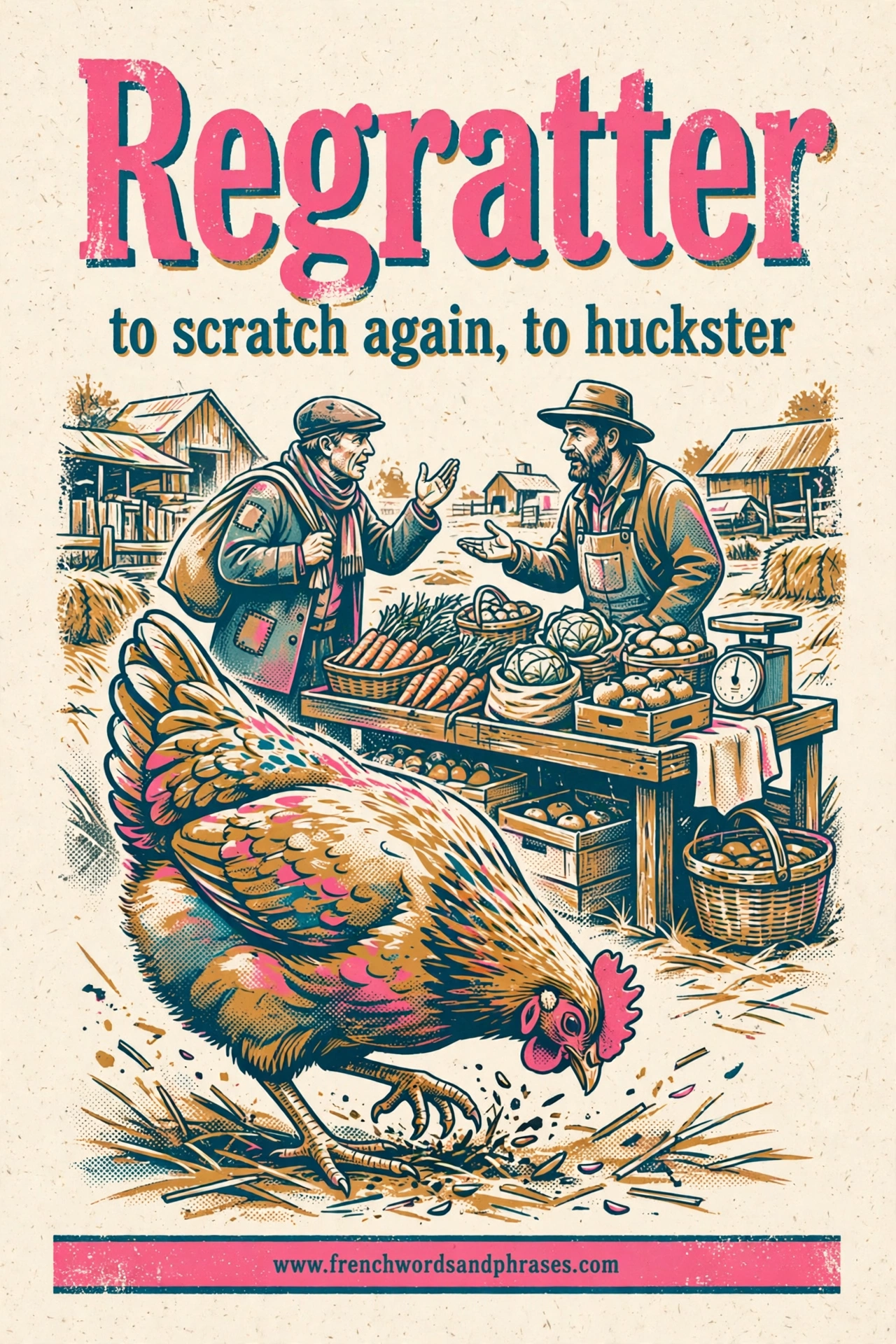
Regratter means to scratch again, to huckster — to scrape once more at a surface, and, in the old trade sense, to sell goods on second-hand.
A gardener scraping once more at the rust on an old gate, a market trader in old Paris selling flour by the spoonful from someone else’s sack — regratter lives two lives: scratching a surface a second time, and the petty second-hand trade the French called le regrat.
In this guide, you’ll learn how to conjugate regratter in all the major French tenses and moods. Explore complete conjugation tables, French examples, English translations, and practice quizzes.
Understanding the French Verb Regratter
Regratter is a regular French verb belonging to the first group of verbs, those ending in-er.
It means to scratch again, to huckster. In modern French the scratching sense is the living one — you regrattes a lottery card, an itchy scab, a coat of paint that did not come off the first time. The trading sense survives only in history books and old regulations, where le regrat names a whole petty economy of resale that Paris once taxed and policed street by street.
Verb classification: First group (-er)
Auxiliary verb: Avoir
Past participle: regratté
Present participle: regrattant
English equivalents: To scratch again, to scrape again; regratter une surface — to scratch a surface once more; regratter la peinture — to scrape at the paint again; (old trade) to retail second-hand goods, to huckster — vendre au regrat, to sell by retail from bulk; un regrattier — a petty second-hand dealer.
One important detail: regratter is gratter (to scratch, to scrape) with the prefix re- bolted on, and it conjugates exactly like gratter — perfectly regular: je regratte, nous regrattons, ils regrattent, past participle regratté. Watch the double t: it belongs to gratter and stays in every form, en regrattant included. The second life of the verb is old commercial French: le regrat was the licensed resale of foodstuffs bought in bulk — salt, flour, grain — and the regrattier who regrattait was the small dealer, half shopkeeper, half huckster, whom the guilds loved to fine.
Experience the Word
Regratter is the verb of the second scrape — the first pass was not enough, so the hand, the knife or the fingernail goes back to work.
Imagine a restorer in a Lyon workshop with a wooden door from 1890. One coat of paint came off yesterday; this morning she tilts the blade and regratte the stubborn corner, patiently, until the old oak shows through again — each pass of the scraper is a small act of regratter.
The door is not new, but it is honest again. She has re-scraped — regratté — until the truth of the wood came back.
How to Conjugate Regratter: Complete French Conjugation Guide
Let’s explore every major conjugation of regratter, beginning with the indicative mood.
How to Conjugate Regratter in the Indicative Mood
The indicative mood is used to express facts, observations, actions, and events.
How to Conjugate Regratter in the Present Tense (Présent)
Used for actions happening now, habitual actions, and general truths.
| Subject | Conjugation |
|---|---|
| je | regratte |
| tu | regrattes |
| il / elle | regratte |
| nous | regrattons |
| vous | regrattez |
| ils / elles | regrattent |
Example
Il regratte la rouille sur la vieille grille.
He is scratching at the rust on the old gate again.
Quick Quiz 1
Complete the sentence:
Nous ______ la rouille sur la grille.
Reveal the answer
regrattons
Nous regrattons la rouille sur la grille.
We are scratching at the rust on the gate again.
How to Conjugate Regratter in the Passé Composé
Used for completed actions in the past. Regratter takes the auxiliary verb avoir.
| Subject | Conjugation |
|---|---|
| j’ | ai regratté |
| tu | as regratté |
| il / elle | a regratté |
| nous | avons regratté |
| vous | avez regratté |
| ils / elles | ont regratté |
Example
Elle a regratté la peinture jusqu’au bois.
She scraped the paint again right down to the wood.
How to Conjugate Regratter in the Imparfait (Imperfect Tense)
Used for habitual past actions, descriptions, and ongoing situations in the past.
| Subject | Conjugation |
|---|---|
| je | regrattais |
| tu | regrattais |
| il / elle | regrattait |
| nous | regrattions |
| vous | regrattiez |
| ils / elles | regrattaient |
Example
Le chat regrattait la porte chaque matin à cinq heures.
The cat used to scratch at the door again every morning at five.
Quick Quiz 2
Choose the correct form:
She scraped the paint again.
Elle ______ la peinture. (a regratté / est regrattée)
Reveal the answer
a regratté
Elle a regratté la peinture.
Regratter takes avoir.
How to Conjugate Regratter in the Plus-que-parfait
Used to describe an action that had already been completed before another past event.
| Subject | Conjugation |
|---|---|
| j’ | avais regratté |
| tu | avais regratté |
| il / elle | avait regratté |
| nous | avions regratté |
| vous | aviez regratté |
| ils / elles | avaient regratté |
Example
Nous avions regratté le billet sans rien gagner.
We had scratched the ticket again without winning anything.
How to Conjugate Regratter in the Passé Simple
Primarily used in formal writing, literature, and historical narratives. It is rarely used in everyday conversation.
| Subject | Conjugation |
|---|---|
| je | regrattai |
| tu | regrattas |
| il / elle | regratta |
| nous | regrattâmes |
| vous | regrattâtes |
| ils / elles | regrattèrent |
Example
Le regrattier regratta son sel au marché pendant vingt ans.
The huckster retailed his salt at the market for twenty years.
How to Conjugate Regratter in the Passé Antérieur
A literary tense used to express an action completed immediately before another past action, generally in the passé simple.
| Subject | Conjugation |
|---|---|
| j’ | eus regratté |
| tu | eus regratté |
| il / elle | eut regratté |
| nous | eûmes regratté |
| vous | eûtes regratté |
| ils / elles | eurent regratté |
Example
Quand il eut regratté toute la coque, le bateau parut neuf.
When he had scraped the whole hull again, the boat looked new.
How to Conjugate Regratter in the Future Tense (Futur Simple)
Used to describe actions that will take place in the future.
| Subject | Conjugation |
|---|---|
| je | regratterai |
| tu | regratteras |
| il / elle | regrattera |
| nous | regratterons |
| vous | regratterez |
| ils / elles | regratteront |
Example
Demain, je regratterai la dernière couche de vernis.
Tomorrow, I will scrape at the last coat of varnish again.
How to Conjugate Regratter in the Futur Antérieur (Future Perfect)
Used for an action that will have been completed before a particular point in the future.
| Subject | Conjugation |
|---|---|
| j’ | aurai regratté |
| tu | auras regratté |
| il / elle | aura regratté |
| nous | aurons regratté |
| vous | aurez regratté |
| ils / elles | auront regratté |
Example
À midi, ils auront regratté tout le mur.
By noon, they will have scraped the whole wall again.
How to Conjugate Regratter in the Near Future (Futur Proche)
Used to describe something that is going to happen soon. Formed with aller + infinitive.
| Subject | Conjugation |
|---|---|
| je | vais regratter |
| tu | vas regratter |
| il / elle | va regratter |
| nous | allons regratter |
| vous | allez regratter |
| ils / elles | vont regratter |
Example
Ne va pas regratter ta croûte, elle doit cicatriser !
Do not go scratching your scab again, it needs to heal!
How to Conjugate Regratter in the Conditional Mood
The conditional mood expresses what would happen under certain circumstances. It is also frequently used to make polite requests or express wishes.
How to Conjugate Regratter in the Present Conditional
| Subject | Conjugation |
|---|---|
| je | regratterais |
| tu | regratterais |
| il / elle | regratterait |
| nous | regratterions |
| vous | regratteriez |
| ils / elles | regratteraient |
Example
Avec un meilleur outil, tu regratterais moins longtemps.
With a better tool, you would spend less time scraping.
How to Conjugate Regratter in the Past Conditional
| Subject | Conjugation |
|---|---|
| j’ | aurais regratté |
| tu | aurais regratté |
| il / elle | aurait regratté |
| nous | aurions regratté |
| vous | auriez regratté |
| ils / elles | auraient regratté |
Example
Il aurait regratté le billet s’il avait eu une pièce.
He would have scratched the ticket again if he had had a coin.
Regratter in the Literary Past Conditional Form
This less common literary form uses the imperfect subjunctive of avoir.
| Subject | Conjugation |
|---|---|
| j’ | eusse regratté |
| tu | eusses regratté |
| il / elle | eût regratté |
| nous | eussions regratté |
| vous | eussiez regratté |
| ils / elles | eussent regratté |
Example
Le marchand eût regratté son grain sans les édits du roi.
The merchant would have retailed his grain second-hand but for the king’s edicts.
How to Conjugate Regratter in the Subjunctive Mood
The subjunctive is used to express wishes, emotions, doubts, necessity, and uncertainty. It frequently follows expressions such as il faut que (it is necessary that) or bien que (although).
How to Conjugate Regratter in the Present Subjunctive
| Subject | Conjugation |
|---|---|
| que je | regratte |
| que tu | regrattes |
| qu’il / qu’elle | regratte |
| que nous | regrattions |
| que vous | regrattiez |
| qu’ils / qu’elles | regrattent |
Example
Il faut que je regratte cette tache avant de peindre.
I must scratch at this patch again before painting.
Quick Quiz 3
Complete the sentence using the subjunctive:
Il faut que vous ______ le mur avant de l’enduire.
Reveal the answer
regrattiez
Il faut que vous regrattiez le mur avant de l’enduire.
You must scrape the wall again before coating it.
How to Conjugate Regratter in the Imperfect Subjunctive
A literary tense, rarely encountered in modern spoken French.
| Subject | Conjugation |
|---|---|
| que je | regrattasse |
| que tu | regrattasses |
| qu’il / qu’elle | regrattât |
| que nous | regrattassions |
| que vous | regrattassiez |
| qu’ils / qu’elles | regrattassent |
Example
Elle craignait qu’il regrattât sa blessure.
She feared he might scratch his wound open again.
How to Conjugate Regratter in the Pluperfect Subjunctive
A literary construction used to express an action completed before another past action.
| Subject | Conjugation |
|---|---|
| que j’ | eusse regratté |
| que tu | eusses regratté |
| qu’il / qu’elle | eût regratté |
| nous | eussions regratté |
| que vous | eussiez regratté |
| qu’ils / qu’elles | eussent regratté |
Example
On disait que les regrattiers eussent regratté la farine de tout le quartier.
People said the hucksters had retailed the whole district’s flour second-hand.
How to Conjugate Regratter in the Past Subjunctive
| Subject | Conjugation |
|---|---|
| que j’ | aie regratté |
| que tu | aies regratté |
| qu’il / qu’elle | ait regratté |
| que nous | ayons regratté |
| que vous | ayez regratté |
| qu’ils / qu’elles | aient regratté |
Example
Je suis content que tu aies regratté la rouille à temps.
I am glad you scraped at the rust again in time.
How to Conjugate Regratter in the Imperative
The imperative is used to give commands, instructions, invitations, or suggestions. Subject pronouns are omitted.
How to Conjugate Regratter in the Present Imperative
| Person | Conjugation |
|---|---|
| (tu) | regratte |
| (nous) | regrattons |
| (vous) | regrattez |
Example
Regratte doucement, tu vas abîmer le bois !
Scrape gently, you will damage the wood!
Quick Quiz 4
How would you say Scrape gently (tu form)?
Reveal the answer
Regratte doucement !
French Participles of Regratter
Participles are verb forms that can be used in compound tenses and other grammatical constructions.
Present Participle of Regratter
regrattant
En regrattant la coque, il a trouvé une fissure.
By scraping the hull again, he found a crack.
Past Participle of Regratter
regratté
Regrattée avec soin, la grille a retrouvé son fer d’origine.
Scraped again with care, the gate recovered its original iron.
Regratter in Everyday French: Real-Life Examples
Now that you know the conjugations, let’s see how regratter appears in everyday French.
Example 1 — Present
Il regratte la rouille sur la grille.
He is scratching at the rust on the gate again.
Example 2 — Passé composé
Elle a regratté la peinture jusqu’au bois.
She scraped the paint again down to the wood.
Example 3 — Imparfait
Le chat regrattait la porte chaque matin.
The cat used to scratch at the door every morning.
Example 4 — Future
Je regratterai la dernière couche demain.
I will scrape at the last coat again tomorrow.
Example 5 — Conditional
Tu regratterais moins longtemps avec un meilleur outil.
You would scrape for less time with a better tool.
Example 6 — Imperative
Regratte doucement, sans forcer !
Scrape gently, without forcing!
Beyond Translation: The Meaning of Regratter
English once had the same double life: a regrater in old English markets was exactly the French regrattier — a licensed reseller of food bought in bulk, and regrating was an offence in English law too.
Both languages fined the middleman.
The verb comes from gratter, to scratch — the trader scratched his living, sou by sou, off other men’s sacks, and the scratching sense and the trading sense have shared one word ever since.
How to Remember the French Verb Regratter
Remember it this way: Regratter is about the second scrape — and the old huckster scratching a living off other men’s sacks.
- It is gratter with re- in front: to scratch is gratter, to scratch again is regratter — double t everywhere.
- The old trade sense hides in le regrat: second-hand resale of food, and the regrattier was its petty dealer.
- Regular -er: je regratte, nous regrattons, past participle regratté.
The key idea is the second scrape — and the old huckster scratching a living off other men’s sacks.
Test Your Knowledge of Regratter
Let’s see how much you’ve learned. Try answering these questions before revealing the answers.
Question 1
What are the two lives of regratter?
Reveal the answer
To scratch or scrape again, and, in old trade French, to retail second-hand goods — le regrat.
Question 2
How do you say He is scratching at the rust again in French?
Reveal the answer
Il regratte la rouille.
Question 3
Translate: She scraped the paint again down to the wood.
Reveal the answer
Elle a regratté la peinture jusqu’au bois.
Question 4
What is the past participle of regratter?
Reveal the answer
Regratté.
Question 5
Complete the sentence:
Il faut que je ______ cette tache avant de peindre.
Reveal the answer
regratte
Il faut que je regratte cette tache avant de peindre.
I must scratch at this patch again before painting.
Your Final Challenge
Can You Use It?
How would you say this in French?
He has been scraping at the old gate since dawn, and the iron slowly remembers its colour.
Reveal the answer
Il regratte la vieille grille depuis l’aube, et le fer, lentement, se souvient de sa couleur.
He has been scraping at the old gate since dawn, and the iron slowly remembers its colour.
A little French. A little curiosity. A richer everyday life.
LEARN FRENCH ONE WORD AT A TIME