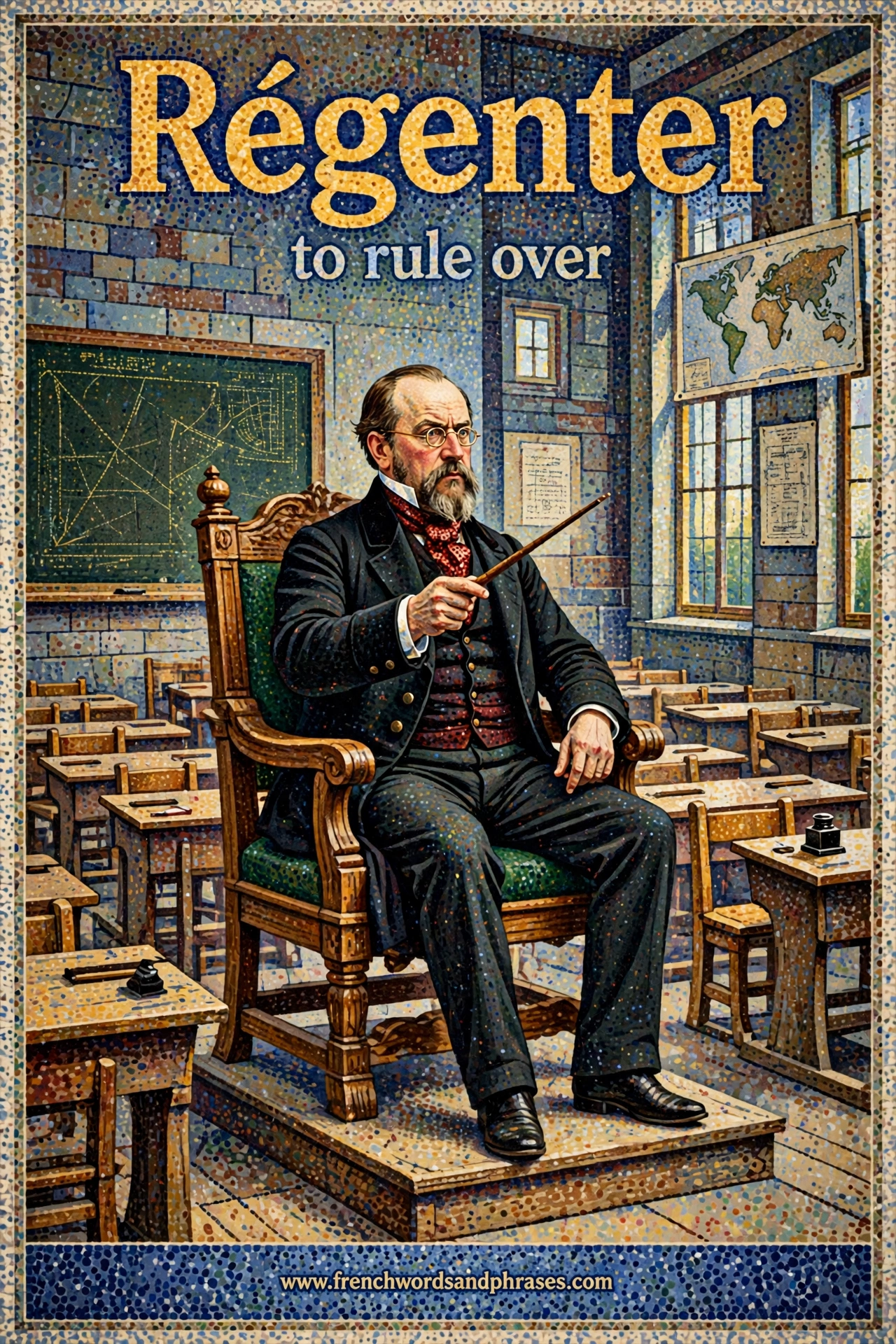
A French Word to Live By
How to Conjugate Régenter in French
/ʁe.ʒɑ̃.te/
Régenter means to rule over — to run everything and everyone around you with a regent’s authority, and usually a raised eyebrow from the narrator.
Every family, office and village has one: the person who decides the menu, the timetable and the seating plan, and expects obedience. Régenter is the verb of that small domestic reign — to rule over everything, down to the last cushion.
In this guide, you’ll learn how to conjugate régenter in all the major French tenses and moods. Explore complete conjugation tables, French examples, English translations, and practice quizzes.
Understanding the French Verb Régenter
Régenter is a regular French verb belonging to the first group of verbs, those ending in-er.
It means to rule over. It thrives in family chronicles, village gossip and office politics, where somebody always régentes — organising, deciding, correcting. French uses it with affectionate exasperation rather than real anger: la grand-mère qui régente tout is a figure of comedy as much as of power.
Verb classification: First group (-er)
Auxiliary verb: Avoir
Past participle: régenté
Present participle: régentant
English equivalents: To rule over, to run everything, to lord it over; régenter la maison — to run the household with a rod of iron; tout régenter — to want to control everything; régenter sa famille — to rule one’s family; régenter un bureau — to run an office; un régent — a regent.
One detail of tone before spelling: régenter is almost never a compliment — it is what the ruled call the ruler, with a smile that is not quite a smile. The spelling itself is a model of regularity: je régente, nous régentons — the é never changes, because the syllable after it is always sounded. Its root is régent, the regent who governs in the king’s place, and the verb keeps the whiff of borrowed authority: to régenter is to reign over a kingdom the size of a kitchen.
Experience the Word
Régenter is the verb of the small kingdom — the household, the office, the club — and of the one person who runs it all.
Imagine a grandmother in a farmhouse in the Périgord. She decides who sits where, when the soup is served, which grandson repairs the roof and which granddaughter is ‘trop maigre’. Personne ne l’a élue; elle régente la maison depuis cinquante ans, and honestly, the house has never run better.
No crown, no title. She rules — elle régente — and dinner is at seven.
How to Conjugate Régenter: Complete French Conjugation Guide
Let’s explore every major conjugation of régenter, beginning with the indicative mood.
How to Conjugate Régenter in the Indicative Mood
The indicative mood is used to express facts, observations, actions, and events.
How to Conjugate Régenter in the Present Tense (Présent)
Used for actions happening now, habitual actions, and general truths.
| Subject | Conjugation |
|---|---|
| je | régente |
| tu | régentes |
| il / elle | régente |
| nous | régentons |
| vous | régentez |
| ils / elles | régentent |
Example
Elle régente la maison d’une main de fer.
She rules the household with an iron hand.
Quick Quiz 1
Complete the sentence:
Nous savons qu’elle ______ toute la maison.
Reveal the answer
régente
Nous savons qu’elle régente toute la maison.
We know she rules the whole household.
How to Conjugate Régenter in the Passé Composé
Used for completed actions in the past. Régenter takes the auxiliary verb avoir.
| Subject | Conjugation |
|---|---|
| j’ | ai régenté |
| tu | as régenté |
| il / elle | a régenté |
| nous | avons régenté |
| vous | avez régenté |
| ils / elles | ont régenté |
Example
Il a régenté le bureau pendant vingt ans.
He ran the office like a little kingdom for twenty years.
How to Conjugate Régenter in the Imparfait (Imperfect Tense)
Used for habitual past actions, descriptions, and ongoing situations in the past.
| Subject | Conjugation |
|---|---|
| je | régentais |
| tu | régentais |
| il / elle | régentait |
| nous | régentions |
| vous | régentiez |
| ils / elles | régentaient |
Example
Ma tante régentait les repas de famille au détail près.
My aunt used to rule the family meals down to the last detail.
Quick Quiz 2
Choose the correct form:
He ran the office for twenty years.
Il ______ le bureau pendant vingt ans. (a régenté / est régenté)
Reveal the answer
a régenté
Il a régenté le bureau pendant vingt ans.
Régenter takes avoir.
How to Conjugate Régenter in the Plus-que-parfait
Used to describe an action that had already been completed before another past event.
| Subject | Conjugation |
|---|---|
| j’ | avais régenté |
| tu | avais régenté |
| il / elle | avait régenté |
| nous | avions régenté |
| vous | aviez régenté |
| ils / elles | avaient régenté |
Example
Elle avait régenté trois générations de cuisinières.
She had ruled over three generations of cooks.
How to Conjugate Régenter in the Passé Simple
Primarily used in formal writing, literature, and historical narratives. It is rarely used in everyday conversation.
| Subject | Conjugation |
|---|---|
| je | régentai |
| tu | régentas |
| il / elle | régenta |
| nous | régentâmes |
| vous | régentâtes |
| ils / elles | régentèrent |
Example
Le vieux directeur régenta l’école comme un royaume.
The old headmaster ruled the school like a kingdom.
How to Conjugate Régenter in the Passé Antérieur
A literary tense used to express an action completed immediately before another past action, generally in the passé simple.
| Subject | Conjugation |
|---|---|
| j’ | eus régenté |
| tu | eus régenté |
| il / elle | eut régenté |
| nous | eûmes régenté |
| vous | eûtes régenté |
| ils / elles | eurent régenté |
Example
Quand il eut régenté le village pendant dix ans, on finit par l’élire maire.
When he had run the village for ten years, they finally elected him mayor.
How to Conjugate Régenter in the Future Tense (Futur Simple)
Used to describe actions that will take place in the future.
| Subject | Conjugation |
|---|---|
| je | régenterai |
| tu | régenteras |
| il / elle | régentera |
| nous | régenterons |
| vous | régenterez |
| ils / elles | régenteront |
Example
À Noël, grand-mère régentera encore toute la tablée.
At Christmas, grandmother will once again rule the whole table.
How to Conjugate Régenter in the Futur Antérieur (Future Perfect)
Used for an action that will have been completed before a particular point in the future.
| Subject | Conjugation |
|---|---|
| j’ | aurai régenté |
| tu | auras régenté |
| il / elle | aura régenté |
| nous | aurons régenté |
| vous | aurez régenté |
| ils / elles | auront régenté |
Example
À sa retraite, elle aura régenté le service pendant trente ans.
By her retirement, she will have run the department for thirty years.
How to Conjugate Régenter in the Near Future (Futur Proche)
Used to describe something that is going to happen soon. Formed with aller + infinitive.
| Subject | Conjugation |
|---|---|
| je | vais régenter |
| tu | vas régenter |
| il / elle | va régenter |
| nous | allons régenter |
| vous | allez régenter |
| ils / elles | vont régenter |
Example
Attention, elle va encore régenter les préparatifs.
Careful, she is going to take charge of the preparations again.
How to Conjugate Régenter in the Conditional Mood
The conditional mood expresses what would happen under certain circumstances. It is also frequently used to make polite requests or express wishes.
How to Conjugate Régenter in the Present Conditional
| Subject | Conjugation |
|---|---|
| je | régenterais |
| tu | régenterais |
| il / elle | régenterait |
| nous | régenterions |
| vous | régenteriez |
| ils / elles | régenteraient |
Example
Sans elle, personne ne régenterait cette bande d’enfants.
Without her, nobody would keep this gang of children in order.
How to Conjugate Régenter in the Past Conditional
| Subject | Conjugation |
|---|---|
| j’ | aurais régenté |
| tu | aurais régenté |
| il / elle | aurait régenté |
| nous | aurions régenté |
| vous | auriez régenté |
| ils / elles | auraient régenté |
Example
Il aurait régenté tout le quartier si on l’avait laissé faire.
He would have ruled the whole neighbourhood if they had let him.
Régenter in the Literary Past Conditional Form
This less common literary form uses the imperfect subjunctive of avoir.
| Subject | Conjugation |
|---|---|
| j’ | eusse régenté |
| tu | eusses régenté |
| il / elle | eût régenté |
| nous | eussions régenté |
| vous | eussiez régenté |
| ils / elles | eussent régenté |
Example
Elle eût régenté la cour entière sans le roi.
She would have ruled the entire court without the king.
How to Conjugate Régenter in the Subjunctive Mood
The subjunctive is used to express wishes, emotions, doubts, necessity, and uncertainty. It frequently follows expressions such as il faut que (it is necessary that) or bien que (although).
How to Conjugate Régenter in the Present Subjunctive
| Subject | Conjugation |
|---|---|
| que je | régente |
| que tu | régentes |
| qu’il / qu’elle | régente |
| que nous | régentions |
| que vous | régentiez |
| qu’ils / qu’elles | régentent |
Example
Il faut toujours qu’elle régente les moindres détails.
She always has to control the smallest details.
Quick Quiz 3
Complete the sentence using the subjunctive:
Il faut toujours qu’elle ______ les détails.
Reveal the answer
régente
Il faut toujours qu’elle régente les détails.
She always has to control the details.
How to Conjugate Régenter in the Imperfect Subjunctive
A literary tense, rarely encountered in modern spoken French.
| Subject | Conjugation |
|---|---|
| que je | régentasse |
| que tu | régentasses |
| qu’il / qu’elle | régentât |
| que nous | régentassions |
| que vous | régentassiez |
| qu’ils / qu’elles | régentassent |
Example
On riait qu’il régentât jusqu’à la place des couverts.
People laughed that he ruled even over where the cutlery went.
How to Conjugate Régenter in the Pluperfect Subjunctive
A literary construction used to express an action completed before another past action.
| Subject | Conjugation |
|---|---|
| que j’ | eusse régenté |
| que tu | eusses régenté |
| qu’il / qu’elle | eût régenté |
| que nous | eussions régenté |
| que vous | eussiez régenté |
| qu’ils / qu’elles | eussent régenté |
Example
On racontait qu’elle eût régenté le château mieux que le comte.
People said she had run the castle better than the count.
How to Conjugate Régenter in the Past Subjunctive
| Subject | Conjugation |
|---|---|
| que j’ | aie régenté |
| que tu | aies régenté |
| qu’il / qu’elle | ait régenté |
| que nous | ayons régenté |
| que vous | ayez régenté |
| qu’ils / qu’elles | aient régenté |
Example
Je suis étonné qu’elle ait régenté la fête sans lever la voix.
I am amazed she ran the party without raising her voice.
How to Conjugate Régenter in the Imperative
The imperative is used to give commands, instructions, invitations, or suggestions. Subject pronouns are omitted.
How to Conjugate Régenter in the Present Imperative
| Person | Conjugation |
|---|---|
| (tu) | régente |
| (nous) | régentons |
| (vous) | régentez |
Example
Régente un peu moins, on respire à peine ici !
Rule a little less, we can hardly breathe in here!
Quick Quiz 4
How would you say Rule a little less (tu form)?
Reveal the answer
Régente un peu moins !
French Participles of Régenter
Participles are verb forms that can be used in compound tenses and other grammatical constructions.
Present Participle of Régenter
régentant
En régentant les préparatifs, elle a mis tout le monde au pas.
By taking charge of the preparations, she brought everyone into line.
Past Participle of Régenter
régenté
Régentée par sa grand-mère, la maison tournait comme une horloge.
Ruled by her grandmother, the household ran like clockwork.
Régenter in Everyday French: Real-Life Examples
Now that you know the conjugations, let’s see how régenter appears in everyday French.
Example 1 — Present
Elle régente la maison d’une main de fer.
She rules the household with an iron hand.
Example 2 — Passé composé
Il a régenté le bureau pendant vingt ans.
He ran the office for twenty years.
Example 3 — Imparfait
Ma tante régentait les repas de famille.
My aunt used to rule the family meals.
Example 4 — Future
Grand-mère régentera encore toute la tablée.
Grandmother will rule the whole table again.
Example 5 — Conditional
Il régenterait tout le quartier si on le laissait faire.
He would rule the whole neighbourhood if they let him.
Example 6 — Imperative
Ne régente pas tout, laisse-nous respirer !
Don’t control everything, let us breathe!
Beyond Translation: The Meaning of Régenter
A régent governs a kingdom in the sovereign’s absence — Philippe d’Orléans régentant la France is the grand historical picture. Régenter shrinks that grandeur to domestic size, and the shrinkage is the joke: whoever régentes a kitchen or a committee borrows a regent’s authority for a kingdom of twelve chairs. English regent survives in universities and hotels; French kept the verb for the person nobody elected and everybody obeys.
How to Remember the French Verb Régenter
Remember it this way: Régenter is about grandmother ruling Christmas dinner like a regent.
- Almost never a compliment: régenter is what the ruled call the ruler — picture a grandmother running Christmas.
- Perfectly regular spelling: je régente, nous régentons — the é never changes.
- From régent, the stand-in king: to régenter is to reign over a small kingdom — une maison, un bureau, un village.
The key idea is grandmother ruling Christmas dinner like a regent.
Test Your Knowledge of Régenter
Let’s see how much you’ve learned. Try answering these questions before revealing the answers.
Question 1
Is régenter usually a compliment?
Reveal the answer
No — it is said with a smile by the ruled about the ruler: elle régente tout, she controls everything.
Question 2
How do you say She rules the household with an iron hand in French?
Reveal the answer
Elle régente la maison d’une main de fer.
Question 3
Translate: He ran the office for twenty years.
Reveal the answer
Il a régenté le bureau pendant vingt ans.
Question 4
What is the past participle of régenter?
Reveal the answer
Régenté.
Question 5
Complete the sentence:
Il faut toujours qu’elle ______ les moindres détails.
Reveal the answer
régente
Il faut toujours qu’elle régente les moindres détails.
She always has to control the smallest details.
Your Final Challenge
Can You Use It?
How would you say this in French?
She has ruled the household for fifty years, and nobody can imagine Sunday without her orders and her soup.
Reveal the answer
Elle régente la maison depuis cinquante ans, et personne n’imagine le dimanche sans ses ordres et sa soupe.
She has ruled the household for fifty years, and nobody can imagine Sunday without her orders and her soup.
A little French. A little curiosity. A richer everyday life.
LEARN FRENCH ONE WORD AT A TIME