A French Word to Live By
How to Conjugate Regimber in French
/ʁə.ʒɛ̃.be/
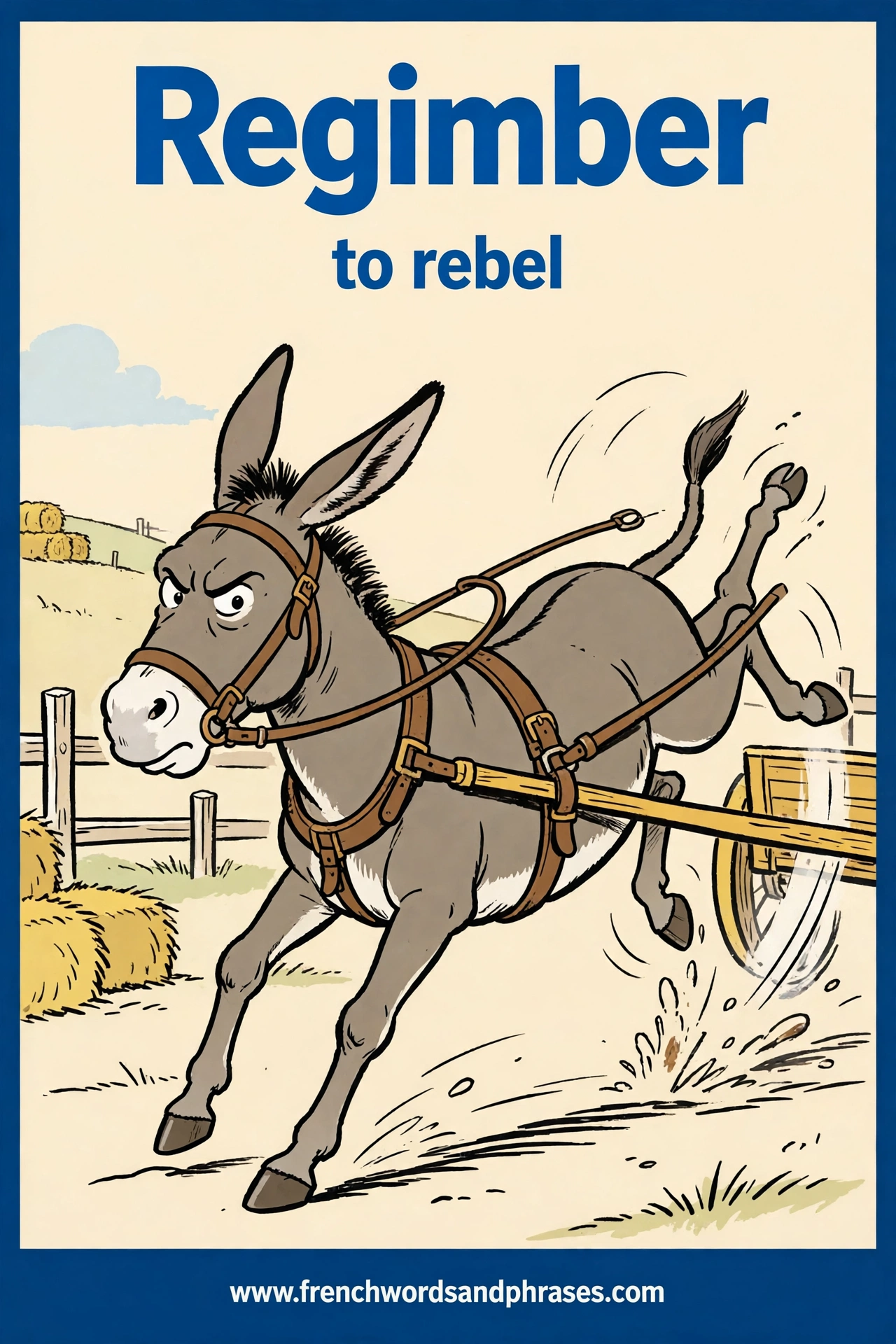
Regimber means to rebel — to kick out against the spur and refuse, suddenly, to go where you are being driven.
A cavalry horse feeling the spur and kicking instead of charging, a clerk who has nodded for twenty years suddenly saying no — regimber is the verb of the sudden refusal: the kick backwards against whoever holds the reins.
In this guide, you’ll learn how to conjugate regimber in all the major French tenses and moods. Explore complete conjugation tables, French examples, English translations, and practice quizzes.
Understanding the French Verb Regimber
Regimber is a regular French verb belonging to the first group of verbs, those ending in-er.
It means to rebel. It is commonly used of horses jibbing — refusing to advance and kicking — and, far more often today, of people and groups who suddenly resist an order, a reform or an injustice after long submission: les employés ont regimbé contre la réforme.
Verb classification: First group (-er)
Auxiliary verb: Avoir
Past participle: regimbé
Present participle: regimbant
English equivalents: To balk, to jib, to kick against, to rebel; regimber contre l’autorité — to rebel against authority; regimber contre une décision — to balk at a decision; regimber contre l’aiguillon — to kick against the goad; un cheval qui regimbe — a horse that jibs.
One important detail: regimber is a literary verb — you will meet it in novels and essays far more often than in conversation, where French prefers se rebeller, râler or renâcler. It is a perfectly regular -er verb: je regimbe, nous regimbons, ils regimbent. Its favourite partner is the preposition contre: one regimbes contre an order, a decision, a fate. The reflexive twin se regimber exists and means the same; it has its own page.
Experience the Word
Regimber is the verb of the long-patient creature — man or horse — who one day kicks instead of obeying.
Imagine a cavalry remount at the manège. For an hour it has trotted in circles without protest; then the rider digs in his spurs once too often, and the horse regimbe — heels flying, head down — and the whole lesson stops.
It has not fled or fallen. It has kicked back — regimbé — and said no with its heels.
How to Conjugate Regimber: Complete French Conjugation Guide
Let’s explore every major conjugation of regimber, beginning with the indicative mood.
How to Conjugate Regimber in the Indicative Mood
The indicative mood is used to express facts, observations, actions, and events.
How to Conjugate Regimber in the Present Tense (Présent)
Used for actions happening now, habitual actions, and general truths.
| Subject | Conjugation |
|---|---|
| je | regimbe |
| tu | regimbes |
| il / elle | regimbe |
| nous | regimbons |
| vous | regimbez |
| ils / elles | regimbent |
Example
Le cheval regimbe dès qu’on lui serre les rênes.
The horse balks as soon as anyone tightens the reins on it.
Quick Quiz 1
Complete the sentence:
Nous ______ contre cette mesure injuste.
Reveal the answer
regimbons
Nous regimbons contre cette mesure injuste.
We are rebelling against this unjust measure.
How to Conjugate Regimber in the Passé Composé
Used for completed actions in the past. Regimber takes the auxiliary verb avoir.
| Subject | Conjugation |
|---|---|
| j’ | ai regimbé |
| tu | as regimbé |
| il / elle | a regimbé |
| nous | avons regimbé |
| vous | avez regimbé |
| ils / elles | ont regimbé |
Example
Les employés ont regimbé contre la nouvelle direction.
The employees rebelled against the new management.
How to Conjugate Regimber in the Imparfait (Imperfect Tense)
Used for habitual past actions, descriptions, and ongoing situations in the past.
| Subject | Conjugation |
|---|---|
| je | regimbais |
| tu | regimbais |
| il / elle | regimbait |
| nous | regimbions |
| vous | regimbiez |
| ils / elles | regimbaient |
Example
La vieille jument regimbait chaque fois qu’on approchait la selle.
The old mare used to kick out every time anyone brought the saddle near.
Quick Quiz 2
Choose the correct form:
The staff rebelled against the schedule.
Le personnel ______ contre le planning. (a regimbé / est regimbé)
Reveal the answer
a regimbé
Le personnel a regimbé contre le planning.
Regimber takes avoir.
How to Conjugate Regimber in the Plus-que-parfait
Used to describe an action that had already been completed before another past event.
| Subject | Conjugation |
|---|---|
| j’ | avais regimbé |
| tu | avais regimbé |
| il / elle | avait regimbé |
| nous | avions regimbé |
| vous | aviez regimbé |
| ils / elles | avaient regimbé |
Example
Il avait regimbé tant de fois qu’on ne l’écoutait plus.
He had rebelled so many times that nobody listened to him any more.
How to Conjugate Regimber in the Passé Simple
Primarily used in formal writing, literature, and historical narratives. It is rarely used in everyday conversation.
| Subject | Conjugation |
|---|---|
| je | regimbai |
| tu | regimbas |
| il / elle | regimba |
| nous | regimbâmes |
| vous | regimbâtes |
| ils / elles | regimbèrent |
Example
Le mulet regimba et renversa sa charge dans la poussière.
The mule kicked out and tipped its load into the dust.
How to Conjugate Regimber in the Passé Antérieur
A literary tense used to express an action completed immediately before another past action, generally in the passé simple.
| Subject | Conjugation |
|---|---|
| j’ | eus regimbé |
| tu | eus regimbé |
| il / elle | eut regimbé |
| nous | eûmes regimbé |
| vous | eûtes regimbé |
| ils / elles | eurent regimbé |
Example
Quand le soldat eut regimbé contre l’ordre absurde, on le mit aux arrêts.
When the soldier had rebelled against the absurd order, he was put under arrest.
How to Conjugate Regimber in the Future Tense (Futur Simple)
Used to describe actions that will take place in the future.
| Subject | Conjugation |
|---|---|
| je | regimberai |
| tu | regimberas |
| il / elle | regimbera |
| nous | regimberons |
| vous | regimberez |
| ils / elles | regimberont |
Example
Si vous serrez trop la vis, les gens regimberont.
If you tighten the screw too much, people will rebel.
How to Conjugate Regimber in the Futur Antérieur (Future Perfect)
Used for an action that will have been completed before a particular point in the future.
| Subject | Conjugation |
|---|---|
| j’ | aurai regimbé |
| tu | auras regimbé |
| il / elle | aura regimbé |
| nous | aurons regimbé |
| vous | aurez regimbé |
| ils / elles | auront regimbé |
Example
À la fin du mois, le personnel aura regimbé trois fois contre le planning.
By the end of the month, the staff will have rebelled three times against the schedule.
How to Conjugate Regimber in the Near Future (Futur Proche)
Used to describe something that is going to happen soon. Formed with aller + infinitive.
| Subject | Conjugation |
|---|---|
| je | vais regimber |
| tu | vas regimber |
| il / elle | va regimber |
| nous | allons regimber |
| vous | allez regimber |
| ils / elles | vont regimber |
Example
Attention, le cheval va regimber si tu tires sur le mors.
Careful, the horse is going to kick out if you pull on the bit.
How to Conjugate Regimber in the Conditional Mood
The conditional mood expresses what would happen under certain circumstances. It is also frequently used to make polite requests or express wishes.
How to Conjugate Regimber in the Present Conditional
| Subject | Conjugation |
|---|---|
| je | regimberais |
| tu | regimberais |
| il / elle | regimberait |
| nous | regimberions |
| vous | regimberiez |
| ils / elles | regimberaient |
Example
Sans cette prime, les ouvriers regimberaient contre les heures supplémentaires.
Without that bonus, the workers would balk at the overtime.
How to Conjugate Regimber in the Past Conditional
| Subject | Conjugation |
|---|---|
| j’ | aurais regimbé |
| tu | aurais regimbé |
| il / elle | aurait regimbé |
| nous | aurions regimbé |
| vous | auriez regimbé |
| ils / elles | auraient regimbé |
Example
Il aurait regimbé contre l’ordre s’il avait osé.
He would have rebelled against the order if he had dared.
Regimber in the Literary Past Conditional Form
This less common literary form uses the imperfect subjunctive of avoir.
| Subject | Conjugation |
|---|---|
| j’ | eusse regimbé |
| tu | eusses regimbé |
| il / elle | eût regimbé |
| nous | eussions regimbé |
| vous | eussiez regimbé |
| ils / elles | eussent regimbé |
Example
Le peuple eût regimbé contre l’impôt injuste.
The people would have rebelled against the unjust tax.
How to Conjugate Regimber in the Subjunctive Mood
The subjunctive is used to express wishes, emotions, doubts, necessity, and uncertainty. It frequently follows expressions such as il faut que (it is necessary that) or bien que (although).
How to Conjugate Regimber in the Present Subjunctive
| Subject | Conjugation |
|---|---|
| que je | regimbe |
| que tu | regimbes |
| qu’il / qu’elle | regimbe |
| que nous | regimbions |
| que vous | regimbiez |
| qu’ils / qu’elles | regimbent |
Example
Je comprends que les voisins regimbent contre ce projet.
I understand that the neighbours are rebelling against this project.
Quick Quiz 3
Complete the sentence using the subjunctive:
Le patron craint que les ouvriers ______ contre la réforme.
Reveal the answer
regimbent
Le patron craint que les ouvriers regimbent contre la réforme.
The boss fears the workers may rebel against the reform.
How to Conjugate Regimber in the Imperfect Subjunctive
A literary tense, rarely encountered in modern spoken French.
| Subject | Conjugation |
|---|---|
| que je | regimbasse |
| que tu | regimbasses |
| qu’il / qu’elle | regimbât |
| que nous | regimbassions |
| que vous | regimbassiez |
| qu’ils / qu’elles | regimbassent |
Example
Le patron craignait que le personnel regimbât contre la réforme.
The boss feared the staff might rebel against the reform.
How to Conjugate Regimber in the Pluperfect Subjunctive
A literary construction used to express an action completed before another past action.
| Subject | Conjugation |
|---|---|
| que j’ | eusse regimbé |
| que tu | eusses regimbé |
| qu’il / qu’elle | eût regimbé |
| que nous | eussions regimbé |
| que vous | eussiez regimbé |
| qu’ils / qu’elles | eussent regimbé |
Example
On racontait que les paysans eussent regimbé contre la taxe.
It was said that the peasants had rebelled against the tax.
How to Conjugate Regimber in the Past Subjunctive
| Subject | Conjugation |
|---|---|
| que j’ | aie regimbé |
| que tu | aies regimbé |
| qu’il / qu’elle | ait regimbé |
| que nous | ayons regimbé |
| que vous | ayez regimbé |
| qu’ils / qu’elles | aient regimbé |
Example
Je suis surpris qu’il ait regimbé si tard.
I am surprised he rebelled so late.
How to Conjugate Regimber in the Imperative
The imperative is used to give commands, instructions, invitations, or suggestions. Subject pronouns are omitted.
How to Conjugate Regimber in the Present Imperative
| Person | Conjugation |
|---|---|
| (tu) | regimbe |
| (nous) | regimbons |
| (vous) | regimbez |
Example
Regimbe contre l’injustice, pas contre moi !
Rebel against injustice, not against me!
Quick Quiz 4
How would you say Rebel against injustice (tu form)?
Reveal the answer
Regimbe contre l’injustice !
French Participles of Regimber
Participles are verb forms that can be used in compound tenses and other grammatical constructions.
Present Participle of Regimber
regimbant
En regimbant contre chaque ordre, il a fini par se faire renvoyer.
By kicking against every order, he ended up getting himself fired.
Past Participle of Regimber
regimbé
Regimbé contre son maître, le cheval fut vendu le lendemain.
Having rebelled against its master, the horse was sold the next day.
Regimber in Everyday French: Real-Life Examples
Now that you know the conjugations, let’s see how regimber appears in everyday French.
Example 1 — Present
Le cheval regimbe contre la main de son cavalier.
The horse balks against its rider’s hand.
Example 2 — Passé composé
Les employés ont regimbé contre la réforme.
The employees rebelled against the reform.
Example 3 — Imparfait
Il regimbait dès qu’on lui donnait un ordre.
He used to balk whenever he was given an order.
Example 4 — Future
Ils regimberont si on les pousse trop loin.
They will rebel if they are pushed too far.
Example 5 — Conditional
Elle regimberait contre cette décision absurde.
She would rebel against that absurd decision.
Example 6 — Imperative
Ne regimbe pas contre un conseil amical !
Do not kick against friendly advice!
Beyond Translation: The Meaning of Regimber
The word carries the smell of the stable: regimber is built on the old verb gimber, to kick and gambol, a cousin of gambade, a frolicsome leap.
From the horse’s heels to the citizen’s conscience.
French borrowed the stable image for politics: regimber contre l’aiguillon — to kick against the goad — is the classic phrase for resistance that only hurts the resister, like the horse wounding itself on the spur.
How to Remember the French Verb Regimber
Remember it this way: Regimber is about the horse that kicks back against the spur.
- Picture the horse: a sudden kick backwards, heels in the air — that kick is regimber.
- Its partner preposition is contre: regimber contre un ordre, contre une réforme.
- Regular -er: je regimbe, nous regimbons, past participle regimbé; literary register — in the street you would hear se rebeller or râler.
The key idea is the horse that kicks back against the spur.
Test Your Knowledge of Regimber
Let’s see how much you’ve learned. Try answering these questions before revealing the answers.
Question 1
What image lies behind regimber?
Reveal the answer
A horse kicking back against the goad — the verb starts in the stable and moves to any sudden refusal to obey.
Question 2
How do you say The employees rebelled against the reform in French?
Reveal the answer
Les employés ont regimbé contre la réforme.
Question 3
Translate: The horse balks as soon as the reins tighten.
Reveal the answer
Le cheval regimbe dès qu’on serre les rênes.
Question 4
What is the past participle of regimber?
Reveal the answer
Regimbé.
Question 5
Complete the sentence:
Je comprends que les voisins ______ contre ce projet.
Reveal the answer
regimbent
Je comprends que les voisins regimbent contre ce projet.
I understand that the neighbours are rebelling against this project.
Your Final Challenge
Can You Use It?
How would you say this in French?
The old horse kicked back one last time, then took the road again without a backward glance.
Reveal the answer
Le vieux cheval a regimbé une dernière fois, puis il a repris le chemin sans un regard en arrière.
The old horse kicked back one last time, then took the road again without a backward glance.
A little French. A little curiosity. A richer everyday life.
LEARN FRENCH ONE WORD AT A TIME