A French Word to Live By
How to Conjugate Concurrencer in French
/kɔ̃.ky.ʁɑ̃.se/
Concurrencer means to compete with — to go up against a rival business, product or person in the same market.
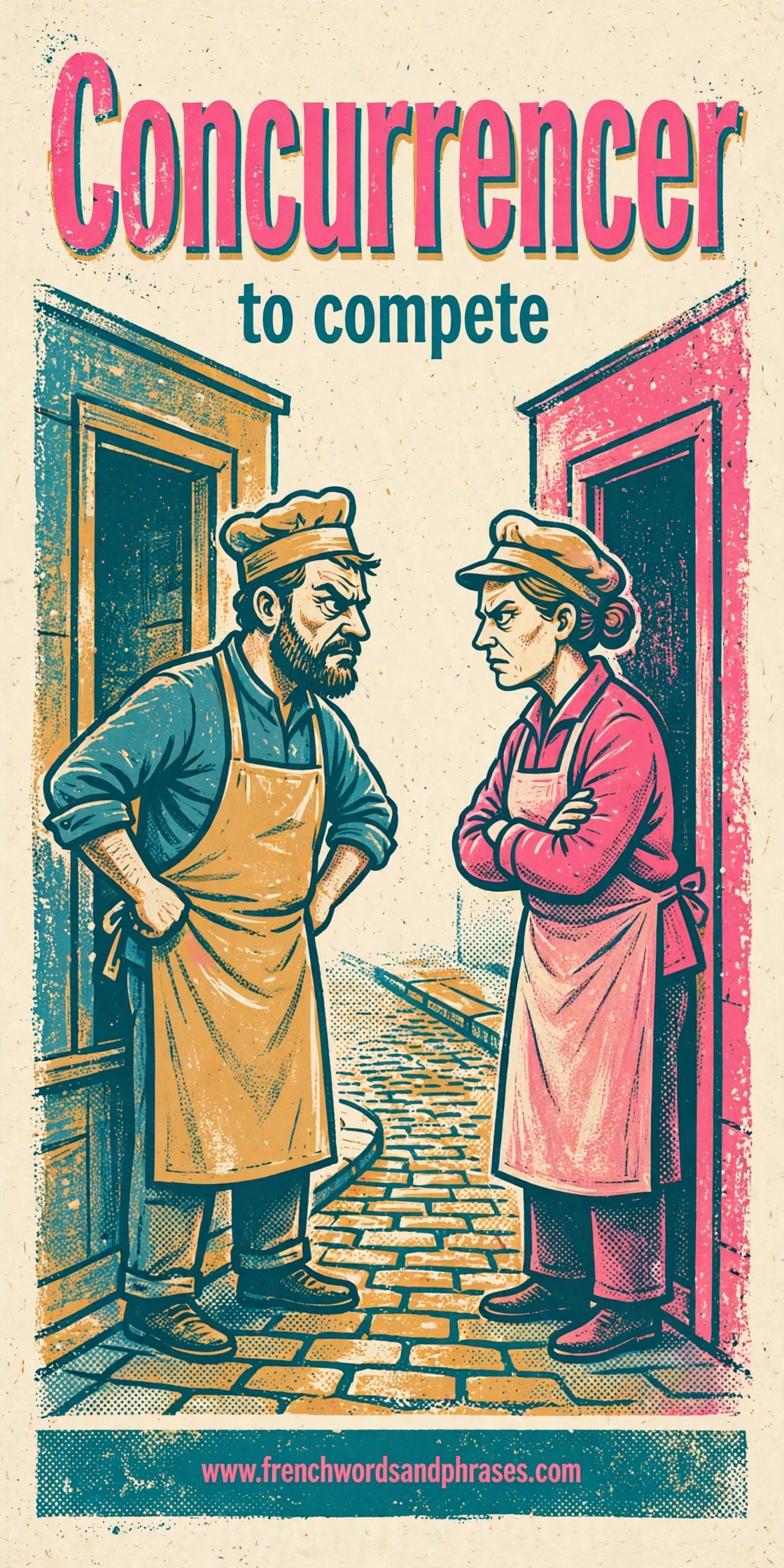
Two cafés on the same square lowering their prices, a small brand daring to stand on the same shelf as a giant — concurrencer is the verb of commercial rivalry: someone is always concurrencé by somebody else.
In this guide, you’ll learn how to conjugate concurrencer in all the major French tenses and moods. Explore complete conjugation tables, French examples, English translations, and practice quizzes.
Understanding the French Verb Concurrencer
Concurrencer is a regular French verb belonging to the first group of verbs, those ending in-er.
It means to compete. It is the everyday verb of business rivalry — shops, brands, prices and products — and it easily turns passive: être concurrencé par les sites chinois is the complaint of a whole generation of shopkeepers. For sport and exams, French prefers concourir or être en compétition; concurrencer belongs to the market.
Verb classification: First group (-er)
Auxiliary verb: Avoir
Past participle: concurrencé
Present participle: concurrençant
English equivalents: To compete with, to rival, to be in competition with; concurrencer une marque — to compete with a brand; concurrencer les prix de quelqu’un — to match a rival’s prices; être concurrencé — to face competition; la concurrence — competition, the competitors.
One important detail: concurrencer is a -cer verb, so the c grows a cedilla before a and o to keep its soft s-sound: nous concurrençons, je concurrençais, en concurrençant, and in the passé simple je concurrençai. Before e and i it stays plain: je concurrence, ils concurrencent, vous concurrenciez. Its other peculiarity is direction: unlike English compete, which can stand alone, concurrencer wants a direct object — you always concurrencer somebody: elle concurrence les grandes marques.
Experience the Word
Concurrencer is the verb of the shelf and the square — nobody concurrencer alone; there is always a rival across the street.
Imagine a little bookshop that has stood on the square for forty years. This spring a national chain opens three doors down, with the same books at lower prices. La librairie est concurrencée comme jamais — and the old bookseller answers the only way she can: with advice no website can give.
The chain has the prices. She has forty years of readers — and she competes, concurrence, with the one thing they cannot discount.
How to Conjugate Concurrencer: Complete French Conjugation Guide
Let’s explore every major conjugation of concurrencer, beginning with the indicative mood.
How to Conjugate Concurrencer in the Indicative Mood
The indicative mood is used to express facts, observations, actions, and events.
How to Conjugate Concurrencer in the Present Tense (Présent)
Used for actions happening now, habitual actions, and general truths.
| Subject | Conjugation |
|---|---|
| je | concurrence |
| tu | concurrences |
| il / elle | concurrence |
| nous | concurrençons |
| vous | concurrencez |
| ils / elles | concurrencent |
Example
Cette marque concurrence les plus grandes maisons de luxe.
This brand competes with the greatest luxury houses.
Quick Quiz 1
Complete the sentence:
Nous ______ les importations sur la qualité.
Reveal the answer
concurrençons
Nous concurrençons les importations sur la qualité.
We compete with imports on quality — note the cedilla.
How to Conjugate Concurrencer in the Passé Composé
Used for completed actions in the past. Concurrencer takes the auxiliary verb avoir.
| Subject | Conjugation |
|---|---|
| j’ | ai concurrencé |
| tu | as concurrencé |
| il / elle | a concurrencé |
| nous | avons concurrencé |
| vous | avez concurrencé |
| ils / elles | ont concurrencé |
Example
Leur nouvelle boutique a concurrencé tous les magasins du quartier.
Their new shop outcompeted all the stores in the neighbourhood.
How to Conjugate Concurrencer in the Imparfait (Imperfect Tense)
Used for habitual past actions, descriptions, and ongoing situations in the past.
| Subject | Conjugation |
|---|---|
| je | concurrençais |
| tu | concurrençais |
| il / elle | concurrençait |
| nous | concurrencions |
| vous | concurrenciez |
| ils / elles | concurrençaient |
Example
Autrefois, ce petit atelier concurrençait les usines géantes.
In the past, this little workshop competed with the giant factories.
Quick Quiz 2
Choose the correct form:
She competed with the best.
Elle ______ les meilleurs. (a concurrencé / est concurrencée)
Reveal the answer
a concurrencé
Elle a concurrencé les meilleurs.
Concurrencer takes avoir in the active voice.
How to Conjugate Concurrencer in the Plus-que-parfait
Used to describe an action that had already been completed before another past event.
| Subject | Conjugation |
|---|---|
| j’ | avais concurrencé |
| tu | avais concurrencé |
| il / elle | avait concurrencé |
| nous | avions concurrencé |
| vous | aviez concurrencé |
| ils / elles | avaient concurrencé |
Example
Elle avait concurrencé les meilleurs avant de créer sa propre marque.
She had competed against the best before creating her own brand.
How to Conjugate Concurrencer in the Passé Simple
Primarily used in formal writing, literature, and historical narratives. It is rarely used in everyday conversation.
| Subject | Conjugation |
|---|---|
| je | concurrençai |
| tu | concurrenças |
| il / elle | concurrença |
| nous | concurrençâmes |
| vous | concurrençâtes |
| ils / elles | concurrençèrent |
Example
Le nouveau venu concurrença bientôt le champion du marché.
The newcomer soon rivalled the market leader.
How to Conjugate Concurrencer in the Passé Antérieur
A literary tense used to express an action completed immediately before another past action, generally in the passé simple.
| Subject | Conjugation |
|---|---|
| j’ | eus concurrencé |
| tu | eus concurrencé |
| il / elle | eut concurrencé |
| nous | eûmes concurrencé |
| vous | eûtes concurrencé |
| ils / elles | eurent concurrencé |
Example
Quand la start-up eut concurrencé le géant, celui-ci réagit enfin.
When the start-up had challenged the giant, the giant finally reacted.
How to Conjugate Concurrencer in the Future Tense (Futur Simple)
Used to describe actions that will take place in the future.
| Subject | Conjugation |
|---|---|
| je | concurrencerai |
| tu | concurrenceras |
| il / elle | concurrencera |
| nous | concurrencerons |
| vous | concurrencerez |
| ils / elles | concurrenceront |
Example
Demain, nos produits concurrenceront les importations bon marché.
Tomorrow, our products will compete with cheap imports.
How to Conjugate Concurrencer in the Futur Antérieur (Future Perfect)
Used for an action that will have been completed before a particular point in the future.
| Subject | Conjugation |
|---|---|
| j’ | aurai concurrencé |
| tu | auras concurrencé |
| il / elle | aura concurrencé |
| nous | aurons concurrencé |
| vous | aurez concurrencé |
| ils / elles | auront concurrencé |
Example
En un an, elle aura concurrencé toutes les marques établies.
Within a year, she will have competed with all the established brands.
How to Conjugate Concurrencer in the Near Future (Futur Proche)
Used to describe something that is going to happen soon. Formed with aller + infinitive.
| Subject | Conjugation |
|---|---|
| je | vais concurrencer |
| tu | vas concurrencer |
| il / elle | va concurrencer |
| nous | allons concurrencer |
| vous | allez concurrencer |
| ils / elles | vont concurrencer |
Example
Ce nouveau modèle va concurrencer les meilleurs du marché.
This new model is going to rival the best on the market.
How to Conjugate Concurrencer in the Conditional Mood
The conditional mood expresses what would happen under certain circumstances. It is also frequently used to make polite requests or express wishes.
How to Conjugate Concurrencer in the Present Conditional
| Subject | Conjugation |
|---|---|
| je | concurrencerais |
| tu | concurrencerais |
| il / elle | concurrencerait |
| nous | concurrencerions |
| vous | concurrenceriez |
| ils / elles | concurrenceraient |
Example
Avec de tels prix, nous concurrencerions n’importe qui.
With such prices, we would compete with anyone.
How to Conjugate Concurrencer in the Past Conditional
| Subject | Conjugation |
|---|---|
| j’ | aurais concurrencé |
| tu | aurais concurrencé |
| il / elle | aurait concurrencé |
| nous | aurions concurrencé |
| vous | auriez concurrencé |
| ils / elles | auraient concurrencé |
Example
Ils auraient concurrencé le leader sans la crise.
They would have rivalled the leader without the crisis.
Concurrencer in the Literary Past Conditional Form
This less common literary form uses the imperfect subjunctive of avoir.
| Subject | Conjugation |
|---|---|
| j’ | eusse concurrencé |
| tu | eusses concurrencé |
| il / elle | eût concurrencé |
| nous | eussions concurrencé |
| vous | eussiez concurrencé |
| ils / elles | eussent concurrencé |
Example
L’atelier eût concurrencé les plus grandes fabriques du pays.
The workshop would have competed with the largest factories in the country.
How to Conjugate Concurrencer in the Subjunctive Mood
The subjunctive is used to express wishes, emotions, doubts, necessity, and uncertainty. It frequently follows expressions such as il faut que (it is necessary that) or bien que (although).
How to Conjugate Concurrencer in the Present Subjunctive
| Subject | Conjugation |
|---|---|
| que je | concurrence |
| que tu | concurrences |
| qu’il / qu’elle | concurrence |
| que nous | concurrencions |
| que vous | concurrenciez |
| qu’ils / qu’elles | concurrencent |
Example
Il faut que notre boutique concurrence les grandes surfaces sur la qualité.
Our shop must compete with the hypermarkets on quality.
Quick Quiz 3
Complete the sentence using the subjunctive:
Il faut que vous ______ les géants sur le service.
Reveal the answer
concurrenciez
Il faut que vous concurrenciez les géants sur le service.
You must compete with the giants on service.
How to Conjugate Concurrencer in the Imperfect Subjunctive
A literary tense, rarely encountered in modern spoken French.
| Subject | Conjugation |
|---|---|
| que je | concurrencasse |
| que tu | concurrencasses |
| qu’il / qu’elle | concurrencât |
| que nous | concurrencassions |
| que vous | concurrencassiez |
| qu’ils / qu’elles | concurrencassent |
Example
On ne pensait pas qu’un si petit magasin concurrençât les chaînes nationales.
Nobody thought such a small shop would rival the national chains.
How to Conjugate Concurrencer in the Pluperfect Subjunctive
A literary construction used to express an action completed before another past action.
| Subject | Conjugation |
|---|---|
| que j’ | eusse concurrencé |
| que tu | eusses concurrencé |
| qu’il / qu’elle | eût concurrencé |
| que nous | eussions concurrencé |
| que vous | eussiez concurrencé |
| qu’ils / qu’elles | eussent concurrencé |
Example
On admirait qu’elle eût concurrencé des marques centenaires.
People admired that she had competed with hundred-year-old brands.
How to Conjugate Concurrencer in the Past Subjunctive
| Subject | Conjugation |
|---|---|
| que j’ | aie concurrencé |
| que tu | aies concurrencé |
| qu’il / qu’elle | ait concurrencé |
| que nous | ayons concurrencé |
| que vous | ayez concurrencé |
| qu’ils / qu’elles | aient concurrencé |
Example
Je suis étonné que ce produit ait concurrencé les originaux.
I am amazed this product rivalled the originals.
How to Conjugate Concurrencer in the Imperative
The imperative is used to give commands, instructions, invitations, or suggestions. Subject pronouns are omitted.
How to Conjugate Concurrencer in the Present Imperative
| Person | Conjugation |
|---|---|
| (tu) | concurrence |
| (nous) | concurrençons |
| (vous) | concurrencez |
Example
Concurrence les autres sur le service, pas sur les rabais !
Compete with the others on service, not on discounts!
Quick Quiz 4
How would you say Compete on quality, not price (tu form)?
Reveal the answer
Concurrence sur la qualité, pas sur les prix !
French Participles of Concurrencer
Participles are verb forms that can be used in compound tenses and other grammatical constructions.
Present Participle of Concurrencer
concurrençant
En concurrençant les prix des géants, elle a conquis le quartier.
By competing with the giants’ prices, she won over the neighbourhood.
Past Participle of Concurrencer
concurrencé
Concurrencée de toutes parts, la vieille marque a dû se réinventer.
Rivalled on all sides, the old brand had to reinvent itself.
Concurrencer in Everyday French: Real-Life Examples
Now that you know the conjugations, let’s see how concurrencer appears in everyday French.
Example 1 — Present
Cette marque concurrence les maisons de luxe.
This brand competes with the luxury houses.
Example 2 — Passé composé
Leur boutique a concurrencé tous les magasins du quartier.
Their shop outcompeted all the stores in the neighbourhood.
Example 3 — Imparfait
Ce petit atelier concurrençait les usines géantes.
This little workshop competed with the giant factories.
Example 4 — Future
Nos produits concurrenceront les importations.
Our products will compete with imports.
Example 5 — Conditional
Nous concurrencerions n’importe qui avec de tels prix.
We would compete with anyone with such prices.
Example 6 — Imperative
Concurrence les autres sur le service !
Compete with the others on service!
Beyond Translation: The Meaning of Concurrencer
English compete can breathe on its own — she competes — but French concurrencer is transitive to its bones: it needs a rival in its sights, the way its noun la concurrence means both the competition and the competitors themselves.
Rivalry is built into the word.
From Latin concurrere, to run together — the same root as concourir — concurrencer is the race seen from the marketplace: not running for a prize, but running against the shop across the street, every single day.
How to Remember the French Verb Concurrencer
Remember it this way: Concurrencer is about the little bookshop facing the chain store three doors down.
- Cedilla alert: nous concurrençons, je concurrençais — the ç keeps the c soft before a and o.
- It always takes a rival as its object: concurrencer une marque, concurrencer les prix de quelqu’un.
- Regular -cer endings otherwise: je concurrence, ils concurrencent, past participle concurrencé.
The key idea is the little bookshop facing the chain store three doors down.
Test Your Knowledge of Concurrencer
Let’s see how much you’ve learned. Try answering these questions before revealing the answers.
Question 1
Why does nous concurrençons have a cedilla?
Reveal the answer
To keep the c soft before o — concurrencer is a -cer verb: nous concurrençons, je concurrençais, but je concurrence without one.
Question 2
How do you say This brand competes with the luxury houses in French?
Reveal the answer
Cette marque concurrence les maisons de luxe.
Question 3
Translate: Their shop outcompeted all the stores in the neighbourhood.
Reveal the answer
Leur boutique a concurrencé tous les magasins du quartier.
Question 4
What is the past participle of concurrencer?
Reveal the answer
Concurrencé.
Question 5
Complete the sentence:
Il faut que notre boutique ______ les grandes surfaces sur la qualité.
Reveal the answer
concurrence
Il faut que notre boutique concurrence les grandes surfaces sur la qualité.
Our shop must compete with the hypermarkets on quality.
Your Final Challenge
Can You Use It?
How would you say this in French?
The little bookshop competes with the big chain, not on prices, but with forty years of faithful advice.
Reveal the answer
La petite librairie concurrence la grande chaîne, non par les prix, mais par quarante ans de conseils fidèles.
The little bookshop competes with the big chain, not on prices, but with forty years of faithful advice.
A little French. A little curiosity. A richer everyday life.
LEARN FRENCH ONE WORD AT A TIME