A French Word to Live By
How to Conjugate Se comporter in French
/sə kɔ̃.pɔʁ.te/
Se comporter means to behave — to carry yourself through the world in a way others can approve of, or not.
A child sitting still through a long dinner, a guest who thanks the cook, a driver who loses his temper in traffic — se comporter is the verb of conduct: the way you carry yourself when other people are watching, and judging.
In this guide, you’ll learn how to conjugate se comporter in all the major French tenses and moods. Explore complete conjugation tables, French examples, English translations, and practice quizzes.
Understanding the French Verb Se comporter
Se comporter is a regular French verb belonging to the first group of verbs, those ending in-er.
It means to behave. It is the standard verb of manners and conduct, used by parents, teachers and referees alike; in psychology and animal science it also describes behaviour neutrally — le comportement is the noun, behaviour itself. Compared with se conduire, it is the more everyday, slightly more moralising word.
Verb classification: First group (-er), reflexive
Auxiliary verb: Être
Past participle: comporté
Present participle: comportant
English equivalents: To behave, to conduct oneself; se comporter bien — to behave well; se comporter mal — to misbehave; se comporter en gentleman — to behave like a gentleman; se comporter comme un enfant — to behave like a child; comporte-toi bien ! — behave yourself!
One important detail: se comporter is comporter turned back on the person — literally ‘to carry oneself’ — so it is reflexive in every tense and takes être in compound tenses, with the participle agreeing: elle s’est bien comportée, ils se sont mal comportés. Its two favourite partners are the adverbs bien and mal, and the construction se comporter en + noun: il s’est comporté en héros, he behaved like a hero. The tu imperative is an order every French child knows: comporte-toi bien !
Experience the Word
Se comporter is the verb of being watched — every child, guest and driver is silently graded on it.
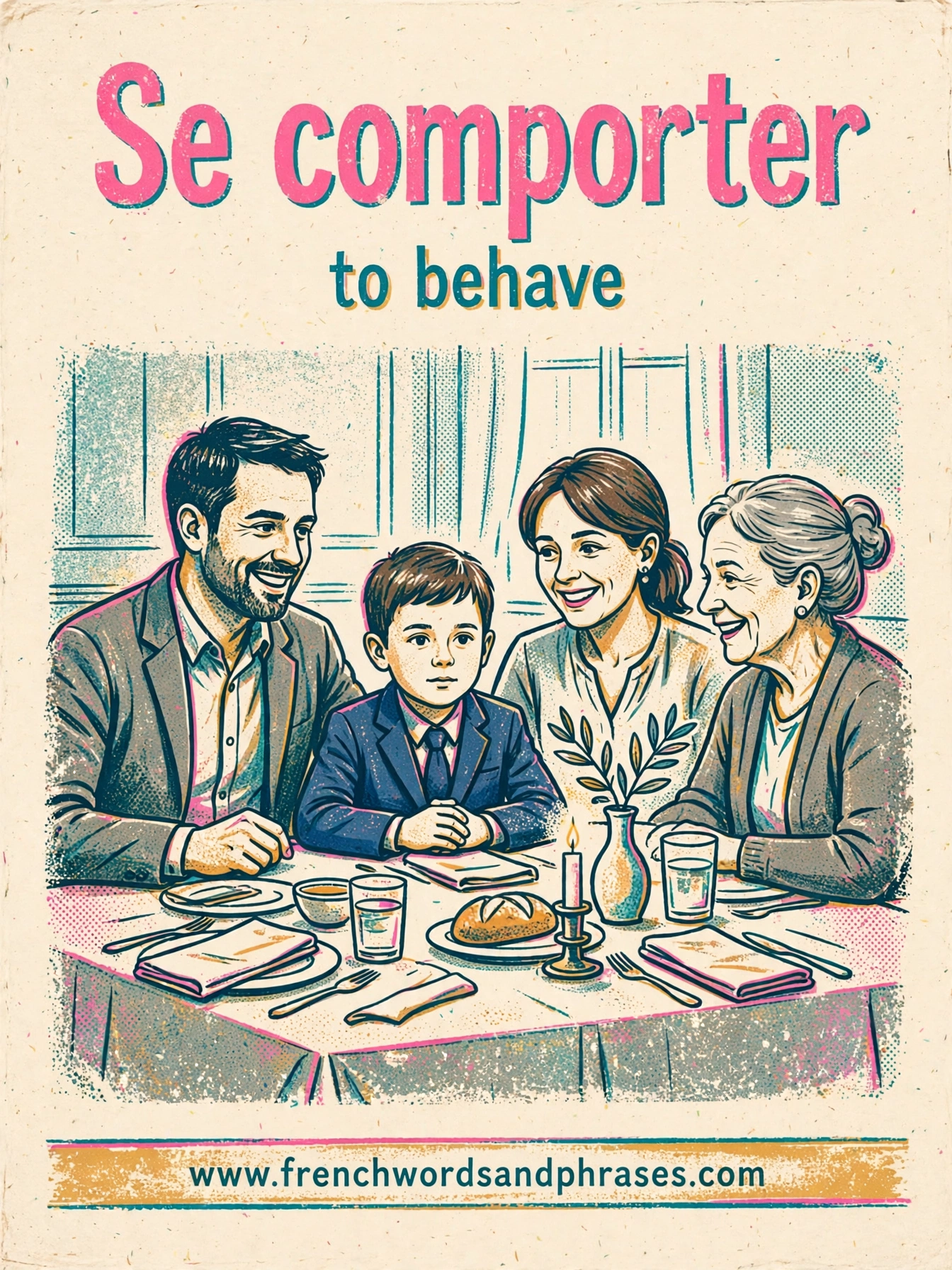
Imagine a small boy at his grandmother’s Sunday lunch. He sits up straight, waits his turn, says merci for the beans he hates — il se comporte bien, and grand-mère nods: the whole art of French politeness in one reflexive verb.
He has not just eaten politely. He has behaved — il s’est comporté en petit gentleman.
How to Conjugate Se comporter: Complete French Conjugation Guide
Let’s explore every major conjugation of se comporter, beginning with the indicative mood.
How to Conjugate Se comporter in the Indicative Mood
The indicative mood is used to express facts, observations, actions, and events.
How to Conjugate Se comporter in the Present Tense (Présent)
Used for actions happening now, habitual actions, and general truths.
| Subject | Conjugation |
|---|---|
| je | me comporte |
| tu | te comportes |
| il / elle | se comporte |
| nous | nous comportons |
| vous | vous comportez |
| ils / elles | se comportent |
Example
Les enfants se comportent très bien chez leurs grands-parents.
The children behave very well at their grandparents’ house.
Quick Quiz 1
Complete the sentence:
Nous nous ______ sagement en classe.
Reveal the answer
comportons
Nous nous comportons sagement en classe.
We behave properly in class.
How to Conjugate Se comporter in the Passé Composé
Used for completed actions in the past. Se comporter takes the auxiliary verb être.
| Subject | Conjugation |
|---|---|
| je | me suis comporté / me suis comportée |
| tu | t’es comporté / t’es comportée |
| il / elle | s’est comporté / s’est comportée |
| nous | nous sommes comportés / nous sommes comportées |
| vous | vous êtes comportés / vous êtes comportées / vous êtes comporté / vous êtes comportée |
| ils / elles | se sont comportés / se sont comportées |
Example
Elle s’est comportée en vraie championne après sa défaite.
She behaved like a true champion after her defeat.
How to Conjugate Se comporter in the Imparfait (Imperfect Tense)
Used for habitual past actions, descriptions, and ongoing situations in the past.
| Subject | Conjugation |
|---|---|
| je | me comportais |
| tu | te comportais |
| il / elle | se comportait |
| nous | nous comportions |
| vous | vous comportiez |
| ils / elles | se comportaient |
Example
Autrefois, les élèves se comportaient sagement en classe.
In the old days, pupils behaved properly in class.
Quick Quiz 2
Choose the correct form:
She behaved well.
Elle ______ bien. (s’est comportée / a comporté)
Reveal the answer
s’est comportée
Elle s’est bien comportée.
Se comporter is reflexive, takes être, and the participle agrees: comportée.
How to Conjugate Se comporter in the Plus-que-parfait
Used to describe an action that had already been completed before another past event.
| Subject | Conjugation |
|---|---|
| je | m’étais comporté / m’étais comportée |
| tu | t’étais comporté / t’étais comportée |
| il / elle | s’était comporté / s’était comportée |
| nous | nous étions comportés / nous étions comportées |
| vous | vous étiez comportés / vous étiez comportées / vous étiez comporté / vous étiez comportée |
| ils / elles | s’étaient comportés / s’étaient comportées |
Example
Il s’était comporté bizarrement toute la soirée.
He had been behaving strangely all evening.
How to Conjugate Se comporter in the Passé Simple
Primarily used in formal writing, literature, and historical narratives. It is rarely used in everyday conversation.
| Subject | Conjugation |
|---|---|
| je | me comportai |
| tu | te comportas |
| il / elle | se comporta |
| nous | nous comportâmes |
| vous | vous comportâtes |
| ils / elles | se comportèrent |
Example
Le jeune officier se comporta bravement sous le feu.
The young officer conducted himself bravely under fire.
How to Conjugate Se comporter in the Passé Antérieur
A literary tense used to express an action completed immediately before another past action, generally in the passé simple.
| Subject | Conjugation |
|---|---|
| je | me fus comporté / me fus comportée |
| tu | te fus comporté / te fus comportée |
| il / elle | se fut comporté / se fut comportée |
| nous | nous fûmes comportés / nous fûmes comportées |
| vous | vous fûtes comportés / vous fûtes comportées / vous fûtes comporté / vous fûtes comportée |
| ils / elles | se furent comportés / se furent comportées |
Example
Dès qu’elle se fut comportée en amie, on lui ouvrit la porte.
As soon as she had behaved like a friend, the door was opened to her.
How to Conjugate Se comporter in the Future Tense (Futur Simple)
Used to describe actions that will take place in the future.
| Subject | Conjugation |
|---|---|
| je | me comporterai |
| tu | te comporteras |
| il / elle | se comportera |
| nous | nous comporterons |
| vous | vous comporterez |
| ils / elles | se comporteront |
Example
Demain, vous vous comporterez correctement à la cérémonie.
Tomorrow, you will behave properly at the ceremony.
How to Conjugate Se comporter in the Futur Antérieur (Future Perfect)
Used for an action that will have been completed before a particular point in the future.
| Subject | Conjugation |
|---|---|
| je | me serai comporté / me serai comportée |
| tu | te seras comporté / te seras comportée |
| il / elle | se sera comporté / se sera comportée |
| nous | nous serons comportés / nous serons comportées |
| vous | vous serez comportés / vous serez comportées / vous serez comporté / vous serez comportée |
| ils / elles | se seront comportés / se seront comportées |
Example
À la fin du repas, ils se seront comportés en invités parfaits.
By the end of the meal, they will have behaved like perfect guests.
How to Conjugate Se comporter in the Near Future (Futur Proche)
Used to describe something that is going to happen soon. Formed with aller + infinitive.
| Subject | Conjugation |
|---|---|
| je | vais me comporter |
| tu | vas te comporter |
| il / elle | va se comporter |
| nous | allons nous comporter |
| vous | allez vous comporter |
| ils / elles | vont se comporter |
Example
Attention, ce chien va encore se comporter comme un fou !
Careful, that dog is going to behave like a mad thing again!
How to Conjugate Se comporter in the Conditional Mood
The conditional mood expresses what would happen under certain circumstances. It is also frequently used to make polite requests or express wishes.
How to Conjugate Se comporter in the Present Conditional
| Subject | Conjugation |
|---|---|
| je | me comporterais |
| tu | te comporterais |
| il / elle | se comporterait |
| nous | nous comporterions |
| vous | vous comporteriez |
| ils / elles | se comporteraient |
Example
Sans ses parents, il se comporterait beaucoup moins bien.
Without his parents, he would behave far less well.
How to Conjugate Se comporter in the Past Conditional
| Subject | Conjugation |
|---|---|
| je | me serais comporté / me serais comportée |
| tu | te serais comporté / te serais comportée |
| il / elle | se serait comporté / se serait comportée |
| nous | nous serions comportés / nous serions comportées |
| vous | vous seriez comportés / vous seriez comportées / vous seriez comporté / vous seriez comportée |
| ils / elles | se seraient comportés / se seraient comportées |
Example
Elle se serait comportée autrement si elle avait su la vérité.
She would have behaved differently if she had known the truth.
Se comporter in the Literary Past Conditional Form
This less common literary form uses the imperfect subjunctive of être.
| Subject | Conjugation |
|---|---|
| je | me fusse comporté / me fusse comportée |
| tu | te fusses comporté / te fusses comportée |
| il / elle | se fût comporté / se fût comportée |
| nous | nous fussions comportés / nous fussions comportées |
| vous | vous fussiez comportés / vous fussiez comportées / vous fussiez comporté / vous fussiez comportée |
| ils / elles | se fussent comportés / se fussent comportées |
Example
Il se fût comporté en lâche sans l’exemple de son père.
He would have behaved like a coward without his father’s example.
How to Conjugate Se comporter in the Subjunctive Mood
The subjunctive is used to express wishes, emotions, doubts, necessity, and uncertainty. It frequently follows expressions such as il faut que (it is necessary that) or bien que (although).
How to Conjugate Se comporter in the Present Subjunctive
| Subject | Conjugation |
|---|---|
| que je | me comporte |
| que tu | te comportes |
| qu’il / qu’elle | se comporte |
| que nous | nous comportions |
| que vous | vous comportiez |
| qu’ils / qu’elles | se comportent |
Example
Je veux que vous vous comportiez bien chez les voisins.
I want you to behave well at the neighbours’ house.
Quick Quiz 3
Complete the sentence using the subjunctive:
Il faut que tu te ______ en adulte.
Reveal the answer
comportes
Il faut que tu te comportes en adulte.
You must behave like an adult.
How to Conjugate Se comporter in the Imperfect Subjunctive
A literary tense, rarely encountered in modern spoken French.
| Subject | Conjugation |
|---|---|
| que je | me comportasse |
| que tu | te comportasses |
| qu’il / qu’elle | se comportât |
| que nous | nous comportassions |
| que vous | vous comportassiez |
| qu’ils / qu’elles | se comportassent |
Example
On craignait que les invités se comportassent mal à table.
People feared the guests might behave badly at table.
How to Conjugate Se comporter in the Pluperfect Subjunctive
A literary construction used to express an action completed before another past action.
| Subject | Conjugation |
|---|---|
| que je | me fusse comporté / me fusse comportée |
| que tu | te fusses comporté / te fusses comportée |
| qu’il / qu’elle | se fût comporté / se fût comportée |
| que nous | nous fussions comportés / nous fussions comportées |
| que vous | vous fussiez comportés / vous fussiez comportées / vous fussiez comporté / vous fussiez comportée |
| qu’ils / qu’elles | se fussent comportés / se fussent comportées |
Example
On racontait qu’ils se fussent comportés en héros ce jour-là.
People said they had behaved like heroes that day.
How to Conjugate Se comporter in the Past Subjunctive
| Subject | Conjugation |
|---|---|
| que je | me sois comporté / me sois comportée |
| que tu | te sois comporté / te sois comportée |
| qu’il / qu’elle | se soit comporté / se soit comportée |
| que nous | nous soyons comportés / nous soyons comportées |
| que vous | vous soyez comportés / vous soyez comportées / vous soyez comporté / vous soyez comportée |
| qu’ils / qu’elles | se soient comportés / se soient comportées |
Example
Je suis fier qu’elle se soit comportée avec tant de calme.
I am proud that she behaved with such calm.
How to Conjugate Se comporter in the Imperative
The imperative is used to give commands, instructions, invitations, or suggestions. Subject pronouns are omitted.
How to Conjugate Se comporter in the Present Imperative
| Person | Conjugation |
|---|---|
| (tu) | comporte-toi |
| (nous) | comportons-nous |
| (vous) | comportez-vous |
Example
Comporte-toi bien chez grand-mère !
Behave yourself well at grandma’s!
Quick Quiz 4
How would you say Behave yourself (tu form)?
Reveal the answer
Comporte-toi bien !
French Participles of Se comporter
Participles are verb forms that can be used in compound tenses and other grammatical constructions.
Present Participle of Se comporter
comportant
En se comportant ainsi, tu donnes le bon exemple.
By behaving like that, you are setting a good example.
Past Participle of Se comporter
comporté
Comportée en parfaite invitée, elle a conquis toute la famille.
Having behaved like a perfect guest, she won over the whole family.
Se comporter in Everyday French: Real-Life Examples
Now that you know the conjugations, let’s see how se comporter appears in everyday French.
Example 1 — Present
Les enfants se comportent bien.
The children are behaving well.
Example 2 — Passé composé
Il s’est comporté en héros.
He behaved like a hero.
Example 3 — Imparfait
Elle se comportait sagement en classe.
She used to behave properly in class.
Example 4 — Future
Tu te comporteras mieux demain.
You will behave better tomorrow.
Example 5 — Conditional
Sans témoins, il se comporterait autrement.
Without witnesses, he would behave differently.
Example 6 — Imperative
Comportez-vous bien, les enfants !
Behave yourselves, children!
Beyond Translation: The Meaning of Se comporter
English once had the same idea: to comport oneself meant to behave, and it survives in formal writing.
Both languages picture conduct as carrying.
To behave, in French, is to carry yourself — se comporter — and the noun le comportement is simply the load you carry through the day: your behaviour.
How to Remember the French Verb Se comporter
Remember it this way: Se comporter is about carrying yourself well at grandmother’s table.
- Reflexive and être: elle s’est bien comportée — the participle agrees.
- Its partners are bien and mal, and se comporter en + noun: il s’est comporté en lâche.
- Do not confuse it with plain comporter (to include): il comporte = it includes; il se comporte = he behaves.
The key idea is carrying yourself well at grandmother’s table.
Test Your Knowledge of Se comporter
Let’s see how much you’ve learned. Try answering these questions before revealing the answers.
Question 1
Which auxiliary does se comporter use?
Reveal the answer
Être — it is reflexive: elle s’est bien comportée.
Question 2
How do you say The children behaved well in French?
Reveal the answer
Les enfants se sont bien comportés.
Question 3
Translate: He behaved like a hero.
Reveal the answer
Il s’est comporté en héros.
Question 4
What is the past participle of se comporter, for a woman?
Reveal the answer
Comportée — elle s’est comportée.
Question 5
Complete the sentence:
Je veux que vous vous ______ bien à table.
Reveal the answer
comportiez
Je veux que vous vous comportiez bien à table.
I want you to behave well at table.
Your Final Challenge
Can You Use It?
How would you say this in French?
He behaved like a gentleman, even when nobody was watching.
Reveal the answer
Il s’est comporté en gentleman, même quand personne ne le regardait.
He behaved like a gentleman, even when nobody was watching.
A little French. A little curiosity. A richer everyday life.
LEARN FRENCH ONE WORD AT A TIME