A French Word to Live By
How to Conjugate Commotionner in French
/kɔ.mɔ.sjɔ.ne/
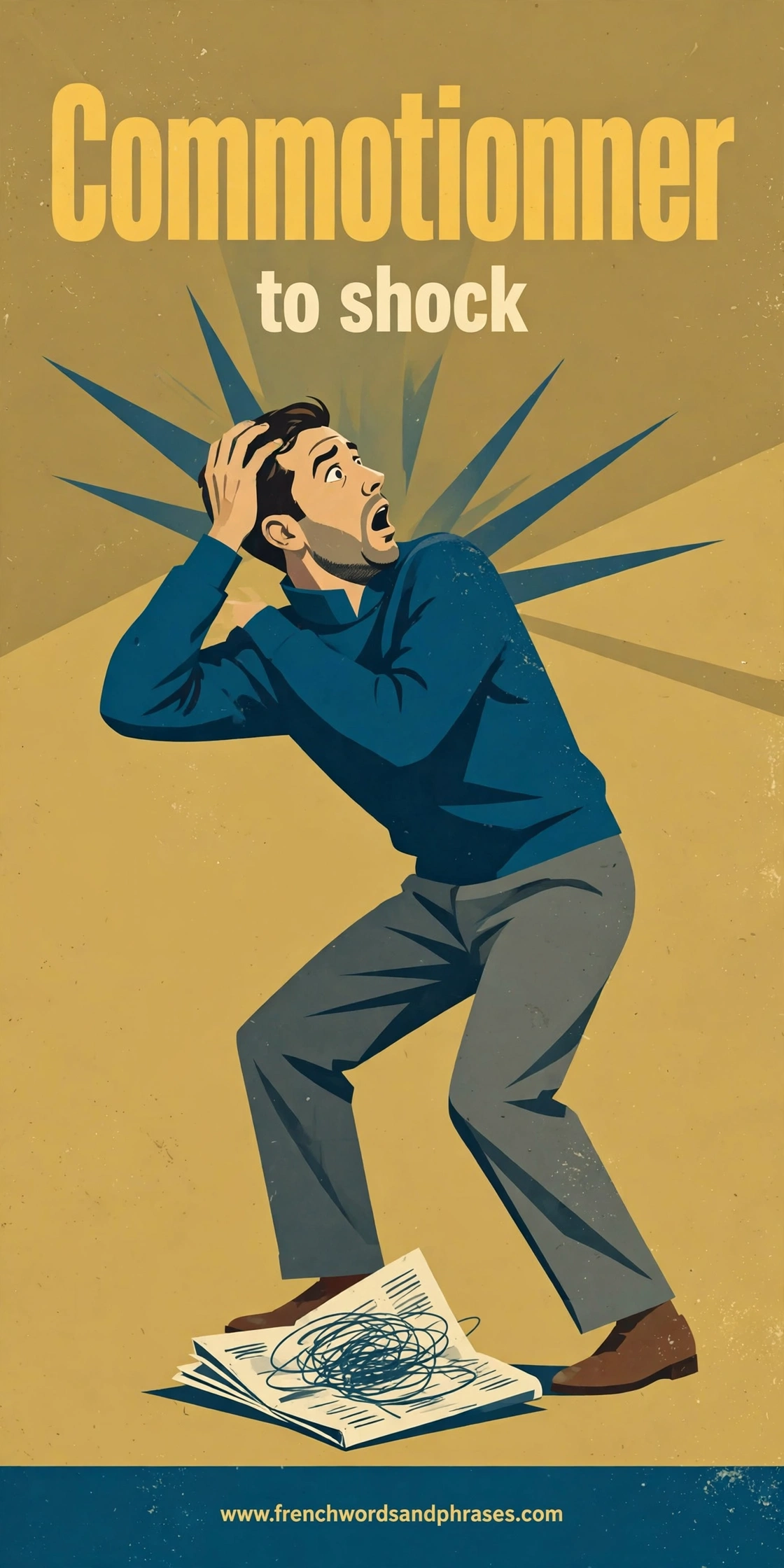
Commotionner means to shock — to shake the body and brain with a blow, a fall or a crash, leaving someone concussed, dazed and reeling.
A rugby player sitting on the grass, eyes unfocused after a tackle; a driver standing by his crumpled car, unable to remember the impact — commotionner is the medical verb of the shaken brain: the blow that leaves the body standing and the mind reeling.
In this guide, you’ll learn how to conjugate commotionner in all the major French tenses and moods. Explore complete conjugation tables, French examples, English translations, and practice quizzes.
Understanding the French Verb Commotionner
Commotionner is a regular French verb belonging to the first group of verbs, those ending in-er.
It means to shock. It belongs to hospitals, accident reports and sports pages: le joueur, commotionné, a quitté le terrain — the concussed player left the field. By extension it can describe a mind reeling from a violent event, but the body is never far away: commotionner always implies a physical shaking.
Verb classification: First group (-er)
Auxiliary verb: Avoir
Past participle: commotionné
Present participle: commotionnant
English equivalents: To concuss, to leave in shock, to shake badly; être commotionné — to be concussed, to be suffering from shock; une commotion cérébrale — concussion; le choc l’a commotionné — the impact left him concussed; légèrement commotionné — mildly concussed, badly shaken.
One important detail: commotionner is a regular -er verb — je commotionne, nous commotionnons with double n, past participle commotionné — but it is almost always met in that participle: être commotionné, to be concussed or in shock. The noun is la commotion, and its medical full form is la commotion cérébrale, concussion. Do not reach for it for emotional surprise — a person shocked by news is bouleversé or choqué; one is commotionné by a blow, a crash or a blast.
Experience the Word
Commotionner is the verb of the bell rung inside the skull — the world keeps moving, but the person stands still, trying to catch up with it.
Imagine a cyclist on a country road, a car door opening at the wrong second. He is on the ground before he understands anything; the driver is speaking, the words arrive slowly, like sounds under water. Le choc l’a commotionné — the impact has concussed him — and for a few minutes his own name feels like somebody else’s.
Nothing is broken, yet nothing works. He is concussed — commotionné — shaken loose inside his own head.
How to Conjugate Commotionner: Complete French Conjugation Guide
Let’s explore every major conjugation of commotionner, beginning with the indicative mood.
How to Conjugate Commotionner in the Indicative Mood
The indicative mood is used to express facts, observations, actions, and events.
How to Conjugate Commotionner in the Present Tense (Présent)
Used for actions happening now, habitual actions, and general truths.
| Subject | Conjugation |
|---|---|
| je | commotionne |
| tu | commotionnes |
| il / elle | commotionne |
| nous | commotionnons |
| vous | commotionnez |
| ils / elles | commotionnent |
Example
Un coup pareil commotionne même les joueurs les plus solides.
A blow like that concusses even the toughest players.
Quick Quiz 1
Complete the sentence:
Un choc pareil ______ même les champions.
Reveal the answer
commotionne
Un choc pareil commotionne même les champions.
A blow like that concusses even champions.
How to Conjugate Commotionner in the Passé Composé
Used for completed actions in the past. Commotionner takes the auxiliary verb avoir.
| Subject | Conjugation |
|---|---|
| j’ | ai commotionné |
| tu | as commotionné |
| il / elle | a commotionné |
| nous | avons commotionné |
| vous | avez commotionné |
| ils / elles | ont commotionné |
Example
La chute a commotionné le cycliste, mais il va bien.
The fall left the cyclist concussed, but he is all right.
How to Conjugate Commotionner in the Imparfait (Imperfect Tense)
Used for habitual past actions, descriptions, and ongoing situations in the past.
| Subject | Conjugation |
|---|---|
| je | commotionnais |
| tu | commotionnais |
| il / elle | commotionnait |
| nous | commotionnions |
| vous | commotionniez |
| ils / elles | commotionnaient |
Example
Autrefois, ces chocs commotionnaient les joueurs sans qu’on s’en inquiète.
In the old days, such blows concussed players without anyone worrying about it.
Quick Quiz 2
Choose the correct form:
The fall left the cyclist concussed.
La chute ______ le cycliste. (a commotionné / est commotionné)
Reveal the answer
a commotionné
La chute a commotionné le cycliste.
Commotionner takes avoir; est commotionné describes the resulting state.
How to Conjugate Commotionner in the Plus-que-parfait
Used to describe an action that had already been completed before another past event.
| Subject | Conjugation |
|---|---|
| j’ | avais commotionné |
| tu | avais commotionné |
| il / elle | avait commotionné |
| nous | avions commotionné |
| vous | aviez commotionné |
| ils / elles | avaient commotionné |
Example
L’explosion avait commotionné plusieurs habitants du quartier.
The explosion had left several residents of the neighbourhood in shock.
How to Conjugate Commotionner in the Passé Simple
Primarily used in formal writing, literature, and historical narratives. It is rarely used in everyday conversation.
| Subject | Conjugation |
|---|---|
| je | commotionnai |
| tu | commotionnas |
| il / elle | commotionna |
| nous | commotionnâmes |
| vous | commotionnâtes |
| ils / elles | commotionnèrent |
Example
Le choc le commotionna si fort qu’il perdit connaissance.
The impact concussed him so badly that he lost consciousness.
How to Conjugate Commotionner in the Passé Antérieur
A literary tense used to express an action completed immediately before another past action, generally in the passé simple.
| Subject | Conjugation |
|---|---|
| j’ | eus commotionné |
| tu | eus commotionné |
| il / elle | eut commotionné |
| nous | eûmes commotionné |
| vous | eûtes commotionné |
| ils / elles | eurent commotionné |
Example
Quand le choc l’eut commotionné, il s’effondra sur la pelouse.
When the impact had concussed him, he collapsed on the pitch.
How to Conjugate Commotionner in the Future Tense (Futur Simple)
Used to describe actions that will take place in the future.
| Subject | Conjugation |
|---|---|
| je | commotionnerai |
| tu | commotionneras |
| il / elle | commotionnera |
| nous | commotionnerons |
| vous | commotionnerez |
| ils / elles | commotionneront |
Example
Un tel accident te commotionnera si tu ne portes pas de casque.
Such an accident will leave you concussed if you do not wear a helmet.
How to Conjugate Commotionner in the Futur Antérieur (Future Perfect)
Used for an action that will have been completed before a particular point in the future.
| Subject | Conjugation |
|---|---|
| j’ | aurai commotionné |
| tu | auras commotionné |
| il / elle | aura commotionné |
| nous | aurons commotionné |
| vous | aurez commotionné |
| ils / elles | auront commotionné |
Example
À l’arrivée des secours, le choc aura commotionné trois passagers.
By the time help arrives, the crash will have left three passengers in shock.
How to Conjugate Commotionner in the Near Future (Futur Proche)
Used to describe something that is going to happen soon. Formed with aller + infinitive.
| Subject | Conjugation |
|---|---|
| je | vais commotionner |
| tu | vas commotionner |
| il / elle | va commotionner |
| nous | allons commotionner |
| vous | allez commotionner |
| ils / elles | vont commotionner |
Example
Attention, cette chute va te commotionner !
Careful, that fall is going to leave you concussed!
How to Conjugate Commotionner in the Conditional Mood
The conditional mood expresses what would happen under certain circumstances. It is also frequently used to make polite requests or express wishes.
How to Conjugate Commotionner in the Present Conditional
| Subject | Conjugation |
|---|---|
| je | commotionnerais |
| tu | commotionnerais |
| il / elle | commotionnerait |
| nous | commotionnerions |
| vous | commotionneriez |
| ils / elles | commotionneraient |
Example
Sans son casque, le coup le commotionnerait gravement.
Without his helmet, the blow would concuss him seriously.
How to Conjugate Commotionner in the Past Conditional
| Subject | Conjugation |
|---|---|
| j’ | aurais commotionné |
| tu | aurais commotionné |
| il / elle | aurait commotionné |
| nous | aurions commotionné |
| vous | auriez commotionné |
| ils / elles | auraient commotionné |
Example
L’explosion aurait commotionné tout le quartier sans les murs épais.
The explosion would have left the whole neighbourhood in shock, without the thick walls.
Commotionner in the Literary Past Conditional Form
This less common literary form uses the imperfect subjunctive of avoir.
| Subject | Conjugation |
|---|---|
| j’ | eusse commotionné |
| tu | eusses commotionné |
| il / elle | eût commotionné |
| nous | eussions commotionné |
| vous | eussiez commotionné |
| ils / elles | eussent commotionné |
Example
Le choc l’eût commotionné pour longtemps, sans les secours rapides.
The impact would have concussed him for a long time, without the quick rescue.
How to Conjugate Commotionner in the Subjunctive Mood
The subjunctive is used to express wishes, emotions, doubts, necessity, and uncertainty. It frequently follows expressions such as il faut que (it is necessary that) or bien que (although).
How to Conjugate Commotionner in the Present Subjunctive
| Subject | Conjugation |
|---|---|
| que je | commotionne |
| que tu | commotionnes |
| qu’il / qu’elle | commotionne |
| que nous | commotionnions |
| que vous | commotionniez |
| qu’ils / qu’elles | commotionnent |
Example
Il est possible que ce coup vous commotionne plus qu’il n’y paraît.
It is possible that this blow has concussed you more than it seems.
Quick Quiz 3
Complete the sentence using the subjunctive:
Il est possible que ce coup te ______ sérieusement.
Reveal the answer
commotionne
Il est possible que ce coup te commotionne sérieusement.
It is possible this blow has seriously concussed you.
How to Conjugate Commotionner in the Imperfect Subjunctive
A literary tense, rarely encountered in modern spoken French.
| Subject | Conjugation |
|---|---|
| que je | commotionnasse |
| que tu | commotionnasses |
| qu’il / qu’elle | commotionnât |
| que nous | commotionnassions |
| que vous | commotionnassiez |
| qu’ils / qu’elles | commotionnassent |
Example
On craignait que la chute ne le commotionnât durablement.
People feared the fall might have concussed him lastingly.
How to Conjugate Commotionner in the Pluperfect Subjunctive
A literary construction used to express an action completed before another past action.
| Subject | Conjugation |
|---|---|
| que j’ | eusse commotionné |
| que tu | eusses commotionné |
| qu’il / qu’elle | eût commotionné |
| que nous | eussions commotionné |
| que vous | eussiez commotionné |
| qu’ils / qu’elles | eussent commotionné |
Example
On racontait que l’explosion les eût commotionnés dès la première seconde.
It was said the explosion had left them in shock from the very first second.
How to Conjugate Commotionner in the Past Subjunctive
| Subject | Conjugation |
|---|---|
| que j’ | aie commotionné |
| que tu | aies commotionné |
| qu’il / qu’elle | ait commotionné |
| que nous | ayons commotionné |
| que vous | ayez commotionné |
| qu’ils / qu’elles | aient commotionné |
Example
Je crains que le choc ne l’ait commotionné.
I fear the impact has concussed him.
How to Conjugate Commotionner in the Imperative
The imperative is used to give commands, instructions, invitations, or suggestions. Subject pronouns are omitted.
How to Conjugate Commotionner in the Present Imperative
| Person | Conjugation |
|---|---|
| (tu) | commotionne |
| (nous) | commotionnons |
| (vous) | commotionnez |
Example
Ne commotionnez pas le blessé, attendez les secours !
Do not jolt the injured man, wait for the ambulance!
Quick Quiz 4
How would you say Do not jolt the injured man (tu form)?
Reveal the answer
Ne commotionne pas le blessé !
French Participles of Commotionner
Participles are verb forms that can be used in compound tenses and other grammatical constructions.
Present Participle of Commotionner
commotionnant
En commotionnant le gardien, l’attaquant a été expulsé.
By concussing the goalkeeper, the striker was sent off.
Past Participle of Commotionner
commotionné
Commotionné par la chute, le cycliste ne se souvenait de rien.
Concussed by the fall, the cyclist remembered nothing.
Commotionner in Everyday French: Real-Life Examples
Now that you know the conjugations, let’s see how commotionner appears in everyday French.
Example 1 — Present
Ce choc commotionne même les plus solides.
This blow concusses even the toughest.
Example 2 — Passé composé
La chute a commotionné le cycliste.
The fall left the cyclist concussed.
Example 3 — Imparfait
Ces coups commotionnaient les joueurs autrefois.
Such blows used to concuss players in the old days.
Example 4 — Future
Sans casque, l’accident te commotionnera.
Without a helmet, the accident will leave you concussed.
Example 5 — Conditional
Le coup le commotionnerait sans son casque.
The blow would concuss him without his helmet.
Example 6 — Imperative
Ne commotionnez pas le blessé !
Do not jolt the injured man!
Beyond Translation: The Meaning of Commotionner
Commotion is Latin commotio — a violent shaking, a moving-together of everything at once.
The word keeps the physics of the blow.
English borrowed commotion for noise and fuss, and concussion for the injury; French kept one family for both — la commotion cérébrale is the medical term, and to be commotionné is to have been shaken, body and brain, in a single blow.
How to Remember the French Verb Commotionner
Remember it this way: Commotionner is about the rugby player on the grass, watching the world arrive slowly, as if under water.
- Almost always met as être commotionné — concussed, in shock after a blow or crash.
- Physical, not emotional: bad news bouleverse; an impact commotionne.
- Regular -er, double n: je commotionne, nous commotionnons, past participle commotionné.
The key idea is the rugby player on the grass, watching the world arrive slowly, as if under water.
Test Your Knowledge of Commotionner
Let’s see how much you’ve learned. Try answering these questions before revealing the answers.
Question 1
What is the full medical expression behind commotionner?
Reveal the answer
Une commotion cérébrale — concussion; to be commotionné is to be concussed or in shock.
Question 2
How do you say The fall left the cyclist concussed in French?
Reveal the answer
La chute a commotionné le cycliste.
Question 3
Translate: Concussed by the fall, he remembered nothing.
Reveal the answer
Commotionné par la chute, il ne se souvenait de rien.
Question 4
What is the past participle of commotionner?
Reveal the answer
Commotionné.
Question 5
Complete the sentence:
Je crains que le choc ne l’______.
Reveal the answer
ait commotionné
Je crains que le choc ne l’ait commotionné.
I fear the impact has concussed him.
Your Final Challenge
Can You Use It?
How would you say this in French?
Concussed by his fall, the cyclist stared at the sky without understanding how he had got there.
Reveal the answer
Commotionné par sa chute, le cycliste regardait le ciel sans comprendre comment il était arrivé là.
Concussed by his fall, the cyclist stared at the sky without understanding how he had got there.
A little French. A little curiosity. A richer everyday life.
LEARN FRENCH ONE WORD AT A TIME