A French Word to Live By
How to Conjugate Colporter in French
/kɔl.pɔʁ.te/
Colporter means to peddle, to hawk — to carry goods from door to door, and, today above all, to carry rumours from ear to ear.
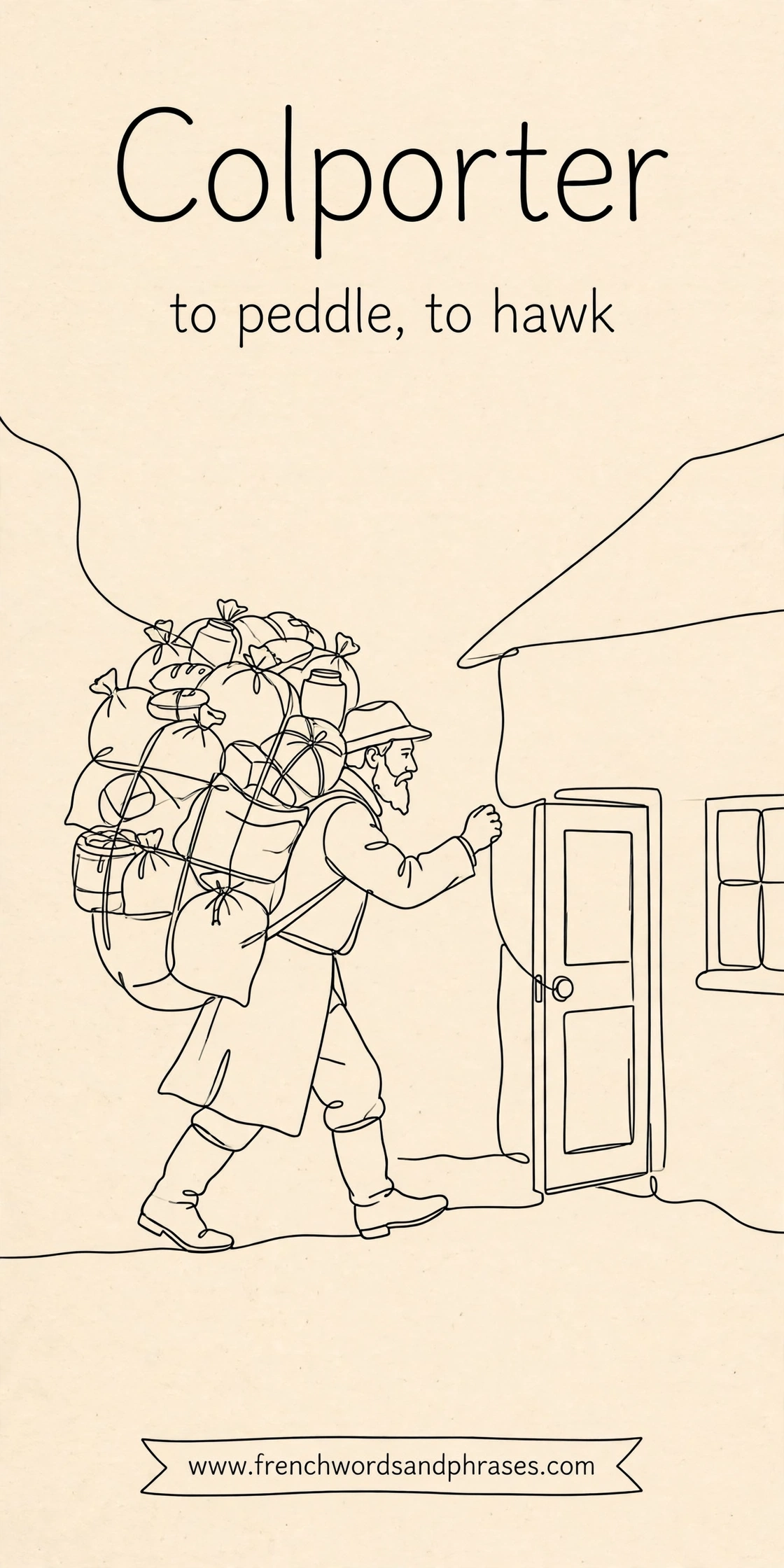
A pedlar with his pack on the road between two villages, a rumour crossing an office before lunch — colporter is the verb of carrying things on your back and passing them on: once it was ribbons and needles, now it is news, true or not.
In this guide, you’ll learn how to conjugate colporter in all the major French tenses and moods. Explore complete conjugation tables, French examples, English translations, and practice quizzes.
Understanding the French Verb Colporter
Colporter is a regular French verb belonging to the first group of verbs, those ending in-er.
It means to peddle, to hawk. Historically it is the word for the travelling pedlars who carried goods, books and news into the countryside for centuries — the colporteurs were France’s first distribution network. Today the physical sense survives in markets and door-to-door selling, while the figurative sense — spreading stories — dominates the newspapers.
Verb classification: First group (-er)
Auxiliary verb: Avoir
Past participle: colporté
Present participle: colportant
English equivalents: To peddle, to hawk, to spread; colporter des marchandises — to peddle goods; colporter une rumeur — to spread a rumour; colporter des nouvelles — to carry news around; un colporteur — a pedlar, a hawker; le colportage — peddling, hawking.
One important detail: colporter is built on porter, to carry — the colporteur carried his whole shop on his back, slung at his neck (le col), and sold from village to village. The verb is perfectly regular, but its cargo has changed: in modern French you will meet it nine times out of ten with invisible goods — colporter une rumeur, colporter des ragots, colporter de fausses nouvelles. To spread a rumour is to peddle it, and French, wisely, uses the same verb for both trades.
Experience the Word
Colporter is the verb of the pack on the back — whatever you carry from place to place and hand over, you are colporting it.
Imagine a village in 1820. The colporteur arrives with the first warm day, opens his pack on the square — ribbons, almanacs, needles, songs — and by evening he has sold half his goods and delivered all the news of three valleys. Il colportait des marchandises le matin et des nouvelles le soir, and nobody could say which cargo mattered more.
The pack is lighter by nightfall. He has peddled it all — colporté, goods and gossip alike.
How to Conjugate Colporter: Complete French Conjugation Guide
Let’s explore every major conjugation of colporter, beginning with the indicative mood.
How to Conjugate Colporter in the Indicative Mood
The indicative mood is used to express facts, observations, actions, and events.
How to Conjugate Colporter in the Present Tense (Présent)
Used for actions happening now, habitual actions, and general truths.
| Subject | Conjugation |
|---|---|
| je | colporte |
| tu | colportes |
| il / elle | colporte |
| nous | colportons |
| vous | colportez |
| ils / elles | colportent |
Example
Les réseaux colportent les rumeurs à toute vitesse.
The networks spread rumours at full speed.
Quick Quiz 1
Complete the sentence:
Nous ______ des marchandises de village en village.
Reveal the answer
colportons
Nous colportons des marchandises de village en village.
We peddle goods from village to village.
How to Conjugate Colporter in the Passé Composé
Used for completed actions in the past. Colporter takes the auxiliary verb avoir.
| Subject | Conjugation |
|---|---|
| j’ | ai colporté |
| tu | as colporté |
| il / elle | a colporté |
| nous | avons colporté |
| vous | avez colporté |
| ils / elles | ont colporté |
Example
Il a colporté la nouvelle dans tout le village.
He spread the news all over the village.
How to Conjugate Colporter in the Imparfait (Imperfect Tense)
Used for habitual past actions, descriptions, and ongoing situations in the past.
| Subject | Conjugation |
|---|---|
| je | colportais |
| tu | colportais |
| il / elle | colportait |
| nous | colportions |
| vous | colportiez |
| ils / elles | colportaient |
Example
Autrefois, les marchands colportaient leurs étoffes de foire en foire.
In the old days, merchants used to peddle their fabrics from fair to fair.
Quick Quiz 2
Choose the correct form:
She spread the story everywhere.
Elle ______ l’histoire partout. (a colporté / est colportée)
Reveal the answer
a colporté
Elle a colporté l’histoire partout.
Colporter takes avoir.
How to Conjugate Colporter in the Plus-que-parfait
Used to describe an action that had already been completed before another past event.
| Subject | Conjugation |
|---|---|
| j’ | avais colporté |
| tu | avais colporté |
| il / elle | avait colporté |
| nous | avions colporté |
| vous | aviez colporté |
| ils / elles | avaient colporté |
Example
Elle avait colporté ce ragot pendant des semaines.
She had been spreading that piece of gossip for weeks.
How to Conjugate Colporter in the Passé Simple
Primarily used in formal writing, literature, and historical narratives. It is rarely used in everyday conversation.
| Subject | Conjugation |
|---|---|
| je | colportai |
| tu | colportas |
| il / elle | colporta |
| nous | colportâmes |
| vous | colportâtes |
| ils / elles | colportèrent |
Example
Le messager colporta la nouvelle de ville en ville.
The messenger carried the news from town to town.
How to Conjugate Colporter in the Passé Antérieur
A literary tense used to express an action completed immediately before another past action, generally in the passé simple.
| Subject | Conjugation |
|---|---|
| j’ | eus colporté |
| tu | eus colporté |
| il / elle | eut colporté |
| nous | eûmes colporté |
| vous | eûtes colporté |
| ils / elles | eurent colporté |
Example
Quand les colporteurs eurent colporté la nouvelle, tout le pays la connaissait.
When the pedlars had carried the news around, the whole country knew it.
How to Conjugate Colporter in the Future Tense (Futur Simple)
Used to describe actions that will take place in the future.
| Subject | Conjugation |
|---|---|
| je | colporterai |
| tu | colporteras |
| il / elle | colportera |
| nous | colporterons |
| vous | colporterez |
| ils / elles | colporteront |
Example
Demain, les journaux colporteront encore cette rumeur.
Tomorrow, the newspapers will spread this rumour again.
How to Conjugate Colporter in the Futur Antérieur (Future Perfect)
Used for an action that will have been completed before a particular point in the future.
| Subject | Conjugation |
|---|---|
| j’ | aurai colporté |
| tu | auras colporté |
| il / elle | aura colporté |
| nous | aurons colporté |
| vous | aurez colporté |
| ils / elles | auront colporté |
Example
En une heure, les réseaux auront colporté la photo partout.
Within an hour, the networks will have spread the photo everywhere.
How to Conjugate Colporter in the Near Future (Futur Proche)
Used to describe something that is going to happen soon. Formed with aller + infinitive.
| Subject | Conjugation |
|---|---|
| je | vais colporter |
| tu | vas colporter |
| il / elle | va colporter |
| nous | allons colporter |
| vous | allez colporter |
| ils / elles | vont colporter |
Example
Attention, il va colporter ton secret à tout le bureau.
Careful, he is going to spread your secret all over the office.
How to Conjugate Colporter in the Conditional Mood
The conditional mood expresses what would happen under certain circumstances. It is also frequently used to make polite requests or express wishes.
How to Conjugate Colporter in the Present Conditional
| Subject | Conjugation |
|---|---|
| je | colporterais |
| tu | colporterais |
| il / elle | colporterait |
| nous | colporterions |
| vous | colporteriez |
| ils / elles | colporteraient |
Example
Sans internet, les gens colporteraient la nouvelle de bouche à oreille.
Without the internet, people would spread the news by word of mouth.
How to Conjugate Colporter in the Past Conditional
| Subject | Conjugation |
|---|---|
| j’ | aurais colporté |
| tu | aurais colporté |
| il / elle | aurait colporté |
| nous | aurions colporté |
| vous | auriez colporté |
| ils / elles | auraient colporté |
Example
Ils auraient colporté la rumeur même sans preuves.
They would have spread the rumour even without proof.
Colporter in the Literary Past Conditional Form
This less common literary form uses the imperfect subjunctive of avoir.
| Subject | Conjugation |
|---|---|
| j’ | eusse colporté |
| tu | eusses colporté |
| il / elle | eût colporté |
| nous | eussions colporté |
| vous | eussiez colporté |
| ils / elles | eussent colporté |
Example
Le crieur eût colporté la nouvelle sur toutes les places sans la pluie.
The town crier would have carried the news to every square without the rain.
How to Conjugate Colporter in the Subjunctive Mood
The subjunctive is used to express wishes, emotions, doubts, necessity, and uncertainty. It frequently follows expressions such as il faut que (it is necessary that) or bien que (although).
How to Conjugate Colporter in the Present Subjunctive
| Subject | Conjugation |
|---|---|
| que je | colporte |
| que tu | colportes |
| qu’il / qu’elle | colporte |
| que nous | colportions |
| que vous | colportiez |
| qu’ils / qu’elles | colportent |
Example
Il ne faut pas que tu colportes des ragots.
You must not spread gossip.
Quick Quiz 3
Complete the sentence using the subjunctive:
Il ne faut pas que vous ______ de fausses nouvelles.
Reveal the answer
colportiez
Il ne faut pas que vous colportiez de fausses nouvelles.
You must not spread false news.
How to Conjugate Colporter in the Imperfect Subjunctive
A literary tense, rarely encountered in modern spoken French.
| Subject | Conjugation |
|---|---|
| que je | colportasse |
| que tu | colportasses |
| qu’il / qu’elle | colportât |
| que nous | colportassions |
| que vous | colportassiez |
| qu’ils / qu’elles | colportassent |
Example
Le maire interdisait que l’on colportât de fausses nouvelles.
The mayor forbade the spreading of false news.
How to Conjugate Colporter in the Pluperfect Subjunctive
A literary construction used to express an action completed before another past action.
| Subject | Conjugation |
|---|---|
| que j’ | eusse colporté |
| que tu | eusses colporté |
| qu’il / qu’elle | eût colporté |
| que nous | eussions colporté |
| que vous | eussiez colporté |
| qu’ils / qu’elles | eussent colporté |
Example
On savait qu’il eût colporté ce secret dans tout le quartier.
People knew he had spread that secret all over the neighbourhood.
How to Conjugate Colporter in the Past Subjunctive
| Subject | Conjugation |
|---|---|
| que j’ | aie colporté |
| que tu | aies colporté |
| qu’il / qu’elle | ait colporté |
| que nous | ayons colporté |
| que vous | ayez colporté |
| qu’ils / qu’elles | aient colporté |
Example
Je regrette qu’elle ait colporté cette histoire.
I regret that she spread that story.
How to Conjugate Colporter in the Imperative
The imperative is used to give commands, instructions, invitations, or suggestions. Subject pronouns are omitted.
How to Conjugate Colporter in the Present Imperative
| Person | Conjugation |
|---|---|
| (tu) | colporte |
| (nous) | colportons |
| (vous) | colportez |
Example
Ne colportez pas de rumeurs sans vérifier !
Do not spread rumours without checking!
Quick Quiz 4
How would you say Do not spread gossip (tu form)?
Reveal the answer
Ne colporte pas de ragots !
French Participles of Colporter
Participles are verb forms that can be used in compound tenses and other grammatical constructions.
Present Participle of Colporter
colportant
En colportant la nouvelle, il a semé la panique.
By spreading the news, he sowed panic.
Past Participle of Colporter
colporté
Colportée de bouche à oreille, la rumeur a grandi à chaque étape.
Carried from mouth to ear, the rumour grew at every step.
Colporter in Everyday French: Real-Life Examples
Now that you know the conjugations, let’s see how colporter appears in everyday French.
Example 1 — Present
Il colporte des rumeurs partout.
He spreads rumours everywhere.
Example 2 — Passé composé
Elle a colporté la nouvelle dans tout le village.
She spread the news all over the village.
Example 3 — Imparfait
Les marchands colportaient leurs étoffes de foire en foire.
The merchants used to peddle their fabrics from fair to fair.
Example 4 — Future
Les journaux colporteront encore cette rumeur.
The newspapers will spread this rumour again.
Example 5 — Conditional
Ils colporteraient la rumeur même sans preuves.
They would spread the rumour even without proof.
Example 6 — Imperative
Ne colporte pas de ragots !
Do not spread gossip!
Beyond Translation: The Meaning of Colporter
Colporter is porter with a pack at the neck — col + porter — and for centuries the colporteur was a walking shop and a walking newspaper in one.
The trade died; the verb changed cargo.
When the pedlars vanished, French kept their verb for the one thing that still travels from door to door on foot: the rumour. To say someone colporte une rumeur is to picture the story being carried, door to door, exactly like ribbons in 1820.
How to Remember the French Verb Colporter
Remember it this way: Colporter is about the pedlar’s pack — ribbons in the morning, rumours by night.
- Built on porter, to carry: the colporteur carried his shop at his neck (le col).
- Modern cargo is invisible: colporter une rumeur, des ragots, de fausses nouvelles.
- Regular -er: je colporte, nous colportons, past participle colporté.
The key idea is the pedlar’s pack — ribbons in the morning, rumours by night.
Test Your Knowledge of Colporter
Let’s see how much you’ve learned. Try answering these questions before revealing the answers.
Question 1
What did the first colporteurs literally carry?
Reveal the answer
Their whole shop on their backs — goods slung at the neck (le col), sold from village to village: ribbons, books, needles and news.
Question 2
How do you say He spread the news all over the village in French?
Reveal the answer
Il a colporté la nouvelle dans tout le village.
Question 3
Translate: You must not spread gossip.
Reveal the answer
Tu ne dois pas colporter de ragots.
Question 4
What is the past participle of colporter?
Reveal the answer
Colporté.
Question 5
Complete the sentence:
Il ne faut pas que tu ______ des ragots.
Reveal the answer
colportes
Il ne faut pas que tu colportes des ragots.
You must not spread gossip.
Your Final Challenge
Can You Use It?
How would you say this in French?
He peddled the news in a single morning, and the whole village knew it before noon.
Reveal the answer
Il a colporté la nouvelle en une matinée, et le village entier la connaissait avant midi.
He peddled the news in a single morning, and the whole village knew it before noon.
A little French. A little curiosity. A richer everyday life.
LEARN FRENCH ONE WORD AT A TIME