A French Word to Live By
How to Conjugate Colleter in French
/kɔl.te/
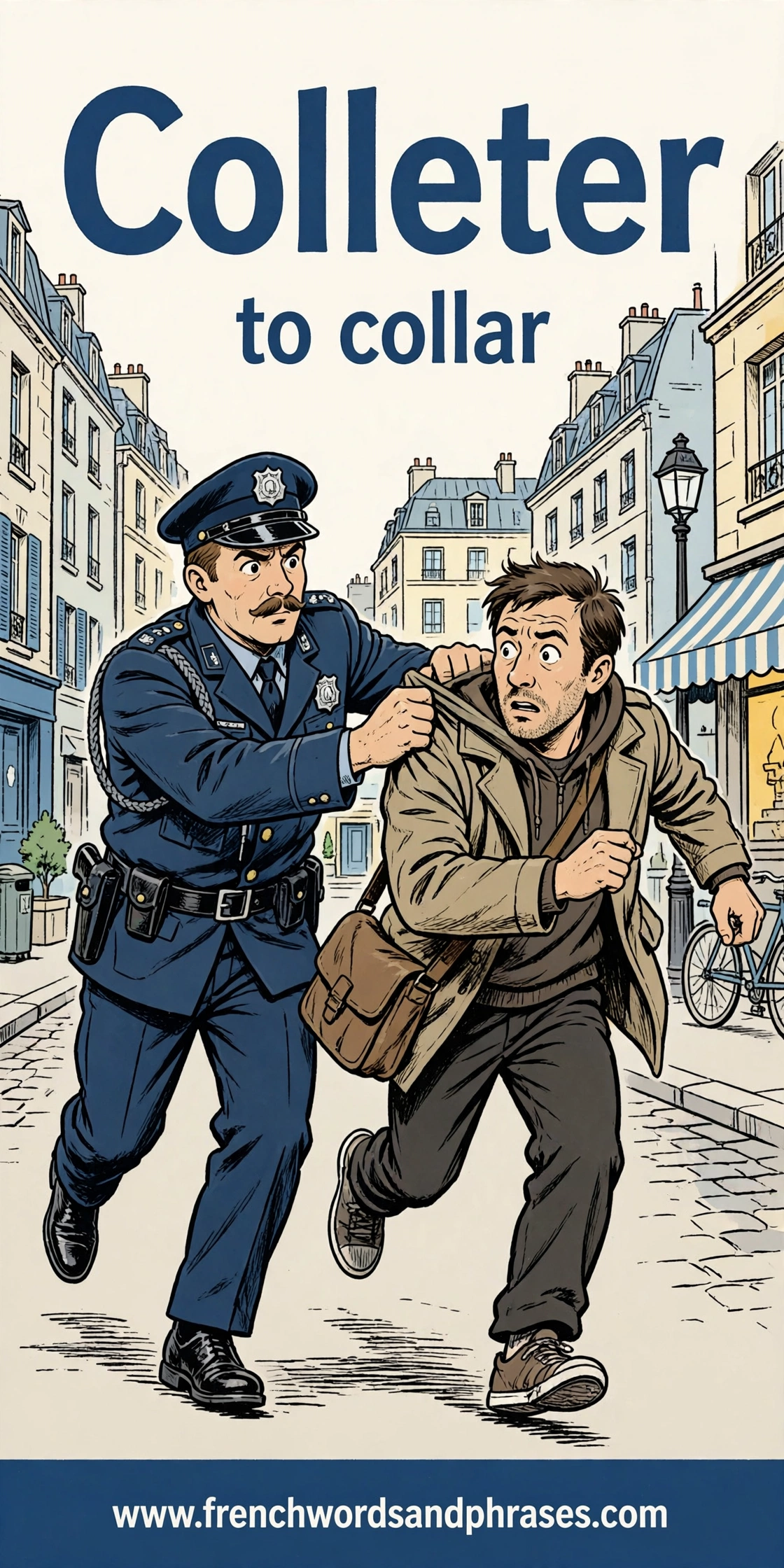
Colleter means to collar — to seize someone by the collar or the neck and hold them fast.
A bouncer’s hand closing on a collar, a policeman catching a fleeing thief by the scruff, a mother grabbing her toddler’s hood a step from the road — colleter is the verb of the grab that stops someone: quick, physical and very final.
In this guide, you’ll learn how to conjugate colleter in all the major French tenses and moods. Explore complete conjugation tables, French examples, English translations, and practice quizzes.
Understanding the French Verb Colleter
Colleter is a regular French verb belonging to the first group of verbs, those ending in-er.
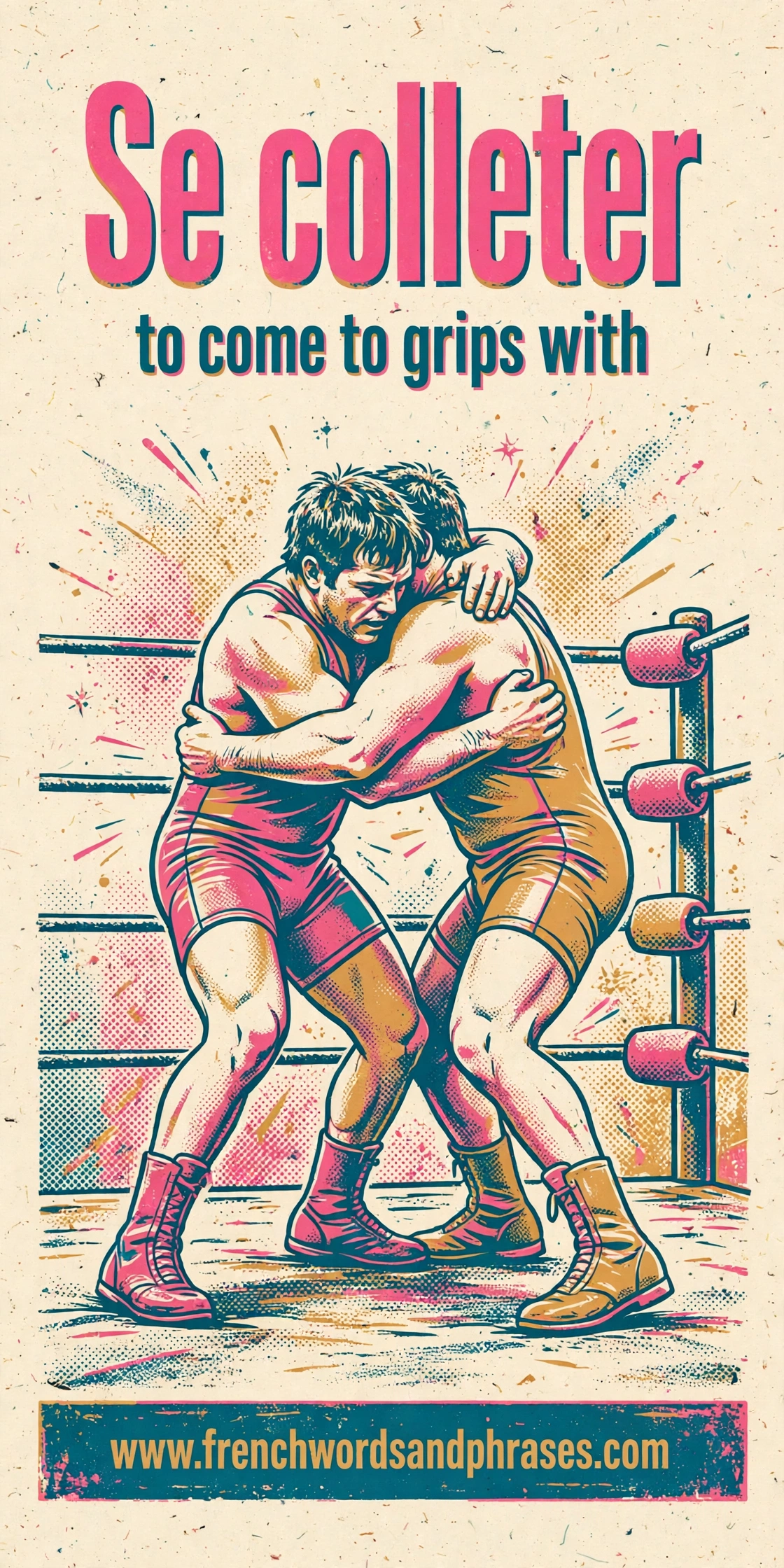
It means to collar. It is a verb of authority and urgency — bouncers, policemen, guards and gamekeepers colleter troublemakers, thieves and poachers — and by extension anyone can colleter a dog by its collar a step from danger. Its reflexive twin, se colleter, turns the grab into a grapple.
Verb classification: First group (-er)
Auxiliary verb: Avoir
Past participle: colleté
Present participle: colletant
English equivalents: To collar, to seize by the collar; colleter un voleur — to collar a thief; prendre quelqu’un au collet — to grab someone by the collar; le collet — the collar, the neck (of a coat, of game).
One important detail: colleter belongs to the appeler family of spelling — the final t of the stem doubles wherever the next syllable is mute: je collette, tu collettes, il collette, ils collettent, and all through the future and conditional: je colletterai, je colletterais. The t stays single wherever the ending is sounded: nous colletons, vous colletez, je colletais, and in both participles: colletant, colleté. The subjunctive splits the same way: que je collette, but que nous colletions. The word is built on le collet, the collar of a coat — to colleter someone is literally to take him by the collet.
Experience the Word
Colleter is the verb of the hand on the collar — the argument is over, because somebody has been caught.
Imagine a village dance in full swing when a drunk starts swinging a chair. The old caretaker crosses the floor without hurrying, collette the man by the collar, marches him to the door — and the band, which never stopped, plays on.
No blows, no shouting. One grab by the collar — colleté — and the evening is saved.
How to Conjugate Colleter: Complete French Conjugation Guide
Let’s explore every major conjugation of colleter, beginning with the indicative mood.
How to Conjugate Colleter in the Indicative Mood
The indicative mood is used to express facts, observations, actions, and events.
How to Conjugate Colleter in the Present Tense (Présent)
Used for actions happening now, habitual actions, and general truths.
| Subject | Conjugation |
|---|---|
| je | collette |
| tu | collettes |
| il / elle | collette |
| nous | colletons |
| vous | colletez |
| ils / elles | collettent |
Example
Le videur collette le fauteur de troubles à la porte du bar.
The bouncer collars the troublemaker at the bar door.
Quick Quiz 1
Complete the sentence:
Nous ______ le suspect à la sortie.
Reveal the answer
colletons
Nous colletons le suspect à la sortie.
We collar the suspect at the exit.
How to Conjugate Colleter in the Passé Composé
Used for completed actions in the past. Colleter takes the auxiliary verb avoir.
| Subject | Conjugation |
|---|---|
| j’ | ai colleté |
| tu | as colleté |
| il / elle | a colleté |
| nous | avons colleté |
| vous | avez colleté |
| ils / elles | ont colleté |
Example
Le policier a colleté le voleur au coin de la rue.
The policeman collared the thief at the street corner.
How to Conjugate Colleter in the Imparfait (Imperfect Tense)
Used for habitual past actions, descriptions, and ongoing situations in the past.
| Subject | Conjugation |
|---|---|
| je | colletais |
| tu | colletais |
| il / elle | colletait |
| nous | colletions |
| vous | colletiez |
| ils / elles | colletaient |
Example
Autrefois, le garde-champêtre colletait les maraudeurs dans les vergers.
In the old days, the rural guard used to collar poachers in the orchards.
Quick Quiz 2
Choose the correct form:
He collared the thief.
Il ______ le voleur. (a colleté / est colleté)
Reveal the answer
a colleté
Il a colleté le voleur.
Colleter takes avoir, and the past participle is colleté — single t, like appelé.
How to Conjugate Colleter in the Plus-que-parfait
Used to describe an action that had already been completed before another past event.
| Subject | Conjugation |
|---|---|
| j’ | avais colleté |
| tu | avais colleté |
| il / elle | avait colleté |
| nous | avions colleté |
| vous | aviez colleté |
| ils / elles | avaient colleté |
Example
Elle avait colleté le chien avant qu’il traverse la route.
She had grabbed the dog by the collar before it crossed the road.
How to Conjugate Colleter in the Passé Simple
Primarily used in formal writing, literature, and historical narratives. It is rarely used in everyday conversation.
| Subject | Conjugation |
|---|---|
| je | colletai |
| tu | colletas |
| il / elle | colleta |
| nous | colletâmes |
| vous | colletâtes |
| ils / elles | colletèrent |
Example
Il colleta l’homme par le col et le poussa dehors.
He collared the man by the neck and pushed him outside.
How to Conjugate Colleter in the Passé Antérieur
A literary tense used to express an action completed immediately before another past action, generally in the passé simple.
| Subject | Conjugation |
|---|---|
| j’ | eus colleté |
| tu | eus colleté |
| il / elle | eut colleté |
| nous | eûmes colleté |
| vous | eûtes colleté |
| ils / elles | eurent colleté |
Example
Quand il eut colleté le fugitif, les gendarmes arrivèrent.
When he had collared the fugitive, the police arrived.
How to Conjugate Colleter in the Future Tense (Futur Simple)
Used to describe actions that will take place in the future.
| Subject | Conjugation |
|---|---|
| je | colletterai |
| tu | colletteras |
| il / elle | collettera |
| nous | colletterons |
| vous | colletterez |
| ils / elles | colletteront |
Example
Si tu recommences, le surveillant te collettera.
If you start again, the supervisor will collar you.
How to Conjugate Colleter in the Futur Antérieur (Future Perfect)
Used for an action that will have been completed before a particular point in the future.
| Subject | Conjugation |
|---|---|
| j’ | aurai colleté |
| tu | auras colleté |
| il / elle | aura colleté |
| nous | aurons colleté |
| vous | aurez colleté |
| ils / elles | auront colleté |
Example
À la sortie, les agents auront colleté les deux fauteurs de troubles.
By closing time, the officers will have collared the two troublemakers.
How to Conjugate Colleter in the Near Future (Futur Proche)
Used to describe something that is going to happen soon. Formed with aller + infinitive.
| Subject | Conjugation |
|---|---|
| je | vais colleter |
| tu | vas colleter |
| il / elle | va colleter |
| nous | allons colleter |
| vous | allez colleter |
| ils / elles | vont colleter |
Example
Attention, le videur va colletter cet homme ivre.
Careful, the bouncer is going to collar that drunk man.
How to Conjugate Colleter in the Conditional Mood
The conditional mood expresses what would happen under certain circumstances. It is also frequently used to make polite requests or express wishes.
How to Conjugate Colleter in the Present Conditional
| Subject | Conjugation |
|---|---|
| je | colletterais |
| tu | colletterais |
| il / elle | colletterait |
| nous | colletterions |
| vous | colletteriez |
| ils / elles | colletteraient |
Example
Sans les caméras, il colletterait le voleur lui-même.
Without the cameras, he would collar the thief himself.
How to Conjugate Colleter in the Past Conditional
| Subject | Conjugation |
|---|---|
| j’ | aurais colleté |
| tu | aurais colleté |
| il / elle | aurait colleté |
| nous | aurions colleté |
| vous | auriez colleté |
| ils / elles | auraient colleté |
Example
Elle aurait colleté le chien si elle avait été plus rapide.
She would have grabbed the dog by the collar if she had been quicker.
Colleter in the Literary Past Conditional Form
This less common literary form uses the imperfect subjunctive of avoir.
| Subject | Conjugation |
|---|---|
| j’ | eusse colleté |
| tu | eusses colleté |
| il / elle | eût colleté |
| nous | eussions colleté |
| vous | eussiez colleté |
| ils / elles | eussent colleté |
Example
Le garde eût colleté le braconnier sans l’obscurité.
The guard would have collared the poacher without the darkness.
How to Conjugate Colleter in the Subjunctive Mood
The subjunctive is used to express wishes, emotions, doubts, necessity, and uncertainty. It frequently follows expressions such as il faut que (it is necessary that) or bien que (although).
How to Conjugate Colleter in the Present Subjunctive
| Subject | Conjugation |
|---|---|
| que je | collette |
| que tu | collettes |
| qu’il / qu’elle | collette |
| que nous | colletions |
| que vous | colletiez |
| qu’ils / qu’elles | collettent |
Example
Il faut que tu collettes le chien avant la route.
You must grab the dog by the collar before the road.
Quick Quiz 3
Complete the sentence using the subjunctive:
Il faut que vous ______ le chien avant la route.
Reveal the answer
colletiez
Il faut que vous colletiez le chien avant la route.
You must grab the dog by the collar before the road.
How to Conjugate Colleter in the Imperfect Subjunctive
A literary tense, rarely encountered in modern spoken French.
| Subject | Conjugation |
|---|---|
| que je | colletasse |
| que tu | colletasses |
| qu’il / qu’elle | colletât |
| que nous | colletassions |
| que vous | colletassiez |
| qu’ils / qu’elles | colletassent |
Example
Je ne pensais pas qu’il colletât un client en pleine salle.
I did not think he would collar a customer in the middle of the room.
How to Conjugate Colleter in the Pluperfect Subjunctive
A literary construction used to express an action completed before another past action.
| Subject | Conjugation |
|---|---|
| que j’ | eusse colleté |
| que tu | eusses colleté |
| qu’il / qu’elle | eût colleté |
| que nous | eussions colleté |
| que vous | eussiez colleté |
| qu’ils / qu’elles | eussent colleté |
Example
On raconta qu’il eût colleté le voleur à mains nues.
It was told that he had collared the thief with his bare hands.
How to Conjugate Colleter in the Past Subjunctive
| Subject | Conjugation |
|---|---|
| que j’ | aie colleté |
| que tu | aies colleté |
| qu’il / qu’elle | ait colleté |
| que nous | ayons colleté |
| que vous | ayez colleté |
| qu’ils / qu’elles | aient colleté |
Example
Je suis étonné que l’agent ait colleté le fauteur de troubles si calmement.
I am surprised the officer collared the troublemaker so calmly.
How to Conjugate Colleter in the Imperative
The imperative is used to give commands, instructions, invitations, or suggestions. Subject pronouns are omitted.
How to Conjugate Colleter in the Present Imperative
| Person | Conjugation |
|---|---|
| (tu) | collette |
| (nous) | colletons |
| (vous) | colletez |
Example
Collette-le avant qu’il s’échappe !
Collar him before he escapes!
Quick Quiz 4
How would you say Collar him (tu form)?
Reveal the answer
Collette-le !
French Participles of Colleter
Participles are verb forms that can be used in compound tenses and other grammatical constructions.
Present Participle of Colleter
colletant
En colletant le suspect, l’agent a déchiré sa propre veste.
While collaring the suspect, the officer tore his own jacket.
Past Participle of Colleter
colleté
Colleté par le videur, l’homme a fini par se calmer.
Collared by the bouncer, the man finally calmed down.
Colleter in Everyday French: Real-Life Examples
Now that you know the conjugations, let’s see how colleter appears in everyday French.
Example 1 — Present
Le videur collette l’homme ivre.
The bouncer is collaring the drunk man.
Example 2 — Passé composé
Le policier a colleté le voleur.
The policeman collared the thief.
Example 3 — Imparfait
Le garde colletait les maraudeurs.
The guard used to collar poachers.
Example 4 — Future
Le surveillant te collettera.
The supervisor will collar you.
Example 5 — Conditional
Elle colletterait le chien plus vite.
She would grab the dog by the collar more quickly.
Example 6 — Imperative
Collette-le !
Collar him!
Beyond Translation: The Meaning of Colleter
English to collar a criminal is the same picture in the same place — a hand at the neck — and French colleter is built openly on le collet, the collar of a coat or the neck of game in a snare.
It is the politest possible violence.
No punch, no weapon: just a grip on the collar and a walk to the door. That is why the verb belongs to caretakers, bouncers and village guards — the people whose job is to end trouble, not to start it.
How to Remember the French Verb Colleter
Remember it this way: Colleter is about the caretaker’s hand closing on the troublemaker’s collar.
- The appeler trap: t doubles before a mute syllable — je collette, ils collettent, je colletterai — but nous colletons, vous colletez.
- Built on le collet, the collar: to colleter is to take someone by the collar and walk him out.
- Past participle colleté, present participle colletant — and the reflexive se colleter means to grapple.
The key idea is the caretaker’s hand closing on the troublemaker’s collar.
Test Your Knowledge of Colleter
Let’s see how much you’ve learned. Try answering these questions before revealing the answers.
Question 1
Why does colleter double its t in je collette but not in nous colletons?
Reveal the answer
The appeler-type rule — the t doubles before a mute syllable (je collette, ils collettent, je colletterai) and stays single where the ending is sounded (nous colletons, vous colletez).
Question 2
How do you say The policeman collared the thief in French?
Reveal the answer
Le policier a colleté le voleur.
Question 3
Translate: The bouncer is collaring the drunk man.
Reveal the answer
Le videur collette l’homme ivre.
Question 4
What is the past participle of colleter?
Reveal the answer
Colleté.
Question 5
Complete the sentence:
Il faut que tu ______ le chien avant la route.
Reveal the answer
collettes
Il faut que tu collettes le chien avant la route.
You must grab the dog by the collar before the road.
Your Final Challenge
Can You Use It?
How would you say this in French?
The bouncer collars the man by the collar, and silence returns to the room.
Reveal the answer
Le videur collette l’homme par le col, et le silence revient dans la salle.
The bouncer collars the man by the collar, and silence returns to the room.
A little French. A little curiosity. A richer everyday life.
LEARN FRENCH ONE WORD AT A TIME