A French Word to Live By
How to Conjugate Boulonner in French
/bu.lɔ.ne/
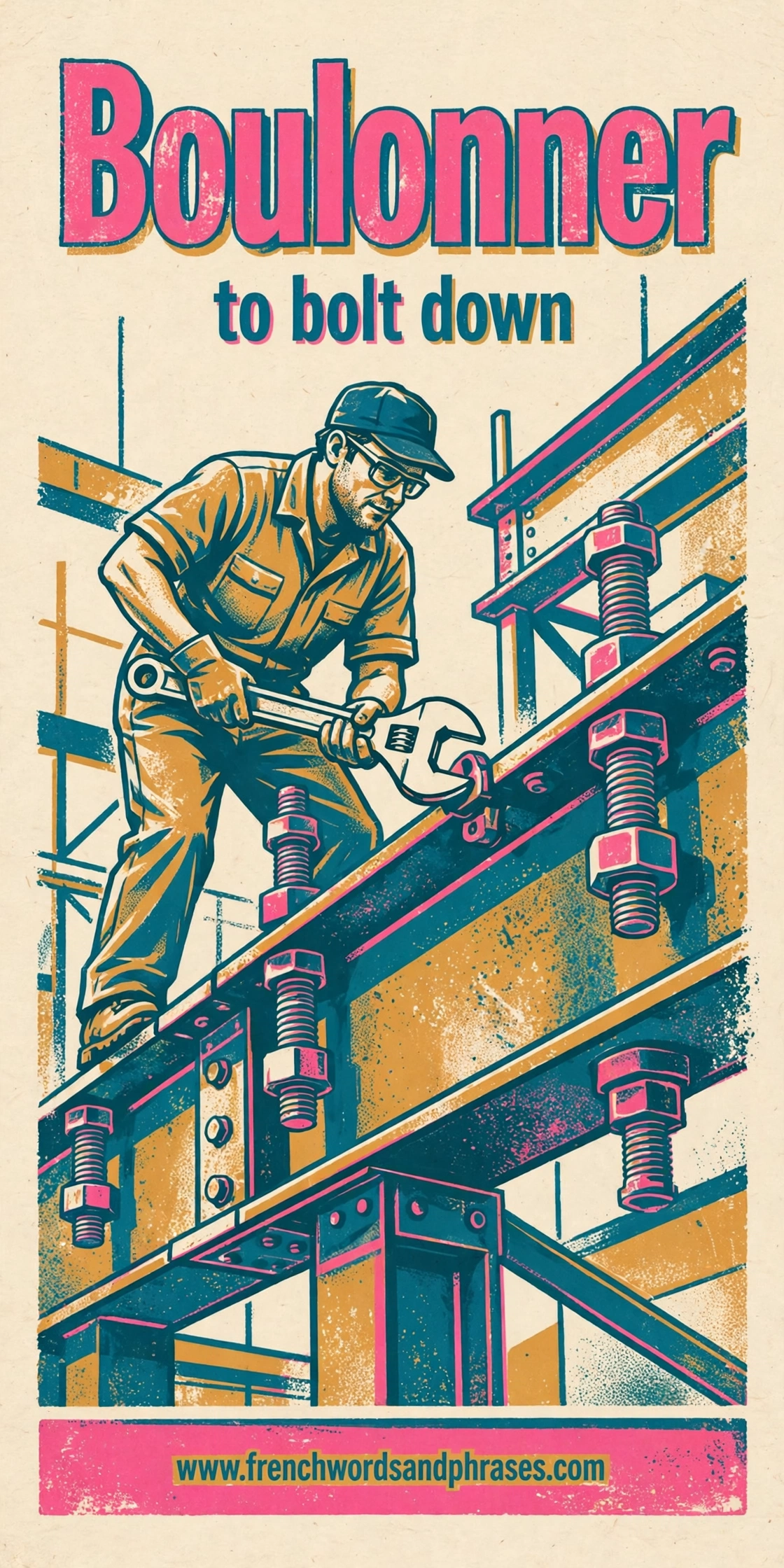
Boulonner means to bolt down — to fasten with bolts like a mechanic, and in familiar French, to slog away at work like one.
A mechanic flat on his back under a lorry, wrench in hand, and a student at midnight with his head in his books — boulonner joins them: the same verb bolts steel in the workshop and, in the slang of work, bolts a person to his task until the job is done.
In this guide, you’ll learn how to conjugate boulonner in all the major French tenses and moods. Explore complete conjugation tables, French examples, English translations, and practice quizzes.
Understanding the French Verb Boulonner
Boulonner is a regular French verb belonging to the first group of verbs, those ending in-er.
It means to bolt down. Literally it belongs to mechanics, construction and railways, where parts are bolted rather than welded; figuratively and familiarly it describes anyone fastened to hard work — students before exams, tradesmen on a deadline, teams finishing a project.
Verb classification: First group (-er)
Auxiliary verb: Avoir
Past participle: boulonné
Present participle: boulonnant
English equivalents: To bolt, to bolt down; un boulon — a bolt; boulonner une pièce — to bolt a part in place; (familiar) to work hard, to slog — boulonner jour et nuit, to slog day and night; déboulonner — to unbolt, to topple (a statue, a reputation).
One important detail: boulonner keeps the double -nn- of un boulon, a bolt, in every form: je boulonne, nous boulonnons, ils boulonnent, past participle boulonné. Its familiar second life — to work hard — is slang of the workshop carried into the office and the classroom, a cousin of bosser: il boulonne jour et nuit means he is slogging, not that he is holding a wrench. Say it with a smile; in a formal report, write travailler dur.
Experience the Word
Boulonner is the verb of the fastening — of steel bolted tight, and of people bolted to their work until it holds.
Imagine the night before the harvest festival. In the workshop, Karim boulonne the last wheel of the old tractor; across the village, his daughter boulonne her revision notes at the kitchen table — father and daughter, one verb, both fastened to the finish.
Neither will stop before the job holds. They are bolting it down — boulonnant, wrench and pen alike.
How to Conjugate Boulonner: Complete French Conjugation Guide
Let’s explore every major conjugation of boulonner, beginning with the indicative mood.
How to Conjugate Boulonner in the Indicative Mood
The indicative mood is used to express facts, observations, actions, and events.
How to Conjugate Boulonner in the Present Tense (Présent)
Used for actions happening now, habitual actions, and general truths.
| Subject | Conjugation |
|---|---|
| je | boulonne |
| tu | boulonnes |
| il / elle | boulonne |
| nous | boulonnons |
| vous | boulonnez |
| ils / elles | boulonnent |
Example
Le mécanicien boulonne la roue avec soin.
The mechanic is bolting the wheel on carefully.
Quick Quiz 1
Complete the sentence:
Nous ______ jusqu’à minuit avant l’examen.
Reveal the answer
boulonnons
Nous boulonnons jusqu’à minuit avant l’examen.
We are slogging until midnight before the exam.
How to Conjugate Boulonner in the Passé Composé
Used for completed actions in the past. Boulonner takes the auxiliary verb avoir.
| Subject | Conjugation |
|---|---|
| j’ | ai boulonné |
| tu | as boulonné |
| il / elle | a boulonné |
| nous | avons boulonné |
| vous | avez boulonné |
| ils / elles | ont boulonné |
Example
Ils ont boulonné toute la semaine pour finir à temps.
They slogged all week to finish on time.
How to Conjugate Boulonner in the Imparfait (Imperfect Tense)
Used for habitual past actions, descriptions, and ongoing situations in the past.
| Subject | Conjugation |
|---|---|
| je | boulonnais |
| tu | boulonnais |
| il / elle | boulonnait |
| nous | boulonnions |
| vous | boulonniez |
| ils / elles | boulonnaient |
Example
Mon père boulonnait jour et nuit dans son atelier.
My father used to work day and night in his workshop.
Quick Quiz 2
Choose the correct form:
They slogged all week.
Ils ______ toute la semaine. (ont boulonné / sont boulonnés)
Reveal the answer
ont boulonné
Ils ont boulonné toute la semaine.
Boulonner takes avoir.
How to Conjugate Boulonner in the Plus-que-parfait
Used to describe an action that had already been completed before another past event.
| Subject | Conjugation |
|---|---|
| j’ | avais boulonné |
| tu | avais boulonné |
| il / elle | avait boulonné |
| nous | avions boulonné |
| vous | aviez boulonné |
| ils / elles | avaient boulonné |
Example
Elle avait boulonné ses examens pendant des mois.
She had been slogging at her exams for months.
How to Conjugate Boulonner in the Passé Simple
Primarily used in formal writing, literature, and historical narratives. It is rarely used in everyday conversation.
| Subject | Conjugation |
|---|---|
| je | boulonnai |
| tu | boulonnas |
| il / elle | boulonna |
| nous | boulonnâmes |
| vous | boulonnâtes |
| ils / elles | boulonnèrent |
Example
L’ouvrier boulonna la plaque et vérifia chaque écrou.
The worker bolted the plate down and checked every nut.
How to Conjugate Boulonner in the Passé Antérieur
A literary tense used to express an action completed immediately before another past action, generally in the passé simple.
| Subject | Conjugation |
|---|---|
| j’ | eus boulonné |
| tu | eus boulonné |
| il / elle | eut boulonné |
| nous | eûmes boulonné |
| vous | eûtes boulonné |
| ils / elles | eurent boulonné |
Example
Quand il eut boulonné la dernière pièce, le moteur démarra.
When he had bolted the last part, the engine started.
How to Conjugate Boulonner in the Future Tense (Futur Simple)
Used to describe actions that will take place in the future.
| Subject | Conjugation |
|---|---|
| je | boulonnerai |
| tu | boulonneras |
| il / elle | boulonnera |
| nous | boulonnerons |
| vous | boulonnerez |
| ils / elles | boulonneront |
Example
Demain, les étudiants boulonneront jusqu’à minuit.
Tomorrow, the students will slog until midnight.
How to Conjugate Boulonner in the Futur Antérieur (Future Perfect)
Used for an action that will have been completed before a particular point in the future.
| Subject | Conjugation |
|---|---|
| j’ | aurai boulonné |
| tu | auras boulonné |
| il / elle | aura boulonné |
| nous | aurons boulonné |
| vous | aurez boulonné |
| ils / elles | auront boulonné |
Example
À la fin du mois, l’équipe aura boulonné sans relâche.
By the end of the month, the team will have slogged without a break.
How to Conjugate Boulonner in the Near Future (Futur Proche)
Used to describe something that is going to happen soon. Formed with aller + infinitive.
| Subject | Conjugation |
|---|---|
| je | vais boulonner |
| tu | vas boulonner |
| il / elle | va boulonner |
| nous | allons boulonner |
| vous | allez boulonner |
| ils / elles | vont boulonner |
Example
Allez, on va boulonner ce week-end et tout sera prêt.
Come on, we are going to slog this weekend and everything will be ready.
How to Conjugate Boulonner in the Conditional Mood
The conditional mood expresses what would happen under certain circumstances. It is also frequently used to make polite requests or express wishes.
How to Conjugate Boulonner in the Present Conditional
| Subject | Conjugation |
|---|---|
| je | boulonnerais |
| tu | boulonnerais |
| il / elle | boulonnerait |
| nous | boulonnerions |
| vous | boulonneriez |
| ils / elles | boulonneraient |
Example
Avec un apprenti, il boulonnerait moins longtemps chaque soir.
With an apprentice, he would not have to work so late every evening.
How to Conjugate Boulonner in the Past Conditional
| Subject | Conjugation |
|---|---|
| j’ | aurais boulonné |
| tu | aurais boulonné |
| il / elle | aurait boulonné |
| nous | aurions boulonné |
| vous | auriez boulonné |
| ils / elles | auraient boulonné |
Example
Tu aurais moins boulonné si tu avais commencé plus tôt.
You would have slogged less if you had started earlier.
Boulonner in the Literary Past Conditional Form
This less common literary form uses the imperfect subjunctive of avoir.
| Subject | Conjugation |
|---|---|
| j’ | eusse boulonné |
| tu | eusses boulonné |
| il / elle | eût boulonné |
| nous | eussions boulonné |
| vous | eussiez boulonné |
| ils / elles | eussent boulonné |
Example
Il eût boulonné jusqu’à l’aube pour tenir sa parole.
He would have worked until dawn to keep his word.
How to Conjugate Boulonner in the Subjunctive Mood
The subjunctive is used to express wishes, emotions, doubts, necessity, and uncertainty. It frequently follows expressions such as il faut que (it is necessary that) or bien que (although).
How to Conjugate Boulonner in the Present Subjunctive
| Subject | Conjugation |
|---|---|
| que je | boulonne |
| que tu | boulonnes |
| qu’il / qu’elle | boulonne |
| que nous | boulonnions |
| que vous | boulonniez |
| qu’ils / qu’elles | boulonnent |
Example
Il faut que je boulonne sérieusement avant l’examen.
I really have to slog before the exam.
Quick Quiz 3
Complete the sentence using the subjunctive:
Il faut que vous ______ chaque pièce avec soin.
Reveal the answer
boulonniez
Il faut que vous boulonniez chaque pièce avec soin.
You must bolt every part down carefully.
How to Conjugate Boulonner in the Imperfect Subjunctive
A literary tense, rarely encountered in modern spoken French.
| Subject | Conjugation |
|---|---|
| que je | boulonnasse |
| que tu | boulonnasses |
| qu’il / qu’elle | boulonnât |
| que nous | boulonnassions |
| que vous | boulonnassiez |
| qu’ils / qu’elles | boulonnassent |
Example
Le chef exigeait que l’on boulonnât la structure avant la tempête.
The boss required the structure to be bolted down before the storm.
How to Conjugate Boulonner in the Pluperfect Subjunctive
A literary construction used to express an action completed before another past action.
| Subject | Conjugation |
|---|---|
| que j’ | eusse boulonné |
| que tu | eusses boulonné |
| qu’il / qu’elle | eût boulonné |
| que nous | eussions boulonné |
| que vous | eussiez boulonné |
| qu’ils / qu’elles | eussent boulonné |
Example
On admirait qu’ils eussent boulonné sans jamais se plaindre.
People admired that they had slogged without ever complaining.
How to Conjugate Boulonner in the Past Subjunctive
| Subject | Conjugation |
|---|---|
| que j’ | aie boulonné |
| que tu | aies boulonné |
| qu’il / qu’elle | ait boulonné |
| que nous | ayons boulonné |
| que vous | ayez boulonné |
| qu’ils / qu’elles | aient boulonné |
Example
Je suis content que tu aies boulonné ce chapitre difficile.
I am glad you slogged through that difficult chapter.
How to Conjugate Boulonner in the Imperative
The imperative is used to give commands, instructions, invitations, or suggestions. Subject pronouns are omitted.
How to Conjugate Boulonner in the Present Imperative
| Person | Conjugation |
|---|---|
| (tu) | boulonne |
| (nous) | boulonnons |
| (vous) | boulonnez |
Example
Boulonne bien chaque pièce, la sécurité d’abord !
Bolt every part down well, safety first!
Quick Quiz 4
How would you say Bolt it down well (tu form)?
Reveal the answer
Boulonne-le bien !
French Participles of Boulonner
Participles are verb forms that can be used in compound tenses and other grammatical constructions.
Present Participle of Boulonner
boulonnant
En boulonnant jour et nuit, elle a réussi son concours.
By slogging day and night, she passed her competitive exam.
Past Participle of Boulonner
boulonné
Boulonnée au sol, la machine ne bougera plus.
Bolted to the floor, the machine will not move again.
Boulonner in Everyday French: Real-Life Examples
Now that you know the conjugations, let’s see how boulonner appears in everyday French.
Example 1 — Present
Le mécanicien boulonne la roue.
The mechanic is bolting the wheel on.
Example 2 — Passé composé
Ils ont boulonné toute la semaine.
They slogged all week.
Example 3 — Imparfait
Mon père boulonnait jour et nuit.
My father used to work day and night.
Example 4 — Future
Les étudiants boulonneront jusqu’à minuit.
The students will slog until midnight.
Example 5 — Conditional
Avec de l’aide, tu boulonnerais moins.
With help, you would not have to slog so much.
Example 6 — Imperative
Boulonne sérieusement avant l’examen !
Slog seriously before the exam!
Beyond Translation: The Meaning of Boulonner
English bolt gives the workshop sense, but the familiar French sense — to slog — is a small poem of its own: the worker is himself a bolt, fastened tight to the job.
Its opposite made history.
Déboulonner is to unbolt — and in modern French, déboulonner une statue is to topple a monument, reputation included; boulonner holds the world together, déboulonner takes it apart, one bolt at a time.
How to Remember the French Verb Boulonner
Remember it this way: Boulonner is about the mechanic under the lorry — and the student bolted to her books at midnight.
- From un boulon, a bolt: double -nn- everywhere — je boulonne, nous boulonnons.
- Two lives: bolting steel in the workshop, and (familiar) slogging at any work — a cousin of bosser.
- Regular -er: je boulonne, nous boulonnons, past participle boulonné.
The key idea is the mechanic under the lorry — and the student bolted to her books at midnight.
Test Your Knowledge of Boulonner
Let’s see how much you’ve learned. Try answering these questions before revealing the answers.
Question 1
What noun gives boulonner its double -nn-, and what are its two senses?
Reveal the answer
Un boulon, a bolt — to bolt parts down, and familiarly, to slog at hard work.
Question 2
How do you say They slogged all week to finish on time in French?
Reveal the answer
Ils ont boulonné toute la semaine pour finir à temps.
Question 3
Translate: The mechanic is bolting the wheel on carefully.
Reveal the answer
Le mécanicien boulonne la roue avec soin.
Question 4
What is the past participle of boulonner?
Reveal the answer
Boulonné.
Question 5
Complete the sentence:
Il faut que je ______ sérieusement avant l’examen.
Reveal the answer
boulonne
Il faut que je boulonne sérieusement avant l’examen.
I really have to slog before the exam.
Your Final Challenge
Can You Use It?
How would you say this in French?
He has been slogging since dawn in the freezing workshop, and tonight the old tractor will purr like a cat.
Reveal the answer
Il boulonne depuis l’aube dans l’atelier glacé, et ce soir le vieux tracteur ronronnera comme un chat.
He has been slogging since dawn in the freezing workshop, and tonight the old tractor will purr like a cat.
A little French. A little curiosity. A richer everyday life.
LEARN FRENCH ONE WORD AT A TIME