A French Word to Live By
How to Conjugate Boulanger in French
/bu.lɑ̃.ʒe/
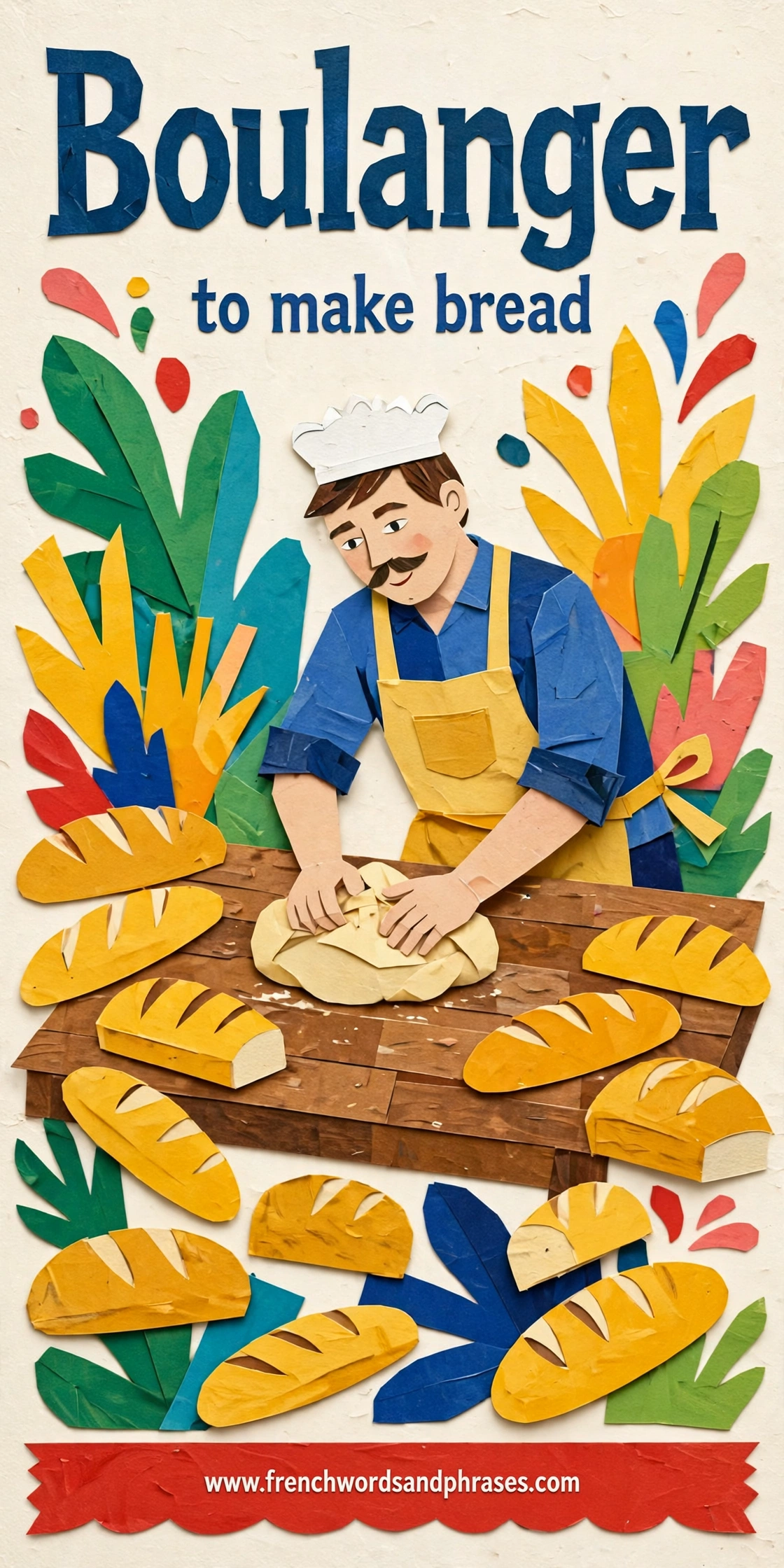
Boulanger means to make bread — to work as a baker, mixing, kneading and baking loaves for a living.
Flour in the air at three in the morning, hands in the dough, the first loaves already crackling in the oven — boulanger is the verb of the baker’s trade itself: not the man, but the work, the daily making of bread before the village wakes.
In this guide, you’ll learn how to conjugate boulanger in all the major French tenses and moods. Explore complete conjugation tables, French examples, English translations, and practice quizzes.
Understanding the French Verb Boulanger
Boulanger is a regular French verb belonging to the first group of verbs, those ending in-er.
It means to make bread. It is a trade verb, used of professionals and of the craft itself — boulanger au feu de bois, boulanger la nuit — and you will meet it far less often than the noun; most French speakers say faire du pain for home baking and keep boulanger for the profession.
Verb classification: First group (-er)
Auxiliary verb: Avoir
Past participle: boulangé
Present participle: boulangeant
English equivalents: To make bread, to work as a baker; un boulanger — a baker (the noun, far commoner than the verb); une boulangerie — a bakery; boulanger à l’ancienne — to bake the old-fashioned way; il boulange depuis vingt ans — he has been baking for twenty years.
One important detail: boulanger the verb is the twin of un boulanger, the baker — the noun is a hundred times commoner, so the verb often surprises. As a -ger verb it keeps a soft g before a and o by writing -ge-: nous boulangeons, je boulangeais, en boulangeant, while je boulange, ils boulangent need nothing added. The g must stay pronounced /ʒ/, never /g/: compare manger, nous mangeons.
Experience the Word
Boulanger is the verb of the night shift of bread — while the town sleeps, someone is already up to his elbows in dough.
Imagine a village bakery at three in the morning. The baker has boulangé through the dark — weighing, kneading, shaping — and as the first customers tap at the window, the shelves are full and the whole street smells of warm crust.
The town sees only the baker and the loaves. Behind them is the verb — boulanger, to make bread, night after night.
How to Conjugate Boulanger: Complete French Conjugation Guide
Let’s explore every major conjugation of boulanger, beginning with the indicative mood.
How to Conjugate Boulanger in the Indicative Mood
The indicative mood is used to express facts, observations, actions, and events.
How to Conjugate Boulanger in the Present Tense (Présent)
Used for actions happening now, habitual actions, and general truths.
| Subject | Conjugation |
|---|---|
| je | boulange |
| tu | boulanges |
| il / elle | boulange |
| nous | boulangeons |
| vous | boulangez |
| ils / elles | boulangent |
Example
Il boulange depuis minuit pour ouvrir à six heures.
He has been baking since midnight to open at six.
Quick Quiz 1
Complete the sentence:
Nous ______ dès trois heures du matin.
Reveal the answer
boulangeons
Nous boulangeons dès trois heures du matin.
We start baking at three in the morning.
How to Conjugate Boulanger in the Passé Composé
Used for completed actions in the past. Boulanger takes the auxiliary verb avoir.
| Subject | Conjugation |
|---|---|
| j’ | ai boulangé |
| tu | as boulangé |
| il / elle | a boulangé |
| nous | avons boulangé |
| vous | avez boulangé |
| ils / elles | ont boulangé |
Example
Mon grand-père a boulangé pendant quarante ans dans ce village.
My grandfather made bread for forty years in this village.
How to Conjugate Boulanger in the Imparfait (Imperfect Tense)
Used for habitual past actions, descriptions, and ongoing situations in the past.
| Subject | Conjugation |
|---|---|
| je | boulangeais |
| tu | boulangeais |
| il / elle | boulangeait |
| nous | boulangions |
| vous | boulangiez |
| ils / elles | boulangeaient |
Example
Autrefois, on boulangeait au feu de bois dans chaque ferme.
In the old days, people baked over a wood fire on every farm.
Quick Quiz 2
Choose the correct form:
She made bread for twenty years.
Elle ______ pendant vingt ans. (a boulangé / est boulangée)
Reveal the answer
a boulangé
Elle a boulangé pendant vingt ans.
Boulanger takes avoir.
How to Conjugate Boulanger in the Plus-que-parfait
Used to describe an action that had already been completed before another past event.
| Subject | Conjugation |
|---|---|
| j’ | avais boulangé |
| tu | avais boulangé |
| il / elle | avait boulangé |
| nous | avions boulangé |
| vous | aviez boulangé |
| ils / elles | avaient boulangé |
Example
Elle avait boulangé toute la nuit avant la fête du village.
She had been baking all night before the village festival.
How to Conjugate Boulanger in the Passé Simple
Primarily used in formal writing, literature, and historical narratives. It is rarely used in everyday conversation.
| Subject | Conjugation |
|---|---|
| je | boulangeai |
| tu | boulangeas |
| il / elle | boulangea |
| nous | boulangeâmes |
| vous | boulangeâtes |
| ils / elles | boulangeèrent |
Example
Le meunier boulangea lui-même le jour de la foire.
The miller baked the bread himself on fair day.
How to Conjugate Boulanger in the Passé Antérieur
A literary tense used to express an action completed immediately before another past action, generally in the passé simple.
| Subject | Conjugation |
|---|---|
| j’ | eus boulangé |
| tu | eus boulangé |
| il / elle | eut boulangé |
| nous | eûmes boulangé |
| vous | eûtes boulangé |
| ils / elles | eurent boulangé |
Example
Quand il eut boulangé ses derniers pains, il ferma le fournil.
When he had baked his last loaves, he closed the bakehouse.
How to Conjugate Boulanger in the Future Tense (Futur Simple)
Used to describe actions that will take place in the future.
| Subject | Conjugation |
|---|---|
| je | boulangerai |
| tu | boulangeras |
| il / elle | boulangera |
| nous | boulangerons |
| vous | boulangerez |
| ils / elles | boulangeront |
Example
Demain, les apprentis boulangeront sous l’œil du maître.
Tomorrow, the apprentices will bake under the master’s eye.
How to Conjugate Boulanger in the Futur Antérieur (Future Perfect)
Used for an action that will have been completed before a particular point in the future.
| Subject | Conjugation |
|---|---|
| j’ | aurai boulangé |
| tu | auras boulangé |
| il / elle | aura boulangé |
| nous | aurons boulangé |
| vous | aurez boulangé |
| ils / elles | auront boulangé |
Example
À l’aube, il aura boulangé trois cents baguettes.
By dawn, he will have baked three hundred baguettes.
How to Conjugate Boulanger in the Near Future (Futur Proche)
Used to describe something that is going to happen soon. Formed with aller + infinitive.
| Subject | Conjugation |
|---|---|
| je | vais boulanger |
| tu | vas boulanger |
| il / elle | va boulanger |
| nous | allons boulanger |
| vous | allez boulanger |
| ils / elles | vont boulanger |
Example
Ce soir, je vais boulanger pour la première fois.
Tonight, I am going to make bread for the first time.
How to Conjugate Boulanger in the Conditional Mood
The conditional mood expresses what would happen under certain circumstances. It is also frequently used to make polite requests or express wishes.
How to Conjugate Boulanger in the Present Conditional
| Subject | Conjugation |
|---|---|
| je | boulangerais |
| tu | boulangerais |
| il / elle | boulangerait |
| nous | boulangerions |
| vous | boulangeriez |
| ils / elles | boulangeraient |
Example
Avec un meilleur four, il boulangerait des pains magnifiques.
With a better oven, he would bake magnificent loaves.
How to Conjugate Boulanger in the Past Conditional
| Subject | Conjugation |
|---|---|
| j’ | aurais boulangé |
| tu | aurais boulangé |
| il / elle | aurait boulangé |
| nous | aurions boulangé |
| vous | auriez boulangé |
| ils / elles | auraient boulangé |
Example
Elle aurait boulangé plus volontiers avec un apprenti.
She would have baked more gladly with an apprentice.
Boulanger in the Literary Past Conditional Form
This less common literary form uses the imperfect subjunctive of avoir.
| Subject | Conjugation |
|---|---|
| j’ | eusse boulangé |
| tu | eusses boulangé |
| il / elle | eût boulangé |
| nous | eussions boulangé |
| vous | eussiez boulangé |
| ils / elles | eussent boulangé |
Example
Il eût boulangé jusqu’à son dernier jour, fidèle au fournil.
He would have baked until his last day, faithful to the bakehouse.
How to Conjugate Boulanger in the Subjunctive Mood
The subjunctive is used to express wishes, emotions, doubts, necessity, and uncertainty. It frequently follows expressions such as il faut que (it is necessary that) or bien que (although).
How to Conjugate Boulanger in the Present Subjunctive
| Subject | Conjugation |
|---|---|
| que je | boulange |
| que tu | boulanges |
| qu’il / qu’elle | boulange |
| que nous | boulangions |
| que vous | boulangiez |
| qu’ils / qu’elles | boulangent |
Example
Il faut qu’il boulange dès trois heures du matin.
He has to start baking at three in the morning.
Quick Quiz 3
Complete the sentence using the subjunctive:
Il faut que vous ______ avant l’aube.
Reveal the answer
boulangiez
Il faut que vous boulangiez avant l’aube.
You must bake before dawn.
How to Conjugate Boulanger in the Imperfect Subjunctive
A literary tense, rarely encountered in modern spoken French.
| Subject | Conjugation |
|---|---|
| que je | boulangasse |
| que tu | boulangasses |
| qu’il / qu’elle | boulangât |
| que nous | boulangassions |
| que vous | boulangassiez |
| qu’ils / qu’elles | boulangassent |
Example
On exigeait que les apprentis boulangeassent sans se plaindre.
The apprentices were required to bake without complaining.
How to Conjugate Boulanger in the Pluperfect Subjunctive
A literary construction used to express an action completed before another past action.
| Subject | Conjugation |
|---|---|
| que j’ | eusse boulangé |
| que tu | eusses boulangé |
| qu’il / qu’elle | eût boulangé |
| que nous | eussions boulangé |
| que vous | eussiez boulangé |
| qu’ils / qu’elles | eussent boulangé |
Example
On admirait qu’il eût boulangé seul pendant tant d’années.
People admired that he had baked alone for so many years.
How to Conjugate Boulanger in the Past Subjunctive
| Subject | Conjugation |
|---|---|
| que j’ | aie boulangé |
| que tu | aies boulangé |
| qu’il / qu’elle | ait boulangé |
| que nous | ayons boulangé |
| que vous | ayez boulangé |
| qu’ils / qu’elles | aient boulangé |
Example
Je suis fier qu’elle ait boulangé le pain de notre mariage.
I am proud that she baked the bread for our wedding.
How to Conjugate Boulanger in the Imperative
The imperative is used to give commands, instructions, invitations, or suggestions. Subject pronouns are omitted.
How to Conjugate Boulanger in the Present Imperative
| Person | Conjugation |
|---|---|
| (tu) | boulange |
| (nous) | boulangeons |
| (vous) | boulangez |
Example
Boulangeons ensemble, la fête commence à midi !
Let us bake together, the party starts at noon!
Quick Quiz 4
How would you say Bake with me (tu form)?
Reveal the answer
Boulange avec moi !
French Participles of Boulanger
Participles are verb forms that can be used in compound tenses and other grammatical constructions.
Present Participle of Boulanger
boulangeant
En boulangeant la nuit, il écoute la radio et les oiseaux du matin.
Baking at night, he listens to the radio and the morning birds.
Past Participle of Boulanger
boulangé
Boulangé au feu de bois, ce pain se conserve une semaine.
Baked over a wood fire, this bread keeps for a week.
Boulanger in Everyday French: Real-Life Examples
Now that you know the conjugations, let’s see how boulanger appears in everyday French.
Example 1 — Present
Il boulange depuis minuit.
He has been baking since midnight.
Example 2 — Passé composé
Elle a boulangé pendant vingt ans.
She made bread for twenty years.
Example 3 — Imparfait
On boulangeait au feu de bois.
People used to bake over a wood fire.
Example 4 — Future
Les apprentis boulangeront demain.
The apprentices will bake tomorrow.
Example 5 — Conditional
Avec ce four, tu boulangerais de beaux pains.
With this oven, you would bake fine loaves.
Example 6 — Imperative
Boulange avec moi ce soir !
Bake with me this evening!
Beyond Translation: The Meaning of Boulanger
English has no everyday verb for what a baker does — you bake, and the bread is incidental; French boulanger names the trade in the verb itself.
The noun swallowed the verb.
Un boulanger the baker is on every street sign in France, while boulanger the verb lives quietly in the bakehouse — a reminder that in French, professions are things you are before they are things you do.
How to Remember the French Verb Boulanger
Remember it this way: Boulanger is about the baker at 3 a.m. — the trade itself, up to the elbows in dough.
- The verb is the noun’s twin: un boulanger bakes — boulanger is what he does all night.
- -ger spelling: nous boulangeons, je boulangeais — the e keeps the g soft.
- Regular -ger: je boulange, nous boulangeons, past participle boulangé.
The key idea is the baker at 3 a.m. — the trade itself, up to the elbows in dough.
Test Your Knowledge of Boulanger
Let’s see how much you’ve learned. Try answering these questions before revealing the answers.
Question 1
What spelling change does boulanger make before a and o, and why?
Reveal the answer
It writes -ge- — nous boulangeons, je boulangeais — so the g stays soft, /ʒ/, as in manger.
Question 2
How do you say My grandfather made bread for forty years in this village in French?
Reveal the answer
Mon grand-père a boulangé pendant quarante ans dans ce village.
Question 3
Translate: He has been baking since midnight.
Reveal the answer
Il boulange depuis minuit.
Question 4
What is the past participle of boulanger?
Reveal the answer
Boulangé.
Question 5
Complete the sentence:
Il faut qu’il ______ dès trois heures du matin.
Reveal the answer
boulange
Il faut qu’il boulange dès trois heures du matin.
He has to start baking at three in the morning.
Your Final Challenge
Can You Use It?
How would you say this in French?
He has been making bread since he was fifteen, and his hands know the dough like a familiar face.
Reveal the answer
Il boulange depuis l’âge de quinze ans, et ses mains reconnaissent la pâte comme un visage familier.
He has been making bread since he was fifteen, and his hands know the dough like a familiar face.
A little French. A little curiosity. A richer everyday life.
LEARN FRENCH ONE WORD AT A TIME