A French Word to Live By
How to Conjugate Bouillonner in French
/bu.jɔ.ne/
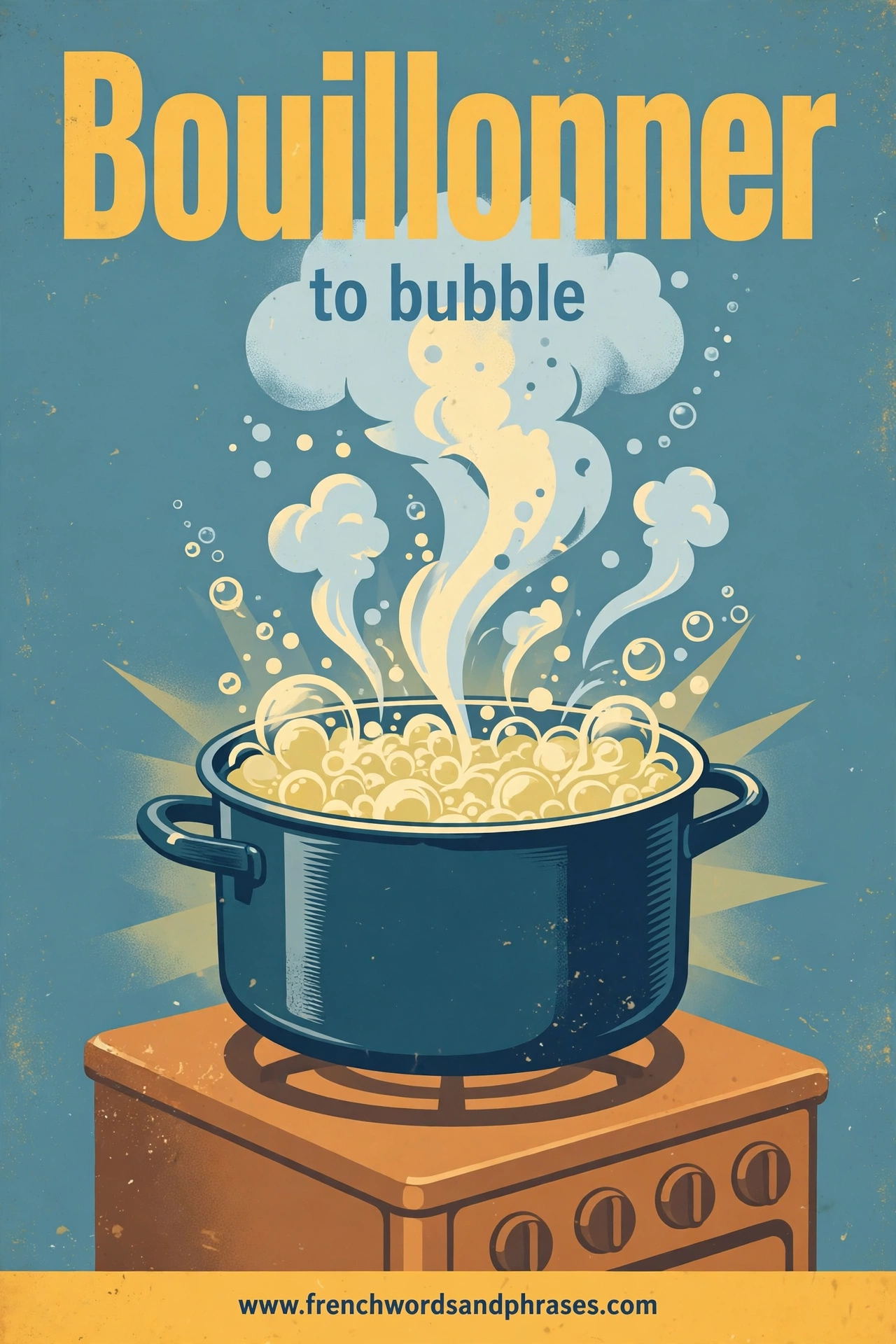
Bouillonner means to bubble — to boil up in rolling bubbles, and by extension to seethe, swarm and churn with barely contained energy.
A pot of soup at a rolling boil, bubbles breaking the surface without pause, a market square swarming at noon — bouillonner is the verb of surfaces that will not stay still: water, crowds and tempers all bouillonnent when something inside them is at full heat.
In this guide, you’ll learn how to conjugate bouillonner in all the major French tenses and moods. Explore complete conjugation tables, French examples, English translations, and practice quizzes.
Understanding the French Verb Bouillonner
Bouillonner is a regular French verb belonging to the first group of verbs, those ending in-er.
It means to bubble. It is used literally of liquids at a lively boil and figuratively of anything seething beneath a surface — a crowd, a city, a mind full of ideas, a heart full of anger: la foule bouillonne, les idées bouillonnent.
Verb classification: First group (-er)
Auxiliary verb: Avoir
Past participle: bouillonné
Present participle: bouillonnant
English equivalents: To bubble, to boil up, to seethe; l’eau bouillonne — the water is bubbling; bouillonner de colère — to seethe with anger; une rue qui bouillonne de vie — a street teeming with life; le bouillonnement — the bubbling, the turmoil.
One important detail: bouillonner keeps the double -nn- of un bouillon (a bubble, a broth) in every form: je bouillonne, nous bouillonnons, ils bouillonnent, past participle bouillonné. It is stronger than bouillir (to boil): bouillir states the temperature, bouillonner shows the movement — rolling, bubbling, foaming at the surface. That is why it extends so naturally to crowds and feelings: bouillonner de colère, bouillonner d’impatience, une ville qui bouillonne.
Experience the Word
Bouillonner is the verb of the surface in revolt — what is inside is too hot, too full or too alive to stay quietly below.
Imagine a great pot of broth on a farmhouse stove. It does not merely boil; it bouillonne — great bubbles rising and bursting, the surface rolling like a small sea, the whole kitchen filling with steam and the smell of dinner.
The pot is not just hot. It is bubbling over with life — bouillonnant, rolling, impossible to ignore.
How to Conjugate Bouillonner: Complete French Conjugation Guide
Let’s explore every major conjugation of bouillonner, beginning with the indicative mood.
How to Conjugate Bouillonner in the Indicative Mood
The indicative mood is used to express facts, observations, actions, and events.
How to Conjugate Bouillonner in the Present Tense (Présent)
Used for actions happening now, habitual actions, and general truths.
| Subject | Conjugation |
|---|---|
| je | bouillonne |
| tu | bouillonnes |
| il / elle | bouillonne |
| nous | bouillonnons |
| vous | bouillonnez |
| ils / elles | bouillonnent |
Example
La soupe bouillonne dans la grande marmite.
The soup is bubbling in the big pot.
Quick Quiz 1
Complete the sentence:
Nous regardons la sauce qui ______ dans la casserole.
Reveal the answer
bouillonne
Nous regardons la sauce qui bouillonne dans la casserole.
We are watching the sauce bubbling in the pan.
How to Conjugate Bouillonner in the Passé Composé
Used for completed actions in the past. Bouillonner takes the auxiliary verb avoir.
| Subject | Conjugation |
|---|---|
| j’ | ai bouillonné |
| tu | as bouillonné |
| il / elle | a bouillonné |
| nous | avons bouillonné |
| vous | avez bouillonné |
| ils / elles | ont bouillonné |
Example
La foule a bouillonné toute la soirée sur la place.
The crowd seethed all evening in the square.
How to Conjugate Bouillonner in the Imparfait (Imperfect Tense)
Used for habitual past actions, descriptions, and ongoing situations in the past.
| Subject | Conjugation |
|---|---|
| je | bouillonnais |
| tu | bouillonnais |
| il / elle | bouillonnait |
| nous | bouillonnions |
| vous | bouillonniez |
| ils / elles | bouillonnaient |
Example
L’eau bouillonnait déjà quand il ajouta les pâtes.
The water was already bubbling when he added the pasta.
Quick Quiz 2
Choose the correct form:
The crowd seethed all evening.
La foule ______ toute la soirée. (a bouillonné / est bouillonnée)
Reveal the answer
a bouillonné
La foule a bouillonné toute la soirée.
Bouillonner takes avoir.
How to Conjugate Bouillonner in the Plus-que-parfait
Used to describe an action that had already been completed before another past event.
| Subject | Conjugation |
|---|---|
| j’ | avais bouillonné |
| tu | avais bouillonné |
| il / elle | avait bouillonné |
| nous | avions bouillonné |
| vous | aviez bouillonné |
| ils / elles | avaient bouillonné |
Example
Les idées avaient bouillonné dans sa tête pendant des mois.
The ideas had been bubbling in his head for months.
How to Conjugate Bouillonner in the Passé Simple
Primarily used in formal writing, literature, and historical narratives. It is rarely used in everyday conversation.
| Subject | Conjugation |
|---|---|
| je | bouillonnai |
| tu | bouillonnas |
| il / elle | bouillonna |
| nous | bouillonnâmes |
| vous | bouillonnâtes |
| ils / elles | bouillonnèrent |
Example
La source bouillonna au pied de la falaise.
The spring bubbled up at the foot of the cliff.
How to Conjugate Bouillonner in the Passé Antérieur
A literary tense used to express an action completed immediately before another past action, generally in the passé simple.
| Subject | Conjugation |
|---|---|
| j’ | eus bouillonné |
| tu | eus bouillonné |
| il / elle | eut bouillonné |
| nous | eûmes bouillonné |
| vous | eûtes bouillonné |
| ils / elles | eurent bouillonné |
Example
Quand la sauce eut bouillonné cinq minutes, elle la retira du feu.
When the sauce had bubbled for five minutes, she took it off the heat.
How to Conjugate Bouillonner in the Future Tense (Futur Simple)
Used to describe actions that will take place in the future.
| Subject | Conjugation |
|---|---|
| je | bouillonnerai |
| tu | bouillonneras |
| il / elle | bouillonnera |
| nous | bouillonnerons |
| vous | bouillonnerez |
| ils / elles | bouillonneront |
Example
Demain, le quartier bouillonnera de monde pour la fête.
Tomorrow, the neighbourhood will be teeming with people for the festival.
How to Conjugate Bouillonner in the Futur Antérieur (Future Perfect)
Used for an action that will have been completed before a particular point in the future.
| Subject | Conjugation |
|---|---|
| j’ | aurai bouillonné |
| tu | auras bouillonné |
| il / elle | aura bouillonné |
| nous | aurons bouillonné |
| vous | aurez bouillonné |
| ils / elles | auront bouillonné |
Example
À midi, l’eau aura bouillonné assez longtemps pour le thé.
By noon, the water will have bubbled long enough for the tea.
How to Conjugate Bouillonner in the Near Future (Futur Proche)
Used to describe something that is going to happen soon. Formed with aller + infinitive.
| Subject | Conjugation |
|---|---|
| je | vais bouillonner |
| tu | vas bouillonner |
| il / elle | va bouillonner |
| nous | allons bouillonner |
| vous | allez bouillonner |
| ils / elles | vont bouillonner |
Example
Attention, le lait va bouillonner et déborder.
Careful, the milk is going to bubble up and boil over.
How to Conjugate Bouillonner in the Conditional Mood
The conditional mood expresses what would happen under certain circumstances. It is also frequently used to make polite requests or express wishes.
How to Conjugate Bouillonner in the Present Conditional
| Subject | Conjugation |
|---|---|
| je | bouillonnerais |
| tu | bouillonnerais |
| il / elle | bouillonnerait |
| nous | bouillonnerions |
| vous | bouillonneriez |
| ils / elles | bouillonneraient |
Example
Sans couvercle, la soupe bouillonnerait partout.
Without a lid, the soup would bubble everywhere.
How to Conjugate Bouillonner in the Past Conditional
| Subject | Conjugation |
|---|---|
| j’ | aurais bouillonné |
| tu | aurais bouillonné |
| il / elle | aurait bouillonné |
| nous | aurions bouillonné |
| vous | auriez bouillonné |
| ils / elles | auraient bouillonné |
Example
Il aurait bouillonné de colère s’il avait entendu ces mots.
He would have seethed with anger if he had heard those words.
Bouillonner in the Literary Past Conditional Form
This less common literary form uses the imperfect subjunctive of avoir.
| Subject | Conjugation |
|---|---|
| j’ | eusse bouillonné |
| tu | eusses bouillonné |
| il / elle | eût bouillonné |
| nous | eussions bouillonné |
| vous | eussiez bouillonné |
| ils / elles | eussent bouillonné |
Example
La ville eût bouillonné de joie à son retour.
The city would have bubbled over with joy at his return.
How to Conjugate Bouillonner in the Subjunctive Mood
The subjunctive is used to express wishes, emotions, doubts, necessity, and uncertainty. It frequently follows expressions such as il faut que (it is necessary that) or bien que (although).
How to Conjugate Bouillonner in the Present Subjunctive
| Subject | Conjugation |
|---|---|
| que je | bouillonne |
| que tu | bouillonnes |
| qu’il / qu’elle | bouillonne |
| que nous | bouillonnions |
| que vous | bouillonniez |
| qu’ils / qu’elles | bouillonnent |
Example
Il faut que l’eau bouillonne avant d’ajouter le riz.
The water must be bubbling before you add the rice.
Quick Quiz 3
Complete the sentence using the subjunctive:
Il faut que vous laissiez la soupe ______ doucement.
Reveal the answer
bouillonner
Il faut que vous laissiez la soupe bouillonner doucement.
You must let the soup bubble gently.
How to Conjugate Bouillonner in the Imperfect Subjunctive
A literary tense, rarely encountered in modern spoken French.
| Subject | Conjugation |
|---|---|
| que je | bouillonnasse |
| que tu | bouillonnasses |
| qu’il / qu’elle | bouillonnât |
| que nous | bouillonnassions |
| que vous | bouillonnassiez |
| qu’ils / qu’elles | bouillonnassent |
Example
On sentait que la colère bouillonnât sous son silence.
You could feel the anger seething beneath his silence.
How to Conjugate Bouillonner in the Pluperfect Subjunctive
A literary construction used to express an action completed before another past action.
| Subject | Conjugation |
|---|---|
| que j’ | eusse bouillonné |
| que tu | eusses bouillonné |
| qu’il / qu’elle | eût bouillonné |
| que nous | eussions bouillonné |
| que vous | eussiez bouillonné |
| qu’ils / qu’elles | eussent bouillonné |
Example
On disait que la place eût bouillonné toute la nuit.
People said the square had seethed all night.
How to Conjugate Bouillonner in the Past Subjunctive
| Subject | Conjugation |
|---|---|
| que j’ | aie bouillonné |
| que tu | aies bouillonné |
| qu’il / qu’elle | ait bouillonné |
| que nous | ayons bouillonné |
| que vous | ayez bouillonné |
| qu’ils / qu’elles | aient bouillonné |
Example
Je suis heureux que le quartier ait bouillonné de vie ce week-end.
I am glad the neighbourhood teemed with life this weekend.
How to Conjugate Bouillonner in the Imperative
The imperative is used to give commands, instructions, invitations, or suggestions. Subject pronouns are omitted.
How to Conjugate Bouillonner in the Present Imperative
| Person | Conjugation |
|---|---|
| (tu) | bouillonne |
| (nous) | bouillonnons |
| (vous) | bouillonnez |
Example
Bouillonnez, les idées, ne restez pas tièdes !
Bubble away, ideas, do not stay lukewarm!
Quick Quiz 4
How would you say Let the sauce bubble (tu form)?
Reveal the answer
Laisse bouillonner la sauce !
French Participles of Bouillonner
Participles are verb forms that can be used in compound tenses and other grammatical constructions.
Present Participle of Bouillonner
bouillonnant
En bouillonnant, la confiture éclabousse les bords du chaudron.
As it bubbles, the jam splashes the sides of the pot.
Past Participle of Bouillonner
bouillonné
Bouillonnée par les rapides, la rivière devient blanche d’écume.
Churned by the rapids, the river turns white with foam.
Bouillonner in Everyday French: Real-Life Examples
Now that you know the conjugations, let’s see how bouillonner appears in everyday French.
Example 1 — Present
La soupe bouillonne dans la marmite.
The soup is bubbling in the pot.
Example 2 — Passé composé
La foule a bouillonné sur la place.
The crowd seethed in the square.
Example 3 — Imparfait
L’eau bouillonnait déjà.
The water was already bubbling.
Example 4 — Future
Le quartier bouillonnera de monde demain.
The neighbourhood will teem with people tomorrow.
Example 5 — Conditional
Il bouillonnerait de colère en entendant cela.
He would seethe with anger on hearing that.
Example 6 — Imperative
Laissez bouillonner la sauce cinq minutes !
Let the sauce bubble for five minutes!
Beyond Translation: The Meaning of Bouillonner
English boil covers the kitchen, but bouillonner is built on un bouillon — a bubble, and also a broth — so the French word keeps the bubbles in view.
To seethe is to bouillonner without water.
English borrowed the same image in a seething crowd; French simply never left the kitchen: la colère bouillonne, la rue bouillonne de vie, and the cook and the poet share one verb.
How to Remember the French Verb Bouillonner
Remember it this way: Bouillonner is about the great pot at a rolling boil — and the crowd seething like its surface.
- From un bouillon, a bubble and a broth: double -nn- everywhere — je bouillonne, nous bouillonnons.
- Bouillir states the boil; bouillonner shows the bubbles — movement at the surface.
- Regular -er: je bouillonne, nous bouillonnons, past participle bouillonné.
The key idea is the great pot at a rolling boil — and the crowd seething like its surface.
Test Your Knowledge of Bouillonner
Let’s see how much you’ve learned. Try answering these questions before revealing the answers.
Question 1
How does bouillonner differ from bouillir?
Reveal the answer
Bouillir states the temperature; bouillonner shows the movement — rolling bubbles at the surface, which is why it extends to crowds and anger.
Question 2
How do you say The soup is bubbling in the big pot in French?
Reveal the answer
La soupe bouillonne dans la grande marmite.
Question 3
Translate: The crowd seethed all evening in the square.
Reveal the answer
La foule a bouillonné toute la soirée sur la place.
Question 4
What is the past participle of bouillonner?
Reveal the answer
Bouillonné.
Question 5
Complete the sentence:
Il faut que l’eau ______ avant d’ajouter le riz.
Reveal the answer
bouillonne
Il faut que l’eau bouillonne avant d’ajouter le riz.
The water must be bubbling before you add the rice.
Your Final Challenge
Can You Use It?
How would you say this in French?
In the square, the crowd seethes like an overfull pot, and the festival has not even begun.
Reveal the answer
Sur la place, la foule bouillonne comme une marmite trop pleine, et la fête n’a pas encore commencé.
In the square, the crowd seethes like an overfull pot, and the festival has not even begun.
A little French. A little curiosity. A richer everyday life.
LEARN FRENCH ONE WORD AT A TIME