A French Word to Live By
How to Conjugate Botter in French
/bɔ.te/
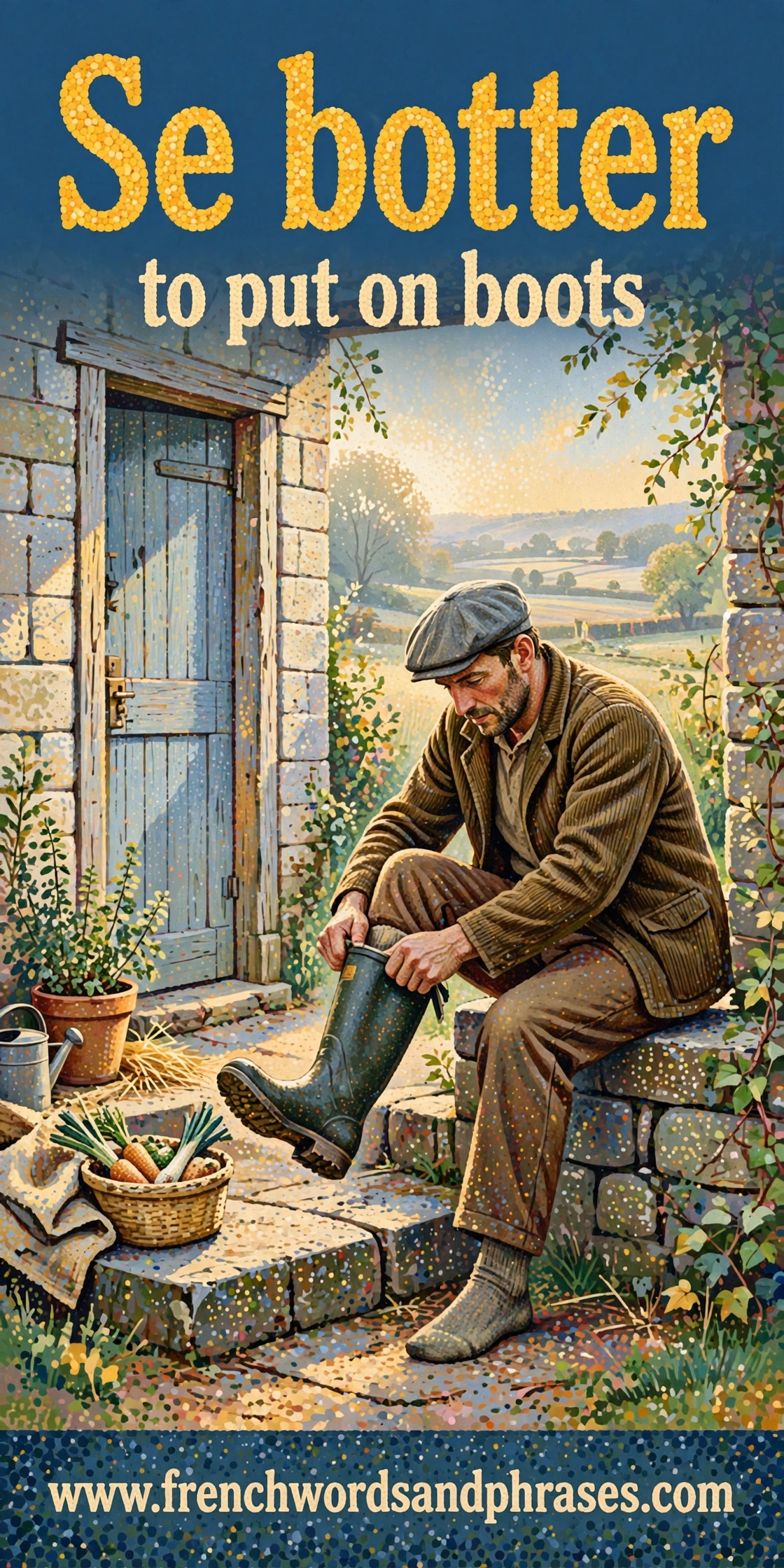
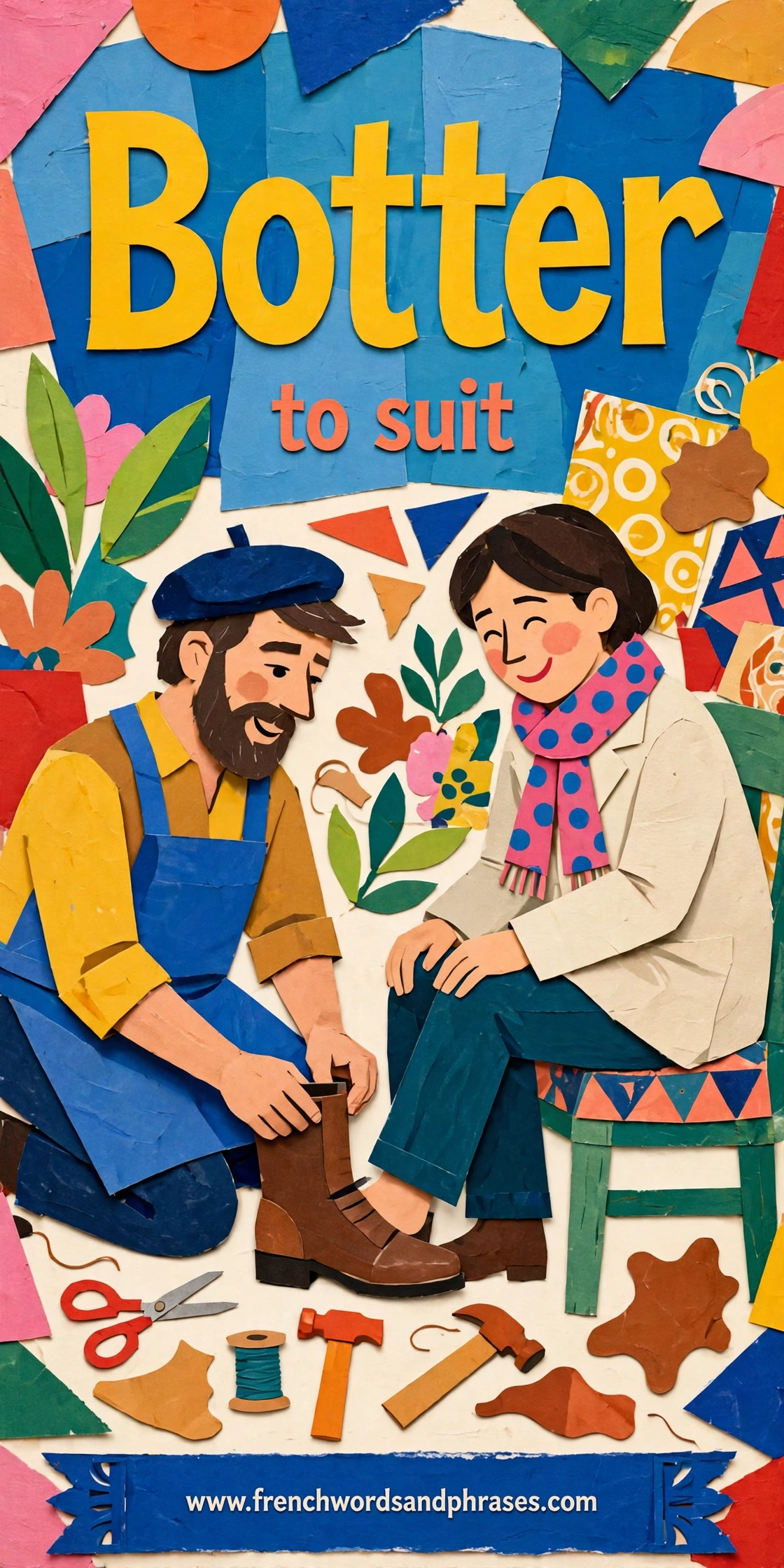
Botter means to suit — in familiar French, ça me botte says a plan pleases you completely; and at its literal root, botter is to kick, to boot a ball.
A friend suggests a midnight swim, a dash to the coast, a second helping — if the idea delights you, familiar French answers ça me botte ! Botter is the verb of the enthusiastic yes, with a boot (une botte) never far behind: it also means to kick, and to boot a ball into touch.
In this guide, you’ll learn how to conjugate botter in all the major French tenses and moods. Explore complete conjugation tables, French examples, English translations, and practice quizzes.
Understanding the French Verb Botter
Botter is a regular French verb belonging to the first group of verbs, those ending in-er.
It means to suit. In everyday speech the pleasure sense dominates: ça te botte de… ? is how friends propose plans, and the answer ça me botte ! needs no further explanation. The kicking senses live on the sports field, where botter en touche is a term of football and rugby, and in the playground threat botter le derrière.
Verb classification: First group (-er)
Auxiliary verb: Avoir
Past participle: botté
Present participle: bottant
English equivalents: To suit, to please (familiar); ça me botte — that suits me, I’d love to; ça ne me botte pas trop — I don’t much fancy it; ça te botte de partir ? — do you fancy leaving?; botter le ballon — to kick the ball; botter en touche — to kick into touch (football, rugby); botter le derrière à quelqu’un — to kick someone’s backside (familiar).
The trap is register: the ‘suit’ sense of botter is familiar — warm, enthusiastic, perfect among friends proposing plans, but too casual for formal writing, where cela me convient or cela me plaît belong. The forms are perfectly regular: je botte, nous bottons, ils bottent, past participle botté. One spelling, two families: the boot that kicks — botter le ballon, botter en touche — and the pleasure that boots you along: ça me botte, ça ne me botte pas trop. Context always tells them apart.
Experience the Word
Botter is the familiar verb of the delighted yes — a plan that fits you like a boot.
Imagine friends planning a weekend. « On part à la mer demain à l’aube ? » — « Ça me botte complètement ! » No weighing up, no diary check: the idea itself gives a small kick of pleasure, and the boot-word says it better than any oui.
She has not merely ‘agreed to the proposal’. It suits her — ça la botte — and she is already packing.
How to Conjugate Botter: Complete French Conjugation Guide
Let’s explore every major conjugation of botter, beginning with the indicative mood.
How to Conjugate Botter in the Indicative Mood
The indicative mood is used to express facts, observations, actions, and events.
How to Conjugate Botter in the Present Tense (Présent)
Used for actions happening now, habitual actions, and general truths.
| Subject | Conjugation |
|---|---|
| je | botte |
| tu | bottes |
| il / elle | botte |
| nous | bottons |
| vous | bottez |
| ils / elles | bottent |
Example
Cette idée me botte beaucoup.
That idea really suits me.
Quick Quiz 1
Complete the sentence:
Cette sortie nous ______ beaucoup.
Reveal the answer
botte
Cette sortie nous botte beaucoup.
We really fancy this outing — nous here is the object: the outing pleases us.
How to Conjugate Botter in the Passé Composé
Used for completed actions in the past. Botter takes the auxiliary verb avoir.
| Subject | Conjugation |
|---|---|
| j’ | ai botté |
| tu | as botté |
| il / elle | a botté |
| nous | avons botté |
| vous | avez botté |
| ils / elles | ont botté |
Example
Ça m’a botté tout de suite.
I fancied it straight away.
How to Conjugate Botter in the Imparfait (Imperfect Tense)
Used for habitual past actions, descriptions, and ongoing situations in the past.
| Subject | Conjugation |
|---|---|
| je | bottais |
| tu | bottais |
| il / elle | bottait |
| nous | bottions |
| vous | bottiez |
| ils / elles | bottaient |
Example
Autrefois, ces sorties me bottaient moins.
In the old days, I was less keen on those outings.
Quick Quiz 2
Choose the correct form:
I love it!
Ça ______ ! (me botte / me bottent)
Reveal the answer
me botte
Ça me botte !
Ça is singular: ça me botte.
How to Conjugate Botter in the Plus-que-parfait
Used to describe an action that had already been completed before another past event.
| Subject | Conjugation |
|---|---|
| j’ | avais botté |
| tu | avais botté |
| il / elle | avait botté |
| nous | avions botté |
| vous | aviez botté |
| ils / elles | avaient botté |
Example
Le projet l’avait botté dès le début.
The project had appealed to him from the start.
How to Conjugate Botter in the Passé Simple
Primarily used in formal writing, literature, and historical narratives. It is rarely used in everyday conversation.
| Subject | Conjugation |
|---|---|
| je | bottai |
| tu | bottas |
| il / elle | botta |
| nous | bottâmes |
| vous | bottâtes |
| ils / elles | bottèrent |
Example
La proposition botta toute l’équipe.
The proposal appealed to the whole team.
How to Conjugate Botter in the Passé Antérieur
A literary tense used to express an action completed immediately before another past action, generally in the passé simple.
| Subject | Conjugation |
|---|---|
| j’ | eus botté |
| tu | eus botté |
| il / elle | eut botté |
| nous | eûmes botté |
| vous | eûtes botté |
| ils / elles | eurent botté |
Example
Quand l’idée eut botté tout le monde, on signa.
When the idea had won everyone over, they signed.
How to Conjugate Botter in the Future Tense (Futur Simple)
Used to describe actions that will take place in the future.
| Subject | Conjugation |
|---|---|
| je | botterai |
| tu | botteras |
| il / elle | bottera |
| nous | botterons |
| vous | botterez |
| ils / elles | botteront |
Example
Ce plan te bottera, tu verras.
You will love this plan, you’ll see.
How to Conjugate Botter in the Futur Antérieur (Future Perfect)
Used for an action that will have been completed before a particular point in the future.
| Subject | Conjugation |
|---|---|
| j’ | aurai botté |
| tu | auras botté |
| il / elle | aura botté |
| nous | aurons botté |
| vous | aurez botté |
| ils / elles | auront botté |
Example
Après le premier entraînement, le rugby l’aura botté pour de bon.
After the first training session, rugby will have hooked him for good.
How to Conjugate Botter in the Near Future (Futur Proche)
Used to describe something that is going to happen soon. Formed with aller + infinitive.
| Subject | Conjugation |
|---|---|
| je | vais botter |
| tu | vas botter |
| il / elle | va botter |
| nous | allons botter |
| vous | allez botter |
| ils / elles | vont botter |
Example
Écoute ma proposition, ça va te botter !
Listen to my suggestion, you are going to love it!
How to Conjugate Botter in the Conditional Mood
The conditional mood expresses what would happen under certain circumstances. It is also frequently used to make polite requests or express wishes.
How to Conjugate Botter in the Present Conditional
| Subject | Conjugation |
|---|---|
| je | botterais |
| tu | botterais |
| il / elle | botterait |
| nous | botterions |
| vous | botteriez |
| ils / elles | botteraient |
Example
Un week-end à la mer me botterait bien.
A weekend by the sea would suit me fine.
How to Conjugate Botter in the Past Conditional
| Subject | Conjugation |
|---|---|
| j’ | aurais botté |
| tu | aurais botté |
| il / elle | aurait botté |
| nous | aurions botté |
| vous | auriez botté |
| ils / elles | auraient botté |
Example
Le projet m’aurait botté si j’avais eu le temps.
The project would have appealed to me if I had had the time.
Botter in the Literary Past Conditional Form
This less common literary form uses the imperfect subjunctive of avoir.
| Subject | Conjugation |
|---|---|
| j’ | eusse botté |
| tu | eusses botté |
| il / elle | eût botté |
| nous | eussions botté |
| vous | eussiez botté |
| ils / elles | eussent botté |
Example
La mer l’eût botté davantage sans la pluie.
The seaside would have appealed to him more without the rain.
How to Conjugate Botter in the Subjunctive Mood
The subjunctive is used to express wishes, emotions, doubts, necessity, and uncertainty. It frequently follows expressions such as il faut que (it is necessary that) or bien que (although).
How to Conjugate Botter in the Present Subjunctive
| Subject | Conjugation |
|---|---|
| que je | botte |
| que tu | bottes |
| qu’il / qu’elle | botte |
| que nous | bottions |
| que vous | bottiez |
| qu’ils / qu’elles | bottent |
Example
Il faut quelque chose qui les botte vraiment.
There has to be something that really appeals to them.
Quick Quiz 3
Complete the sentence using the subjunctive:
Je cherche un cadeau qui le ______.
Reveal the answer
botte
Je cherche un cadeau qui le botte.
I am looking for a present that will really please him.
How to Conjugate Botter in the Imperfect Subjunctive
A literary tense, rarely encountered in modern spoken French.
| Subject | Conjugation |
|---|---|
| que je | bottasse |
| que tu | bottasses |
| qu’il / qu’elle | bottât |
| que nous | bottassions |
| que vous | bottassiez |
| qu’ils / qu’elles | bottassent |
Example
Je cherchais un cadeau qui le bottât.
I was looking for a present that would really please him.
How to Conjugate Botter in the Pluperfect Subjunctive
A literary construction used to express an action completed before another past action.
| Subject | Conjugation |
|---|---|
| que j’ | eusse botté |
| que tu | eusses botté |
| qu’il / qu’elle | eût botté |
| que nous | eussions botté |
| que vous | eussiez botté |
| qu’ils / qu’elles | eussent botté |
Example
On espérait que le spectacle les eût bottés.
People hoped the show had delighted them.
How to Conjugate Botter in the Past Subjunctive
| Subject | Conjugation |
|---|---|
| que j’ | aie botté |
| que tu | aies botté |
| qu’il / qu’elle | ait botté |
| que nous | ayons botté |
| que vous | ayez botté |
| qu’ils / qu’elles | aient botté |
Example
Je suis ravi que le voyage vous ait botté.
I am delighted the trip appealed to you.
How to Conjugate Botter in the Imperative
The imperative is used to give commands, instructions, invitations, or suggestions. Subject pronouns are omitted.
How to Conjugate Botter in the Present Imperative
| Person | Conjugation |
|---|---|
| (tu) | botte |
| (nous) | bottons |
| (vous) | bottez |
Example
Botte le ballon dans le but !
Kick the ball into the goal!
Quick Quiz 4
How would you say Kick the ball (tu form)?
Reveal the answer
Botte le ballon !
French Participles of Botter
Participles are verb forms that can be used in compound tenses and other grammatical constructions.
Present Participle of Botter
bottant
En bottant en touche, il a sauvé son équipe.
By kicking into touch, he saved his team.
Past Participle of Botter
botté
Botté en touche, le ballon a fini dans les tribunes.
Kicked into touch, the ball ended up in the stands.
Botter in Everyday French: Real-Life Examples
Now that you know the conjugations, let’s see how botter appears in everyday French.
Example 1 — Present
Ça me botte, cette idée !
That idea suits me!
Example 2 — Passé composé
Le voyage m’a botté dès le départ.
I loved the trip from the start.
Example 3 — Imparfait
Ces sorties me bottaient moins autrefois.
I was less keen on those outings before.
Example 4 — Future
Ce plan te bottera, tu verras.
You will love this plan, you’ll see.
Example 5 — Conditional
Un week-end à la mer me botterait bien.
A weekend by the sea would suit me fine.
Example 6 — Imperative
Botte le ballon dans le but !
Kick the ball into the goal!
Beyond Translation: The Meaning of Botter
The boot explains everything. Une botte kicks — botter le ballon, botter en touche on the rugby field — and what boots you with pleasure took the same word for the kick of delight it gives: ça me botte.
English ‘it suits me’ is polite; French ça me botte wears boots.
Between the formal cela me convient and the friendly ça me botte lies the whole social map of French: choose the boot-word among friends, and the sentence itself smiles.
How to Remember the French Verb Botter
Remember it this way: Botter is about the plan that fits like a boot — ça me botte !.
- Ça me botte ! = I’d love to — the familiar, enthusiastic yes to any plan.
- Register: friends yes, formal letters no — there, write cela me convient or cela me plaît.
- Two families, one spelling: kick (botter le ballon, botter en touche) and please (ça me botte).
The key idea is the plan that fits like a boot — ça me botte !.
Test Your Knowledge of Botter
Let’s see how much you’ve learned. Try answering these questions before revealing the answers.
Question 1
What does ça me botte mean, and in what register?
Reveal the answer
That suits me — I’d love to — in familiar register, among friends.
Question 2
How do you say A weekend by the sea would suit me fine in French?
Reveal the answer
Un week-end à la mer me botterait bien.
Question 3
Translate: Cette idée me botte beaucoup.
Reveal the answer
That idea really appeals to me.
Question 4
What is the past participle of botter?
Reveal the answer
Botté.
Question 5
Complete the sentence:
Il faut quelque chose qui les ______ vraiment.
Reveal the answer
botte
Il faut quelque chose qui les botte vraiment.
There has to be something that really appeals to them.
Your Final Challenge
Can You Use It?
How would you say this in French?
Shall we leave for the seaside at dawn tomorrow? — I’d love to, and I’m already packing my bag.
Reveal the answer
On part à la mer demain à l’aube ? — Ça me botte, et je prépare déjà le sac.
Shall we leave for the seaside at dawn tomorrow? — I’d love to, and I’m already packing my bag.
A little French. A little curiosity. A richer everyday life.
LEARN FRENCH ONE WORD AT A TIME