A French Word to Live By
How to Conjugate Boitiller in French
/bwa.ti.je/
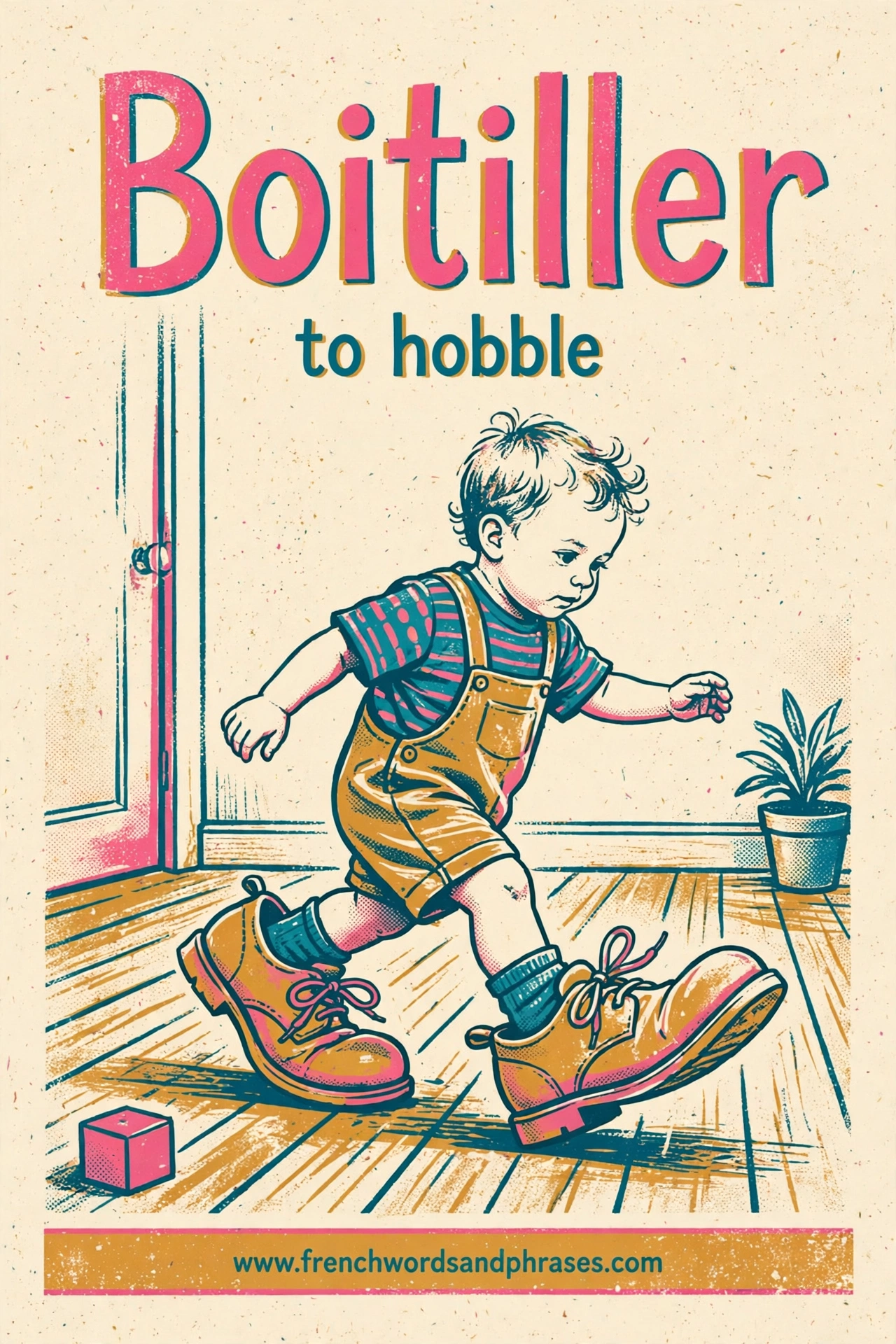
Boitiller means to hobble — to limp a little, with small uneven steps, usually from something minor: a blister, a knock, a stone in the shoe.
A small boy with a pebble in his shoe, a goalkeeper shaking off a knock, a grandfather crossing the yard with his stick — boitiller is boiter in miniature: not the grave limp of injury, but the small, dogged hobble of getting on with it anyway.
In this guide, you’ll learn how to conjugate boitiller in all the major French tenses and moods. Explore complete conjugation tables, French examples, English translations, and practice quizzes.
Understanding the French Verb Boitiller
Boitiller is a regular French verb belonging to the first group of verbs, those ending in-er.
It means to hobble. It is commonly used for the after-effects of minor mishaps — blisters, sprains, knocks in sport — and for the elderly moving carefully. Where boiter states the fact, boitiller softens it: the hobble is small, often slightly comic, and usually expected to pass.
Verb classification: First group (-er)
Auxiliary verb: Avoir
Past participle: boitillé
Present participle: boitillant
English equivalents: To hobble, to limp slightly; boitiller après un choc — to hobble after a knock; boitiller jusqu’à la maison — to hobble home; un boitillement — a slight limp, a hobble.
One important detail: boitiller is boiter plus the diminutive suffix -iller, the suffix of small repeated movements — the same family as sautiller (to hop about), frétiller (to wriggle) and mordiller (to nibble). So the word itself tells you the limp is slight and temporary. Conjugation is regular -er: je boitille, nous boitillons, past participle boitillé — but note the double l of -iller is kept everywhere, and the sound is /bwa.ti.je/, never a hard l.
Experience the Word
Boitiller is the verb of minor damage bravely carried — the body complains, but only in a small voice.
Imagine the last match of the season. The little striker takes a knock on the ankle, waves away the stretcher, and finishes the game boitillant — half running, half hopping, to the loudest applause of the afternoon.
He is not limping like a casualty. He is hobbling — il boitille — and the crowd loves him for it.
How to Conjugate Boitiller: Complete French Conjugation Guide
Let’s explore every major conjugation of boitiller, beginning with the indicative mood.
How to Conjugate Boitiller in the Indicative Mood
The indicative mood is used to express facts, observations, actions, and events.
How to Conjugate Boitiller in the Present Tense (Présent)
Used for actions happening now, habitual actions, and general truths.
| Subject | Conjugation |
|---|---|
| je | boitille |
| tu | boitilles |
| il / elle | boitille |
| nous | boitillons |
| vous | boitillez |
| ils / elles | boitillent |
Example
Le petit boitille à cause d’un caillou dans sa chaussure.
The little boy is hobbling because of a stone in his shoe.
Quick Quiz 1
Complete the sentence:
Nous ______ depuis le match de dimanche.
Reveal the answer
boitillons
Nous boitillons depuis le match de dimanche.
We have been hobbling since Sunday’s match.
How to Conjugate Boitiller in the Passé Composé
Used for completed actions in the past. Boitiller takes the auxiliary verb avoir.
| Subject | Conjugation |
|---|---|
| j’ | ai boitillé |
| tu | as boitillé |
| il / elle | a boitillé |
| nous | avons boitillé |
| vous | avez boitillé |
| ils / elles | ont boitillé |
Example
Après le choc, le joueur a boitillé jusqu’à la touche.
After the knock, the player hobbled to the touchline.
How to Conjugate Boitiller in the Imparfait (Imperfect Tense)
Used for habitual past actions, descriptions, and ongoing situations in the past.
| Subject | Conjugation |
|---|---|
| je | boitillais |
| tu | boitillais |
| il / elle | boitillait |
| nous | boitillions |
| vous | boitilliez |
| ils / elles | boitillaient |
Example
Grand-père boitillait en traversant la cour.
Grandfather used to hobble across the yard.
Quick Quiz 2
Choose the correct form:
The dog hobbled to its kennel.
Le chien ______ jusqu’à sa niche. (a boitillé / est boitillé)
Reveal the answer
a boitillé
Le chien a boitillé jusqu’à sa niche.
Boitiller takes avoir.
How to Conjugate Boitiller in the Plus-que-parfait
Used to describe an action that had already been completed before another past event.
| Subject | Conjugation |
|---|---|
| j’ | avais boitillé |
| tu | avais boitillé |
| il / elle | avait boitillé |
| nous | avions boitillé |
| vous | aviez boitillé |
| ils / elles | avaient boitillé |
Example
Elle avait boitillé toute la matinée avec son entorse.
She had hobbled all morning with her sprain.
How to Conjugate Boitiller in the Passé Simple
Primarily used in formal writing, literature, and historical narratives. It is rarely used in everyday conversation.
| Subject | Conjugation |
|---|---|
| je | boitillai |
| tu | boitillas |
| il / elle | boitilla |
| nous | boitillâmes |
| vous | boitillâtes |
| ils / elles | boitillèrent |
Example
Le chien boitilla jusqu’à sa niche.
The dog hobbled to its kennel.
How to Conjugate Boitiller in the Passé Antérieur
A literary tense used to express an action completed immediately before another past action, generally in the passé simple.
| Subject | Conjugation |
|---|---|
| j’ | eus boitillé |
| tu | eus boitillé |
| il / elle | eut boitillé |
| nous | eûmes boitillé |
| vous | eûtes boitillé |
| ils / elles | eurent boitillé |
Example
Quand il eut boitillé jusqu’au banc, il s’assit enfin.
When he had hobbled to the bench, he finally sat down.
How to Conjugate Boitiller in the Future Tense (Futur Simple)
Used to describe actions that will take place in the future.
| Subject | Conjugation |
|---|---|
| je | boitillerai |
| tu | boitilleras |
| il / elle | boitillera |
| nous | boitillerons |
| vous | boitillerez |
| ils / elles | boitilleront |
Example
Demain, tu boitilleras encore un peu, puis ça passera.
Tomorrow you will still hobble a little, then it will pass.
How to Conjugate Boitiller in the Futur Antérieur (Future Perfect)
Used for an action that will have been completed before a particular point in the future.
| Subject | Conjugation |
|---|---|
| j’ | aurai boitillé |
| tu | auras boitillé |
| il / elle | aura boitillé |
| nous | aurons boitillé |
| vous | aurez boitillé |
| ils / elles | auront boitillé |
Example
À la fin de la semaine, elle aura boitillé huit jours avec cette ampoule.
By the end of the week, she will have hobbled for eight days with that blister.
How to Conjugate Boitiller in the Near Future (Futur Proche)
Used to describe something that is going to happen soon. Formed with aller + infinitive.
| Subject | Conjugation |
|---|---|
| je | vais boitiller |
| tu | vas boitiller |
| il / elle | va boitiller |
| nous | allons boitiller |
| vous | allez boitiller |
| ils / elles | vont boitiller |
Example
Regarde, il va boitiller après ce tacle.
Look, he is going to hobble after that tackle.
How to Conjugate Boitiller in the Conditional Mood
The conditional mood expresses what would happen under certain circumstances. It is also frequently used to make polite requests or express wishes.
How to Conjugate Boitiller in the Present Conditional
| Subject | Conjugation |
|---|---|
| je | boitillerais |
| tu | boitillerais |
| il / elle | boitillerait |
| nous | boitillerions |
| vous | boitilleriez |
| ils / elles | boitilleraient |
Example
Sans cette ampoule, tu boitillerais moins.
Without that blister, you would hobble less.
How to Conjugate Boitiller in the Past Conditional
| Subject | Conjugation |
|---|---|
| j’ | aurais boitillé |
| tu | aurais boitillé |
| il / elle | aurait boitillé |
| nous | aurions boitillé |
| vous | auriez boitillé |
| ils / elles | auraient boitillé |
Example
Elle aurait boitillé davantage sans sa canne.
She would have hobbled more without her stick.
Boitiller in the Literary Past Conditional Form
This less common literary form uses the imperfect subjunctive of avoir.
| Subject | Conjugation |
|---|---|
| j’ | eusse boitillé |
| tu | eusses boitillé |
| il / elle | eût boitillé |
| nous | eussions boitillé |
| vous | eussiez boitillé |
| ils / elles | eussent boitillé |
Example
Il eût boitillé jusqu’à la maison sans demander d’aide.
He would have hobbled all the way home without asking for help.
How to Conjugate Boitiller in the Subjunctive Mood
The subjunctive is used to express wishes, emotions, doubts, necessity, and uncertainty. It frequently follows expressions such as il faut que (it is necessary that) or bien que (although).
How to Conjugate Boitiller in the Present Subjunctive
| Subject | Conjugation |
|---|---|
| que je | boitille |
| que tu | boitilles |
| qu’il / qu’elle | boitille |
| que nous | boitillions |
| que vous | boitilliez |
| qu’ils / qu’elles | boitillent |
Example
Il est normal qu’il boitille après un tel choc.
It is normal for him to hobble after such a knock.
Quick Quiz 3
Complete the sentence using the subjunctive:
Il est normal que vous ______ après une telle randonnée.
Reveal the answer
boitilliez
Il est normal que vous boitilliez après une telle randonnée.
It is normal for you to hobble after such a hike.
How to Conjugate Boitiller in the Imperfect Subjunctive
A literary tense, rarely encountered in modern spoken French.
| Subject | Conjugation |
|---|---|
| que je | boitillasse |
| que tu | boitillasses |
| qu’il / qu’elle | boitillât |
| que nous | boitillassions |
| que vous | boitillassiez |
| qu’ils / qu’elles | boitillassent |
Example
Elle craignait que son fils boitillât encore le lendemain.
She feared her son might still be hobbling the next day.
How to Conjugate Boitiller in the Pluperfect Subjunctive
A literary construction used to express an action completed before another past action.
| Subject | Conjugation |
|---|---|
| que j’ | eusse boitillé |
| que tu | eusses boitillé |
| qu’il / qu’elle | eût boitillé |
| que nous | eussions boitillé |
| que vous | eussiez boitillé |
| qu’ils / qu’elles | eussent boitillé |
Example
On s’amusait qu’il eût boitillé exprès pour éviter la corvée.
People were amused that he had hobbled on purpose to dodge the chore.
How to Conjugate Boitiller in the Past Subjunctive
| Subject | Conjugation |
|---|---|
| que j’ | aie boitillé |
| que tu | aies boitillé |
| qu’il / qu’elle | ait boitillé |
| que nous | ayons boitillé |
| que vous | ayez boitillé |
| qu’ils / qu’elles | aient boitillé |
Example
Je suis surpris qu’elle ait boitillé si peu après la randonnée.
I am surprised she hobbled so little after the hike.
How to Conjugate Boitiller in the Imperative
The imperative is used to give commands, instructions, invitations, or suggestions. Subject pronouns are omitted.
How to Conjugate Boitiller in the Present Imperative
| Person | Conjugation |
|---|---|
| (tu) | boitille |
| (nous) | boitillons |
| (vous) | boitillez |
Example
Ne boitille pas comme ça, enlève ta chaussure !
Do not hobble like that, take your shoe off!
Quick Quiz 4
How would you say Do not hobble like that (tu form)?
Reveal the answer
Ne boitille pas comme ça !
French Participles of Boitiller
Participles are verb forms that can be used in compound tenses and other grammatical constructions.
Present Participle of Boitiller
boitillant
En boitillant, le gardien a quand même arrêté le ballon.
Hobbling, the goalkeeper still stopped the ball.
Past Participle of Boitiller
boitillé
Boitillé jusqu’à la maison, le petit a réclamé un pansement.
Having hobbled home, the little boy asked for a plaster.
Boitiller in Everyday French: Real-Life Examples
Now that you know the conjugations, let’s see how boitiller appears in everyday French.
Example 1 — Present
Le petit boitille à cause d’un caillou dans sa chaussure.
The little boy is hobbling because of a stone in his shoe.
Example 2 — Passé composé
Le joueur a boitillé jusqu’à la touche.
The player hobbled to the touchline.
Example 3 — Imparfait
Grand-père boitillait en traversant la cour.
Grandfather used to hobble across the yard.
Example 4 — Future
Demain, tu boitilleras encore un peu.
Tomorrow, you will still hobble a little.
Example 5 — Conditional
Tu boitillerais moins sans cette ampoule.
You would hobble less without that blister.
Example 6 — Imperative
Ne boitille pas comme ça, enlève ta chaussure !
Do not hobble like that, take your shoe off!
Beyond Translation: The Meaning of Boitiller
French loves its -iller verbs, the verbs of small repeated motions: sautiller to hop, frétiller to wriggle, mordiller to nibble, trembloter‘s cousin grelotter to shiver. Boitiller belongs to that family — the grammar itself miniaturises the limp.
Boiter is the fact; boitiller is the fact with sympathy.
Choose boitiller and you have already said the injury is minor, the sufferer brave, and recovery expected by the weekend.
How to Remember the French Verb Boitiller
Remember it this way: Boitiller is about the little striker hobbling on, waving away the stretcher.
- Boitiller = boiter in miniature: the -iller suffix shrinks the limp to a hobble.
- Same -iller family: sautiller (hop), frétiller (wriggle), mordiller (nibble) — small repeated movements.
- Regular -er with double l throughout: je boitille, nous boitillons, past participle boitillé.
The key idea is the little striker hobbling on, waving away the stretcher.
Test Your Knowledge of Boitiller
Let’s see how much you’ve learned. Try answering these questions before revealing the answers.
Question 1
What does the suffix -iller add to boiter to make boitiller?
Reveal the answer
Smallness — boitiller is to limp slightly, to hobble: a minor, usually temporary limp.
Question 2
How do you say The player hobbled to the touchline in French?
Reveal the answer
Le joueur a boitillé jusqu’à la touche.
Question 3
Translate: The little boy is hobbling because of a stone in his shoe.
Reveal the answer
Le petit boitille à cause d’un caillou dans sa chaussure.
Question 4
What is the past participle of boitiller?
Reveal the answer
Boitillé.
Question 5
Complete the sentence:
Il est normal qu’il ______ après un tel choc.
Reveal the answer
boitille
Il est normal qu’il boitille après un tel choc.
It is normal for him to hobble after such a knock.
Your Final Challenge
Can You Use It?
How would you say this in French?
He is hobbling a little this morning, but the stone is out of his shoe and the day can begin.
Reveal the answer
Il boitille un peu ce matin, mais le caillou est sorti de la chaussure et la journée peut commencer.
He is hobbling a little this morning, but the stone is out of his shoe and the day can begin.
A little French. A little curiosity. A richer everyday life.
LEARN FRENCH ONE WORD AT A TIME