A French Word to Live By
How to Conjugate Boiter in French
/bwa.te/
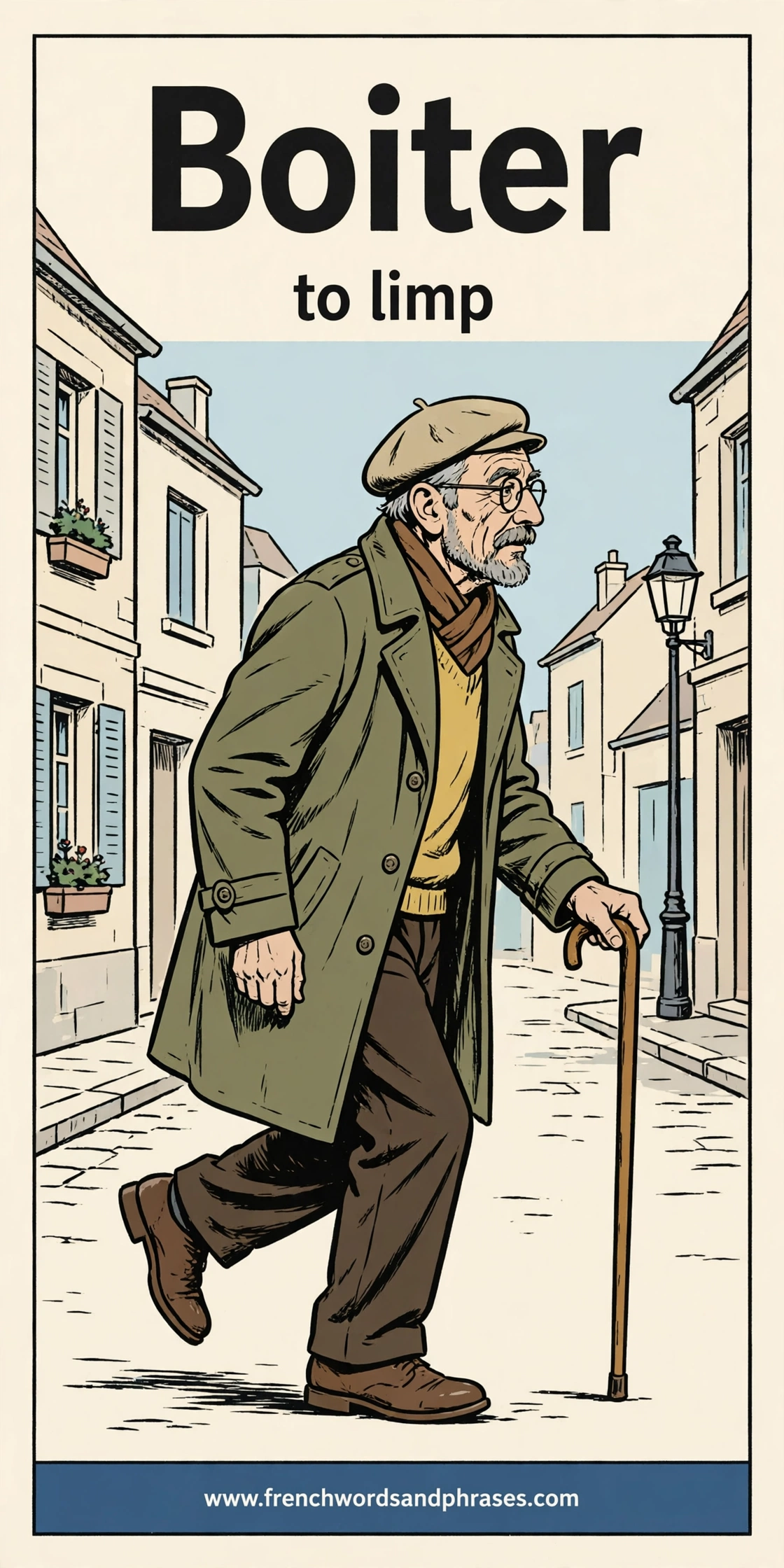
Boiter means to limp — to walk unevenly, favouring one leg, as people, horses, dogs and even tables can do.
A footballer limping off the pitch, an old horse favouring one hoof on the road home, a café table rocking on the terrace — boiter is the verb of the uneven step: one side sound, the other side spared, and the whole body negotiating between them.
In this guide, you’ll learn how to conjugate boiter in all the major French tenses and moods. Explore complete conjugation tables, French examples, English translations, and practice quizzes.
Understanding the French Verb Boiter
Boiter is a regular French verb belonging to the first group of verbs, those ending in-er.
It means to limp. It is the everyday verb for limping in people and animals after an injury or with age, and a favourite of vets and sports pages. Figuratively it marks anything uneven or unsound — a wobbling table, a limping argument, a limping economy in editorials: tout ce qui boite advances with difficulty.
Verb classification: First group (-er)
Auxiliary verb: Avoir
Past participle: boité
Present participle: boitant
English equivalents: To limp, to walk lamely; boiter d’une jambe — to limp on one leg; boiter bas — to limp badly; un raisonnement qui boite — a limping, shaky argument; une table qui boite — a wobbly table; boiteux — limping, lame, wobbly.
One important detail: boiter is completely regular — je boite, nous boitons, ils boitent — but it walks further than the clinic. Animals boitent, injured players boitent, and so does furniture: cette table boite means the table wobbles on uneven legs. The adjective boiteux (boiteuse) extends the metaphor to ideas: un argument boiteux is a lame argument, and une comparaison boiteuse is a comparison that does not stand up.
Experience the Word
Boiter is the verb of the body’s diplomacy — one leg does the work, the other is excused, and the walk goes on, crooked but determined.
Imagine the last kilometre of a mountain hike. A stone in the boot has become a blister, the blister a limp, and now the whole group has slowed to one person’s rhythm — elle boite, smiling through it, refusing the offered arm until the car park is in sight.
She is slower, but she is still walking. She is limping — elle boite — and she will finish.
How to Conjugate Boiter: Complete French Conjugation Guide
Let’s explore every major conjugation of boiter, beginning with the indicative mood.
How to Conjugate Boiter in the Indicative Mood
The indicative mood is used to express facts, observations, actions, and events.
How to Conjugate Boiter in the Present Tense (Présent)
Used for actions happening now, habitual actions, and general truths.
| Subject | Conjugation |
|---|---|
| je | boite |
| tu | boites |
| il / elle | boite |
| nous | boitons |
| vous | boitez |
| ils / elles | boitent |
Example
Depuis sa chute, le chien boite un peu.
Since his fall, the dog limps a little.
Quick Quiz 1
Complete the sentence:
Nous ______ un peu depuis la randonnée d’hier.
Reveal the answer
boitons
Nous boitons un peu depuis la randonnée d’hier.
We have been limping a little since yesterday’s hike.
How to Conjugate Boiter in the Passé Composé
Used for completed actions in the past. Boiter takes the auxiliary verb avoir.
| Subject | Conjugation |
|---|---|
| j’ | ai boité |
| tu | as boité |
| il / elle | a boité |
| nous | avons boité |
| vous | avez boité |
| ils / elles | ont boité |
Example
Elle a boité pendant une semaine après le match.
She limped for a week after the match.
How to Conjugate Boiter in the Imparfait (Imperfect Tense)
Used for habitual past actions, descriptions, and ongoing situations in the past.
| Subject | Conjugation |
|---|---|
| je | boitais |
| tu | boitais |
| il / elle | boitait |
| nous | boitions |
| vous | boitiez |
| ils / elles | boitaient |
Example
Le vieux cheval boitait sur le chemin du retour.
The old horse was limping on the way back.
Quick Quiz 2
Choose the correct form:
She limped for a week.
Elle ______ pendant une semaine. (a boité / est boitée)
Reveal the answer
a boité
Elle a boité pendant une semaine.
Boiter takes avoir.
How to Conjugate Boiter in the Plus-que-parfait
Used to describe an action that had already been completed before another past event.
| Subject | Conjugation |
|---|---|
| j’ | avais boité |
| tu | avais boité |
| il / elle | avait boité |
| nous | avions boité |
| vous | aviez boité |
| ils / elles | avaient boité |
Example
Il avait boité toute la journée sans se plaindre.
He had limped all day without complaining.
How to Conjugate Boiter in the Passé Simple
Primarily used in formal writing, literature, and historical narratives. It is rarely used in everyday conversation.
| Subject | Conjugation |
|---|---|
| je | boitai |
| tu | boitas |
| il / elle | boita |
| nous | boitâmes |
| vous | boitâtes |
| ils / elles | boitèrent |
Example
Le soldat boita jusqu’au village voisin.
The soldier limped as far as the next village.
How to Conjugate Boiter in the Passé Antérieur
A literary tense used to express an action completed immediately before another past action, generally in the passé simple.
| Subject | Conjugation |
|---|---|
| j’ | eus boité |
| tu | eus boité |
| il / elle | eut boité |
| nous | eûmes boité |
| vous | eûtes boité |
| ils / elles | eurent boité |
Example
Quand elle eut boité jusqu’à la porte, on l’aida à entrer.
When she had limped to the door, they helped her in.
How to Conjugate Boiter in the Future Tense (Futur Simple)
Used to describe actions that will take place in the future.
| Subject | Conjugation |
|---|---|
| je | boiterai |
| tu | boiteras |
| il / elle | boitera |
| nous | boiterons |
| vous | boiterez |
| ils / elles | boiteront |
Example
Sans repos, tu boiteras encore demain.
Without rest, you will still be limping tomorrow.
How to Conjugate Boiter in the Futur Antérieur (Future Perfect)
Used for an action that will have been completed before a particular point in the future.
| Subject | Conjugation |
|---|---|
| j’ | aurai boité |
| tu | auras boité |
| il / elle | aura boité |
| nous | aurons boité |
| vous | aurez boité |
| ils / elles | auront boité |
Example
Quand le plâtre partira, elle aura boité pendant deux mois.
When the cast comes off, she will have limped for two months.
How to Conjugate Boiter in the Near Future (Futur Proche)
Used to describe something that is going to happen soon. Formed with aller + infinitive.
| Subject | Conjugation |
|---|---|
| je | vais boiter |
| tu | vas boiter |
| il / elle | va boiter |
| nous | allons boiter |
| vous | allez boiter |
| ils / elles | vont boiter |
Example
Attention, le cheval va boiter si on continue.
Careful, the horse is going to go lame if we carry on.
How to Conjugate Boiter in the Conditional Mood
The conditional mood expresses what would happen under certain circumstances. It is also frequently used to make polite requests or express wishes.
How to Conjugate Boiter in the Present Conditional
| Subject | Conjugation |
|---|---|
| je | boiterais |
| tu | boiterais |
| il / elle | boiterait |
| nous | boiterions |
| vous | boiteriez |
| ils / elles | boiteraient |
Example
Avec une meilleure semelle, tu boiterais moins.
With a better sole, you would limp less.
How to Conjugate Boiter in the Past Conditional
| Subject | Conjugation |
|---|---|
| j’ | aurais boité |
| tu | aurais boité |
| il / elle | aurait boité |
| nous | aurions boité |
| vous | auriez boité |
| ils / elles | auraient boité |
Example
Il aurait moins boité avec des béquilles.
He would have limped less with crutches.
Boiter in the Literary Past Conditional Form
This less common literary form uses the imperfect subjunctive of avoir.
| Subject | Conjugation |
|---|---|
| j’ | eusse boité |
| tu | eusses boité |
| il / elle | eût boité |
| nous | eussions boité |
| vous | eussiez boité |
| ils / elles | eussent boité |
Example
Elle eût boité jusqu’au bout du chemin sans un murmure.
She would have limped to the end of the road without a murmur.
How to Conjugate Boiter in the Subjunctive Mood
The subjunctive is used to express wishes, emotions, doubts, necessity, and uncertainty. It frequently follows expressions such as il faut que (it is necessary that) or bien que (although).
How to Conjugate Boiter in the Present Subjunctive
| Subject | Conjugation |
|---|---|
| que je | boite |
| que tu | boites |
| qu’il / qu’elle | boite |
| que nous | boitions |
| que vous | boitiez |
| qu’ils / qu’elles | boitent |
Example
Je ne veux pas que le chien boite encore demain.
I do not want the dog to still be limping tomorrow.
Quick Quiz 3
Complete the sentence using the subjunctive:
Il craignait que son fils ______ après l’opération.
Reveal the answer
boitât
Il craignait que son fils boitât après l’opération.
He feared his son might limp after the operation.
How to Conjugate Boiter in the Imperfect Subjunctive
A literary tense, rarely encountered in modern spoken French.
| Subject | Conjugation |
|---|---|
| que je | boitasse |
| que tu | boitasses |
| qu’il / qu’elle | boitât |
| que nous | boitassions |
| que vous | boitassiez |
| qu’ils / qu’elles | boitassent |
Example
Il craignait que son fils boitât après l’opération.
He feared his son might limp after the operation.
How to Conjugate Boiter in the Pluperfect Subjunctive
A literary construction used to express an action completed before another past action.
| Subject | Conjugation |
|---|---|
| que j’ | eusse boité |
| que tu | eusses boité |
| qu’il / qu’elle | eût boité |
| que nous | eussions boité |
| que vous | eussiez boité |
| qu’ils / qu’elles | eussent boité |
Example
On s’étonnait qu’elle eût boité si longtemps sans consulter.
People were amazed she had limped so long without seeing a doctor.
How to Conjugate Boiter in the Past Subjunctive
| Subject | Conjugation |
|---|---|
| que j’ | aie boité |
| que tu | aies boité |
| qu’il / qu’elle | ait boité |
| que nous | ayons boité |
| que vous | ayez boité |
| qu’ils / qu’elles | aient boité |
Example
Je suis content qu’il ait si peu boité après sa chute.
I am glad he limped so little after his fall.
How to Conjugate Boiter in the Imperative
The imperative is used to give commands, instructions, invitations, or suggestions. Subject pronouns are omitted.
How to Conjugate Boiter in the Present Imperative
| Person | Conjugation |
|---|---|
| (tu) | boite |
| (nous) | boitons |
| (vous) | boitez |
Example
Ne boite pas exprès, je sais que tu n’as rien !
Do not limp on purpose, I know there is nothing wrong with you!
Quick Quiz 4
How would you say Do not limp on purpose (tu form)?
Reveal the answer
Ne boite pas exprès !
French Participles of Boiter
Participles are verb forms that can be used in compound tenses and other grammatical constructions.
Present Participle of Boiter
boitant
En boitant légèrement, elle a tout de même terminé la course.
Limping slightly, she finished the race all the same.
Past Participle of Boiter
boité
Boité jusqu’à l’écurie, le cheval a enfin pu se reposer.
Having limped as far as the stable, the horse could finally rest.
Boiter in Everyday French: Real-Life Examples
Now that you know the conjugations, let’s see how boiter appears in everyday French.
Example 1 — Present
Depuis sa chute, le chien boite un peu.
Since his fall, the dog limps a little.
Example 2 — Passé composé
Elle a boité pendant une semaine.
She limped for a week.
Example 3 — Imparfait
Le vieux cheval boitait sur le chemin du retour.
The old horse was limping on the way back.
Example 4 — Future
Sans repos, tu boiteras encore demain.
Without rest, you will still be limping tomorrow.
Example 5 — Conditional
Tu boiterais moins avec une meilleure semelle.
You would limp less with a better sole.
Example 6 — Imperative
Ne boite pas exprès, je sais que tu n’as rien !
Do not limp on purpose, I know there is nothing wrong with you!
Beyond Translation: The Meaning of Boiter
Boiter’s adjective, boiteux, has had a long second career as an insult for anything unsound: a lame excuse, a shaky argument, a wobbly peace treaty — French reaches for the limp whenever something advances badly.
Even furniture limps in French.
Une table qui boite is not injured, it is uneven — and the same verb serves the vet, the coach and the carpenter, which tells you how exactly French watches the way things move.
How to Remember the French Verb Boiter
Remember it this way: Boiter is about the old horse favouring one hoof on the road home.
- People, animals and tables all boitent: if it advances unevenly, it boite.
- The adjective boiteux (boiteuse) means limping, wobbly or lame — un argument boiteux, a lame argument.
- Regular -er: je boite, nous boitons, past participle boité, auxiliary avoir.
The key idea is the old horse favouring one hoof on the road home.
Test Your Knowledge of Boiter
Let’s see how much you’ve learned. Try answering these questions before revealing the answers.
Question 1
What else besides people and animals can boiter in French?
Reveal the answer
Furniture and ideas — une table qui boite wobbles, and un raisonnement qui boite is a shaky argument.
Question 2
How do you say The dog limps a little in French?
Reveal the answer
Le chien boite un peu.
Question 3
Translate: She limped for a week after the match.
Reveal the answer
Elle a boité pendant une semaine après le match.
Question 4
What is the past participle of boiter?
Reveal the answer
Boité.
Question 5
Complete the sentence:
Je ne veux pas que le chien ______ encore demain.
Reveal the answer
boite
Je ne veux pas que le chien boite encore demain.
I do not want the dog to still be limping tomorrow.
Your Final Challenge
Can You Use It?
How would you say this in French?
The old horse limps a little, but he knows the road by heart and he always finds his way back to the stable.
Reveal the answer
Le vieux cheval boite un peu, mais il connaît le chemin par cœur et il rentre toujours à l’écurie.
The old horse limps a little, but he knows the road by heart and he always finds his way back to the stable.
A little French. A little curiosity. A richer everyday life.
LEARN FRENCH ONE WORD AT A TIME