A French Word to Live By
How to Conjugate Se bloquer in French
/sə blɔ.ke/
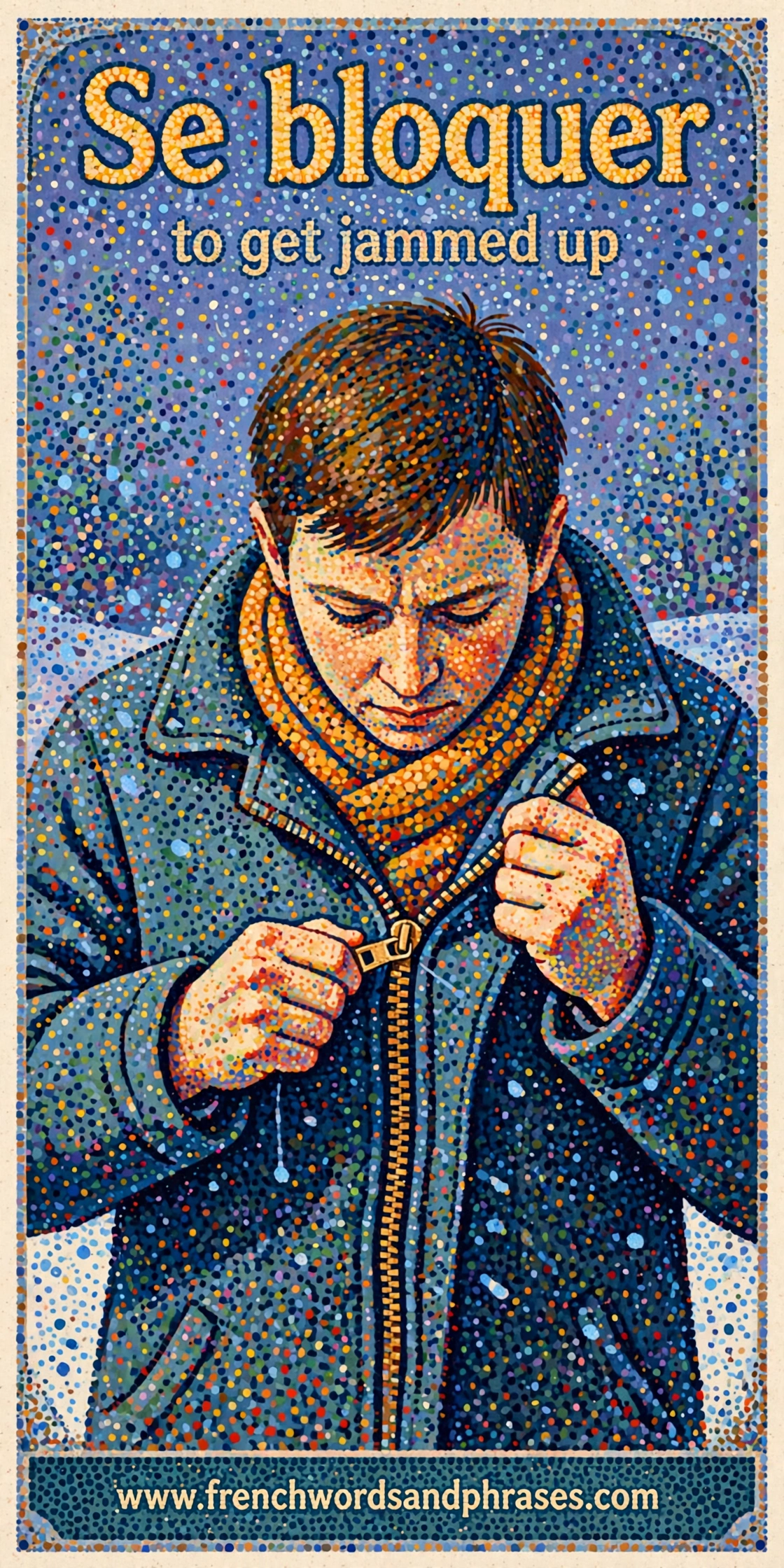
Se bloquer means to get jammed up — to seize, stick or freeze so that nothing moves any more.
A key that will not turn, a zip that stops halfway, a speaker who dries up mid-sentence in front of two hundred people — se bloquer is the verb of the sudden seize-up: the mechanism, the door, the mind, jammed solid.
In this guide, you’ll learn how to conjugate se bloquer in all the major French tenses and moods. Explore complete conjugation tables, French examples, English translations, and practice quizzes.
Understanding the French Verb Se bloquer
Se bloquer is a regular French verb belonging to the first group of verbs, those ending in-er.
It means to get jammed up. It is used of locks, keys, zips, drawers, wheels and mechanisms that seize, and just as often of people: a candidate who freezes at the first question, a writer stuck on one sentence, a negotiator who digs in — se bloquer sur quelque chose is to get mentally stuck on it and refuse to budge.
Verb classification: First group (-er), reflexive
Auxiliary verb: Être
Past participle: bloqué
Present participle: bloquant
English equivalents: To jam, to seize up, to get stuck; la clé se bloque — the key sticks; la porte s’est bloquée — the door jammed shut; se bloquer sur un mot — to get stuck on a word; se bloquer devant tout le monde — to freeze up in front of everyone.
One important detail: se bloquer is what a thing does to itself, where plain bloquer needs an outside agent — la neige bloque la route, but la porte se bloque toute seule. Being reflexive, it takes être in every compound tense and the past participle agrees with the subject: elle s’est bloquée, les clés se sont bloquées. The tu imperative tucks the pronoun behind the verb — bloque-toi — except in the negative, where it jumps back in front: ne te bloque pas sur ce détail !
Experience the Word
Se bloquer is the verb of the seize-up — the small click, and then nothing moves at all.
Imagine the morning of the oral exam. The candidate knows everything, has revised for weeks — and at the very first question, on a single ordinary word, il se bloque: the sentence starts, stops, and the silence fills the room while the examiners wait.
He knew the answer perfectly. He had simply jammed — bloqué — like a key in the wrong lock.
How to Conjugate Se bloquer: Complete French Conjugation Guide
Let’s explore every major conjugation of se bloquer, beginning with the indicative mood.
How to Conjugate Se bloquer in the Indicative Mood
The indicative mood is used to express facts, observations, actions, and events.
How to Conjugate Se bloquer in the Present Tense (Présent)
Used for actions happening now, habitual actions, and general truths.
| Subject | Conjugation |
|---|---|
| je | me bloque |
| tu | te bloques |
| il / elle | se bloque |
| nous | nous bloquons |
| vous | vous bloquez |
| ils / elles | se bloquent |
Example
La clé se bloque toujours dans cette serrure.
The key always sticks in this lock.
Quick Quiz 1
Complete the sentence:
Nous nous ______ toujours sur le même mot.
Reveal the answer
bloquons
Nous nous bloquons toujours sur le même mot.
We always get stuck on the same word.
How to Conjugate Se bloquer in the Passé Composé
Used for completed actions in the past. Se bloquer takes the auxiliary verb être.
| Subject | Conjugation |
|---|---|
| je | me suis bloqué / me suis bloquée |
| tu | t’es bloqué / t’es bloquée |
| il / elle | s’est bloqué / s’est bloquée |
| nous | nous sommes bloqués / nous sommes bloquées |
| vous | vous êtes bloqués / vous êtes bloquées / vous êtes bloqué / vous êtes bloquée |
| ils / elles | se sont bloqués / se sont bloquées |
Example
La porte s’est bloquée au moment de partir.
The door jammed just as we were leaving.
How to Conjugate Se bloquer in the Imparfait (Imperfect Tense)
Used for habitual past actions, descriptions, and ongoing situations in the past.
| Subject | Conjugation |
|---|---|
| je | me bloquais |
| tu | te bloquais |
| il / elle | se bloquait |
| nous | nous bloquions |
| vous | vous bloquiez |
| ils / elles | se bloquaient |
Example
Autrefois, le mécanisme se bloquait dès qu’il faisait froid.
In the old days, the mechanism used to seize up as soon as it turned cold.
Quick Quiz 2
Choose the correct form:
The door jammed.
La porte ______ . (s’est bloquée / a bloqué)
Reveal the answer
s’est bloquée
La porte s’est bloquée.
Se bloquer is reflexive, takes être, and the participle agrees: bloquée.
How to Conjugate Se bloquer in the Plus-que-parfait
Used to describe an action that had already been completed before another past event.
| Subject | Conjugation |
|---|---|
| je | m’étais bloqué / m’étais bloquée |
| tu | t’étais bloqué / t’étais bloquée |
| il / elle | s’était bloqué / s’était bloquée |
| nous | nous étions bloqués / nous étions bloquées |
| vous | vous étiez bloqués / vous étiez bloquées / vous étiez bloqué / vous étiez bloquée |
| ils / elles | s’étaient bloqués / s’étaient bloquées |
Example
Le tiroir s’était bloqué bien avant les travaux.
The drawer had jammed long before the building work.
How to Conjugate Se bloquer in the Passé Simple
Primarily used in formal writing, literature, and historical narratives. It is rarely used in everyday conversation.
| Subject | Conjugation |
|---|---|
| je | me bloquai |
| tu | te bloquas |
| il / elle | se bloqua |
| nous | nous bloquâmes |
| vous | vous bloquâtes |
| ils / elles | se bloquèrent |
Example
Au premier tour, la clé se bloqua net.
At the first turn, the key stuck fast.
How to Conjugate Se bloquer in the Passé Antérieur
A literary tense used to express an action completed immediately before another past action, generally in the passé simple.
| Subject | Conjugation |
|---|---|
| je | me fus bloqué / me fus bloquée |
| tu | te fus bloqué / te fus bloquée |
| il / elle | se fut bloqué / se fut bloquée |
| nous | nous fûmes bloqués / nous fûmes bloquées |
| vous | vous fûtes bloqués / vous fûtes bloquées / vous fûtes bloqué / vous fûtes bloquée |
| ils / elles | se furent bloqués / se furent bloquées |
Example
Dès que la machine se fut bloquée, tout l’atelier s’arrêta.
As soon as the machine had jammed, the whole workshop stopped.
How to Conjugate Se bloquer in the Future Tense (Futur Simple)
Used to describe actions that will take place in the future.
| Subject | Conjugation |
|---|---|
| je | me bloquerai |
| tu | te bloqueras |
| il / elle | se bloquera |
| nous | nous bloquerons |
| vous | vous bloquerez |
| ils / elles | se bloqueront |
Example
Si tu forces, la fermeture se bloquera encore.
If you force it, the fastener will jam again.
How to Conjugate Se bloquer in the Futur Antérieur (Future Perfect)
Used for an action that will have been completed before a particular point in the future.
| Subject | Conjugation |
|---|---|
| je | me serai bloqué / me serai bloquée |
| tu | te seras bloqué / te seras bloquée |
| il / elle | se sera bloqué / se sera bloquée |
| nous | nous serons bloqués / nous serons bloquées |
| vous | vous serez bloqués / vous serez bloquées / vous serez bloqué / vous serez bloquée |
| ils / elles | se seront bloqués / se seront bloquées |
Example
À force de forcer, le verrou se sera bloqué pour de bon.
From being forced so much, the bolt will have jammed for good.
How to Conjugate Se bloquer in the Near Future (Futur Proche)
Used to describe something that is going to happen soon. Formed with aller + infinitive.
| Subject | Conjugation |
|---|---|
| je | vais me bloquer |
| tu | vas te bloquer |
| il / elle | va se bloquer |
| nous | allons nous bloquer |
| vous | allez vous bloquer |
| ils / elles | vont se bloquer |
Example
Attention, la fermeture éclair va se bloquer.
Careful, the zip is going to jam.
How to Conjugate Se bloquer in the Conditional Mood
The conditional mood expresses what would happen under certain circumstances. It is also frequently used to make polite requests or express wishes.
How to Conjugate Se bloquer in the Present Conditional
| Subject | Conjugation |
|---|---|
| je | me bloquerais |
| tu | te bloquerais |
| il / elle | se bloquerait |
| nous | nous bloquerions |
| vous | vous bloqueriez |
| ils / elles | se bloqueraient |
Example
Sans cette vis, le tiroir se bloquerait à chaque fois.
Without this screw, the drawer would jam every time.
How to Conjugate Se bloquer in the Past Conditional
| Subject | Conjugation |
|---|---|
| je | me serais bloqué / me serais bloquée |
| tu | te serais bloqué / te serais bloquée |
| il / elle | se serait bloqué / se serait bloquée |
| nous | nous serions bloqués / nous serions bloquées |
| vous | vous seriez bloqués / vous seriez bloquées / vous seriez bloqué / vous seriez bloquée |
| ils / elles | se seraient bloqués / se seraient bloquées |
Example
Elle se serait bloquée devant tout le monde sans l’aide du professeur.
She would have frozen up in front of everyone without the teacher’s help.
Se bloquer in the Literary Past Conditional Form
This less common literary form uses the imperfect subjunctive of être.
| Subject | Conjugation |
|---|---|
| je | me fusse bloqué / me fusse bloquée |
| tu | te fusses bloqué / te fusses bloquée |
| il / elle | se fût bloqué / se fût bloquée |
| nous | nous fussions bloqués / nous fussions bloquées |
| vous | vous fussiez bloqués / vous fussiez bloquées / vous fussiez bloqué / vous fussiez bloquée |
| ils / elles | se fussent bloqués / se fussent bloquées |
Example
Il se fût bloqué au premier mot sans son texte sous les yeux.
He would have frozen at the first word without his text in front of him.
How to Conjugate Se bloquer in the Subjunctive Mood
The subjunctive is used to express wishes, emotions, doubts, necessity, and uncertainty. It frequently follows expressions such as il faut que (it is necessary that) or bien que (although).
How to Conjugate Se bloquer in the Present Subjunctive
| Subject | Conjugation |
|---|---|
| que je | me bloque |
| que tu | te bloques |
| qu’il / qu’elle | se bloque |
| que nous | nous bloquions |
| que vous | vous bloquiez |
| qu’ils / qu’elles | se bloquent |
Example
Je crains que la porte se bloque pendant la nuit.
I am afraid the door will jam during the night.
Quick Quiz 3
Complete the sentence using the subjunctive:
Je crains que vous vous ______ devant le jury.
Reveal the answer
bloquiez
Je crains que vous vous bloquiez devant le jury.
I am afraid you will freeze up in front of the panel.
How to Conjugate Se bloquer in the Imperfect Subjunctive
A literary tense, rarely encountered in modern spoken French.
| Subject | Conjugation |
|---|---|
| que je | me bloquasse |
| que tu | te bloquasses |
| qu’il / qu’elle | se bloquât |
| que nous | nous bloquassions |
| que vous | vous bloquassiez |
| qu’ils / qu’elles | se bloquassent |
Example
Il fallait éviter que le mécanisme se bloquât.
We had to make sure the mechanism did not seize up.
How to Conjugate Se bloquer in the Pluperfect Subjunctive
A literary construction used to express an action completed before another past action.
| Subject | Conjugation |
|---|---|
| que je | me fusse bloqué / me fusse bloquée |
| que tu | te fusses bloqué / te fusses bloquée |
| qu’il / qu’elle | se fût bloqué / se fût bloquée |
| que nous | nous fussions bloqués / nous fussions bloquées |
| que vous | vous fussiez bloqués / vous fussiez bloquées / vous fussiez bloqué / vous fussiez bloquée |
| qu’ils / qu’elles | se fussent bloqués / se fussent bloquées |
Example
On disait qu’il se fût bloqué dès la première question.
People said he had frozen at the very first question.
How to Conjugate Se bloquer in the Past Subjunctive
| Subject | Conjugation |
|---|---|
| que je | me sois bloqué / me sois bloquée |
| que tu | te sois bloqué / te sois bloquée |
| qu’il / qu’elle | se soit bloqué / se soit bloquée |
| que nous | nous soyons bloqués / nous soyons bloquées |
| que vous | vous soyez bloqués / vous soyez bloquées / vous soyez bloqué / vous soyez bloquée |
| qu’ils / qu’elles | se soient bloqués / se soient bloquées |
Example
Je suis étonné que la clé se soit bloquée si facilement.
I am amazed the key jammed so easily.
How to Conjugate Se bloquer in the Imperative
The imperative is used to give commands, instructions, invitations, or suggestions. Subject pronouns are omitted.
How to Conjugate Se bloquer in the Present Imperative
| Person | Conjugation |
|---|---|
| (tu) | bloque-toi |
| (nous) | bloquons-nous |
| (vous) | bloquez-vous |
Example
Ne te bloque pas sur ce détail, continue !
Do not get stuck on that detail, carry on!
Quick Quiz 4
How would you say Do not get stuck on it (tu form)?
Reveal the answer
Ne te bloque pas là-dessus !
French Participles of Se bloquer
Participles are verb forms that can be used in compound tenses and other grammatical constructions.
Present Participle of Se bloquer
bloquant
En se bloquant sur un mot, il a perdu le fil de son discours.
By getting stuck on one word, he lost the thread of his speech.
Past Participle of Se bloquer
bloqué
Bloquée au milieu de sa phrase, elle a cherché ses mots un long moment.
Stuck in the middle of her sentence, she searched for her words for a long moment.
Se bloquer in Everyday French: Real-Life Examples
Now that you know the conjugations, let’s see how se bloquer appears in everyday French.
Example 1 — Present
La clé se bloque dans la serrure.
The key sticks in the lock.
Example 2 — Passé composé
La porte s’est bloquée.
The door jammed.
Example 3 — Imparfait
Le tiroir se bloquait toujours en hiver.
The drawer always used to jam in winter.
Example 4 — Future
Si tu forces, ça se bloquera.
If you force it, it will jam.
Example 5 — Conditional
Il se bloquerait devant tout le monde.
He would freeze up in front of everyone.
Example 6 — Imperative
Ne te bloque pas pour si peu !
Do not get stuck over so little!
Beyond Translation: The Meaning of Se bloquer
The machine and the mind jam with the same verb in French, and the metaphor is honest: se bloquer describes a speaker exactly as it describes a lock — a mechanism that stops mid-movement.
Every freeze-up is a little lock turning the wrong way.
French even keeps the family together: le blocage is the jam itself, un déblocage is getting things moving again — in a negotiation as much as in a door.
How to Remember the French Verb Se bloquer
Remember it this way: Se bloquer is about the key that sticks — and the speaker who freezes.
- Always reflexive: je me bloque, elle s’est bloquée — être, and the participle agrees.
- Bloquer blocks something else; se bloquer is the thing — or the person — jamming on its own.
- Regular -er underneath: je me bloque, nous nous bloquons, past participle bloqué.
The key idea is the key that sticks — and the speaker who freezes.
Test Your Knowledge of Se bloquer
Let’s see how much you’ve learned. Try answering these questions before revealing the answers.
Question 1
Which auxiliary does se bloquer use, and why?
Reveal the answer
Être — it is a reflexive verb: la porte s’est bloquée.
Question 2
How do you say The key sticks in this lock in French?
Reveal the answer
La clé se bloque dans cette serrure.
Question 3
Translate: She froze up in front of everyone.
Reveal the answer
Elle s’est bloquée devant tout le monde.
Question 4
What is the past participle of se bloquer?
Reveal the answer
Bloqué — agreeing: bloquée, bloqués, bloquées.
Question 5
Complete the sentence:
Je crains que la porte se ______ pendant la nuit.
Reveal the answer
bloque
Je crains que la porte se bloque pendant la nuit.
I am afraid the door will jam during the night.
Your Final Challenge
Can You Use It?
How would you say this in French?
The key sticks, the door refuses, and the whole house holds its breath.
Reveal the answer
La clé se bloque, la porte refuse, et toute la maison retient son souffle.
The key sticks, the door refuses, and the whole house holds its breath.
A little French. A little curiosity. A richer everyday life.
LEARN FRENCH ONE WORD AT A TIME