A French Word to Live By
How to Conjugate Bloquer in French
/blɔ.ke/
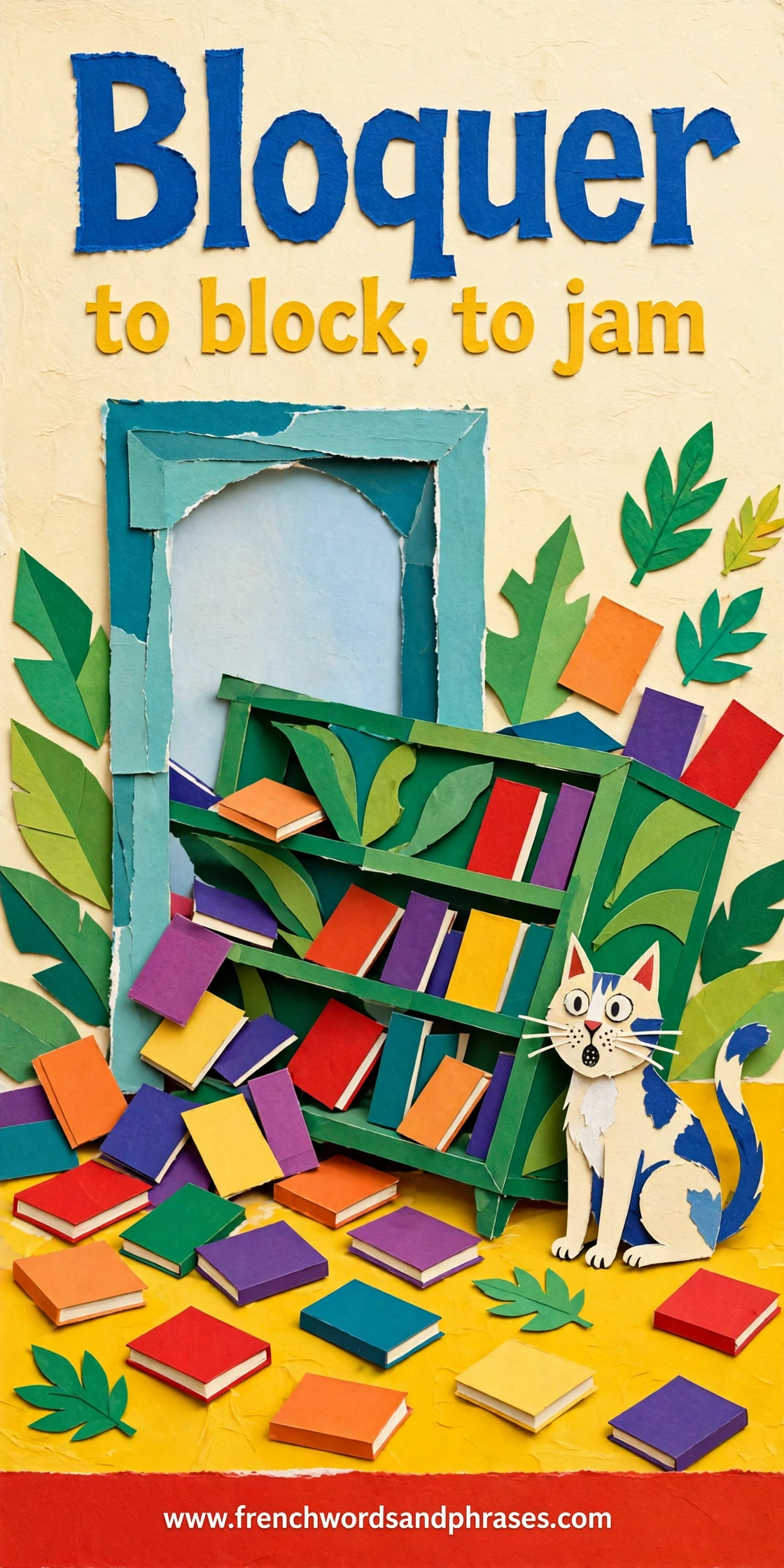
Bloquer means to block, to jam — to stop something from moving, passing or working.
A lorry stuck across a narrow street, snow sealing every road out of a village, a strikers’ picket across a factory gate — bloquer is the verb of the obstacle that wins: whatever should move, pass or flow, and suddenly cannot.
In this guide, you’ll learn how to conjugate bloquer in all the major French tenses and moods. Explore complete conjugation tables, French examples, English translations, and practice quizzes.
Understanding the French Verb Bloquer
Bloquer is a regular French verb belonging to the first group of verbs, those ending in-er.
It means to block, to jam. It covers physical blockages (roads, doors, pipes, wheels), administrative freezes (accounts, prices, funds), diaries (bloquer une date — to reserve a day) and modern digital life (bloquer un numéro, bloquer quelqu’un sur un réseau social). Its reflexive, se bloquer, is the machine or the mind jamming on its own.
Verb classification: First group (-er)
Auxiliary verb: Avoir
Past participle: bloqué
Present participle: bloquant
English equivalents: To block, to jam, to obstruct; bloquer la route — to block the road; bloquer un compte — to freeze an account; bloquer une date — to block out a date in the diary; bloquer les prix — to freeze prices; être bloqué — to be stuck.
One important detail: bloquer is a perfectly regular -er verb — je bloque, nous bloquons, ils bloquent, past participle bloqué — but it leads a double life. Transitive, it blocks something else: la neige bloque les routes. The moment the thing jams itself, French switches to the reflexive twin, se bloquer: la porte se bloque. And for the person stuck at the airport, French prefers the participle as an adjective: je suis bloqué à l’aéroport — I am stranded at the airport.
Experience the Word
Bloquer is the verb of the full stop in the middle of the road — everything was moving, and then it was not.
Imagine the only bridge out of a mountain village on the first morning of the holidays. A delivery lorry misjudges the turn, wedges itself between the two parapets, and bloque the whole valley: forty cars behind it, horns, picnics eaten on the bonnet, and one very red driver.
Nothing was broken, nobody was hurt. One lorry had simply blocked — bloqué — the entire day.
How to Conjugate Bloquer: Complete French Conjugation Guide
Let’s explore every major conjugation of bloquer, beginning with the indicative mood.
How to Conjugate Bloquer in the Indicative Mood
The indicative mood is used to express facts, observations, actions, and events.
How to Conjugate Bloquer in the Present Tense (Présent)
Used for actions happening now, habitual actions, and general truths.
| Subject | Conjugation |
|---|---|
| je | bloque |
| tu | bloques |
| il / elle | bloque |
| nous | bloquons |
| vous | bloquez |
| ils / elles | bloquent |
Example
Un camion en panne bloque la rue depuis ce matin.
A broken-down lorry has been blocking the street since this morning.
Quick Quiz 1
Complete the sentence:
Nous ______ la porte avec une vieille chaise.
Reveal the answer
bloquons
Nous bloquons la porte avec une vieille chaise.
We are blocking the door with an old chair.
How to Conjugate Bloquer in the Passé Composé
Used for completed actions in the past. Bloquer takes the auxiliary verb avoir.
| Subject | Conjugation |
|---|---|
| j’ | ai bloqué |
| tu | as bloqué |
| il / elle | a bloqué |
| nous | avons bloqué |
| vous | avez bloqué |
| ils / elles | ont bloqué |
Example
La neige a bloqué toutes les routes du département.
The snow blocked every road in the département.
How to Conjugate Bloquer in the Imparfait (Imperfect Tense)
Used for habitual past actions, descriptions, and ongoing situations in the past.
| Subject | Conjugation |
|---|---|
| je | bloquais |
| tu | bloquais |
| il / elle | bloquait |
| nous | bloquions |
| vous | bloquiez |
| ils / elles | bloquaient |
Example
Chaque hiver, la glace bloquait le port pendant des semaines.
Every winter, the ice used to block the harbour for weeks.
Quick Quiz 2
Choose the correct form:
The snow blocked the airport.
La neige ______ l’aéroport. (a bloqué / est bloquée)
Reveal the answer
a bloqué
La neige a bloqué l’aéroport.
Bloquer takes avoir.
How to Conjugate Bloquer in the Plus-que-parfait
Used to describe an action that had already been completed before another past event.
| Subject | Conjugation |
|---|---|
| j’ | avais bloqué |
| tu | avais bloqué |
| il / elle | avait bloqué |
| nous | avions bloqué |
| vous | aviez bloqué |
| ils / elles | avaient bloqué |
Example
Un éboulement avait bloqué le tunnel avant notre arrivée.
A rockfall had blocked the tunnel before we arrived.
How to Conjugate Bloquer in the Passé Simple
Primarily used in formal writing, literature, and historical narratives. It is rarely used in everyday conversation.
| Subject | Conjugation |
|---|---|
| je | bloquai |
| tu | bloquas |
| il / elle | bloqua |
| nous | bloquâmes |
| vous | bloquâtes |
| ils / elles | bloquèrent |
Example
Soudain, une voiture bloqua le passage.
Suddenly, a car blocked the way through.
How to Conjugate Bloquer in the Passé Antérieur
A literary tense used to express an action completed immediately before another past action, generally in the passé simple.
| Subject | Conjugation |
|---|---|
| j’ | eus bloqué |
| tu | eus bloqué |
| il / elle | eut bloqué |
| nous | eûmes bloqué |
| vous | eûtes bloqué |
| ils / elles | eurent bloqué |
Example
Quand la foule eut bloqué la place, la police ferma les grilles.
When the crowd had blocked the square, the police closed the gates.
How to Conjugate Bloquer in the Future Tense (Futur Simple)
Used to describe actions that will take place in the future.
| Subject | Conjugation |
|---|---|
| je | bloquerai |
| tu | bloqueras |
| il / elle | bloquera |
| nous | bloquerons |
| vous | bloquerez |
| ils / elles | bloqueront |
Example
Demain, les grévistes bloqueront l’entrée de l’usine.
Tomorrow, the strikers will block the factory entrance.
How to Conjugate Bloquer in the Futur Antérieur (Future Perfect)
Used for an action that will have been completed before a particular point in the future.
| Subject | Conjugation |
|---|---|
| j’ | aurai bloqué |
| tu | auras bloqué |
| il / elle | aura bloqué |
| nous | aurons bloqué |
| vous | aurez bloqué |
| ils / elles | auront bloqué |
Example
À midi, les manifestants auront bloqué le pont pendant trois heures.
By noon, the demonstrators will have blocked the bridge for three hours.
How to Conjugate Bloquer in the Near Future (Futur Proche)
Used to describe something that is going to happen soon. Formed with aller + infinitive.
| Subject | Conjugation |
|---|---|
| je | vais bloquer |
| tu | vas bloquer |
| il / elle | va bloquer |
| nous | allons bloquer |
| vous | allez bloquer |
| ils / elles | vont bloquer |
Example
Attention, ce meuble va bloquer la porte.
Careful, that piece of furniture is going to block the door.
How to Conjugate Bloquer in the Conditional Mood
The conditional mood expresses what would happen under certain circumstances. It is also frequently used to make polite requests or express wishes.
How to Conjugate Bloquer in the Present Conditional
| Subject | Conjugation |
|---|---|
| je | bloquerais |
| tu | bloquerais |
| il / elle | bloquerait |
| nous | bloquerions |
| vous | bloqueriez |
| ils / elles | bloqueraient |
Example
Sans les travaux, rien ne bloquerait la circulation.
Without the roadworks, nothing would block the traffic.
How to Conjugate Bloquer in the Past Conditional
| Subject | Conjugation |
|---|---|
| j’ | aurais bloqué |
| tu | aurais bloqué |
| il / elle | aurait bloqué |
| nous | aurions bloqué |
| vous | auriez bloqué |
| ils / elles | auraient bloqué |
Example
Tu aurais bloqué la porte avec une chaise, et personne ne serait entré.
You would have blocked the door with a chair, and nobody would have got in.
Bloquer in the Literary Past Conditional Form
This less common literary form uses the imperfect subjunctive of avoir.
| Subject | Conjugation |
|---|---|
| j’ | eusse bloqué |
| tu | eusses bloqué |
| il / elle | eût bloqué |
| nous | eussions bloqué |
| vous | eussiez bloqué |
| ils / elles | eussent bloqué |
Example
Un seul rocher eût bloqué le chemin des armées.
A single rock would have blocked the armies’ path.
How to Conjugate Bloquer in the Subjunctive Mood
The subjunctive is used to express wishes, emotions, doubts, necessity, and uncertainty. It frequently follows expressions such as il faut que (it is necessary that) or bien que (although).
How to Conjugate Bloquer in the Present Subjunctive
| Subject | Conjugation |
|---|---|
| que je | bloque |
| que tu | bloques |
| qu’il / qu’elle | bloque |
| que nous | bloquions |
| que vous | bloquiez |
| qu’ils / qu’elles | bloquent |
Example
Il faut que quelqu’un bloque la porte pendant la réparation.
Someone must block the door during the repair.
Quick Quiz 3
Complete the sentence using the subjunctive:
Il faut que vous ______ l’entrée pendant les travaux.
Reveal the answer
bloquiez
Il faut que vous bloquiez l’entrée pendant les travaux.
You must block the entrance during the works.
How to Conjugate Bloquer in the Imperfect Subjunctive
A literary tense, rarely encountered in modern spoken French.
| Subject | Conjugation |
|---|---|
| que je | bloquasse |
| que tu | bloquasses |
| qu’il / qu’elle | bloquât |
| que nous | bloquassions |
| que vous | bloquassiez |
| qu’ils / qu’elles | bloquassent |
Example
Elle craignait que la serrure bloquât au pire moment.
She feared the lock might jam at the worst moment.
How to Conjugate Bloquer in the Pluperfect Subjunctive
A literary construction used to express an action completed before another past action.
| Subject | Conjugation |
|---|---|
| que j’ | eusse bloqué |
| que tu | eusses bloqué |
| qu’il / qu’elle | eût bloqué |
| que nous | eussions bloqué |
| que vous | eussiez bloqué |
| qu’ils / qu’elles | eussent bloqué |
Example
On racontait que des racines eussent bloqué le tuyau depuis des années.
People said roots had been blocking the pipe for years.
How to Conjugate Bloquer in the Past Subjunctive
| Subject | Conjugation |
|---|---|
| que j’ | aie bloqué |
| que tu | aies bloqué |
| qu’il / qu’elle | ait bloqué |
| que nous | ayons bloqué |
| que vous | ayez bloqué |
| qu’ils / qu’elles | aient bloqué |
Example
Je suis surpris que la neige ait bloqué l’aéroport.
I am surprised the snow blocked the airport.
How to Conjugate Bloquer in the Imperative
The imperative is used to give commands, instructions, invitations, or suggestions. Subject pronouns are omitted.
How to Conjugate Bloquer in the Present Imperative
| Person | Conjugation |
|---|---|
| (tu) | bloque |
| (nous) | bloquons |
| (vous) | bloquez |
Example
Bloque la roue avec cette cale, vite !
Chock the wheel with this block, quickly!
Quick Quiz 4
How would you say Block the door (tu form)?
Reveal the answer
Bloque la porte !
French Participles of Bloquer
Participles are verb forms that can be used in compound tenses and other grammatical constructions.
Present Participle of Bloquer
bloquant
En bloquant la sortie, il a provoqué une belle pagaille.
By blocking the exit, he caused a fine mess.
Past Participle of Bloquer
bloqué
Bloquée par la neige, la route est restée fermée deux jours.
Blocked by the snow, the road stayed closed for two days.
Bloquer in Everyday French: Real-Life Examples
Now that you know the conjugations, let’s see how bloquer appears in everyday French.
Example 1 — Present
Un camion bloque la rue.
A lorry is blocking the street.
Example 2 — Passé composé
La neige a bloqué les routes.
The snow blocked the roads.
Example 3 — Imparfait
La glace bloquait le port chaque hiver.
The ice used to block the harbour every winter.
Example 4 — Future
Les grévistes bloqueront l’usine.
The strikers will block the factory.
Example 5 — Conditional
Rien ne bloquerait la rue sans les travaux.
Nothing would block the street without the roadworks.
Example 6 — Imperative
Bloque la porte avec la chaise !
Block the door with the chair!
Beyond Translation: The Meaning of Bloquer
English block and French bloquer are the same Germanic word travelling in both directions — a bloc is a lump, a chunk, something that gets in the way.
From one lump comes a whole vocabulary of stuckness.
Un blocus is a blockade, le blocage is the blockage itself, and the modern French speaker bloque dates in a diary, bloque phone numbers and se bloque in front of a blank page — the lump is everywhere.
How to Remember the French Verb Bloquer
Remember it this way: Bloquer is about the lorry wedged across the only bridge.
- Regular -er: je bloque, nous bloquons, past participle bloqué.
- Bloquer blocks something else; se bloquer jams itself; je suis bloqué is the stranded traveller.
- Modern lives included: bloquer un compte, un numéro, une date.
The key idea is the lorry wedged across the only bridge.
Test Your Knowledge of Bloquer
Let’s see how much you’ve learned. Try answering these questions before revealing the answers.
Question 1
How do you say The snow blocked the roads in French?
Reveal the answer
La neige a bloqué les routes.
Question 2
Which form means the door jams by itself: bloque or se bloque?
Reveal the answer
Se bloque — la porte se bloque: the reflexive is the thing jamming itself.
Question 3
Translate: I am stuck at the airport.
Reveal the answer
Je suis bloqué à l’aéroport.
Question 4
What is the past participle of bloquer?
Reveal the answer
Bloqué.
Question 5
Complete the sentence:
Il faut que quelqu’un ______ la porte pendant la réparation.
Reveal the answer
bloque
Il faut que quelqu’un bloque la porte pendant la réparation.
Someone must block the door during the repair.
Your Final Challenge
Can You Use It?
How would you say this in French?
The snow blocks the roads, the village falls asleep, and silence does the rest.
Reveal the answer
La neige bloque les routes, le village s’endort, et le silence fait le reste.
The snow blocks the roads, the village falls asleep, and silence does the rest.
A little French. A little curiosity. A richer everyday life.
LEARN FRENCH ONE WORD AT A TIME