A French Word to Live By
How to Conjugate Blettir in French
/blɛ.tiʁ/
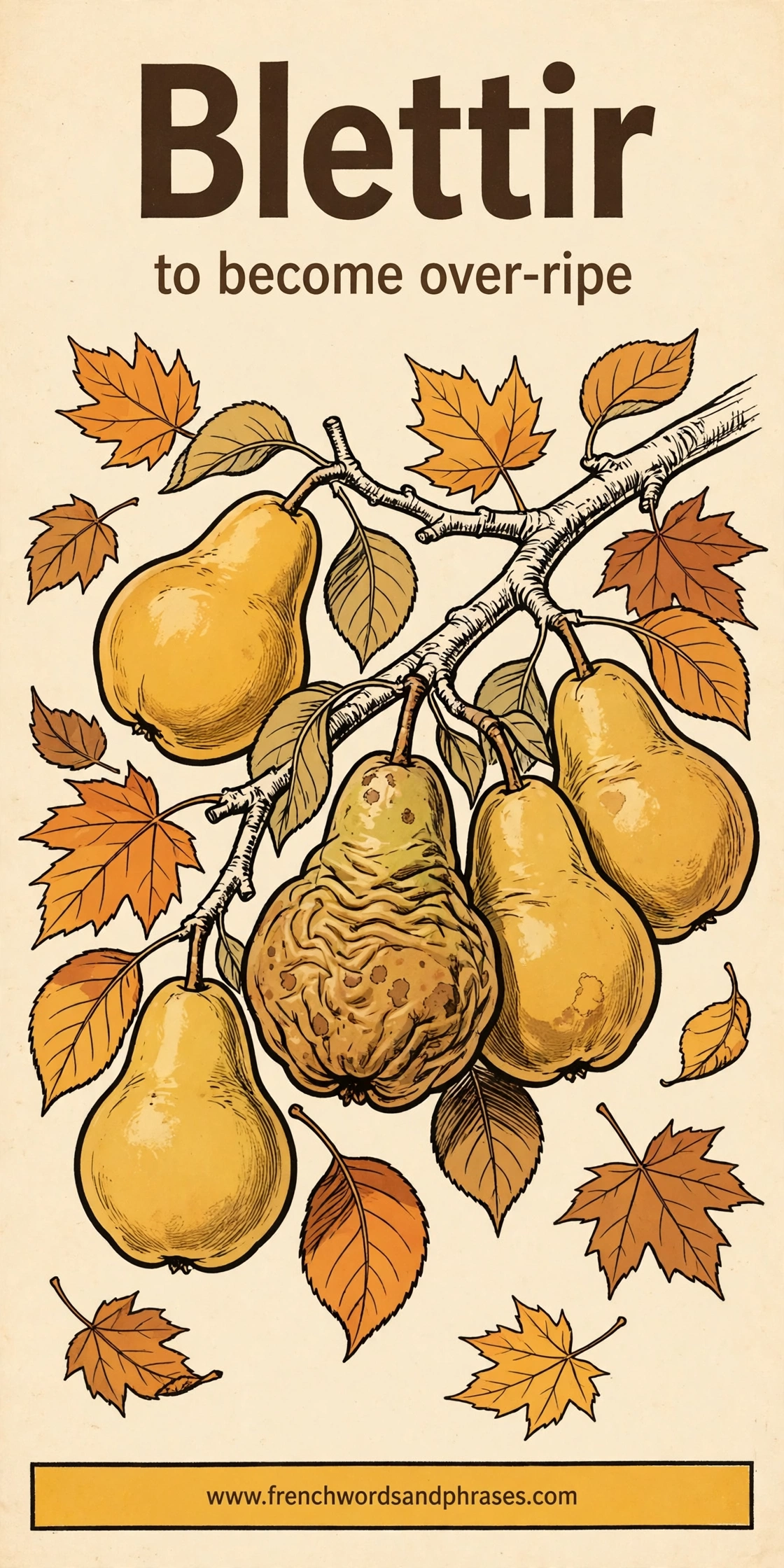
Blettir means to become over-ripe — for a fruit to pass firm ripeness and soften into the sweet, melting stage beyond it.
A medlar rock-hard on the tree in October, laid in straw until December softens it to honey; a persimmon glowing orange and still inedible, waiting for the frost — blettir is the verb of fruit that must go too far before it can be eaten at all.
In this guide, you’ll learn how to conjugate blettir in all the major French tenses and moods. Explore complete conjugation tables, French examples, English translations, and practice quizzes.
Understanding the French Verb Blettir
Blettir is a regular French verb belonging to the second group of verbs, those ending in -ir.
It means to become over-ripe. It is a specialist’s verb, at home in orchards, markets and old cookery books: medlars (les nèfles), persimmons (les kakis), quinces and some pears are inedible until they have bletti, when the astringent flesh turns sweet, brown and spoon-soft.
Verb classification: Second group (-ir)
Auxiliary verb: Avoir
Past participle: bletti
Present participle: blettissant
English equivalents: To become over-ripe, to blet; faire blettir des nèfles — to blet medlars; des fruits blets — over-ripe, bletted fruit; la nèfle se mange blette — the medlar is eaten when bletted; blettir dans la paille — to ripen past ripeness in straw.
One important detail: blettir is a regular second-group verb in -ir, built like finir: il blettit, les fruits blettissent, participle bletti, present participle blettissant. In practice it lives almost entirely in the third person — fruits blettissent, people rarely do. Its adjective is a separate word to learn: blet, blette — une poire blette is a pear gone soft and over-ripe, and the whole process is called le blettissement.
Experience the Word
Blettir is the verb of fruit that must overshoot ripeness — not rotten, not ripe, but in the brief, honeyed country beyond ripe.
Imagine a farmhouse loft in November. In a crate of straw lie two dozen medlars, picked hard as stones a month ago. Week by week they darken and soften; the farmer presses one gently each morning, waiting for the day it gives like a ripe fig. Les nèfles blettissent, and patience is the only recipe.
They are not spoiling — they are arriving. The medlars have bletted — bletti — into the only state in which they can be eaten.
How to Conjugate Blettir: Complete French Conjugation Guide
Let’s explore every major conjugation of blettir, beginning with the indicative mood.
How to Conjugate Blettir in the Indicative Mood
The indicative mood is used to express facts, observations, actions, and events.
How to Conjugate Blettir in the Present Tense (Présent)
Used for actions happening now, habitual actions, and general truths.
| Subject | Conjugation |
|---|---|
| je | blettis |
| tu | blettis |
| il / elle | blettit |
| nous | blettissons |
| vous | blettissez |
| ils / elles | blettissent |
Example
Les nèfles blettissent lentement dans la paille.
The medlars are slowly becoming over-ripe in the straw.
Quick Quiz 1
Complete the sentence:
Dans la cave, les kakis ______ lentement.
Reveal the answer
blettissent
Dans la cave, les kakis blettissent lentement.
In the cellar, the persimmons are slowly becoming over-ripe.
How to Conjugate Blettir in the Passé Composé
Used for completed actions in the past. Blettir takes the auxiliary verb avoir.
| Subject | Conjugation |
|---|---|
| j’ | ai bletti |
| tu | as bletti |
| il / elle | a bletti |
| nous | avons bletti |
| vous | avez bletti |
| ils / elles | ont bletti |
Example
Les poires ont bletti en quelques jours sur le rebord de la fenêtre.
The pears became over-ripe in a few days on the windowsill.
How to Conjugate Blettir in the Imparfait (Imperfect Tense)
Used for habitual past actions, descriptions, and ongoing situations in the past.
| Subject | Conjugation |
|---|---|
| je | blettissais |
| tu | blettissais |
| il / elle | blettissait |
| nous | blettissions |
| vous | blettissiez |
| ils / elles | blettissaient |
Example
Autrefois, les kakis blettissaient sur l’arbre jusqu’aux premières gelées.
In the old days, persimmons used to blet on the tree until the first frosts.
Quick Quiz 2
Choose the correct form:
The pears became over-ripe in a few days.
Les poires ______ en quelques jours. (ont bletti / sont bletties)
Reveal the answer
ont bletti
Les poires ont bletti en quelques jours.
Blettir takes avoir.
How to Conjugate Blettir in the Plus-que-parfait
Used to describe an action that had already been completed before another past event.
| Subject | Conjugation |
|---|---|
| j’ | avais bletti |
| tu | avais bletti |
| il / elle | avait bletti |
| nous | avions bletti |
| vous | aviez bletti |
| ils / elles | avaient bletti |
Example
Les fruits avaient bletti avant même la récolte.
The fruit had become over-ripe even before the harvest.
How to Conjugate Blettir in the Passé Simple
Primarily used in formal writing, literature, and historical narratives. It is rarely used in everyday conversation.
| Subject | Conjugation |
|---|---|
| je | blettis |
| tu | blettis |
| il / elle | blettit |
| nous | blettîmes |
| vous | blettîtes |
| ils / elles | blettirent |
Example
Le coing blettit sur la branche et devint fondant.
The quince became over-ripe on the branch and turned melting-soft.
How to Conjugate Blettir in the Passé Antérieur
A literary tense used to express an action completed immediately before another past action, generally in the passé simple.
| Subject | Conjugation |
|---|---|
| j’ | eus bletti |
| tu | eus bletti |
| il / elle | eut bletti |
| nous | eûmes bletti |
| vous | eûtes bletti |
| ils / elles | eurent bletti |
Example
Quand les nèfles eurent bletti, on les servit au dessert.
When the medlars had bletted, they were served for dessert.
How to Conjugate Blettir in the Future Tense (Futur Simple)
Used to describe actions that will take place in the future.
| Subject | Conjugation |
|---|---|
| je | blettirai |
| tu | blettiras |
| il / elle | blettira |
| nous | blettirons |
| vous | blettirez |
| ils / elles | blettiront |
Example
Ces poires blettiront vite si tu les laisses au soleil.
These pears will become over-ripe quickly if you leave them in the sun.
How to Conjugate Blettir in the Futur Antérieur (Future Perfect)
Used for an action that will have been completed before a particular point in the future.
| Subject | Conjugation |
|---|---|
| j’ | aurai bletti |
| tu | auras bletti |
| il / elle | aura bletti |
| nous | aurons bletti |
| vous | aurez bletti |
| ils / elles | auront bletti |
Example
À la fin de la semaine, tous les kakis auront bletti.
By the end of the week, all the persimmons will have become over-ripe.
How to Conjugate Blettir in the Near Future (Futur Proche)
Used to describe something that is going to happen soon. Formed with aller + infinitive.
| Subject | Conjugation |
|---|---|
| je | vais blettir |
| tu | vas blettir |
| il / elle | va blettir |
| nous | allons blettir |
| vous | allez blettir |
| ils / elles | vont blettir |
Example
Attention, ces figues vont blettir si on ne les mange pas.
Careful, these figs are going to become over-ripe if we do not eat them.
How to Conjugate Blettir in the Conditional Mood
The conditional mood expresses what would happen under certain circumstances. It is also frequently used to make polite requests or express wishes.
How to Conjugate Blettir in the Present Conditional
| Subject | Conjugation |
|---|---|
| je | blettirais |
| tu | blettirais |
| il / elle | blettirait |
| nous | blettirions |
| vous | blettiriez |
| ils / elles | blettiraient |
Example
Sans le froid de la cave, les fruits blettiraient trop tôt.
Without the cold of the cellar, the fruit would become over-ripe too soon.
How to Conjugate Blettir in the Past Conditional
| Subject | Conjugation |
|---|---|
| j’ | aurais bletti |
| tu | aurais bletti |
| il / elle | aurait bletti |
| nous | aurions bletti |
| vous | auriez bletti |
| ils / elles | auraient bletti |
Example
Les nèfles auraient bletti plus vite dans une pièce chaude.
The medlars would have bletted faster in a warm room.
Blettir in the Literary Past Conditional Form
This less common literary form uses the imperfect subjunctive of avoir.
| Subject | Conjugation |
|---|---|
| j’ | eusse bletti |
| tu | eusses bletti |
| il / elle | eût bletti |
| nous | eussions bletti |
| vous | eussiez bletti |
| ils / elles | eussent bletti |
Example
Les poires eussent bletti avant Noël dans une cave plus chaude.
The pears would have become over-ripe before Christmas in a warmer cellar.
How to Conjugate Blettir in the Subjunctive Mood
The subjunctive is used to express wishes, emotions, doubts, necessity, and uncertainty. It frequently follows expressions such as il faut que (it is necessary that) or bien que (although).
How to Conjugate Blettir in the Present Subjunctive
| Subject | Conjugation |
|---|---|
| que je | blettisse |
| que tu | blettisses |
| qu’il / qu’elle | blettisse |
| que nous | blettissions |
| que vous | blettissiez |
| qu’ils / qu’elles | blettissent |
Example
Il faut que les nèfles blettissent avant d’être mangées.
The medlars must become over-ripe before being eaten.
Quick Quiz 3
Complete the sentence using the subjunctive:
Il faut que les fruits ______ complètement.
Reveal the answer
blettissent
Il faut que les fruits blettissent complètement.
The fruit must become completely over-ripe.
How to Conjugate Blettir in the Imperfect Subjunctive
A literary tense, rarely encountered in modern spoken French.
| Subject | Conjugation |
|---|---|
| que je | blettisse |
| que tu | blettisses |
| qu’il / qu’elle | blettît |
| que nous | blettissions |
| que vous | blettissiez |
| qu’ils / qu’elles | blettissent |
Example
Le jardinier voulait que les kakis blettissent sur l’arbre.
The gardener wanted the persimmons to blet on the tree.
How to Conjugate Blettir in the Pluperfect Subjunctive
A literary construction used to express an action completed before another past action.
| Subject | Conjugation |
|---|---|
| que j’ | eusse bletti |
| que tu | eusses bletti |
| qu’il / qu’elle | eût bletti |
| que nous | eussions bletti |
| que vous | eussiez bletti |
| qu’ils / qu’elles | eussent bletti |
Example
On attendait que les fruits eussent bletti complètement.
They were waiting for the fruit to have bletted completely.
How to Conjugate Blettir in the Past Subjunctive
| Subject | Conjugation |
|---|---|
| que j’ | aie bletti |
| que tu | aies bletti |
| qu’il / qu’elle | ait bletti |
| que nous | ayons bletti |
| que vous | ayez bletti |
| qu’ils / qu’elles | aient bletti |
Example
Je suis content que les poires aient bletti à point.
I am glad the pears have become over-ripe at just the right point.
How to Conjugate Blettir in the Imperative
The imperative is used to give commands, instructions, invitations, or suggestions. Subject pronouns are omitted.
How to Conjugate Blettir in the Present Imperative
| Person | Conjugation |
|---|---|
| (tu) | blettis |
| (nous) | blettissons |
| (vous) | blettissez |
Example
Blettissez lentement dans la paille, mes nèfles !
Blet slowly in the straw, my medlars!
Quick Quiz 4
How would you say Become over-ripe slowly (tu form, to a medlar)?
Reveal the answer
Blettis lentement !
French Participles of Blettir
Participles are verb forms that can be used in compound tenses and other grammatical constructions.
Present Participle of Blettir
blettissant
En blettissant, la nèfle devient douce et fondante.
In becoming over-ripe, the medlar turns sweet and melting.
Past Participle of Blettir
bletti
Bletties à point, les nèfles se mangent à la cuillère.
Bletted to perfection, medlars are eaten with a spoon.
Blettir in Everyday French: Real-Life Examples
Now that you know the conjugations, let’s see how blettir appears in everyday French.
Example 1 — Present
Les nèfles blettissent dans la paille.
The medlars are becoming over-ripe in the straw.
Example 2 — Passé composé
Les poires ont bletti en quelques jours.
The pears became over-ripe in a few days.
Example 3 — Imparfait
Les kakis blettissaient sur l’arbre.
The persimmons used to blet on the tree.
Example 4 — Future
Ces figues blettiront si on les oublie.
These figs will become over-ripe if we forget them.
Example 5 — Conditional
Sans le froid, les fruits blettiraient trop tôt.
Without the cold, the fruit would become over-ripe too soon.
Example 6 — Imperative
Laissez les nèfles blettir avant de les goûter !
Let the medlars become over-ripe before tasting them!
Beyond Translation: The Meaning of Blettir
English actually owns this word — to blet, borrowed from French blettir in the nineteenth century, is the technical term pomologists use for a medlar or persimmon ripening past firmness into softness.
Few fruits ask to be eaten at their worst-looking moment.
The medlar is hard, sour and inedible when ripe, and delicious only when blette — dark, soft and wrinkled. Blettir is the verb of that paradox: for some fruits, perfection is one step beyond ripe.
How to Remember the French Verb Blettir
Remember it this way: Blettir is about medlars softening in straw until they turn to honey.
- Second group, like finir: les nèfles blettissent, with the -iss- that gives it away.
- Almost always third person — fruit blettit; its adjective is blet, blette: une poire blette.
- Regular -ir: il blettit, ils blettissent, past participle bletti; English borrowed it as to blet.
The key idea is medlars softening in straw until they turn to honey.
Test Your Knowledge of Blettir
Let’s see how much you’ve learned. Try answering these questions before revealing the answers.
Question 1
Which group does blettir belong to, and what is the giveaway in its plural forms?
Reveal the answer
The second group (-ir) — the -iss- in ils blettissent, like finir.
Question 2
How do you say The medlars are becoming over-ripe in the straw in French?
Reveal the answer
Les nèfles blettissent dans la paille.
Question 3
Translate: The pears became over-ripe in a few days.
Reveal the answer
Les poires ont bletti en quelques jours.
Question 4
What is the past participle of blettir?
Reveal the answer
Bletti — and the adjective is blet, blette: une poire blette.
Question 5
Complete the sentence:
Il faut que les nèfles ______ avant d’être mangées.
Reveal the answer
blettissent
Il faut que les nèfles blettissent avant d’être mangées.
The medlars must become over-ripe before being eaten.
Your Final Challenge
Can You Use It?
How would you say this in French?
The medlar is eaten neither unripe nor ripe: it waits, in the straw, until it has become over-ripe.
Reveal the answer
La nèfle ne se mange ni verte ni mûre : elle attend, dans la paille, d’avoir bletti.
The medlar is eaten neither unripe nor ripe: it waits, in the straw, until it has become over-ripe.
A little French. A little curiosity. A richer everyday life.
LEARN FRENCH ONE WORD AT A TIME