A French Word to Live By
How to Conjugate Blairer in French
/blɛ.ʁe/
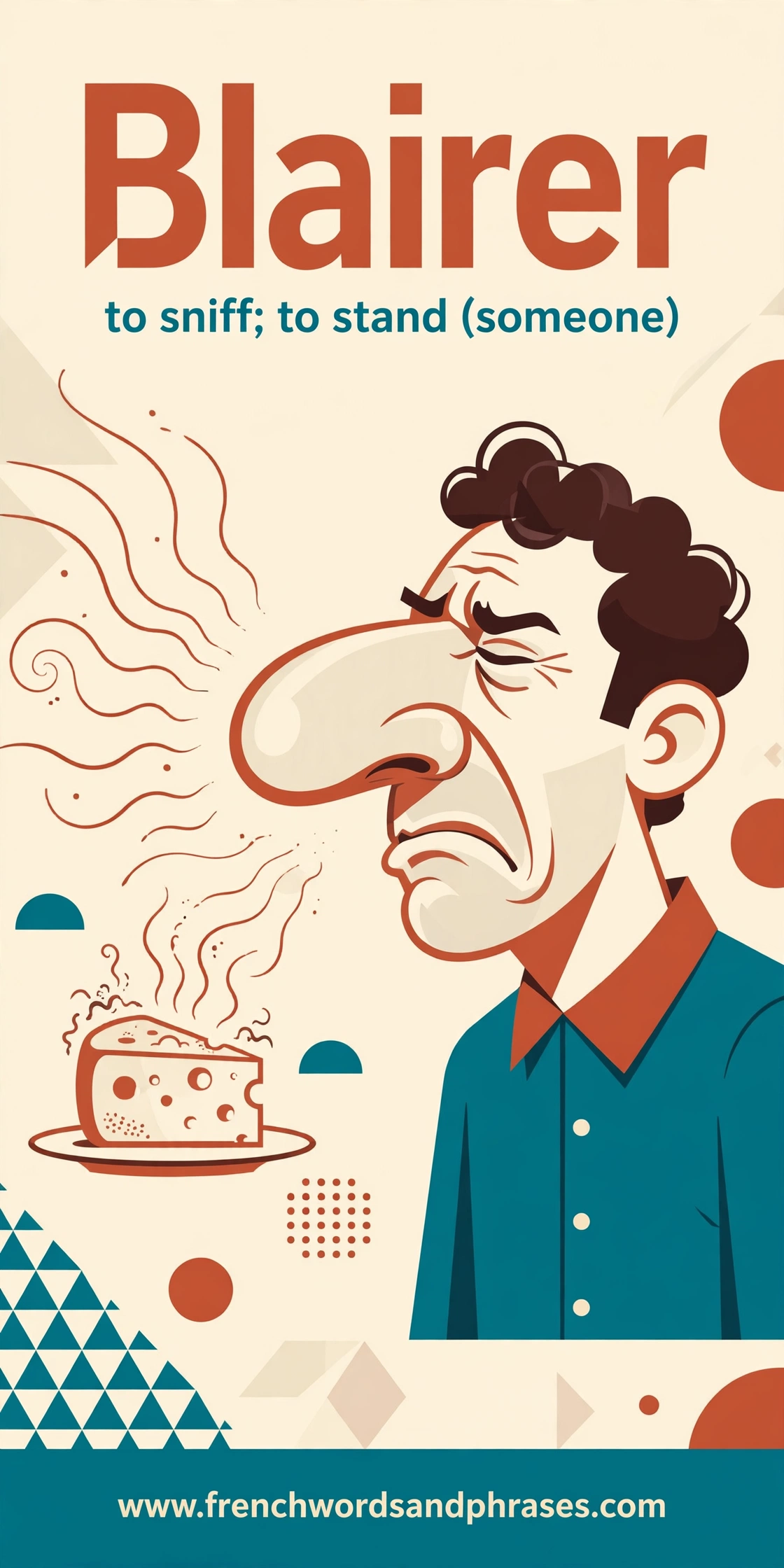
Blairer means to sniff — and, in familiar French, to stand someone: je ne peux pas le blairer is the classic way to say you cannot stand him.
A dog working its nose along a garden fence, a colleague you have disliked since the first handshake — blairer joins the two scenes: at bottom it is the verb of the nose, and French slang turned smelling someone into tolerating them, or not.
In this guide, you’ll learn how to conjugate blairer in all the major French tenses and moods. Explore complete conjugation tables, French examples, English translations, and practice quizzes.
Understanding the French Verb Blairer
Blairer is a regular French verb belonging to the first group of verbs, those ending in -er.
It means to sniff; to stand (someone). In the ‘stand someone’ sense it is stronger and more visceral than ne pas supporter: it is gut-level dislike, felt in the nose. The literal sniffing sense survives with dogs and hunting, and in the playful imperative blaire-moi ça ! — have a sniff of that.
Verb classification: First group (-er)
Auxiliary verb: Avoir
Past participle: blairé
Present participle: blairant
English equivalents: To sniff, to get the scent of; (familiar) to stand, to bear someone; je ne peux pas le blairer — I cannot stand him; ne pas pouvoir blairer quelqu’un — to be unable to stand someone; se blairer — to be able to stand each other (usually in the negative); blairer une piste — to pick up a trail (of a dog).
One important detail: blairer lives two lives. Its old, literal life is the nose: a hunting dog blaire the air or a trail, sniffing it out — un blair is even slang for a nose. Its famous modern life is familiar: je ne peux pas le blairer, I can’t stand him — as if the dislike were a smell you cannot bear. In that sense the verb is almost always negative or interrogative, and it works reciprocally too: ils ne se blairent pas, they can’t stand each other. The conjugation itself is a regular -er: je blaire, nous blairons, ils blairent, past participle blairé.
Experience the Word
Blairer is the verb of the nose’s verdict — before the mind has decided, the nose has already voted.
Imagine a bloodhound at the edge of a wood at dawn. Nose down, it blaire the cold grass, lifts its head, blaire the wind — and suddenly the whole body changes: the trail is there. Three centuries of hunters used this verb for exactly that moment, long before office workers borrowed it for the colleague they cannot stand.
The dog has not seen anything yet. It has scented — il a blairé — and that is enough.
How to Conjugate Blairer: Complete French Conjugation Guide
Let’s explore every major conjugation of blairer, beginning with the indicative mood.
How to Conjugate Blairer in the Indicative Mood
The indicative mood is used to express facts, observations, actions, and events.
How to Conjugate Blairer in the Present Tense (Présent)
Used for actions happening now, habitual actions, and general truths.
| Subject | Conjugation |
|---|---|
| je | blaire |
| tu | blaires |
| il / elle | blaire |
| nous | blairons |
| vous | blairez |
| ils / elles | blairent |
Example
Je ne peux pas blairer mon voisin du dessus.
I cannot stand my upstairs neighbour.
Quick Quiz 1
Complete the sentence:
Nous ne pouvons pas ______ le nouveau chef.
Reveal the answer
blairer
Nous ne pouvons pas blairer le nouveau chef.
We cannot stand the new boss.
How to Conjugate Blairer in the Passé Composé
Used for completed actions in the past. Blairer takes the auxiliary verb avoir.
| Subject | Conjugation |
|---|---|
| j’ | ai blairé |
| tu | as blairé |
| il / elle | a blairé |
| nous | avons blairé |
| vous | avez blairé |
| ils / elles | ont blairé |
Example
Dès le premier jour, elle ne l’a pas blairé.
From the very first day, she could not stand him.
How to Conjugate Blairer in the Imparfait (Imperfect Tense)
Used for habitual past actions, descriptions, and ongoing situations in the past.
| Subject | Conjugation |
|---|---|
| je | blairais |
| tu | blairais |
| il / elle | blairait |
| nous | blairions |
| vous | blairiez |
| ils / elles | blairaient |
Example
Autrefois, le chien blairait chaque passant devant la grille.
In the old days, the dog used to sniff every passer-by at the gate.
Quick Quiz 2
Choose the correct form:
She never could stand him.
Elle ne l’______ jamais. (a blairé / est blairée)
Reveal the answer
a blairé
Elle ne l’a jamais blairé.
Blairer takes avoir.
How to Conjugate Blairer in the Plus-que-parfait
Used to describe an action that had already been completed before another past event.
| Subject | Conjugation |
|---|---|
| j’ | avais blairé |
| tu | avais blairé |
| il / elle | avait blairé |
| nous | avions blairé |
| vous | aviez blairé |
| ils / elles | avaient blairé |
Example
Il ne l’avait jamais blairé, même avant leur dispute.
He had never been able to stand him, even before their quarrel.
How to Conjugate Blairer in the Passé Simple
Primarily used in formal writing, literature, and historical narratives. It is rarely used in everyday conversation.
| Subject | Conjugation |
|---|---|
| je | blairai |
| tu | blairas |
| il / elle | blaira |
| nous | blairâmes |
| vous | blairâtes |
| ils / elles | blairèrent |
Example
Le limier blaira la piste et se mit en route.
The bloodhound sniffed the trail and set off.
How to Conjugate Blairer in the Passé Antérieur
A literary tense used to express an action completed immediately before another past action, generally in the passé simple.
| Subject | Conjugation |
|---|---|
| j’ | eus blairé |
| tu | eus blairé |
| il / elle | eut blairé |
| nous | eûmes blairé |
| vous | eûtes blairé |
| ils / elles | eurent blairé |
Example
Dès que le chien eut blairé la piste une fois, il refusa de revenir.
As soon as the dog had picked up the trail once, it refused to come back.
How to Conjugate Blairer in the Future Tense (Futur Simple)
Used to describe actions that will take place in the future.
| Subject | Conjugation |
|---|---|
| je | blairerai |
| tu | blaireras |
| il / elle | blairera |
| nous | blairerons |
| vous | blairerez |
| ils / elles | blaireront |
Example
Si tu continues ainsi, personne ne te blairera plus.
If you go on like this, nobody will be able to stand you any more.
How to Conjugate Blairer in the Futur Antérieur (Future Perfect)
Used for an action that will have been completed before a particular point in the future.
| Subject | Conjugation |
|---|---|
| j’ | aurai blairé |
| tu | auras blairé |
| il / elle | aura blairé |
| nous | aurons blairé |
| vous | aurez blairé |
| ils / elles | auront blairé |
Example
Après cette semaine ensemble, ils auront fini par se blairer.
After this week together, they will finally have got to like each other.
How to Conjugate Blairer in the Near Future (Futur Proche)
Used to describe something that is going to happen soon. Formed with aller + infinitive.
| Subject | Conjugation |
|---|---|
| je | vais blairer |
| tu | vas blairer |
| il / elle | va blairer |
| nous | allons blairer |
| vous | allez blairer |
| ils / elles | vont blairer |
Example
Je sens que je ne vais pas blairer le nouveau collègue.
I have a feeling I am not going to be able to stand the new colleague.
How to Conjugate Blairer in the Conditional Mood
The conditional mood expresses what would happen under certain circumstances. It is also frequently used to make polite requests or express wishes.
How to Conjugate Blairer in the Present Conditional
| Subject | Conjugation |
|---|---|
| je | blairerais |
| tu | blairerais |
| il / elle | blairerait |
| nous | blairerions |
| vous | blaireriez |
| ils / elles | blaireraient |
Example
Sans son humour, je ne le blairerais pas du tout.
Without his humour, I could not stand him at all.
How to Conjugate Blairer in the Past Conditional
| Subject | Conjugation |
|---|---|
| j’ | aurais blairé |
| tu | aurais blairé |
| il / elle | aurait blairé |
| nous | aurions blairé |
| vous | auriez blairé |
| ils / elles | auraient blairé |
Example
Elle l’aurait blairé s’il avait été plus poli.
She would have liked him if he had been politer.
Blairer in the Literary Past Conditional Form
This less common literary form uses the imperfect subjunctive of avoir.
| Subject | Conjugation |
|---|---|
| j’ | eusse blairé |
| tu | eusses blairé |
| il / elle | eût blairé |
| nous | eussions blairé |
| vous | eussiez blairé |
| ils / elles | eussent blairé |
Example
Il ne l’eût jamais blairé, même avec le temps.
He would never have been able to stand him, even with time.
How to Conjugate Blairer in the Subjunctive Mood
The subjunctive is used to express wishes, emotions, doubts, necessity, and uncertainty. It frequently follows expressions such as il faut que (it is necessary that) or bien que (although).
How to Conjugate Blairer in the Present Subjunctive
| Subject | Conjugation |
|---|---|
| que je | blaire |
| que tu | blaires |
| qu’il / qu’elle | blaire |
| que nous | blairions |
| que vous | blairiez |
| qu’ils / qu’elles | blairent |
Example
Ce n’est pas étonnant qu’elle ne le blaire pas.
It is not surprising that she cannot stand him.
Quick Quiz 3
Complete the sentence using the subjunctive:
Ce n’est pas étonnant que tu ne le ______ pas.
Reveal the answer
blaires
Ce n’est pas étonnant que tu ne le blaires pas.
It is not surprising that you cannot stand him.
How to Conjugate Blairer in the Imperfect Subjunctive
A literary tense, rarely encountered in modern spoken French.
| Subject | Conjugation |
|---|---|
| que je | blairasse |
| que tu | blairasses |
| qu’il / qu’elle | blairât |
| que nous | blairassions |
| que vous | blairassiez |
| qu’ils / qu’elles | blairassent |
Example
Il était clair que je ne le blairasse guère.
It was clear that I could hardly stand him.
How to Conjugate Blairer in the Pluperfect Subjunctive
A literary construction used to express an action completed before another past action.
| Subject | Conjugation |
|---|---|
| que j’ | eusse blairé |
| que tu | eusses blairé |
| qu’il / qu’elle | eût blairé |
| que nous | eussions blairé |
| que vous | eussiez blairé |
| qu’ils / qu’elles | eussent blairé |
Example
Tout le monde savait qu’ils ne se fussent jamais blairés.
Everyone knew they had never been able to stand each other.
How to Conjugate Blairer in the Past Subjunctive
| Subject | Conjugation |
|---|---|
| que j’ | aie blairé |
| que tu | aies blairé |
| qu’il / qu’elle | ait blairé |
| que nous | ayons blairé |
| que vous | ayez blairé |
| qu’ils / qu’elles | aient blairé |
Example
Je suis surpris qu’elle ne l’ait jamais blairé.
I am surprised she never could stand him.
How to Conjugate Blairer in the Imperative
The imperative is used to give commands, instructions, invitations, or suggestions. Subject pronouns are omitted.
How to Conjugate Blairer in the Present Imperative
| Person | Conjugation |
|---|---|
| (tu) | blaire |
| (nous) | blairons |
| (vous) | blairez |
Example
Blaire cette fleur, elle sent délicieusement bon.
Sniff this flower, it smells wonderful.
Quick Quiz 4
How would you say Sniff this flower (tu form)?
Reveal the answer
Blaire cette fleur !
French Participles of Blairer
Participles are verb forms that can be used in compound tenses and other grammatical constructions.
Present Participle of Blairer
blairant
En blairant le sol, le chien a retrouvé la piste.
By sniffing the ground, the dog found the trail again.
Past Participle of Blairer
blairé
Jamais blairé par ses collègues, il a changé de service.
Never liked by his colleagues, he moved to another department.
Blairer in Everyday French: Real-Life Examples
Now that you know the conjugations, let’s see how blairer appears in everyday French.
Example 1 — Present
Je ne peux pas le blairer.
I cannot stand him.
Example 2 — Passé composé
Elle ne l’a jamais blairé.
She never could stand him.
Example 3 — Imparfait
Le chien blairait les passants.
The dog used to sniff the passers-by.
Example 4 — Future
Tu le blaireras mieux avec le temps.
You will get to like him better with time.
Example 5 — Conditional
Je le blairerais s’il était moins bruyant.
I would like him if he were less noisy.
Example 6 — Imperative
Blaire ce parfum, il est nouveau.
Sniff this perfume, it is new.
Beyond Translation: The Meaning of Blairer
The bridge between the two senses is the nose itself: un blair is slang for a nose, and to dislike someone in French is often a matter of smell — compare je ne peux pas le sentir, I can’t stand him, built on sentir, to smell.
Dislike, in French, is something you breathe.
English says the same thing in its own way — I can’t stand him is about posture, the French version is about air: some people simply cannot be in your lungs. Blairer keeps the oldest version of the idea, the hunting dog’s nose deciding in a second what the mind would take an hour to explain.
How to Remember the French Verb Blairer
Remember it this way: Blairer is about the bloodhound’s nose at dawn — and the colleague it votes against.
- Follow the nose: blairer is first a dog sniffing a trail — un blair is slang for a nose.
- The famous use is negative and familiar: je ne peux pas le blairer = I can’t stand him; ils ne se blairent pas = they can’t stand each other.
- Regular -er: je blaire, nous blairons, past participle blairé.
The key idea is the bloodhound’s nose at dawn — and the colleague it votes against.
Test Your Knowledge of Blairer
Let’s see how much you’ve learned. Try answering these questions before revealing the answers.
Question 1
What does je ne peux pas le blairer mean?
Reveal the answer
I cannot stand him — literally, I cannot bear his smell; blairer is familiar in this sense.
Question 2
How do you say I cannot stand him in French?
Reveal the answer
Je ne peux pas le blairer.
Question 3
Translate: She never could stand him.
Reveal the answer
Elle ne l’a jamais blairé.
Question 4
What is the past participle of blairer?
Reveal the answer
Blairé.
Question 5
Complete the sentence:
Ce n’est pas étonnant qu’elle ne le ______ pas.
Reveal the answer
blaire
Ce n’est pas étonnant qu’elle ne le blaire pas.
It is not surprising that she cannot stand him.
Your Final Challenge
Can You Use It?
How would you say this in French?
The old dog sniffed the wind one last time, then slowly set off back towards the house.
Reveal the answer
Le vieux chien blaira le vent une dernière fois, puis il repartit lentement vers la maison.
The old dog sniffed the wind one last time, then slowly set off back towards the house.
A little French. A little curiosity. A richer everyday life.
LEARN FRENCH ONE WORD AT A TIME