A French Word to Live By
How to Conjugate Bizuter in French
/bi.zy.te/
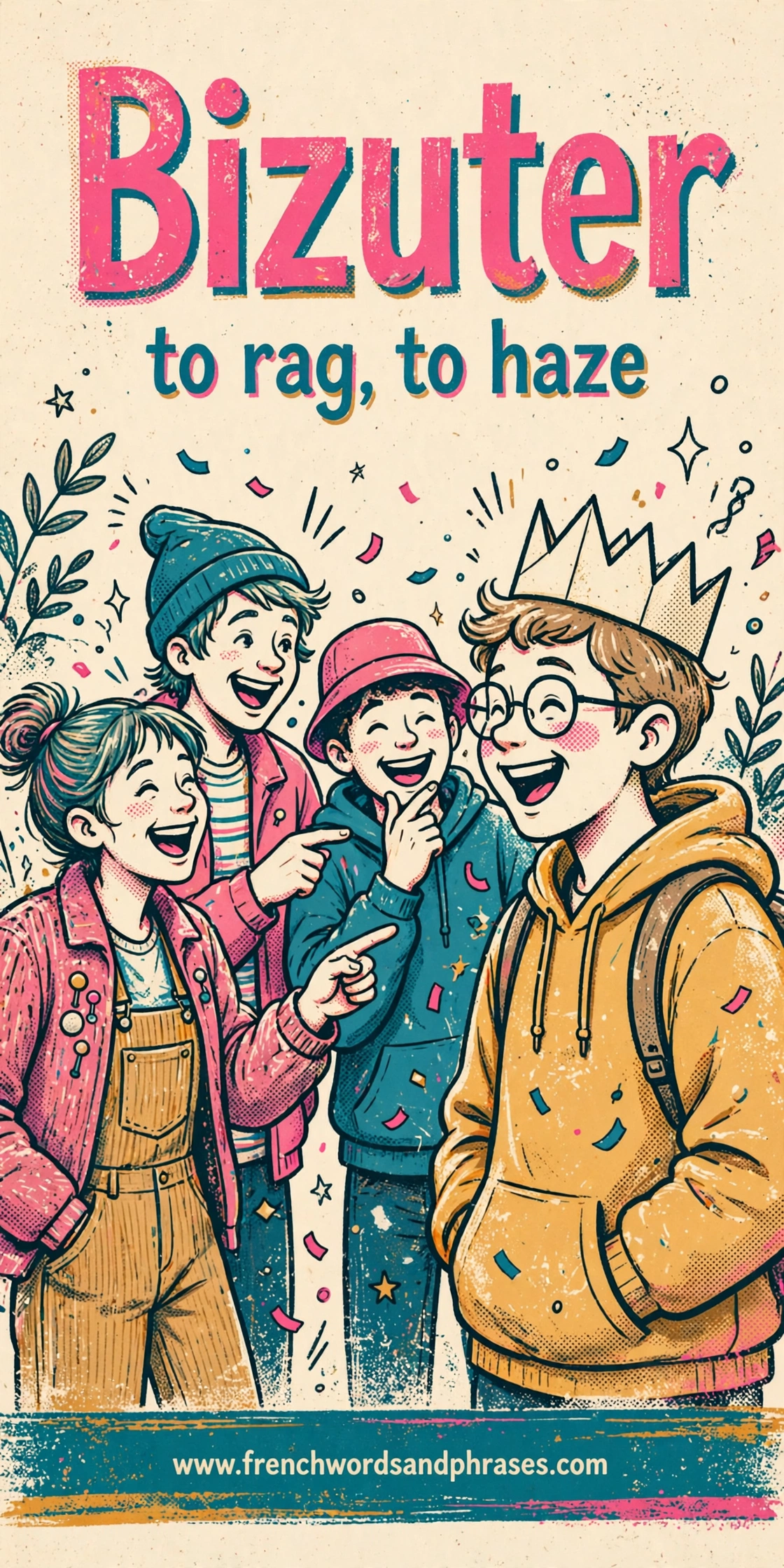
Bizuter means to haze — for older students to put newcomers through the rituals, jokes and ordeals of the traditional welcome.
The first week of the school year: a first-year student with flour in his hair, singing the school song in the courtyard while the older students laugh and applaud — bizuter is the verb of that ritual welcome, half party, half ordeal, that generations of French students have given and received.
In this guide, you’ll learn how to conjugate bizuter in all the major French tenses and moods. Explore complete conjugation tables, French examples, English translations, and practice quizzes.
Understanding the French Verb Bizuter
Bizuter is a regular French verb belonging to the first group of verbs, those ending in -er.
It means to rag, to haze. It belongs to universities, grandes écoles, medical schools and boarding schools, anywhere a promotion of anciens welcomes a promotion of nouveaux; in its softened modern form it means the organised fun of integration week, and in its hard old form the ordeals the law now forbids — the tone of the sentence usually tells you which.
Verb classification: First group (-er)
Auxiliary verb: Avoir
Past participle: bizuté
Present participle: bizutant
English equivalents: To haze, to rag (British university slang), to initiate roughly; le bizutage — hazing, the initiation rituals; un bizut (or bizuth) — a first-year student, a freshman; bizuter les nouveaux — to haze the newcomers; le bizutage est interdit — hazing is banned.
One important detail: bizuter is built on its victim — un bizut (also spelled bizuth) is a first-year student, a freshman, and to bizuter him is to subject him to le bizutage: the songs, costumes, flour, eggs and treasure hunts of the traditional welcome. The verb is a regular -er: je bizute, nous bizutons, past participle bizuté. A serious note belongs on the page: humiliating or dangerous hazing has been an offence in France since 1998, and modern bizutage survives mostly as games and parties that the bizuts themselves enjoy.
Experience the Word
Bizuter is the verb of the ritual welcome — the moment the newcomers stop being strangers and become, flour and all, members of the tribe.
Imagine the courtyard of a grande école on the first Monday of October. The second-years, dressed as Romans, are teaching a hundred bizuts the school song; someone is painted blue; everyone, including the painted, is laughing. On bizute les nouveaux — and by Friday, they will be defending the same tradition against next year’s intake.
They arrived as strangers and were sung at, painted and fed. They have been hazed — bizutés, and thereby adopted.
How to Conjugate Bizuter: Complete French Conjugation Guide
Let’s explore every major conjugation of bizuter, beginning with the indicative mood.
How to Conjugate Bizuter in the Indicative Mood
The indicative mood is used to express facts, observations, actions, and events.
How to Conjugate Bizuter in the Present Tense (Présent)
Used for actions happening now, habitual actions, and general truths.
| Subject | Conjugation |
|---|---|
| je | bizute |
| tu | bizutes |
| il / elle | bizute |
| nous | bizutons |
| vous | bizutez |
| ils / elles | bizutent |
Example
Les anciens bizutent les nouveaux étudiants à la rentrée.
The older students haze the new students at the start of term.
Quick Quiz 1
Complete the sentence:
Les anciens ______ les nouveaux à la rentrée.
Reveal the answer
bizutent
Les anciens bizutent les nouveaux à la rentrée.
The older students haze the newcomers at the start of term.
How to Conjugate Bizuter in the Passé Composé
Used for completed actions in the past. Bizuter takes the auxiliary verb avoir.
| Subject | Conjugation |
|---|---|
| j’ | ai bizuté |
| tu | as bizuté |
| il / elle | a bizuté |
| nous | avons bizuté |
| vous | avez bizuté |
| ils / elles | ont bizuté |
Example
On l’a bizuté dès son premier jour à l’université.
They hazed him on his very first day at university.
How to Conjugate Bizuter in the Imparfait (Imperfect Tense)
Used for habitual past actions, descriptions, and ongoing situations in the past.
| Subject | Conjugation |
|---|---|
| je | bizutais |
| tu | bizutais |
| il / elle | bizutait |
| nous | bizutions |
| vous | bizutiez |
| ils / elles | bizutaient |
Example
Autrefois, on bizutait les bizuts sans pitié.
In the old days, freshmen were hazed without mercy.
Quick Quiz 2
Choose the correct form:
They hazed him on the first day.
On l’______ dès le premier jour. (a bizuté / est bizuté)
Reveal the answer
a bizuté
On l’a bizuté dès le premier jour.
Bizuter takes avoir.
How to Conjugate Bizuter in the Plus-que-parfait
Used to describe an action that had already been completed before another past event.
| Subject | Conjugation |
|---|---|
| j’ | avais bizuté |
| tu | avais bizuté |
| il / elle | avait bizuté |
| nous | avions bizuté |
| vous | aviez bizuté |
| ils / elles | avaient bizuté |
Example
Ils avaient bizuté les nouveaux avant l’interdiction officielle.
They had hazed the new students before the official ban.
How to Conjugate Bizuter in the Passé Simple
Primarily used in formal writing, literature, and historical narratives. It is rarely used in everyday conversation.
| Subject | Conjugation |
|---|---|
| je | bizutai |
| tu | bizutas |
| il / elle | bizuta |
| nous | bizutâmes |
| vous | bizutâtes |
| ils / elles | bizutèrent |
Example
Cette année-là, les anciens bizutèrent les bizuts pendant une semaine.
That year, the older students hazed the freshmen for a week.
How to Conjugate Bizuter in the Passé Antérieur
A literary tense used to express an action completed immediately before another past action, generally in the passé simple.
| Subject | Conjugation |
|---|---|
| j’ | eus bizuté |
| tu | eus bizuté |
| il / elle | eut bizuté |
| nous | eûmes bizuté |
| vous | eûtes bizuté |
| ils / elles | eurent bizuté |
Example
Quand ils eurent bizuté les nouveaux, la fête commença.
When they had hazed the new students, the party began.
How to Conjugate Bizuter in the Future Tense (Futur Simple)
Used to describe actions that will take place in the future.
| Subject | Conjugation |
|---|---|
| je | bizuterai |
| tu | bizuteras |
| il / elle | bizutera |
| nous | bizuterons |
| vous | bizuterez |
| ils / elles | bizuteront |
Example
Cette année, personne ne bizutera les nouveaux : c’est interdit.
This year, no one will haze the new students: it is banned.
How to Conjugate Bizuter in the Futur Antérieur (Future Perfect)
Used for an action that will have been completed before a particular point in the future.
| Subject | Conjugation |
|---|---|
| j’ | aurai bizuté |
| tu | auras bizuté |
| il / elle | aura bizuté |
| nous | aurons bizuté |
| vous | aurez bizuté |
| ils / elles | auront bizuté |
Example
À la fin de la semaine, ils auront bizuté toute la promotion.
By the end of the week, they will have hazed the whole year group.
How to Conjugate Bizuter in the Near Future (Futur Proche)
Used to describe something that is going to happen soon. Formed with aller + infinitive.
| Subject | Conjugation |
|---|---|
| je | vais bizuter |
| tu | vas bizuter |
| il / elle | va bizuter |
| nous | allons bizuter |
| vous | allez bizuter |
| ils / elles | vont bizuter |
Example
Je crois qu’ils vont bizuter les bizuts ce soir.
I think they are going to haze the freshmen tonight.
How to Conjugate Bizuter in the Conditional Mood
The conditional mood expresses what would happen under certain circumstances. It is also frequently used to make polite requests or express wishes.
How to Conjugate Bizuter in the Present Conditional
| Subject | Conjugation |
|---|---|
| je | bizuterais |
| tu | bizuterais |
| il / elle | bizuterait |
| nous | bizuterions |
| vous | bizuteriez |
| ils / elles | bizuteraient |
Example
Sans surveillance, certains bizuteraient encore les nouveaux.
Unsupervised, some would still haze the new students.
How to Conjugate Bizuter in the Past Conditional
| Subject | Conjugation |
|---|---|
| j’ | aurais bizuté |
| tu | aurais bizuté |
| il / elle | aurait bizuté |
| nous | aurions bizuté |
| vous | auriez bizuté |
| ils / elles | auraient bizuté |
Example
Ils auraient bizuté les nouveaux si la direction n’était pas intervenue.
They would have hazed the new students if the administration had not stepped in.
Bizuter in the Literary Past Conditional Form
This less common literary form uses the imperfect subjunctive of avoir.
| Subject | Conjugation |
|---|---|
| j’ | eusse bizuté |
| tu | eusses bizuté |
| il / elle | eût bizuté |
| nous | eussions bizuté |
| vous | eussiez bizuté |
| ils / elles | eussent bizuté |
Example
Les anciens eussent bizuté les bizuts selon la tradition.
The older students would have hazed the freshmen according to tradition.
How to Conjugate Bizuter in the Subjunctive Mood
The subjunctive is used to express wishes, emotions, doubts, necessity, and uncertainty. It frequently follows expressions such as il faut que (it is necessary that) or bien que (although).
How to Conjugate Bizuter in the Present Subjunctive
| Subject | Conjugation |
|---|---|
| que je | bizute |
| que tu | bizutes |
| qu’il / qu’elle | bizute |
| que nous | bizutions |
| que vous | bizutiez |
| qu’ils / qu’elles | bizutent |
Example
Il est interdit que les étudiants bizutent les nouveaux.
Students are forbidden to haze the newcomers.
Quick Quiz 3
Complete the sentence using the subjunctive:
Il est interdit que vous ______ les nouveaux.
Reveal the answer
bizutiez
Il est interdit que vous bizutiez les nouveaux.
You are forbidden to haze the newcomers.
How to Conjugate Bizuter in the Imperfect Subjunctive
A literary tense, rarely encountered in modern spoken French.
| Subject | Conjugation |
|---|---|
| que je | bizutasse |
| que tu | bizutasses |
| qu’il / qu’elle | bizutât |
| que nous | bizutassions |
| que vous | bizutassiez |
| qu’ils / qu’elles | bizutassent |
Example
La direction craignait que les anciens bizutassent les bizuts.
The administration feared the older students might haze the freshmen.
How to Conjugate Bizuter in the Pluperfect Subjunctive
A literary construction used to express an action completed before another past action.
| Subject | Conjugation |
|---|---|
| que j’ | eusse bizuté |
| que tu | eusses bizuté |
| qu’il / qu’elle | eût bizuté |
| que nous | eussions bizuté |
| que vous | eussiez bizuté |
| qu’ils / qu’elles | eussent bizuté |
Example
On apprit qu’ils eussent bizuté les nouveaux en secret.
It was learned that they had hazed the new students in secret.
How to Conjugate Bizuter in the Past Subjunctive
| Subject | Conjugation |
|---|---|
| que j’ | aie bizuté |
| que tu | aies bizuté |
| qu’il / qu’elle | ait bizuté |
| que nous | ayons bizuté |
| que vous | ayez bizuté |
| qu’ils / qu’elles | aient bizuté |
Example
Je suis choqué qu’on ait bizuté ces étudiants.
I am shocked that these students were hazed.
How to Conjugate Bizuter in the Imperative
The imperative is used to give commands, instructions, invitations, or suggestions. Subject pronouns are omitted.
How to Conjugate Bizuter in the Present Imperative
| Person | Conjugation |
|---|---|
| (tu) | bizute |
| (nous) | bizutons |
| (vous) | bizutez |
Example
Ne bizutez personne : accueillez les nouveaux !
Do not haze anyone: welcome the newcomers!
Quick Quiz 4
How would you say Do not haze anyone (tu form)?
Reveal the answer
Ne bizute personne !
French Participles of Bizuter
Participles are verb forms that can be used in compound tenses and other grammatical constructions.
Present Participle of Bizuter
bizutant
En bizutant les nouveaux, on perpétue une tradition douteuse.
By hazing the newcomers, one perpetuates a dubious tradition.
Past Participle of Bizuter
bizuté
Bizuté à son arrivée, il a décidé de protéger les suivants.
Hazed on his arrival, he decided to protect those who came after him.
Bizuter in Everyday French: Real-Life Examples
Now that you know the conjugations, let’s see how bizuter appears in everyday French.
Example 1 — Present
Les anciens bizutent les nouveaux à la rentrée.
The older students haze the newcomers at the start of term.
Example 2 — Passé composé
On l’a bizuté dès le premier jour.
They hazed him from the very first day.
Example 3 — Imparfait
On bizutait les bizuts autrefois.
People used to haze freshmen in the old days.
Example 4 — Future
Personne ne bizutera les nouveaux cette année.
No one will haze the newcomers this year.
Example 5 — Conditional
Ils bizuteraient les nouveaux sans surveillance.
They would haze the newcomers if unsupervised.
Example 6 — Imperative
Ne bizute personne, accueille-le !
Do not haze anyone, welcome him!
Beyond Translation: The Meaning of Bizuter
English to rag is the old British university twin — the same mix of costume, song and mild torment — and American hazing its rougher cousin; French bizuter names the ritual from the victim’s side, since a bizut is the newcomer himself.
The word has outlived the worst of the thing.
Since 1998 French law punishes humiliating bizutage, and the word now mostly smells of flour, fancy dress and integration weekends — the ordeal become a party, with the name kept as a souvenir.
How to Remember the French Verb Bizuter
Remember it this way: Bizuter is about the first-year with flour in his hair, singing the school song in the courtyard.
- Un bizut is a first-year student; bizuter is what the anciens do to him; le bizutage is the ritual.
- Modern bizutage is games and parties — humiliating hazing has been an offence in France since 1998.
- Regular -er: je bizute, nous bizutons, past participle bizuté.
The key idea is the first-year with flour in his hair, singing the school song in the courtyard.
Test Your Knowledge of Bizuter
Let’s see how much you’ve learned. Try answering these questions before revealing the answers.
Question 1
What is un bizut?
Reveal the answer
A first-year student, a freshman — the newcomer whom the anciens bizutent.
Question 2
How do you say They hazed him on his first day in French?
Reveal the answer
On l’a bizuté dès le premier jour.
Question 3
Translate: It is forbidden to haze newcomers at university.
Reveal the answer
Il est interdit de bizuter les nouveaux à l’université.
Question 4
What is the past participle of bizuter?
Reveal the answer
Bizuté.
Question 5
Complete the sentence:
La direction craint que les anciens ______ les bizuts.
Reveal the answer
bizutent
La direction craint que les anciens bizutent les bizuts.
The administration fears the older students may haze the freshmen.
Your Final Challenge
Can You Use It?
How would you say this in French?
The older students are hazing the newcomers in the courtyard, and already the freshmen are laughing louder than their elders.
Reveal the answer
Les anciens bizutent les nouveaux dans la cour, et déjà les bizuts rient plus fort que leurs aînés.
The older students are hazing the newcomers in the courtyard, and already the freshmen are laughing louder than their elders.
A little French. A little curiosity. A richer everyday life.
LEARN FRENCH ONE WORD AT A TIME