A French Word to Live By
How to Conjugate Bisser in French
/bi.se/
Bisser means to encore — for an audience to call a performer back, and for the performer to sing or play the piece once more.
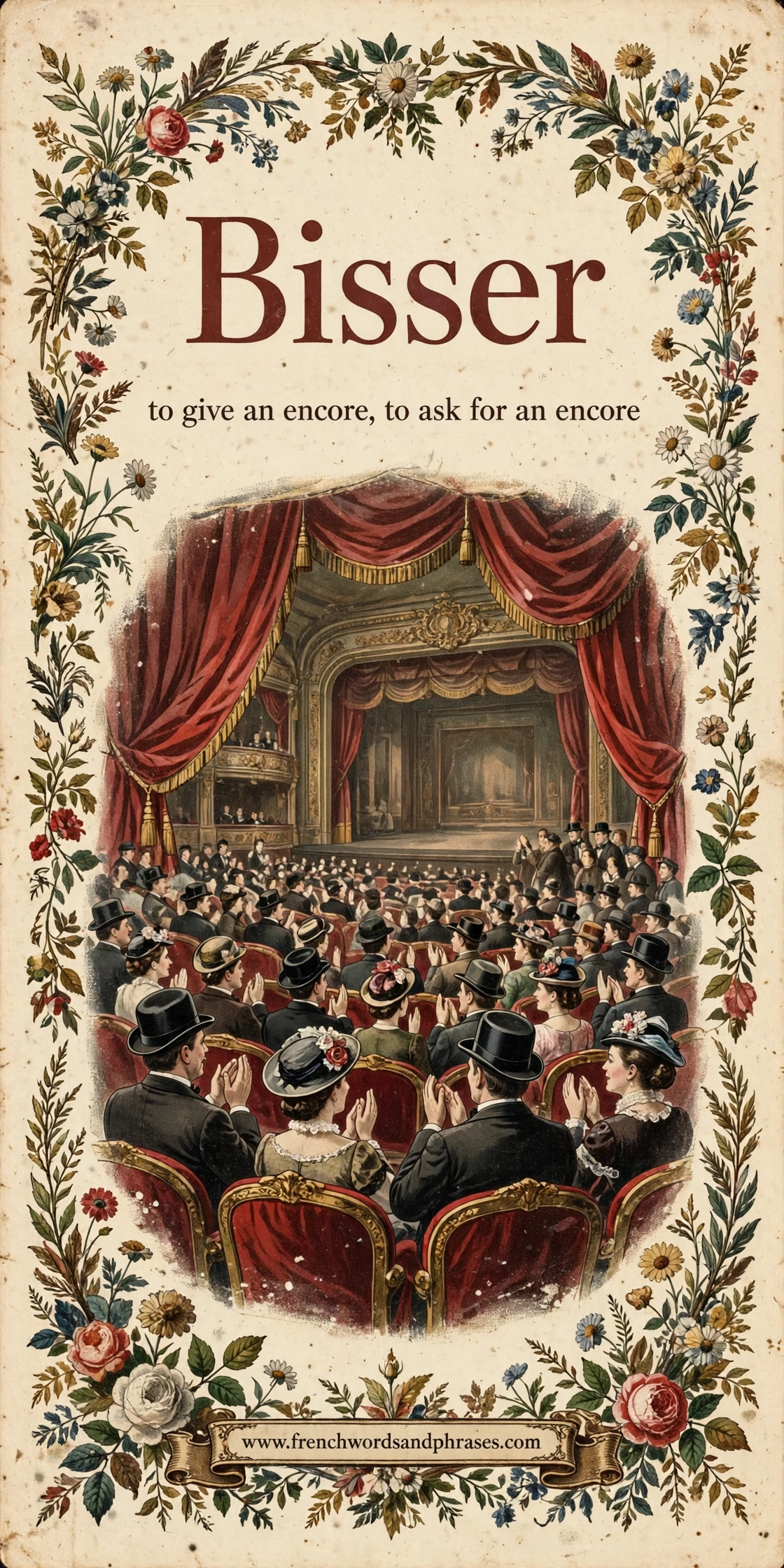
The concert is over, the singer has bowed and left — but the hall is on its feet, clapping in rhythm and shouting one small word: « Bis ! » Bis, bis ! — bisser is the verb of that moment, the encore demanded and the encore given.
In this guide, you’ll learn how to conjugate bisser in all the major French tenses and moods. Explore complete conjugation tables, French examples, English translations, and practice quizzes.
Understanding the French Verb Bisser
Bisser is a regular French verb belonging to the first group of verbs, those ending in -er.
It means to give an encore, to ask for an encore. It belongs to concert halls, theatres and opera houses, and it measures success better than any review: an artist who is bissé three times has triumphed. Outside the arts it appears wherever a delighted public demands a repeat performance — a speech, a dish, a trick.
Verb classification: First group (-er)
Auxiliary verb: Avoir
Past participle: bissé
Present participle: bissant
English equivalents: To encore, to call back for an encore, to repeat (a song) as an encore; le public bisse l’artiste — the audience calls the artist back; bisser une chanson — to sing a song again as an encore; un bis — an encore.
One important detail: bisser works in both directions of the theatre. The audience does it — le public bisse la chanteuse, the audience calls the singer back — and the performer does it too: elle bisse sa chanson célèbre, she encores her famous song, she sings it a second time. The verb is born from the shout itself: bis is Latin for « twice », and the French audience still cries « Bis ! » where English cries « Encore ! ». The conjugation is utterly regular: je bisse, nous bissons, past participle bissé.
Experience the Word
Bisser is the verb of « once more ! » — the sound of a audience refusing to let the evening end.
Imagine the last note of the aria fading into silence. For one second, nothing — then the whole hall erupts, feet stamping, hands clapping in time, voices shouting « Bis ! Bis ! » The tenor returns, smiling, bowing — le public l’a bissé, and he will sing it all again.
The concert was already finished. It has been encored back to life — bissé, by a hall on its feet.
How to Conjugate Bisser: Complete French Conjugation Guide
Let’s explore every major conjugation of bisser, beginning with the indicative mood.
How to Conjugate Bisser in the Indicative Mood
The indicative mood is used to express facts, observations, actions, and events.
How to Conjugate Bisser in the Present Tense (Présent)
Used for actions happening now, habitual actions, and general truths.
| Subject | Conjugation |
|---|---|
| je | bisse |
| tu | bisses |
| il / elle | bisse |
| nous | bissons |
| vous | bissez |
| ils / elles | bissent |
Example
À la fin du concert, le public bisse l’orchestre avec enthousiasme.
At the end of the concert, the audience enthusiastically calls the orchestra back.
Quick Quiz 1
Complete the sentence:
Nous ______ le ténor après le concert.
Reveal the answer
bissons
Nous bissons le ténor après le concert.
We call the tenor back after the concert.
How to Conjugate Bisser in the Passé Composé
Used for completed actions in the past. Bisser takes the auxiliary verb avoir.
| Subject | Conjugation |
|---|---|
| j’ | ai bissé |
| tu | as bissé |
| il / elle | a bissé |
| nous | avons bissé |
| vous | avez bissé |
| ils / elles | ont bissé |
Example
Les spectateurs ont bissé le pianiste trois fois.
The audience called the pianist back three times.
How to Conjugate Bisser in the Imparfait (Imperfect Tense)
Used for habitual past actions, descriptions, and ongoing situations in the past.
| Subject | Conjugation |
|---|---|
| je | bissais |
| tu | bissais |
| il / elle | bissait |
| nous | bissions |
| vous | bissiez |
| ils / elles | bissaient |
Example
Autrefois, le public bissait rarement les jeunes artistes.
In the old days, audiences rarely encored young artists.
Quick Quiz 2
Choose the correct form:
The audience called the singer back.
Le public ______ la chanteuse. (a bissé / est bissée)
Reveal the answer
a bissé
Le public a bissé la chanteuse.
Bisser takes avoir.
How to Conjugate Bisser in the Plus-que-parfait
Used to describe an action that had already been completed before another past event.
| Subject | Conjugation |
|---|---|
| j’ | avais bissé |
| tu | avais bissé |
| il / elle | avait bissé |
| nous | avions bissé |
| vous | aviez bissé |
| ils / elles | avaient bissé |
Example
Le public avait bissé le chanteur si fort qu’il était revenu deux fois.
The audience had encored the singer so loudly that he had come back twice.
How to Conjugate Bisser in the Passé Simple
Primarily used in formal writing, literature, and historical narratives. It is rarely used in everyday conversation.
| Subject | Conjugation |
|---|---|
| je | bissai |
| tu | bissas |
| il / elle | bissa |
| nous | bissâmes |
| vous | bissâtes |
| ils / elles | bissèrent |
Example
La salle entière bissa le ténor, qui revint saluer.
The whole hall called the tenor back, and he returned to take a bow.
How to Conjugate Bisser in the Passé Antérieur
A literary tense used to express an action completed immediately before another past action, generally in the passé simple.
| Subject | Conjugation |
|---|---|
| j’ | eus bissé |
| tu | eus bissé |
| il / elle | eut bissé |
| nous | eûmes bissé |
| vous | eûtes bissé |
| ils / elles | eurent bissé |
Example
Quand le public eut bissé l’actrice, elle reparut en larmes.
When the audience had called the actress back, she reappeared in tears.
How to Conjugate Bisser in the Future Tense (Futur Simple)
Used to describe actions that will take place in the future.
| Subject | Conjugation |
|---|---|
| je | bisserai |
| tu | bisseras |
| il / elle | bissera |
| nous | bisserons |
| vous | bisserez |
| ils / elles | bisseront |
Example
Si le concert est réussi, le public bissera les musiciens.
If the concert goes well, the audience will encore the musicians.
How to Conjugate Bisser in the Futur Antérieur (Future Perfect)
Used for an action that will have been completed before a particular point in the future.
| Subject | Conjugation |
|---|---|
| j’ | aurai bissé |
| tu | auras bissé |
| il / elle | aura bissé |
| nous | aurons bissé |
| vous | aurez bissé |
| ils / elles | auront bissé |
Example
À la fin de la soirée, le public aura bissé la vedette quatre fois.
By the end of the evening, the audience will have called the star back four times.
How to Conjugate Bisser in the Near Future (Futur Proche)
Used to describe something that is going to happen soon. Formed with aller + infinitive.
| Subject | Conjugation |
|---|---|
| je | vais bisser |
| tu | vas bisser |
| il / elle | va bisser |
| nous | allons bisser |
| vous | allez bisser |
| ils / elles | vont bisser |
Example
Écoute ces applaudissements : ils vont bisser l’orchestre !
Listen to that applause: they are going to encore the orchestra!
How to Conjugate Bisser in the Conditional Mood
The conditional mood expresses what would happen under certain circumstances. It is also frequently used to make polite requests or express wishes.
How to Conjugate Bisser in the Present Conditional
| Subject | Conjugation |
|---|---|
| je | bisserais |
| tu | bisserais |
| il / elle | bisserait |
| nous | bisserions |
| vous | bisseriez |
| ils / elles | bisseraient |
Example
Avec un tel succès, le public bisserait même le décor.
With such a success, the audience would encore even the scenery.
How to Conjugate Bisser in the Past Conditional
| Subject | Conjugation |
|---|---|
| j’ | aurais bissé |
| tu | aurais bissé |
| il / elle | aurait bissé |
| nous | aurions bissé |
| vous | auriez bissé |
| ils / elles | auraient bissé |
Example
Le public aurait bissé le chanteur s’il n’était pas parti si vite.
The audience would have encored the singer if he had not left so quickly.
Bisser in the Literary Past Conditional Form
This less common literary form uses the imperfect subjunctive of avoir.
| Subject | Conjugation |
|---|---|
| j’ | eusse bissé |
| tu | eusses bissé |
| il / elle | eût bissé |
| nous | eussions bissé |
| vous | eussiez bissé |
| ils / elles | eussent bissé |
Example
La salle eût bissé l’artiste jusqu’au matin.
The hall would have called the artist back until morning.
How to Conjugate Bisser in the Subjunctive Mood
The subjunctive is used to express wishes, emotions, doubts, necessity, and uncertainty. It frequently follows expressions such as il faut que (it is necessary that) or bien que (although).
How to Conjugate Bisser in the Present Subjunctive
| Subject | Conjugation |
|---|---|
| que je | bisse |
| que tu | bisses |
| qu’il / qu’elle | bisse |
| que nous | bissions |
| que vous | bissiez |
| qu’ils / qu’elles | bissent |
Example
Il est rare que le public bisse un premier concert.
It is rare for an audience to encore a first concert.
Quick Quiz 3
Complete the sentence using the subjunctive:
Il est rare que le public ______ un débutant.
Reveal the answer
bisse
Il est rare que le public bisse un débutant.
It is rare for an audience to encore a beginner.
How to Conjugate Bisser in the Imperfect Subjunctive
A literary tense, rarely encountered in modern spoken French.
| Subject | Conjugation |
|---|---|
| que je | bissasse |
| que tu | bissasses |
| qu’il / qu’elle | bissât |
| que nous | bissassions |
| que vous | bissassiez |
| qu’ils / qu’elles | bissassent |
Example
Le chef espérait que la salle bissât son orchestre.
The conductor hoped the hall would encore his orchestra.
How to Conjugate Bisser in the Pluperfect Subjunctive
A literary construction used to express an action completed before another past action.
| Subject | Conjugation |
|---|---|
| que j’ | eusse bissé |
| que tu | eusses bissé |
| qu’il / qu’elle | eût bissé |
| que nous | eussions bissé |
| que vous | eussiez bissé |
| qu’ils / qu’elles | eussent bissé |
Example
On racontait que le public eût bissé le ténor sept fois.
It was said that the audience had called the tenor back seven times.
How to Conjugate Bisser in the Past Subjunctive
| Subject | Conjugation |
|---|---|
| que j’ | aie bissé |
| que tu | aies bissé |
| qu’il / qu’elle | ait bissé |
| que nous | ayons bissé |
| que vous | ayez bissé |
| qu’ils / qu’elles | aient bissé |
Example
Je suis ravi que le public ait bissé nos élèves.
I am delighted that the audience encored our students.
How to Conjugate Bisser in the Imperative
The imperative is used to give commands, instructions, invitations, or suggestions. Subject pronouns are omitted.
How to Conjugate Bisser in the Present Imperative
| Person | Conjugation |
|---|---|
| (tu) | bisse |
| (nous) | bissons |
| (vous) | bissez |
Example
Bissez-la, elle le mérite !
Call her back, she deserves it!
Quick Quiz 4
How would you say Call her back for an encore (tu form)?
Reveal the answer
Bisse-la !
French Participles of Bisser
Participles are verb forms that can be used in compound tenses and other grammatical constructions.
Present Participle of Bisser
bissant
En bissant l’artiste, le public obtient une dernière chanson.
By calling for an encore, the audience obtains one last song.
Past Participle of Bisser
bissé
Bissée par une salle debout, la chanteuse a chanté une dernière fois.
Called back by a standing audience, the singer sang one last time.
Bisser in Everyday French: Real-Life Examples
Now that you know the conjugations, let’s see how bisser appears in everyday French.
Example 1 — Present
Le public bisse la chanteuse.
The audience calls the singer back for an encore.
Example 2 — Passé composé
Ils ont bissé le pianiste trois fois.
They called the pianist back three times.
Example 3 — Imparfait
On bissait les grands acteurs autrefois.
People used to encore the great actors in the old days.
Example 4 — Future
Le public bissera l’orchestre, c’est sûr.
The audience will encore the orchestra, for sure.
Example 5 — Conditional
Elle bisserait volontiers ce chanteur.
She would gladly encore this singer.
Example 6 — Imperative
Bissez l’orchestre !
Call the orchestra back!
Beyond Translation: The Meaning of Bisser
English says encore — a French word borrowed for the shout — but French kept the older cry, bis, Latin for « twice », and built its verb on it: bisser.
The noun is just as alive.
Un bis is the encore itself — the extra song — and French addresses even carry the word: a house numbered 12 bis is the second number 12 on the street, the encore house.
How to Remember the French Verb Bisser
Remember it this way: Bisser is about the whole hall on its feet shouting « Bis ! Bis ! ».
- Born from the shout « Bis ! » — Latin for twice — which French audiences cry instead of « Encore ! ».
- It works both ways: le public bisse l’artiste (calls back), l’artiste bisse une chanson (sings it again).
- Regular -er: je bisse, nous bissons, past participle bissé; the encore itself is un bis.
The key idea is the whole hall on its feet shouting « Bis ! Bis ! ».
Test Your Knowledge of Bisser
Let’s see how much you’ve learned. Try answering these questions before revealing the answers.
Question 1
What do French audiences shout to trigger this verb?
Reveal the answer
« Bis ! » — Latin for « twice »: sing it a second time!
Question 2
How do you say The audience called the pianist back three times in French?
Reveal the answer
Le public a bissé le pianiste trois fois.
Question 3
Translate: The singer encored her most famous song.
Reveal the answer
La chanteuse a bissé sa chanson la plus célèbre.
Question 4
What is the past participle of bisser?
Reveal the answer
Bissé.
Question 5
Complete the sentence:
Il est rare que le public ______ un premier concert.
Reveal the answer
bisse
Il est rare que le public bisse un premier concert.
It is rare for an audience to encore a first concert.
Your Final Challenge
Can You Use It?
How would you say this in French?
The audience calls the singer back a third time, and she returns, tears in her eyes, to sing for it alone.
Reveal the answer
Le public bisse la chanteuse une troisième fois, et elle revient, les larmes aux yeux, chanter pour lui seul.
The audience calls the singer back a third time, and she returns, tears in her eyes, to sing for it alone.
A little French. A little curiosity. A richer everyday life.
LEARN FRENCH ONE WORD AT A TIME