A French Word to Live By
How to Conjugate Biseauter in French
/bi.zo.te/
Biseauter means to bevel — to cut an edge at a slant instead of leaving it square, so that it catches the light.
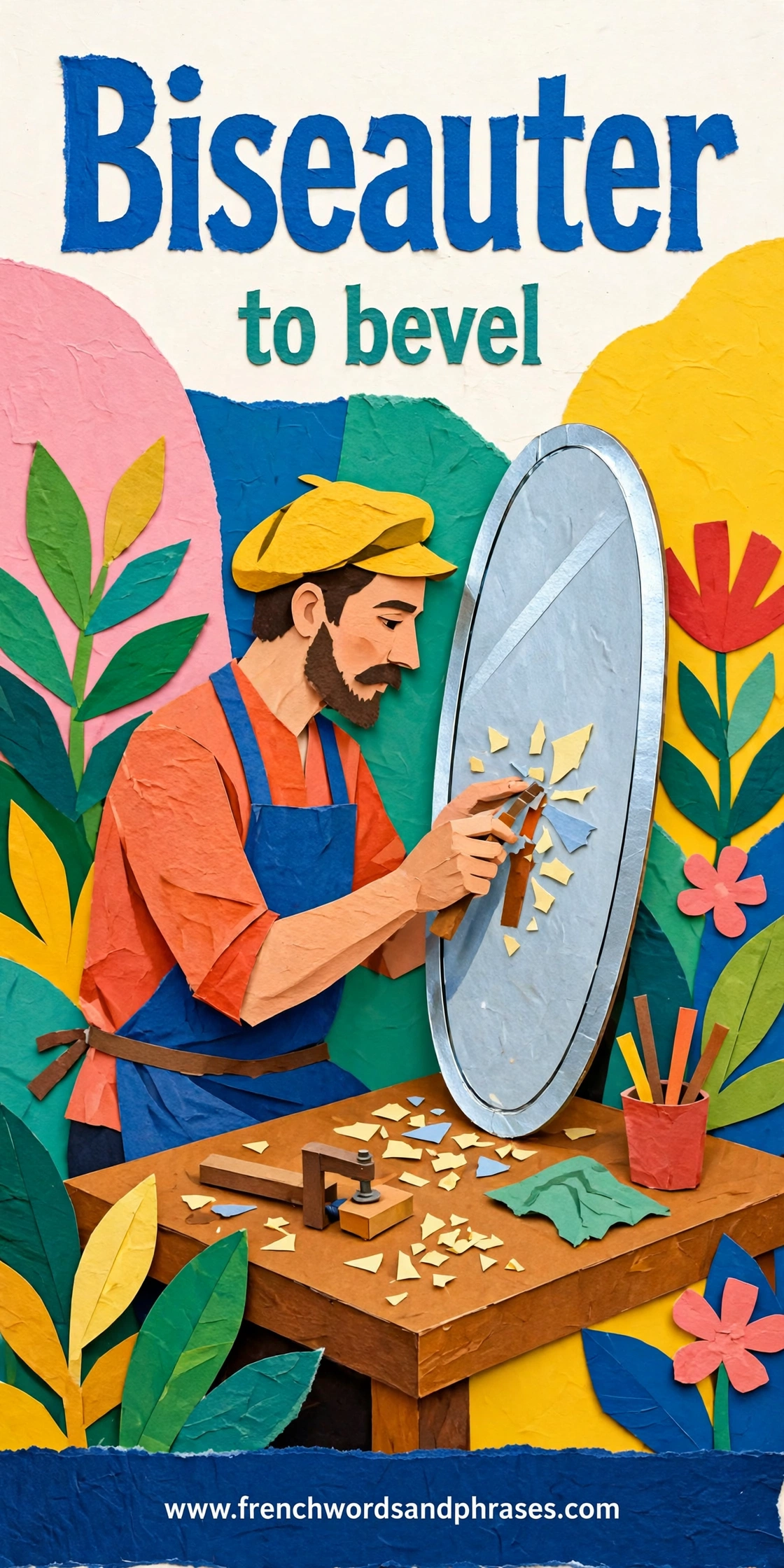
A glazier’s workshop, a great mirror lying on the bench, its edges ground to a shining slope that throws back the light in a thin rainbow line — biseauter is the craftsman’s cut at forty-five degrees, the slant that turns a plain edge into a jewel.
In this guide, you’ll learn how to conjugate biseauter in all the major French tenses and moods. Explore complete conjugation tables, French examples, English translations, and practice quizzes.
Understanding the French Verb Biseauter
Biseauter is a regular French verb belonging to the first group of verbs, those ending in -er.
It means to bevel. Carpenters, glaziers and stonecutters biseautent edges to remove sharpness, to fit pieces together, or purely for beauty — the bevelled edge of a mirror or a marble slab is decoration made by subtraction, a frame the material cuts into itself.
Verb classification: First group (-er)
Auxiliary verb: Avoir
Past participle: biseauté
Present participle: biseautant
English equivalents: To bevel, to chamfer; biseauter un miroir — to bevel a mirror; une glace biseautée — a bevelled mirror; biseauter une planche — to bevel a plank; le biseau — the bevel, the slanted edge itself.
One important detail: the noun is the key — un biseau is the slanted edge itself (also a chisel’s bevel, and in geometry a bevel), and biseauter is to cut that slant. Its classic partner is glass: une glace biseautée, un miroir biseauté — a bevelled mirror, the kind that lined old Parisian cafés. The past participle doubles as the everyday adjective: des angles biseautés. The verb is a regular -er: je biseaute, nous biseautons, past participle biseauté.
Experience the Word
Biseauter is the verb of the elegant edge — nothing added, everything refined by taking a corner away.
Imagine a mirror-maker finishing a great café mirror. The glass is cut, the silvering done; now the wheel hums against the edge — il biseaute la glace — and a bright slope appears, four centimetres of pure light running round the glass like a frame made of the mirror itself.
The mirror has gained no ornament at all. It has simply been bevelled — biseautée — and the light does the rest.
How to Conjugate Biseauter: Complete French Conjugation Guide
Let’s explore every major conjugation of biseauter, beginning with the indicative mood.
How to Conjugate Biseauter in the Indicative Mood
The indicative mood is used to express facts, observations, actions, and events.
How to Conjugate Biseauter in the Present Tense (Présent)
Used for actions happening now, habitual actions, and general truths.
| Subject | Conjugation |
|---|---|
| je | biseaute |
| tu | biseautes |
| il / elle | biseaute |
| nous | biseautons |
| vous | biseautez |
| ils / elles | biseautent |
Example
Le menuisier biseaute le bord de la planche.
The carpenter bevels the edge of the plank.
Quick Quiz 1
Complete the sentence:
Nous ______ le bord de la planche.
Reveal the answer
biseautons
Nous biseautons le bord de la planche.
We bevel the edge of the plank.
How to Conjugate Biseauter in the Passé Composé
Used for completed actions in the past. Biseauter takes the auxiliary verb avoir.
| Subject | Conjugation |
|---|---|
| j’ | ai biseauté |
| tu | as biseauté |
| il / elle | a biseauté |
| nous | avons biseauté |
| vous | avez biseauté |
| ils / elles | ont biseauté |
Example
Elle a biseauté les angles du miroir.
She bevelled the corners of the mirror.
How to Conjugate Biseauter in the Imparfait (Imperfect Tense)
Used for habitual past actions, descriptions, and ongoing situations in the past.
| Subject | Conjugation |
|---|---|
| je | biseautais |
| tu | biseautais |
| il / elle | biseautait |
| nous | biseautions |
| vous | biseautiez |
| ils / elles | biseautaient |
Example
Autrefois, on biseautait les glaces à la main.
In the old days, mirrors were bevelled by hand.
Quick Quiz 2
Choose the correct form:
He bevelled the edge of the table.
Il ______ le bord de la table. (a biseauté / est biseauté)
Reveal the answer
a biseauté
Il a biseauté le bord de la table.
Biseauter takes avoir.
How to Conjugate Biseauter in the Plus-que-parfait
Used to describe an action that had already been completed before another past event.
| Subject | Conjugation |
|---|---|
| j’ | avais biseauté |
| tu | avais biseauté |
| il / elle | avait biseauté |
| nous | avions biseauté |
| vous | aviez biseauté |
| ils / elles | avaient biseauté |
Example
Il avait biseauté la vitre avant de la poser.
He had bevelled the pane before fitting it.
How to Conjugate Biseauter in the Passé Simple
Primarily used in formal writing, literature, and historical narratives. It is rarely used in everyday conversation.
| Subject | Conjugation |
|---|---|
| je | biseautai |
| tu | biseautas |
| il / elle | biseauta |
| nous | biseautâmes |
| vous | biseautâtes |
| ils / elles | biseautèrent |
Example
L’artisan biseauta le marbre avec précision.
The craftsman bevelled the marble with precision.
How to Conjugate Biseauter in the Passé Antérieur
A literary tense used to express an action completed immediately before another past action, generally in the passé simple.
| Subject | Conjugation |
|---|---|
| j’ | eus biseauté |
| tu | eus biseauté |
| il / elle | eut biseauté |
| nous | eûmes biseauté |
| vous | eûtes biseauté |
| ils / elles | eurent biseauté |
Example
Quand il eut biseauté le cadre, il le dora.
When he had bevelled the frame, he gilded it.
How to Conjugate Biseauter in the Future Tense (Futur Simple)
Used to describe actions that will take place in the future.
| Subject | Conjugation |
|---|---|
| je | biseauterai |
| tu | biseauteras |
| il / elle | biseautera |
| nous | biseauterons |
| vous | biseauterez |
| ils / elles | biseauteront |
Example
Je biseauterai les étagères ce week-end.
I shall bevel the shelves this weekend.
How to Conjugate Biseauter in the Futur Antérieur (Future Perfect)
Used for an action that will have been completed before a particular point in the future.
| Subject | Conjugation |
|---|---|
| j’ | aurai biseauté |
| tu | auras biseauté |
| il / elle | aura biseauté |
| nous | aurons biseauté |
| vous | aurez biseauté |
| ils / elles | auront biseauté |
Example
À midi, le vitrier aura biseauté toutes les glaces.
By noon, the glazier will have bevelled all the mirrors.
How to Conjugate Biseauter in the Near Future (Futur Proche)
Used to describe something that is going to happen soon. Formed with aller + infinitive.
| Subject | Conjugation |
|---|---|
| je | vais biseauter |
| tu | vas biseauter |
| il / elle | va biseauter |
| nous | allons biseauter |
| vous | allez biseauter |
| ils / elles | vont biseauter |
Example
Tu vas biseauter ce miroir pour la salle de bains ?
Are you going to bevel this mirror for the bathroom?
How to Conjugate Biseauter in the Conditional Mood
The conditional mood expresses what would happen under certain circumstances. It is also frequently used to make polite requests or express wishes.
How to Conjugate Biseauter in the Present Conditional
| Subject | Conjugation |
|---|---|
| je | biseauterais |
| tu | biseauterais |
| il / elle | biseauterait |
| nous | biseauterions |
| vous | biseauteriez |
| ils / elles | biseauteraient |
Example
Avec une meule fine, on biseauterait ce verre sans l’ébrécher.
With a fine wheel, you could bevel this glass without chipping it.
How to Conjugate Biseauter in the Past Conditional
| Subject | Conjugation |
|---|---|
| j’ | aurais biseauté |
| tu | aurais biseauté |
| il / elle | aurait biseauté |
| nous | aurions biseauté |
| vous | auriez biseauté |
| ils / elles | auraient biseauté |
Example
Elle aurait biseauté la planche sans la panne de la machine.
She would have bevelled the plank if the machine had not broken down.
Biseauter in the Literary Past Conditional Form
This less common literary form uses the imperfect subjunctive of avoir.
| Subject | Conjugation |
|---|---|
| j’ | eusse biseauté |
| tu | eusses biseauté |
| il / elle | eût biseauté |
| nous | eussions biseauté |
| vous | eussiez biseauté |
| ils / elles | eussent biseauté |
Example
Il eût biseauté le miroir entier sans la nuit tombante.
He would have bevelled the whole mirror if night had not fallen.
How to Conjugate Biseauter in the Subjunctive Mood
The subjunctive is used to express wishes, emotions, doubts, necessity, and uncertainty. It frequently follows expressions such as il faut que (it is necessary that) or bien que (although).
How to Conjugate Biseauter in the Present Subjunctive
| Subject | Conjugation |
|---|---|
| que je | biseaute |
| que tu | biseautes |
| qu’il / qu’elle | biseaute |
| que nous | biseautions |
| que vous | biseautiez |
| qu’ils / qu’elles | biseautent |
Example
Il faut que tu biseautes le bord pour éviter les coupures.
You must bevel the edge to avoid cuts.
Quick Quiz 3
Complete the sentence using the subjunctive:
Il faut que vous ______ les quatre côtés.
Reveal the answer
biseautiez
Il faut que vous biseautiez les quatre côtés.
You must bevel all four sides.
How to Conjugate Biseauter in the Imperfect Subjunctive
A literary tense, rarely encountered in modern spoken French.
| Subject | Conjugation |
|---|---|
| que je | biseautasse |
| que tu | biseautasses |
| qu’il / qu’elle | biseautât |
| que nous | biseautassions |
| que vous | biseautassiez |
| qu’ils / qu’elles | biseautassent |
Example
Le client demanda que l’ouvrier biseautât les quatre côtés.
The customer asked the workman to bevel all four sides.
How to Conjugate Biseauter in the Pluperfect Subjunctive
A literary construction used to express an action completed before another past action.
| Subject | Conjugation |
|---|---|
| que j’ | eusse biseauté |
| que tu | eusses biseauté |
| qu’il / qu’elle | eût biseauté |
| que nous | eussions biseauté |
| que vous | eussiez biseauté |
| qu’ils / qu’elles | eussent biseauté |
Example
On admirait qu’il eût biseauté la glace sans une seule éraflure.
People admired that he had bevelled the mirror without a single scratch.
How to Conjugate Biseauter in the Past Subjunctive
| Subject | Conjugation |
|---|---|
| que j’ | aie biseauté |
| que tu | aies biseauté |
| qu’il / qu’elle | ait biseauté |
| que nous | ayons biseauté |
| que vous | ayez biseauté |
| qu’ils / qu’elles | aient biseauté |
Example
Je suis content que vous ayez biseauté les angles.
I am glad you bevelled the corners.
How to Conjugate Biseauter in the Imperative
The imperative is used to give commands, instructions, invitations, or suggestions. Subject pronouns are omitted.
How to Conjugate Biseauter in the Present Imperative
| Person | Conjugation |
|---|---|
| (tu) | biseaute |
| (nous) | biseautons |
| (vous) | biseautez |
Example
Biseaute les bords, pas le centre !
Bevel the edges, not the middle!
Quick Quiz 4
How would you say Bevel the edges, not the middle (tu form)?
Reveal the answer
Biseaute les bords, pas le centre !
French Participles of Biseauter
Participles are verb forms that can be used in compound tenses and other grammatical constructions.
Present Participle of Biseauter
biseautant
En biseautant le verre, le vitrier crée un filet de lumière.
By bevelling the glass, the glazier creates a thread of light.
Past Participle of Biseauter
biseauté
Biseautée sur les bords, la glace reflète la lumière en arc-en-ciel.
Bevelled at the edges, the mirror reflects the light in a rainbow.
Biseauter in Everyday French: Real-Life Examples
Now that you know the conjugations, let’s see how biseauter appears in everyday French.
Example 1 — Present
Le vitrier biseaute les miroirs.
The glazier bevels the mirrors.
Example 2 — Passé composé
Il a biseauté le bord de la table.
He bevelled the edge of the table.
Example 3 — Imparfait
On biseautait les glaces à la main.
Mirrors used to be bevelled by hand.
Example 4 — Future
Je biseauterai cette planche demain.
I shall bevel this plank tomorrow.
Example 5 — Conditional
Elle biseauterait le verre avec une meilleure meule.
She would bevel the glass with a better wheel.
Example 6 — Imperative
Biseaute les angles, ils sont tranchants !
Bevel the corners, they are sharp!
Beyond Translation: The Meaning of Biseauter
French cuts a whole geometry of slants from this one root: en biseau means diagonally, a chisel’s edge is a biseau, and the bevelled mirror — la glace biseautée — became a fixture of Parisian café walls.
The bevel is the humblest of luxuries.
No gold, no carving: just an edge persuaded to meet the light at an angle, and a plain sheet of glass turned into furniture.
How to Remember the French Verb Biseauter
Remember it this way: Biseauter is about the bevelled mirror edge catching the light.
- Un biseau is the slant itself; biseauter is cutting it — remember the pair together.
- Its set phrase is glass: une glace biseautée, un miroir biseauté — the bevelled mirror of old cafés.
- Regular -er: je biseaute, nous biseautons, past participle biseauté.
The key idea is the bevelled mirror edge catching the light.
Test Your Knowledge of Biseauter
Let’s see how much you’ve learned. Try answering these questions before revealing the answers.
Question 1
What is un biseau, and what does biseauter do to it?
Reveal the answer
Un biseau is the slanted edge itself — biseauter cuts that slant into an edge.
Question 2
How do you say The glazier bevels the mirrors in French?
Reveal the answer
Le vitrier biseaute les miroirs.
Question 3
Translate: She bevelled the corners of the mirror.
Reveal the answer
Elle a biseauté les angles du miroir.
Question 4
What is the past participle of biseauter?
Reveal the answer
Biseauté — une glace biseautée.
Question 5
Complete the sentence:
Il faut que tu ______ le bord pour éviter les coupures.
Reveal the answer
biseautes
Il faut que tu biseautes le bord pour éviter les coupures.
You must bevel the edge to avoid cuts.
Your Final Challenge
Can You Use It?
How would you say this in French?
He bevels the mirror slowly, and the mirror frames itself with light.
Reveal the answer
Il biseaute la glace lentement, et le miroir se borde lui-même de lumière.
He bevels the mirror slowly, and the mirror frames itself with light.
A little French. A little curiosity. A richer everyday life.
LEARN FRENCH ONE WORD AT A TIME