A French Word to Live By
How to Conjugate Biner in French
/bi.ne/
Biner means to hoe — to loosen the soil between young plants with a hoe, the gardener’s careful second pass after planting.
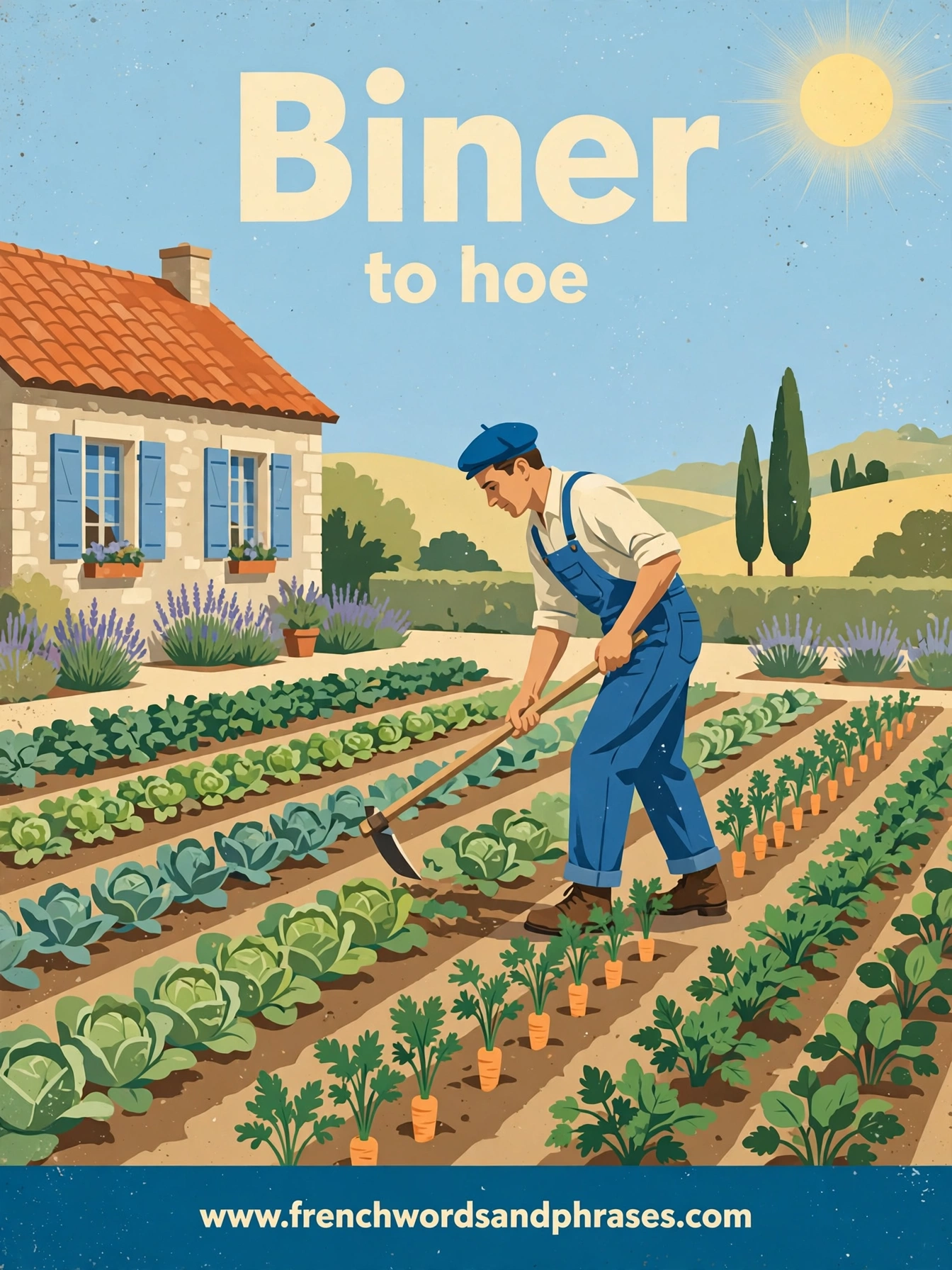
A vegetable garden in June, rows of young potatoes stretching away, and a gardener moving slowly backwards down each row, hoe flashing in the sun — biner is the quiet, essential work between planting and harvest.
In this guide, you’ll learn how to conjugate biner in all the major French tenses and moods. Explore complete conjugation tables, French examples, English translations, and practice quizzes.
Understanding the French Verb Biner
Biner is a regular French verb belonging to the first group of verbs, those ending in -er.
It means to hoe. It belongs to the potager and the vineyard row: you bine between plants that are already growing, never on bare empty ground, and the gesture is quick and shallow — the binette skims the surface rather than turning the earth over.
Verb classification: First group (-er)
Auxiliary verb: Avoir
Past participle: biné
Present participle: binant
English equivalents: To hoe, to harrow lightly; biner les pommes de terre — to hoe the potatoes; biner un rang de haricots — to hoe a row of beans; un binage — a hoeing; la binette — the hoe itself.
One important detail: the tool gives the verb — la binette is the light hoe, and biner is the shallow cultivation between rows that breaks the crust, cuts young weeds and lets air and rain into the soil. It is lighter than bêcher (to dig) and more than sarcler (to weed). The gardeners’ proverb sums it up: un binage vaut deux arrosages — one hoeing is worth two waterings. The verb is a regular -er: je bine, nous binons, past participle biné.
Experience the Word
Biner is the verb of the garden’s in-between season — nothing to sow, nothing to pick, everything to keep alive.
Imagine a June morning in a village potager. The potatoes are knee-high, the soil has baked into a crust, and the gardener works down the rows — bine, bine, bine — the hoe ticking against the earth, weeds falling, the soil loosening around every plant before the heat of the day.
By breakfast, every row is breathing again. He has hoed — biné — and the proverb says it was worth two waterings.
How to Conjugate Biner: Complete French Conjugation Guide
Let’s explore every major conjugation of biner, beginning with the indicative mood.
How to Conjugate Biner in the Indicative Mood
The indicative mood is used to express facts, observations, actions, and events.
How to Conjugate Biner in the Present Tense (Présent)
Used for actions happening now, habitual actions, and general truths.
| Subject | Conjugation |
|---|---|
| je | bine |
| tu | bines |
| il / elle | bine |
| nous | binons |
| vous | binez |
| ils / elles | binent |
Example
Le jardinier bine les pommes de terre au mois de juin.
The gardener hoes the potatoes in June.
Quick Quiz 1
Complete the sentence:
Nous ______ les légumes chaque semaine.
Reveal the answer
binons
Nous binons les légumes chaque semaine.
We hoe the vegetables every week.
How to Conjugate Biner in the Passé Composé
Used for completed actions in the past. Biner takes the auxiliary verb avoir.
| Subject | Conjugation |
|---|---|
| j’ | ai biné |
| tu | as biné |
| il / elle | a biné |
| nous | avons biné |
| vous | avez biné |
| ils / elles | ont biné |
Example
Elle a biné les haricots hier matin.
She hoed the beans yesterday morning.
How to Conjugate Biner in the Imparfait (Imperfect Tense)
Used for habitual past actions, descriptions, and ongoing situations in the past.
| Subject | Conjugation |
|---|---|
| je | binais |
| tu | binais |
| il / elle | binait |
| nous | binions |
| vous | biniez |
| ils / elles | binaient |
Example
Mon grand-père binait ses légumes chaque semaine.
My grandfather used to hoe his vegetables every week.
Quick Quiz 2
Choose the correct form:
She hoed the whole garden.
Elle ______ tout le potager. (a biné / est biné)
Reveal the answer
a biné
Elle a biné tout le potager.
Biner takes avoir.
How to Conjugate Biner in the Plus-que-parfait
Used to describe an action that had already been completed before another past event.
| Subject | Conjugation |
|---|---|
| j’ | avais biné |
| tu | avais biné |
| il / elle | avait biné |
| nous | avions biné |
| vous | aviez biné |
| ils / elles | avaient biné |
Example
Nous avions biné les rangs avant la pluie.
We had hoed the rows before the rain.
How to Conjugate Biner in the Passé Simple
Primarily used in formal writing, literature, and historical narratives. It is rarely used in everyday conversation.
| Subject | Conjugation |
|---|---|
| je | binai |
| tu | binas |
| il / elle | bina |
| nous | binâmes |
| vous | binâtes |
| ils / elles | binèrent |
Example
Il bina le jardin entier avant la nuit.
He hoed the whole garden before nightfall.
How to Conjugate Biner in the Passé Antérieur
A literary tense used to express an action completed immediately before another past action, generally in the passé simple.
| Subject | Conjugation |
|---|---|
| j’ | eus biné |
| tu | eus biné |
| il / elle | eut biné |
| nous | eûmes biné |
| vous | eûtes biné |
| ils / elles | eurent biné |
Example
Quand elle eut biné le dernier rang, elle rentra dîner.
When she had hoed the last row, she went in for dinner.
How to Conjugate Biner in the Future Tense (Futur Simple)
Used to describe actions that will take place in the future.
| Subject | Conjugation |
|---|---|
| je | binerai |
| tu | bineras |
| il / elle | binera |
| nous | binerons |
| vous | binerez |
| ils / elles | bineront |
Example
Demain, je binerai les betteraves et les carottes.
Tomorrow, I shall hoe the beetroot and the carrots.
How to Conjugate Biner in the Futur Antérieur (Future Perfect)
Used for an action that will have been completed before a particular point in the future.
| Subject | Conjugation |
|---|---|
| j’ | aurai biné |
| tu | auras biné |
| il / elle | aura biné |
| nous | aurons biné |
| vous | aurez biné |
| ils / elles | auront biné |
Example
À la fin du mois, nous aurons biné tout le potager.
By the end of the month, we shall have hoed the whole vegetable garden.
How to Conjugate Biner in the Near Future (Futur Proche)
Used to describe something that is going to happen soon. Formed with aller + infinitive.
| Subject | Conjugation |
|---|---|
| je | vais biner |
| tu | vas biner |
| il / elle | va biner |
| nous | allons biner |
| vous | allez biner |
| ils / elles | vont biner |
Example
Je vais biner les courgettes avant qu’il fasse trop chaud.
I am going to hoe the courgettes before it gets too hot.
How to Conjugate Biner in the Conditional Mood
The conditional mood expresses what would happen under certain circumstances. It is also frequently used to make polite requests or express wishes.
How to Conjugate Biner in the Present Conditional
| Subject | Conjugation |
|---|---|
| je | binerais |
| tu | binerais |
| il / elle | binerait |
| nous | binerions |
| vous | bineriez |
| ils / elles | bineraient |
Example
Avec une bonne binette, tu binerais ce rang en dix minutes.
With a good hoe, you would hoe this row in ten minutes.
How to Conjugate Biner in the Past Conditional
| Subject | Conjugation |
|---|---|
| j’ | aurais biné |
| tu | aurais biné |
| il / elle | aurait biné |
| nous | aurions biné |
| vous | auriez biné |
| ils / elles | auraient biné |
Example
Elle aurait biné les haricots sans la pluie de l’après-midi.
She would have hoed the beans without the afternoon rain.
Biner in the Literary Past Conditional Form
This less common literary form uses the imperfect subjunctive of avoir.
| Subject | Conjugation |
|---|---|
| j’ | eusse biné |
| tu | eusses biné |
| il / elle | eût biné |
| nous | eussions biné |
| vous | eussiez biné |
| ils / elles | eussent biné |
Example
Il eût biné tout le jardin sans la chaleur écrasante.
He would have hoed the whole garden without the crushing heat.
How to Conjugate Biner in the Subjunctive Mood
The subjunctive is used to express wishes, emotions, doubts, necessity, and uncertainty. It frequently follows expressions such as il faut que (it is necessary that) or bien que (although).
How to Conjugate Biner in the Present Subjunctive
| Subject | Conjugation |
|---|---|
| que je | bine |
| que tu | bines |
| qu’il / qu’elle | bine |
| que nous | binions |
| que vous | biniez |
| qu’ils / qu’elles | binent |
Example
Il faut que je bine les pommes de terre cette semaine.
I must hoe the potatoes this week.
Quick Quiz 3
Complete the sentence using the subjunctive:
Il faut que vous ______ entre les rangs.
Reveal the answer
biniez
Il faut que vous biniez entre les rangs.
You must hoe between the rows.
How to Conjugate Biner in the Imperfect Subjunctive
A literary tense, rarely encountered in modern spoken French.
| Subject | Conjugation |
|---|---|
| que je | binasse |
| que tu | binasses |
| qu’il / qu’elle | binât |
| que nous | binassions |
| que vous | binassiez |
| qu’ils / qu’elles | binassent |
Example
Le jardinier voulait que son fils binât les rangs bien droits.
The gardener wanted his son to hoe the rows nice and straight.
How to Conjugate Biner in the Pluperfect Subjunctive
A literary construction used to express an action completed before another past action.
| Subject | Conjugation |
|---|---|
| que j’ | eusse biné |
| que tu | eusses biné |
| qu’il / qu’elle | eût biné |
| que nous | eussions biné |
| que vous | eussiez biné |
| qu’ils / qu’elles | eussent biné |
Example
On disait qu’il eût biné le potager dès l’aube.
People said he had hoed the vegetable garden from dawn.
How to Conjugate Biner in the Past Subjunctive
| Subject | Conjugation |
|---|---|
| que j’ | aie biné |
| que tu | aies biné |
| qu’il / qu’elle | ait biné |
| que nous | ayons biné |
| que vous | ayez biné |
| qu’ils / qu’elles | aient biné |
Example
Je suis content que tu aies biné les haricots à temps.
I am glad you hoed the beans in time.
How to Conjugate Biner in the Imperative
The imperative is used to give commands, instructions, invitations, or suggestions. Subject pronouns are omitted.
How to Conjugate Biner in the Present Imperative
| Person | Conjugation |
|---|---|
| (tu) | bine |
| (nous) | binons |
| (vous) | binez |
Example
Bine entre les rangs sans abîmer les racines !
Hoe between the rows without damaging the roots!
Quick Quiz 4
How would you say Hoe between the rows (tu form)?
Reveal the answer
Bine entre les rangs !
French Participles of Biner
Participles are verb forms that can be used in compound tenses and other grammatical constructions.
Present Participle of Biner
binant
En binant régulièrement, on garde la terre meuble et propre.
By hoeing regularly, you keep the soil loose and clean.
Past Participle of Biner
biné
Biné au printemps, le rang de laitues pousse sans mauvaises herbes.
Hoed in spring, the row of lettuces grows without weeds.
Biner in Everyday French: Real-Life Examples
Now that you know the conjugations, let’s see how biner appears in everyday French.
Example 1 — Present
Je bine les pommes de terre en juin.
I hoe the potatoes in June.
Example 2 — Passé composé
Elle a biné tout le potager.
She hoed the whole vegetable garden.
Example 3 — Imparfait
Nous binions les légumes chaque semaine.
We used to hoe the vegetables every week.
Example 4 — Future
Tu bineras les carottes demain.
You will hoe the carrots tomorrow.
Example 5 — Conditional
Il binerait plus vite avec une binette neuve.
He would hoe faster with a new hoe.
Example 6 — Imperative
Binez entre les rangs, doucement !
Hoe between the rows, gently!
Beyond Translation: The Meaning of Biner
The little hoe has a double life in French: la binette is the tool, and in slang it is also a face — une drôle de binette, a funny mug.
But biner itself never left the garden.
It carries the whole philosophy of the potager in its proverb — un binage vaut deux arrosages — the idea that loosening the soil patiently does more than drowning it in water.
How to Remember the French Verb Biner
Remember it this way: Biner is about the hoe moving down the potato rows in June.
- The tool is la binette; biner is what you do with it — a light pass between growing rows.
- Not digging: biner is shallower than bêcher, and the proverb is your hook — un binage vaut deux arrosages.
- Regular -er: je bine, nous binons, past participle biné.
The key idea is the hoe moving down the potato rows in June.
Test Your Knowledge of Biner
Let’s see how much you’ve learned. Try answering these questions before revealing the answers.
Question 1
What is the gardener’s proverb about biner?
Reveal the answer
Un binage vaut deux arrosages — one hoeing is worth two waterings.
Question 2
How do you say The gardener hoes the potatoes in French?
Reveal the answer
Le jardinier bine les pommes de terre.
Question 3
Translate: She hoed the beans yesterday morning.
Reveal the answer
Elle a biné les haricots hier matin.
Question 4
What is the past participle of biner?
Reveal the answer
Biné.
Question 5
Complete the sentence:
Il faut que je ______ les pommes de terre cette semaine.
Reveal the answer
bine
Il faut que je bine les pommes de terre cette semaine.
I must hoe the potatoes this week.
Your Final Challenge
Can You Use It?
How would you say this in French?
He hoes his potatoes in the early morning, and the garden breathes between the rows.
Reveal the answer
Il bine ses pommes de terre au petit matin, et le jardin respire entre les rangs.
He hoes his potatoes in the early morning, and the garden breathes between the rows.
A little French. A little curiosity. A richer everyday life.
LEARN FRENCH ONE WORD AT A TIME