A French Word to Live By
How to Conjugate Se bigorner in French
/sə bi.ɡɔʁ.ne/
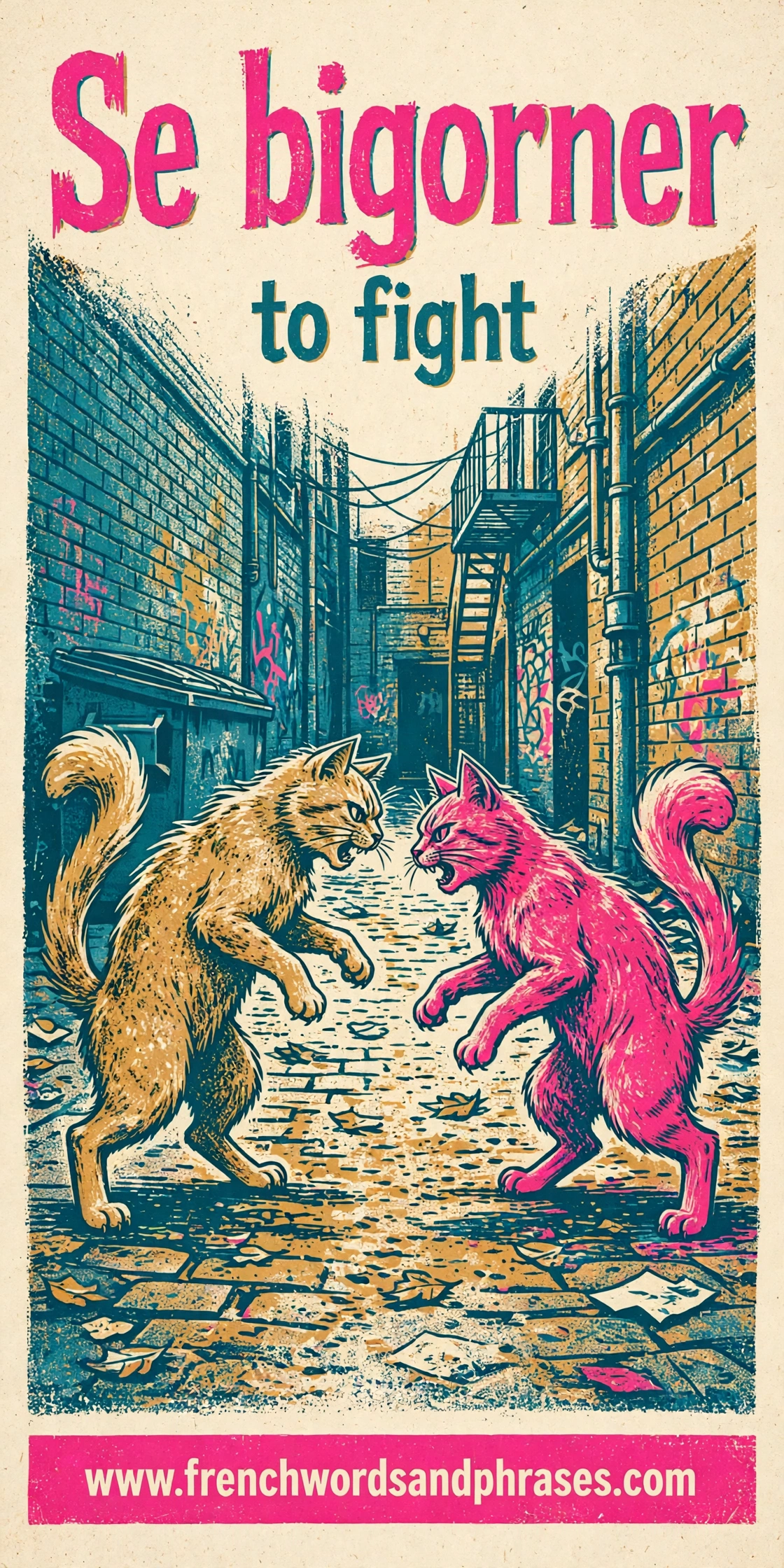
Se bigorner means to fight — to come to blows in familiar French, the schoolyard scrap rather than the battlefield.
A schoolyard at break time, a disputed marble, two boys squaring up while a circle forms around them — se bigorner is the verb of the scrap: fists up, shirts pulled, and everybody friends again by lunch.
In this guide, you’ll learn how to conjugate se bigorner in all the major French tenses and moods. Explore complete conjugation tables, French examples, English translations, and practice quizzes.
Understanding the French Verb Se bigorner
Se bigorner is a regular French verb belonging to the first group of verbs, those ending in -er.
It means to fight. It belongs to playgrounds, terraces and family rows — short, noisy, physical scraps over small things, never to war or serious violence. Two brothers, two neighbours, two cockerels in a farmyard: if they are scrapping, ils se bigornent.
Verb classification: First group (-er), reflexive
Auxiliary verb: Être
Past participle: bigorné
Present participle: bigornant
English equivalents: To fight, to scrap, to come to blows (fam.); se bigorner dans la cour — to scrap in the yard; se bigorner pour un rien — to fight over nothing; se bigorner avec quelqu’un — to have a fight with someone.
One important detail: in the fighting sense the verb lives only in the reflexive — se bigorner — while plain bigorner means to bash or dent something, usually a car. Being reflexive, it takes être in every compound tense and the past participle agrees with the subject: ils se sont bigornés, elles se sont bigornées. The register is familiar: for neutral French use se battre (to fight) or se disputer (to argue). The tu imperative tucks the pronoun behind the verb: bigorne-toi ! — though you will hear the negative far more often: ne te bigorne pas !
Experience the Word
Se bigorner is the verb of the harmless fight — all noise, bumps and torn shirts, and forgotten by dinner.
Imagine the school gate at four o’clock. Two boys disagree about a football, voices rise, the circle forms — et ils se bigornent, rolling on the pavement while their satchels watch. The supervisor arrives, separates them, and by tomorrow they will be best friends again.
Nobody was really hurt. They had simply scrapped — bigornés — the way boys have always done over a ball.
How to Conjugate Se bigorner: Complete French Conjugation Guide
Let’s explore every major conjugation of se bigorner, beginning with the indicative mood.
How to Conjugate Se bigorner in the Indicative Mood
The indicative mood is used to express facts, observations, actions, and events.
How to Conjugate Se bigorner in the Present Tense (Présent)
Used for actions happening now, habitual actions, and general truths.
| Subject | Conjugation |
|---|---|
| je | me bigorne |
| tu | te bigornes |
| il / elle | se bigorne |
| nous | nous bigornons |
| vous | vous bigornez |
| ils / elles | se bigornent |
Example
Les deux frères se bigornent pour un rien.
The two brothers fight over nothing.
Quick Quiz 1
Complete the sentence:
Nous nous ______ pour un rien, parfois.
Reveal the answer
bigornons
Nous nous bigornons pour un rien, parfois.
We fight over nothing, sometimes.
How to Conjugate Se bigorner in the Passé Composé
Used for completed actions in the past. Se bigorner takes the auxiliary verb être.
| Subject | Conjugation |
|---|---|
| je | me suis bigorné / me suis bigornée |
| tu | t’es bigorné / t’es bigornée |
| il / elle | s’est bigorné / s’est bigornée |
| nous | nous sommes bigornés / nous sommes bigornées |
| vous | vous êtes bigornés / vous êtes bigornées / vous êtes bigorné / vous êtes bigornée |
| ils / elles | se sont bigornés / se sont bigornées |
Example
Ils se sont bigornés dans la cour de récréation.
They had a scrap in the playground.
How to Conjugate Se bigorner in the Imparfait (Imperfect Tense)
Used for habitual past actions, descriptions, and ongoing situations in the past.
| Subject | Conjugation |
|---|---|
| je | me bigornais |
| tu | te bigornais |
| il / elle | se bigornait |
| nous | nous bigornions |
| vous | vous bigorniez |
| ils / elles | se bigornaient |
Example
Autrefois, les gamins du quartier se bigornaient tous les samedis.
In the old days, the neighbourhood kids used to scrap every Saturday.
Quick Quiz 2
Choose the correct form:
They had a scrap in the playground.
Ils ______ dans la cour. (se sont bigornés / ont bigorné)
Reveal the answer
se sont bigornés
Ils se sont bigornés dans la cour.
Se bigorner is reflexive and takes être.
How to Conjugate Se bigorner in the Plus-que-parfait
Used to describe an action that had already been completed before another past event.
| Subject | Conjugation |
|---|---|
| je | m’étais bigorné / m’étais bigornée |
| tu | t’étais bigorné / t’étais bigornée |
| il / elle | s’était bigorné / s’était bigornée |
| nous | nous étions bigornés / nous étions bigornées |
| vous | vous étiez bigornés / vous étiez bigornées / vous étiez bigorné / vous étiez bigornée |
| ils / elles | s’étaient bigornés / s’étaient bigornées |
Example
Ils s’étaient déjà bigornés avant l’arrivée du surveillant.
They had already had their fight before the supervisor arrived.
How to Conjugate Se bigorner in the Passé Simple
Primarily used in formal writing, literature, and historical narratives. It is rarely used in everyday conversation.
| Subject | Conjugation |
|---|---|
| je | me bigornai |
| tu | te bigornas |
| il / elle | se bigorna |
| nous | nous bigornâmes |
| vous | vous bigornâtes |
| ils / elles | se bigornèrent |
Example
Les deux coqs se bigornèrent dès l’aube dans la basse-cour.
The two cockerels set about each other at dawn in the farmyard.
How to Conjugate Se bigorner in the Passé Antérieur
A literary tense used to express an action completed immediately before another past action, generally in the passé simple.
| Subject | Conjugation |
|---|---|
| j’ | me fus bigorné / me fus bigornée |
| tu | te fus bigorné / te fus bigornée |
| il / elle | se fut bigorné / se fut bigornée |
| nous | nous fûmes bigornés / nous fûmes bigornées |
| vous | vous fûtes bigornés / vous fûtes bigornées / vous fûtes bigorné / vous fûtes bigornée |
| ils / elles | se furent bigornés / se furent bigornées |
Example
Dès qu’ils se furent bigornés, ils redevinrent amis.
As soon as they had had their scrap, they became friends again.
How to Conjugate Se bigorner in the Future Tense (Futur Simple)
Used to describe actions that will take place in the future.
| Subject | Conjugation |
|---|---|
| je | me bigornerai |
| tu | te bigorneras |
| il / elle | se bigornera |
| nous | nous bigornerons |
| vous | vous bigornerez |
| ils / elles | se bigorneront |
Example
Si tu continues à le provoquer, vous vous bigornerez encore demain.
If you keep provoking him, you will be fighting again tomorrow.
How to Conjugate Se bigorner in the Futur Antérieur (Future Perfect)
Used for an action that will have been completed before a particular point in the future.
| Subject | Conjugation |
|---|---|
| je | me serai bigorné / me serai bigornée |
| tu | te seras bigorné / te seras bigornée |
| il / elle | se sera bigorné / se sera bigornée |
| nous | nous serons bigornés / nous serons bigornées |
| vous | vous serez bigornés / vous serez bigornées / vous serez bigorné / vous serez bigornée |
| ils / elles | se seront bigornés / se seront bigornées |
Example
À la fin de la récré, ils se seront bigornés deux fois.
By the end of break, they will have scrapped twice.
How to Conjugate Se bigorner in the Near Future (Futur Proche)
Used to describe something that is going to happen soon. Formed with aller + infinitive.
| Subject | Conjugation |
|---|---|
| je | vais me bigorner |
| tu | vas te bigorner |
| il / elle | va se bigorner |
| nous | allons nous bigorner |
| vous | allez vous bigorner |
| ils / elles | vont se bigorner |
Example
Regarde-les, ils vont se bigorner pour le ballon !
Look at them, they are going to fight over the ball!
How to Conjugate Se bigorner in the Conditional Mood
The conditional mood expresses what would happen under certain circumstances. It is also frequently used to make polite requests or express wishes.
How to Conjugate Se bigorner in the Present Conditional
| Subject | Conjugation |
|---|---|
| je | me bigornerais |
| tu | te bigornerais |
| il / elle | se bigornerait |
| nous | nous bigornerions |
| vous | vous bigorneriez |
| ils / elles | se bigorneraient |
Example
Sans l’arbitre, les deux joueurs se bigorneraient sur le terrain.
Without the referee, the two players would come to blows on the pitch.
How to Conjugate Se bigorner in the Past Conditional
| Subject | Conjugation |
|---|---|
| je | me serais bigorné / me serais bigornée |
| tu | te serais bigorné / te serais bigornée |
| il / elle | se serait bigorné / se serait bigornée |
| nous | nous serions bigornés / nous serions bigornées |
| vous | vous seriez bigornés / vous seriez bigornées / vous seriez bigorné / vous seriez bigornée |
| ils / elles | se seraient bigornés / se seraient bigornées |
Example
Ils se seraient bigornés sans l’arrivée du professeur.
They would have fought if the teacher had not arrived.
Se bigorner in the Literary Past Conditional Form
This less common literary form uses the imperfect subjunctive of être.
| Subject | Conjugation |
|---|---|
| je | me fusse bigorné / me fusse bigornée |
| tu | te fusses bigorné / te fusses bigornée |
| il / elle | se fût bigorné / se fût bigornée |
| nous | nous fussions bigornés / nous fussions bigornées |
| vous | vous fussiez bigornés / vous fussiez bigornées / vous fussiez bigorné / vous fussiez bigornée |
| ils / elles | se fussent bigornés / se fussent bigornées |
Example
Ils se fussent bigornés sans l’intervention du gardien.
They would have fought without the caretaker stepping in.
How to Conjugate Se bigorner in the Subjunctive Mood
The subjunctive is used to express wishes, emotions, doubts, necessity, and uncertainty. It frequently follows expressions such as il faut que (it is necessary that) or bien que (although).
How to Conjugate Se bigorner in the Present Subjunctive
| Subject | Conjugation |
|---|---|
| que je | me bigorne |
| que tu | te bigornes |
| qu’il / qu’elle | se bigorne |
| que nous | nous bigornions |
| que vous | vous bigorniez |
| qu’ils / qu’elles | se bigornent |
Example
Je ne veux pas que les enfants se bigornent dans la cour.
I do not want the children fighting in the yard.
Quick Quiz 3
Complete the sentence using the subjunctive:
Je ne veux pas que vous vous ______ pour un jouet.
Reveal the answer
bigorniez
Je ne veux pas que vous vous bigorniez pour un jouet.
I do not want you fighting over a toy.
How to Conjugate Se bigorner in the Imperfect Subjunctive
A literary tense, rarely encountered in modern spoken French.
| Subject | Conjugation |
|---|---|
| que je | me bigornasse |
| que tu | te bigornasses |
| qu’il / qu’elle | se bigornât |
| que nous | nous bigornassions |
| que vous | vous bigornassiez |
| qu’ils / qu’elles | se bigornassent |
Example
La maîtresse craignait que les élèves se bigornassent à la sortie.
The teacher feared the pupils might scrap on the way out.
How to Conjugate Se bigorner in the Pluperfect Subjunctive
A literary construction used to express an action completed before another past action.
| Subject | Conjugation |
|---|---|
| que je | me fusse bigorné / me fusse bigornée |
| que tu | te fusses bigorné / te fusses bigornée |
| qu’il / qu’elle | se fût bigorné / se fût bigornée |
| que nous | nous fussions bigornés / nous fussions bigornées |
| que vous | vous fussiez bigornés / vous fussiez bigornées / vous fussiez bigorné / vous fussiez bigornée |
| qu’ils / qu’elles | se fussent bigornés / se fussent bigornées |
Example
On disait qu’ils se fussent bigornés pour une histoire de billes.
People said they had fought over a matter of marbles.
How to Conjugate Se bigorner in the Past Subjunctive
| Subject | Conjugation |
|---|---|
| que je | me sois bigorné / me sois bigornée |
| que tu | te sois bigorné / te sois bigornée |
| qu’il / qu’elle | se soit bigorné / se soit bigornée |
| que nous | nous soyons bigornés / nous soyons bigornées |
| que vous | vous soyez bigornés / vous soyez bigornées / vous soyez bigorné / vous soyez bigornée |
| qu’ils / qu’elles | se soient bigornés / se soient bigornées |
Example
Je suis étonné qu’ils se soient bigornés pour si peu.
I am amazed they fought over so little.
How to Conjugate Se bigorner in the Imperative
The imperative is used to give commands, instructions, invitations, or suggestions. Subject pronouns are omitted.
How to Conjugate Se bigorner in the Present Imperative
| Person | Conjugation |
|---|---|
| (tu) | bigorne-toi |
| (nous) | bigornons-nous |
| (vous) | bigornez-vous |
Example
Ne vous bigornez pas pour un jouet !
Do not fight over a toy!
Quick Quiz 4
How would you say Do not fight with your brother (tu form)?
Reveal the answer
Ne te bigorne pas avec ton frère !
French Participles of Se bigorner
Participles are verb forms that can be used in compound tenses and other grammatical constructions.
Present Participle of Se bigorner
bigornant
En se bigornant ainsi, ils ont déchiré leurs chemises.
By scrapping like that, they tore their shirts.
Past Participle of Se bigorner
bigorné
Bigornés pour un ballon, les enfants ont fini la récré en larmes.
Having fought over a ball, the children ended break in tears.
Se bigorner in Everyday French: Real-Life Examples
Now that you know the conjugations, let’s see how se bigorner appears in everyday French.
Example 1 — Present
Les enfants se bigornent dans la cour.
The children are fighting in the yard.
Example 2 — Passé composé
Ils se sont bigornés pour une bille.
They fought over a marble.
Example 3 — Imparfait
Les deux frères se bigornaient souvent.
The two brothers used to fight often.
Example 4 — Future
Ils se bigorneront encore demain si on les laisse.
They will fight again tomorrow if they are left to it.
Example 5 — Conditional
Sans le surveillant, ils se bigorneraient tous les jours.
Without the supervisor, they would fight every day.
Example 6 — Imperative
Ne te bigorne pas avec ton frère !
Do not fight with your brother!
Beyond Translation: The Meaning of Se bigorner
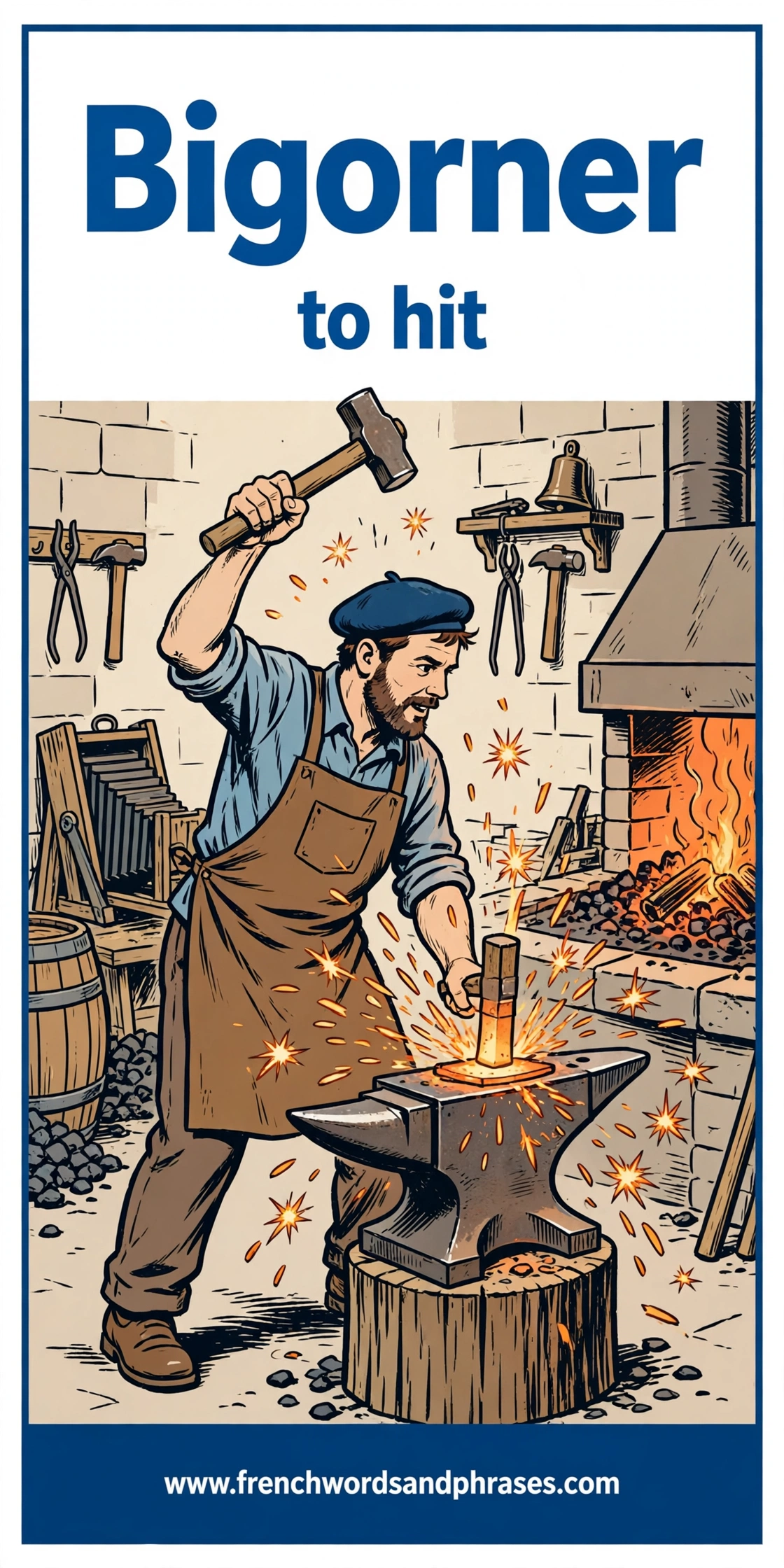
The reflexive of bigorner is a small poem in itself: two people denting each other, like metal on the blacksmith’s anvil that gave the verb its name.
French keeps its fights at several temperatures.
Se disputer is words only, se battre is the neutral all-purpose fight, and se bigorner is the familiar, bump-and-tumble scrap — noisy, brief, and rarely serious.
How to Remember the French Verb Se bigorner
Remember it this way: Se bigorner is about two schoolboys scrapping over a marble.
- Reflexive only in this sense: je me bigorne, ils se sont bigornés — être, and the participle agrees.
- Plain bigorner is for cars (to dent); se bigorner is for people (to scrap).
- Familiar register: the schoolyard fight, not the battlefield — neutral French says se battre.
The key idea is two schoolboys scrapping over a marble.
Test Your Knowledge of Se bigorner
Let’s see how much you’ve learned. Try answering these questions before revealing the answers.
Question 1
Which auxiliary does se bigorner use, and why?
Reveal the answer
Être — it is a reflexive verb: ils se sont bigornés dans la cour.
Question 2
How do you say They fought over a marble in French?
Reveal the answer
Ils se sont bigornés pour une bille.
Question 3
Translate: The children are fighting in the yard.
Reveal the answer
Les enfants se bigornent dans la cour.
Question 4
What is the past participle of se bigorner?
Reveal the answer
Bigorné — agreeing: bigornés, bigornées.
Question 5
Complete the sentence:
Je ne veux pas que les enfants se ______ dans la cour.
Reveal the answer
bigornent
Je ne veux pas que les enfants se bigornent dans la cour.
I do not want the children fighting in the yard.
Your Final Challenge
Can You Use It?
How would you say this in French?
They fought over a marble, then shared their snack as if nothing had happened.
Reveal the answer
Ils se sont bigornés pour une bille, puis ils ont partagé leur goûter comme si de rien n’était.
They fought over a marble, then shared their snack as if nothing had happened.
A little French. A little curiosity. A richer everyday life.
LEARN FRENCH ONE WORD AT A TIME