A French Word to Live By
How to Conjugate Se bidonner in French
/sə bi.dɔ.ne/
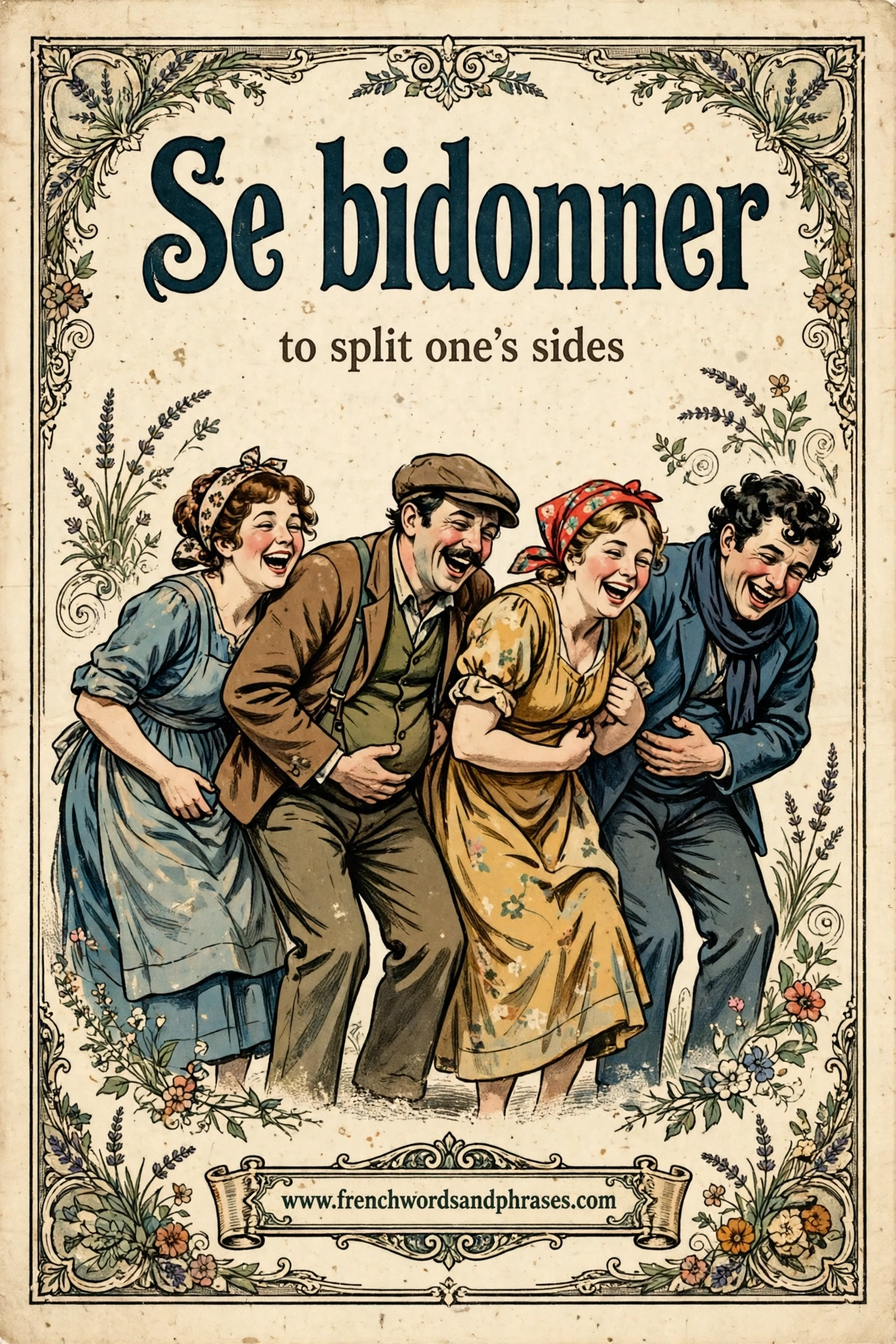
Se bidonner means to split one’s sides — to laugh so hard that your belly shakes, in warm familiar French.
Two old friends on a café terrace, one anecdote too many, and suddenly neither of them can breathe for laughing — se bidonner is the familiar verb of helpless laughter: the belly-shaking, tear-wiping kind that no polite smile can imitate.
In this guide, you’ll learn how to conjugate se bidonner in all the major French tenses and moods. Explore complete conjugation tables, French examples, English translations, and practice quizzes.
Understanding the French Verb Se bidonner
Se bidonner is a regular French verb belonging to the first group of verbs, those ending in -er.
It means to split one’s sides. It is used for audiences helpless before a comedian, children before a clown, and friends before an old story told for the hundredth time. The laughter is physical and uncontrollable — a polite chuckle is sourire or rire, never se bidonner.
Verb classification: First group (-er), reflexive
Auxiliary verb: Être
Past participle: bidonné
Present participle: bidonnant
English equivalents: To split one’s sides laughing, to crack up (familiar); se bidonner devant un sketch — to crack up at a sketch; se bidonner comme un bossu — to laugh fit to burst (fam.); se marrer, se tordre de rire — its close cousins, to be in stitches.
One important detail: se bidonner is reflexive-only in this sense, and familiar in register — the word of friends and family, not of formal writing. Un bidon is a jerrycan, and in slang the belly itself; the laughter is pictured shaking the belly like a can. Being reflexive, it takes être in every compound tense and the past participle agrees with the subject: elle s’est bidonnée, ils se sont bidonnés. The tu imperative tucks the pronoun behind the verb: bidonne-toi ! For polite company, French says rire aux éclats; se bidonner is what actually happens on the terrace.
Experience the Word
Se bidonner is the verb of laughter that takes over the body — shoulders shaking, eyes watering, breath gone.
Imagine a village wedding, late in the evening. The best man begins his speech, reaches the story of the groom and the goat, and loses the room entirely: the grandmother is wiping her eyes, the children are under the table, and even the groom cannot speak — toute la salle se bidonne, and the speech has to wait for the laughter to run out.
Nobody is merely amused. They are splitting their sides — bidonnés — from the first row to the kitchen door.
How to Conjugate Se bidonner: Complete French Conjugation Guide
Let’s explore every major conjugation of se bidonner, beginning with the indicative mood.
How to Conjugate Se bidonner in the Indicative Mood
The indicative mood is used to express facts, observations, actions, and events.
How to Conjugate Se bidonner in the Present Tense (Présent)
Used for actions happening now, habitual actions, and general truths.
| Subject | Conjugation |
|---|---|
| je | me bidonne |
| tu | te bidonnes |
| il / elle | se bidonne |
| nous | nous bidonnons |
| vous | vous bidonnez |
| ils / elles | se bidonnent |
Example
Les enfants se bidonnent devant ce dessin animé.
The children are splitting their sides at this cartoon.
Quick Quiz 1
Complete the sentence:
Nous nous ______ devant ce sketch.
Reveal the answer
bidonnons
Nous nous bidonnons devant ce sketch.
We are splitting our sides at this sketch.
How to Conjugate Se bidonner in the Passé Composé
Used for completed actions in the past. Se bidonner takes the auxiliary verb être.
| Subject | Conjugation |
|---|---|
| je | me suis bidonné / me suis bidonnée |
| tu | t’es bidonné / t’es bidonnée |
| il / elle | s’est bidonné / s’est bidonnée |
| nous | nous sommes bidonnés / nous sommes bidonnées |
| vous | vous êtes bidonnés / vous êtes bidonnées / vous êtes bidonné / vous êtes bidonnée |
| ils / elles | se sont bidonnés / se sont bidonnées |
Example
Elle s’est bidonnée pendant tout le spectacle.
She cracked up throughout the whole show.
How to Conjugate Se bidonner in the Imparfait (Imperfect Tense)
Used for habitual past actions, descriptions, and ongoing situations in the past.
| Subject | Conjugation |
|---|---|
| je | me bidonnais |
| tu | te bidonnais |
| il / elle | se bidonnait |
| nous | nous bidonnions |
| vous | vous bidonniez |
| ils / elles | se bidonnaient |
Example
Nous nous bidonnions à chaque récréation.
We used to be in stitches at every break.
Quick Quiz 2
Choose the correct form:
She cracked up during the show.
Elle ______ pendant le spectacle. (s’est bidonnée / a bidonné)
Reveal the answer
s’est bidonnée
Elle s’est bidonnée pendant le spectacle.
Se bidonner is reflexive, takes être, and the participle agrees: bidonnée.
How to Conjugate Se bidonner in the Plus-que-parfait
Used to describe an action that had already been completed before another past event.
| Subject | Conjugation |
|---|---|
| je | m’étais bidonné / m’étais bidonnée |
| tu | t’étais bidonné / t’étais bidonnée |
| il / elle | s’était bidonné / s’était bidonnée |
| nous | nous étions bidonnés / nous étions bidonnées |
| vous | vous étiez bidonnés / vous étiez bidonnées / vous étiez bidonné / vous étiez bidonnée |
| ils / elles | s’étaient bidonnés / s’étaient bidonnées |
Example
Ils s’étaient bidonnés bien avant la fin de l’histoire.
They had been helpless with laughter long before the end of the story.
How to Conjugate Se bidonner in the Passé Simple
Primarily used in formal writing, literature, and historical narratives. It is rarely used in everyday conversation.
| Subject | Conjugation |
|---|---|
| je | me bidonnai |
| tu | te bidonnas |
| il / elle | se bidonna |
| nous | nous bidonnâmes |
| vous | vous bidonnâtes |
| ils / elles | se bidonnèrent |
Example
À cette remarque, toute la salle se bidonna.
At that remark, the whole hall burst out laughing.
How to Conjugate Se bidonner in the Passé Antérieur
A literary tense used to express an action completed immediately before another past action, generally in the passé simple.
| Subject | Conjugation |
|---|---|
| je | me fus bidonné / me fus bidonnée |
| tu | te fus bidonné / te fus bidonnée |
| il / elle | se fut bidonné / se fut bidonnée |
| nous | nous fûmes bidonnés / nous fûmes bidonnées |
| vous | vous fûtes bidonnés / vous fûtes bidonnées / vous fûtes bidonné / vous fûtes bidonnée |
| ils / elles | se furent bidonnés / se furent bidonnées |
Example
Dès qu’ils se furent bidonnés un bon coup, ils reprirent leur sérieux.
As soon as they had had a good laugh, they became serious again.
How to Conjugate Se bidonner in the Future Tense (Futur Simple)
Used to describe actions that will take place in the future.
| Subject | Conjugation |
|---|---|
| je | me bidonnerai |
| tu | te bidonneras |
| il / elle | se bidonnera |
| nous | nous bidonnerons |
| vous | vous bidonnerez |
| ils / elles | se bidonneront |
Example
Ce soir, vous vous bidonnerez devant la nouvelle comédie.
Tonight, you will split your sides at the new comedy.
How to Conjugate Se bidonner in the Futur Antérieur (Future Perfect)
Used for an action that will have been completed before a particular point in the future.
| Subject | Conjugation |
|---|---|
| je | me serai bidonné / me serai bidonnée |
| tu | te seras bidonné / te seras bidonnée |
| il / elle | se sera bidonné / se sera bidonnée |
| nous | nous serons bidonnés / nous serons bidonnées |
| vous | vous serez bidonnés / vous serez bidonnées / vous serez bidonné / vous serez bidonnée |
| ils / elles | se seront bidonnés / se seront bidonnées |
Example
À la fin du film, ils se seront bidonnés pendant deux heures.
By the end of the film, they will have been in stitches for two hours.
How to Conjugate Se bidonner in the Near Future (Futur Proche)
Used to describe something that is going to happen soon. Formed with aller + infinitive.
| Subject | Conjugation |
|---|---|
| je | vais me bidonner |
| tu | vas te bidonner |
| il / elle | va se bidonner |
| nous | allons nous bidonner |
| vous | allez vous bidonner |
| ils / elles | vont se bidonner |
Example
Regarde-les, ils vont se bidonner dès la première scène.
Look at them, they are going to crack up from the very first scene.
How to Conjugate Se bidonner in the Conditional Mood
The conditional mood expresses what would happen under certain circumstances. It is also frequently used to make polite requests or express wishes.
How to Conjugate Se bidonner in the Present Conditional
| Subject | Conjugation |
|---|---|
| je | me bidonnerais |
| tu | te bidonnerais |
| il / elle | se bidonnerait |
| nous | nous bidonnerions |
| vous | vous bidonneriez |
| ils / elles | se bidonneraient |
Example
Sans les voisins, on se bidonnerait encore plus fort.
Without the neighbours, we would laugh even louder.
How to Conjugate Se bidonner in the Past Conditional
| Subject | Conjugation |
|---|---|
| je | me serais bidonné / me serais bidonnée |
| tu | te serais bidonné / te serais bidonnée |
| il / elle | se serait bidonné / se serait bidonnée |
| nous | nous serions bidonnés / nous serions bidonnées |
| vous | vous seriez bidonnés / vous seriez bidonnées / vous seriez bidonné / vous seriez bidonnée |
| ils / elles | se seraient bidonnés / se seraient bidonnées |
Example
Elle se serait bidonnée si elle avait entendu la blague.
She would have split her sides if she had heard the joke.
Se bidonner in the Literary Past Conditional Form
This less common literary form uses the imperfect subjunctive of être.
| Subject | Conjugation |
|---|---|
| je | me fusse bidonné / me fusse bidonnée |
| tu | te fusses bidonné / te fusses bidonnée |
| il / elle | se fût bidonné / se fût bidonnée |
| nous | nous fussions bidonnés / nous fussions bidonnées |
| vous | vous fussiez bidonnés / vous fussiez bidonnées / vous fussiez bidonné / vous fussiez bidonnée |
| ils / elles | se fussent bidonnés / se fussent bidonnées |
Example
Il se fût bidonné à gorge déployée devant un tel spectacle.
He would have laughed his head off at such a show.
How to Conjugate Se bidonner in the Subjunctive Mood
The subjunctive is used to express wishes, emotions, doubts, necessity, and uncertainty. It frequently follows expressions such as il faut que (it is necessary that) or bien que (although).
How to Conjugate Se bidonner in the Present Subjunctive
| Subject | Conjugation |
|---|---|
| que je | me bidonne |
| que tu | te bidonnes |
| qu’il / qu’elle | se bidonne |
| que nous | nous bidonnions |
| que vous | vous bidonniez |
| qu’ils / qu’elles | se bidonnent |
Example
Je veux que vous vous bidonniez un peu ce soir.
I want you to have a good laugh tonight.
Quick Quiz 3
Complete the sentence using the subjunctive:
Il faut que tu te ______ un peu ce soir.
Reveal the answer
bidonnes
Il faut que tu te bidonnes un peu ce soir.
You must have a good laugh tonight.
How to Conjugate Se bidonner in the Imperfect Subjunctive
A literary tense, rarely encountered in modern spoken French.
| Subject | Conjugation |
|---|---|
| que je | me bidonnasse |
| que tu | te bidonnasses |
| qu’il / qu’elle | se bidonnât |
| que nous | nous bidonnassions |
| que vous | vous bidonnassiez |
| qu’ils / qu’elles | se bidonnassent |
Example
Il fallait que les enfants se bidonnassent en silence.
The children had to laugh in silence.
How to Conjugate Se bidonner in the Pluperfect Subjunctive
A literary construction used to express an action completed before another past action.
| Subject | Conjugation |
|---|---|
| que je | me fusse bidonné / me fusse bidonnée |
| que tu | te fusses bidonné / te fusses bidonnée |
| qu’il / qu’elle | se fût bidonné / se fût bidonnée |
| que nous | nous fussions bidonnés / nous fussions bidonnées |
| que vous | vous fussiez bidonnés / vous fussiez bidonnées / vous fussiez bidonné / vous fussiez bidonnée |
| qu’ils / qu’elles | se fussent bidonnés / se fussent bidonnées |
Example
On racontait qu’ils se fussent bidonnés toute la soirée.
People said they had been in stitches all evening.
How to Conjugate Se bidonner in the Past Subjunctive
| Subject | Conjugation |
|---|---|
| que je | me sois bidonné / me sois bidonnée |
| que tu | te sois bidonné / te sois bidonnée |
| qu’il / qu’elle | se soit bidonné / se soit bidonnée |
| que nous | nous soyons bidonnés / nous soyons bidonnées |
| que vous | vous soyez bidonnés / vous soyez bidonnées / vous soyez bidonné / vous soyez bidonnée |
| qu’ils / qu’elles | se soient bidonnés / se soient bidonnées |
Example
Je suis content qu’elle se soit bidonnée à ma blague.
I am glad she cracked up at my joke.
How to Conjugate Se bidonner in the Imperative
The imperative is used to give commands, instructions, invitations, or suggestions. Subject pronouns are omitted.
How to Conjugate Se bidonner in the Present Imperative
| Person | Conjugation |
|---|---|
| (tu) | bidonne-toi |
| (nous) | bidonnons-nous |
| (vous) | bidonnez-vous |
Example
Bidonne-toi un peu, ça fait du bien !
Have a good laugh, it does you good!
Quick Quiz 4
How would you say Have a good laugh (tu form)?
Reveal the answer
Bidonne-toi !
French Participles of Se bidonner
Participles are verb forms that can be used in compound tenses and other grammatical constructions.
Present Participle of Se bidonner
bidonnant
En se bidonnant, il a renversé son verre.
While splitting his sides, he knocked over his glass.
Past Participle of Se bidonner
bidonné
Bidonnés pendant tout le trajet, les passagers sont arrivés de bonne humeur.
Having laughed all the way, the passengers arrived in a good mood.
Se bidonner in Everyday French: Real-Life Examples
Now that you know the conjugations, let’s see how se bidonner appears in everyday French.
Example 1 — Present
Les enfants se bidonnent devant le clown.
The children are splitting their sides at the clown.
Example 2 — Passé composé
Elle s’est bidonnée pendant le spectacle.
She cracked up during the show.
Example 3 — Imparfait
Nous nous bidonnions à chaque récréation.
We used to be in stitches at every break.
Example 4 — Future
Vous vous bidonnerez devant ce film.
You will split your sides at this film.
Example 5 — Conditional
On se bidonnerait encore plus sans les voisins.
We would laugh even more without the neighbours.
Example 6 — Imperative
Bidonnez-vous un peu, ça fait du bien !
Have a good laugh, it does you good!
Beyond Translation: The Meaning of Se bidonner
The word hides a belly: in slang, le bidon is the stomach, and laughter violent enough to shake it needed a verb of its own.
French grades its laughter carefully.
One sourit (smiles), rit (laughs), rit aux éclats (bursts out laughing) — and at the top of the scale, among friends, on se bidonne: the belly shakes, the eyes water, and conversation has to stop until it passes.
How to Remember the French Verb Se bidonner
Remember it this way: Se bidonner is about the belly shaking with helpless laughter.
- Always reflexive: je me bidonne, elle s’est bidonnée — être, and the participle agrees.
- Le bidon is slang for the belly: se bidonner is laughter that shakes the belly.
- Familiar register: the polite scale-topper is rire aux éclats; se bidonner is for friends and terraces.
The key idea is the belly shaking with helpless laughter.
Test Your Knowledge of Se bidonner
Let’s see how much you’ve learned. Try answering these questions before revealing the answers.
Question 1
Which auxiliary does se bidonner use, and why?
Reveal the answer
Être — it is a reflexive verb: elle s’est bidonnée pendant le spectacle.
Question 2
How do you say The children are splitting their sides at the clown in French?
Reveal the answer
Les enfants se bidonnent devant le clown.
Question 3
Translate: She cracked up at my joke.
Reveal the answer
Elle s’est bidonnée à ma blague.
Question 4
What is the past participle of se bidonner?
Reveal the answer
Bidonné — agreeing: bidonnée, bidonnés, bidonnées.
Question 5
Complete the sentence:
Je veux que vous vous ______ un peu ce soir.
Reveal the answer
bidonniez
Je veux que vous vous bidonniez un peu ce soir.
I want you to have a good laugh tonight.
Your Final Challenge
Can You Use It?
How would you say this in French?
At the comedian’s last line, the whole hall splits its sides, and even the waiters stop to laugh.
Reveal the answer
À la dernière réplique du comédien, toute la salle se bidonne, et même les serveurs s’arrêtent pour rire.
At the comedian’s last line, the whole hall splits its sides, and even the waiters stop to laugh.
A little French. A little curiosity. A richer everyday life.
LEARN FRENCH ONE WORD AT A TIME