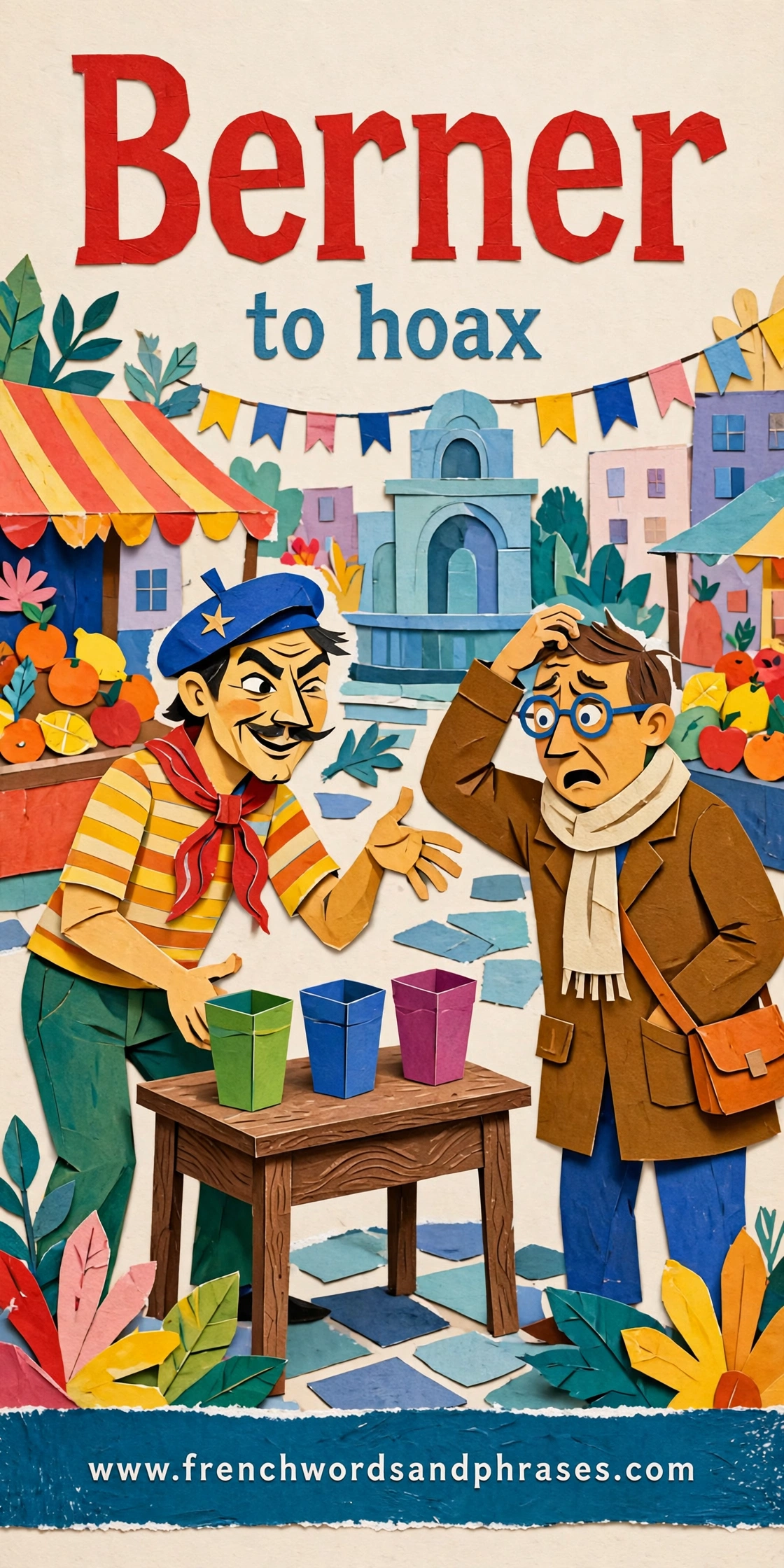
A French Word to Live By
How to Conjugate Berner in French
/bɛʁ.ne/
Berner means to hoax — to fool someone completely with a trick, a story or a false promise.
A smooth-talking salesman with a miracle cure, a fox flattering a crow out of its cheese, a stranger who swears the treasure is buried right here — berner is the verb of the successful trick: someone believes, someone else profits, and the truth arrives too late.
In this guide, you’ll learn how to conjugate berner in all the major French tenses and moods. Explore complete conjugation tables, French examples, English translations, and practice quizzes.
Understanding the French Verb Berner
Berner is a regular French verb belonging to the first group of verbs, those ending in -er.
It means to hoax. It is commonly used for con men, smooth salesmen and flatterers, and figuratively for hopes and promises that fool us — se laisser berner par l’espoir, to let oneself be duped by hope. The victim is always someone who believed too easily.
Verb classification: First group (-er)
Auxiliary verb: Avoir
Past participle: berné
Present participle: bernant
English equivalents: To dupe, to fool, to take in; berner quelqu’un — to dupe someone; se laisser berner — to let oneself be fooled; berner par de belles paroles — to talk someone round with fine words; berner par des promesses — to fool someone with promises.
One important detail: berner is a perfectly regular -er verb — je berne, nous bernons, ils bernent, past participle berné — and its only trap is a nuance. Where tromper simply means to deceive, berner adds the humiliation of the dupe: the victim of berner has believed a story, swallowed a promise, and been made to look a fool. Its favourite victims are taken in par de belles paroles — by fine words — or par des promesses, and the classic warning is se laisser berner, to let oneself be fooled.
Experience the Word
Berner is the verb of the perfect trick — the victim smiles, says thank you, and only understands tomorrow.
Imagine the market square at noon. A stranger in a clean suit unfolds a map, lowers his voice, and explains that the old well behind the church hides a chest of gold coins. An hour later, three farmers have paid for the map — il les a bernés, with nothing but a story and a confident smile.
He has not robbed anyone at knifepoint. He has duped — berné — the whole square, and everyone paid cash.
How to Conjugate Berner: Complete French Conjugation Guide
Let’s explore every major conjugation of berner, beginning with the indicative mood.
How to Conjugate Berner in the Indicative Mood
The indicative mood is used to express facts, observations, actions, and events.
How to Conjugate Berner in the Present Tense (Présent)
Used for actions happening now, habitual actions, and general truths.
| Subject | Conjugation |
|---|---|
| je | berne |
| tu | bernes |
| il / elle | berne |
| nous | bernons |
| vous | bernez |
| ils / elles | bernent |
Example
Le vendeur berne les touristes avec ses fausses antiquités.
The salesman dupes the tourists with his fake antiques.
Quick Quiz 1
Complete the sentence:
Nous ne ______ plus les clients.
Reveal the answer
bernons
Nous ne bernons plus les clients.
We no longer dupe the customers.
How to Conjugate Berner in the Passé Composé
Used for completed actions in the past. Berner takes the auxiliary verb avoir.
| Subject | Conjugation |
|---|---|
| j’ | ai berné |
| tu | as berné |
| il / elle | a berné |
| nous | avons berné |
| vous | avez berné |
| ils / elles | ont berné |
Example
Il a berné tout le village avec son histoire de trésor.
He fooled the whole village with his treasure story.
How to Conjugate Berner in the Imparfait (Imperfect Tense)
Used for habitual past actions, descriptions, and ongoing situations in the past.
| Subject | Conjugation |
|---|---|
| je | bernais |
| tu | bernais |
| il / elle | bernait |
| nous | bernions |
| vous | berniez |
| ils / elles | bernaient |
Example
Autrefois, les charlatans bernaient les gens sur les marchés.
In the old days, charlatans used to dupe people at the markets.
Quick Quiz 2
Choose the correct form:
He fooled the whole village.
Il ______ tout le village. (a berné / est berné)
Reveal the answer
a berné
Il a berné tout le village.
Berner takes avoir.
How to Conjugate Berner in the Plus-que-parfait
Used to describe an action that had already been completed before another past event.
| Subject | Conjugation |
|---|---|
| j’ | avais berné |
| tu | avais berné |
| il / elle | avait berné |
| nous | avions berné |
| vous | aviez berné |
| ils / elles | avaient berné |
Example
Elle avait berné son frère bien avant l’arrivée de la police.
She had fooled her brother long before the police arrived.
How to Conjugate Berner in the Passé Simple
Primarily used in formal writing, literature, and historical narratives. It is rarely used in everyday conversation.
| Subject | Conjugation |
|---|---|
| je | bernai |
| tu | bernas |
| il / elle | berna |
| nous | bernâmes |
| vous | bernâtes |
| ils / elles | bernèrent |
Example
Le renard berna le corbeau avec de belles paroles.
The fox tricked the crow with fine words.
How to Conjugate Berner in the Passé Antérieur
A literary tense used to express an action completed immediately before another past action, generally in the passé simple.
| Subject | Conjugation |
|---|---|
| j’ | eus berné |
| tu | eus berné |
| il / elle | eut berné |
| nous | eûmes berné |
| vous | eûtes berné |
| ils / elles | eurent berné |
Example
Quand il eut berné le fermier, il disparut avec l’argent.
When he had duped the farmer, he vanished with the money.
How to Conjugate Berner in the Future Tense (Futur Simple)
Used to describe actions that will take place in the future.
| Subject | Conjugation |
|---|---|
| je | bernerai |
| tu | berneras |
| il / elle | bernera |
| nous | bernerons |
| vous | bernerez |
| ils / elles | berneront |
Example
Personne ne te bernera deux fois avec le même mensonge.
Nobody will fool you twice with the same lie.
How to Conjugate Berner in the Futur Antérieur (Future Perfect)
Used for an action that will have been completed before a particular point in the future.
| Subject | Conjugation |
|---|---|
| j’ | aurai berné |
| tu | auras berné |
| il / elle | aura berné |
| nous | aurons berné |
| vous | aurez berné |
| ils / elles | auront berné |
Example
À la fin de la soirée, il aura berné tous les invités.
By the end of the evening, he will have fooled all the guests.
How to Conjugate Berner in the Near Future (Futur Proche)
Used to describe something that is going to happen soon. Formed with aller + infinitive.
| Subject | Conjugation |
|---|---|
| je | vais berner |
| tu | vas berner |
| il / elle | va berner |
| nous | allons berner |
| vous | allez berner |
| ils / elles | vont berner |
Example
Attention, ce vendeur va te berner !
Careful, that salesman is going to dupe you!
How to Conjugate Berner in the Conditional Mood
The conditional mood expresses what would happen under certain circumstances. It is also frequently used to make polite requests or express wishes.
How to Conjugate Berner in the Present Conditional
| Subject | Conjugation |
|---|---|
| je | bernerais |
| tu | bernerais |
| il / elle | bernerait |
| nous | bernerions |
| vous | berneriez |
| ils / elles | berneraient |
Example
Sans ton aide, il bernerait encore ses clients.
Without your help, he would still be duping his customers.
How to Conjugate Berner in the Past Conditional
| Subject | Conjugation |
|---|---|
| j’ | aurais berné |
| tu | aurais berné |
| il / elle | aurait berné |
| nous | aurions berné |
| vous | auriez berné |
| ils / elles | auraient berné |
Example
Il aurait berné le juge lui-même si l’avocat n’était pas intervenu.
He would have fooled the judge himself if the lawyer had not stepped in.
Berner in the Literary Past Conditional Form
This less common literary form uses the imperfect subjunctive of avoir.
| Subject | Conjugation |
|---|---|
| j’ | eusse berné |
| tu | eusses berné |
| il / elle | eût berné |
| nous | eussions berné |
| vous | eussiez berné |
| ils / elles | eussent berné |
Example
Il eût berné tout le village sans la méfiance du maire.
He would have duped the whole village without the mayor’s suspicion.
How to Conjugate Berner in the Subjunctive Mood
The subjunctive is used to express wishes, emotions, doubts, necessity, and uncertainty. It frequently follows expressions such as il faut que (it is necessary that) or bien que (although).
How to Conjugate Berner in the Present Subjunctive
| Subject | Conjugation |
|---|---|
| que je | berne |
| que tu | bernes |
| qu’il / qu’elle | berne |
| que nous | bernions |
| que vous | berniez |
| qu’ils / qu’elles | bernent |
Example
Je doute qu’il berne vraiment ses clients.
I doubt he really dupes his customers.
Quick Quiz 3
Complete the sentence using the subjunctive:
Je doute que vous ______ ces pauvres gens.
Reveal the answer
berniez
Je doute que vous berniez ces pauvres gens.
I doubt you are duping those poor people.
How to Conjugate Berner in the Imperfect Subjunctive
A literary tense, rarely encountered in modern spoken French.
| Subject | Conjugation |
|---|---|
| que je | bernasse |
| que tu | bernasses |
| qu’il / qu’elle | bernât |
| que nous | bernassions |
| que vous | bernassiez |
| qu’ils / qu’elles | bernassent |
Example
Elle craignait qu’il bernât son pauvre père.
She feared he might dupe her poor father.
How to Conjugate Berner in the Pluperfect Subjunctive
A literary construction used to express an action completed before another past action.
| Subject | Conjugation |
|---|---|
| que j’ | eusse berné |
| que tu | eusses berné |
| qu’il / qu’elle | eût berné |
| que nous | eussions berné |
| que vous | eussiez berné |
| qu’ils / qu’elles | eussent berné |
Example
On racontait qu’il eût berné des centaines de personnes.
People said he had duped hundreds of people.
How to Conjugate Berner in the Past Subjunctive
| Subject | Conjugation |
|---|---|
| que j’ | aie berné |
| que tu | aies berné |
| qu’il / qu’elle | ait berné |
| que nous | ayons berné |
| que vous | ayez berné |
| qu’ils / qu’elles | aient berné |
Example
Je suis surpris qu’elle ait berné tout le monde si facilement.
I am surprised she fooled everyone so easily.
How to Conjugate Berner in the Imperative
The imperative is used to give commands, instructions, invitations, or suggestions. Subject pronouns are omitted.
How to Conjugate Berner in the Present Imperative
| Person | Conjugation |
|---|---|
| (tu) | berne |
| (nous) | bernons |
| (vous) | bernez |
Example
Ne berne plus jamais tes amis avec ces histoires !
Never fool your friends with those stories again!
Quick Quiz 4
How would you say Do not fool your friends (tu form)?
Reveal the answer
Ne berne pas tes amis !
French Participles of Berner
Participles are verb forms that can be used in compound tenses and other grammatical constructions.
Present Participle of Berner
bernant
En bernant ses clients, il a fini par perdre son magasin.
By duping his customers, he ended up losing his shop.
Past Participle of Berner
berné
Berné par son propre associé, il a tout perdu.
Duped by his own partner, he lost everything.
Berner in Everyday French: Real-Life Examples
Now that you know the conjugations, let’s see how berner appears in everyday French.
Example 1 — Present
Le vendeur berne les touristes.
The salesman dupes the tourists.
Example 2 — Passé composé
Il a berné tout le village.
He fooled the whole village.
Example 3 — Imparfait
Les charlatans bernaient les gens au marché.
Charlatans used to dupe people at the market.
Example 4 — Future
Personne ne te bernera deux fois.
Nobody will fool you twice.
Example 5 — Conditional
Il bernerait encore ses clients sans ton aide.
He would still dupe his customers without your help.
Example 6 — Imperative
Ne berne plus tes amis !
Do not fool your friends any more!
Beyond Translation: The Meaning of Berner
The word carries an old humiliation inside it: la berne was a rough hazing game in which the victim was tossed up and down in a blanket while everyone laughed — to be berné was, literally, to be made a public fool of.
French literature’s most famous berné is a bird.
In La Fontaine’s fable, the fox flatters the crow until it drops its cheese: le renard berna le corbeau — and every French schoolchild learns that fine words are the oldest trick of all.
How to Remember the French Verb Berner
Remember it this way: Berner is about the fox flattering the crow out of its cheese.
- Berner is tromper with a story attached: the victim believes, applauds, and pays.
- Its favourite weapons are words: berner par de belles paroles, berner par des promesses.
- Regular -er: je berne, nous bernons, past participle berné.
The key idea is the fox flattering the crow out of its cheese.
Test Your Knowledge of Berner
Let’s see how much you’ve learned. Try answering these questions before revealing the answers.
Question 1
What is the difference between tromper and berner?
Reveal the answer
Berner adds humiliation — the victim has believed a story and been made a fool of, not merely deceived.
Question 2
How do you say He fooled the whole village in French?
Reveal the answer
Il a berné tout le village.
Question 3
Translate: The fox tricked the crow with fine words.
Reveal the answer
Le renard berna le corbeau avec de belles paroles.
Question 4
What is the past participle of berner?
Reveal the answer
Berné.
Question 5
Complete the sentence:
Je doute qu’il ______ vraiment ses clients.
Reveal the answer
berne
Je doute qu’il berne vraiment ses clients.
I doubt he really dupes his customers.
Your Final Challenge
Can You Use It?
How would you say this in French?
The fox duped the crow with compliments, and the cheese fell.
Reveal the answer
Le renard berna le corbeau avec des compliments, et le fromage tomba.
The fox duped the crow with compliments, and the cheese fell.
A little French. A little curiosity. A richer everyday life.
LEARN FRENCH ONE WORD AT A TIME