A French Word to Live By
How to Conjugate Bavarder in French
/ba.vaʁ.de/
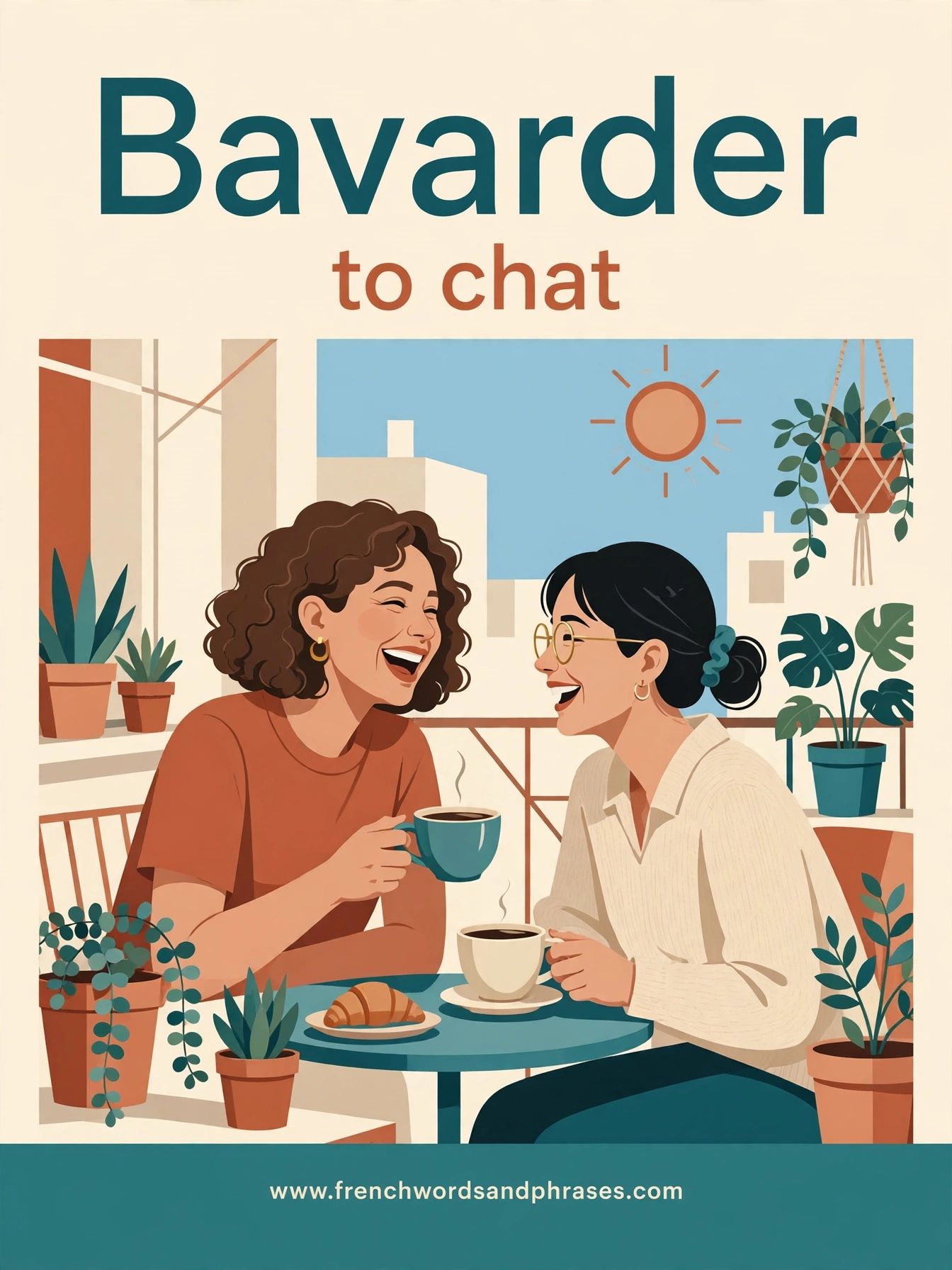
Bavarder means to chat — to talk at length, lightly and happily, about nothing in particular.
Two neighbours over the garden fence, schoolgirls whispering behind the teacher’s back, old friends on the telephone long after the news has run out — bavarder is the verb of talk for talk’s sake: easy, endless, and never quite about anything important.
In this guide, you’ll learn how to conjugate bavarder in all the major French tenses and moods. Explore complete conjugation tables, French examples, English translations, and practice quizzes.
Understanding the French Verb Bavarder
Bavarder is a regular French verb belonging to the first group of verbs, those ending in -er.
It means to chat. Use it for sociable, aimless talk between friends, neighbours and colleagues; for a real discussion use discuter, and for telling news, raconter. Teachers use bavarder as the standard word for classroom chatter.
Verb classification: First group (-er)
Auxiliary verb: Avoir
Past participle: bavardé
Present participle: bavardant
English equivalents: To chat, to chatter, to gossip; bavarder avec un ami — to chat with a friend; bavarder de tout et de rien — to chat about everything and nothing; bavarder au téléphone — to chat on the phone; bavarder en classe — to chatter in class (and get told off).
One important detail: bavarder is perfectly regular — je bavarde, nous bavardons, ils bavardent — but it carries a judgement inside it. A teacher who says Ne bavardez pas ! is not inviting discussion; bavarder is talk that fills time instead of doing work. Its noun, un bavard, is a chatterbox, and le bavardage is chatter — the French ear hears in bavarder a little babble, like water running: pleasant, but not serious.
Experience the Word
Bavarder is the verb of talk with no destination — conversation as pure pleasure.
Imagine two old friends who meet by chance at the market. The shopping can wait; twenty minutes disappear among the cabbages — elles bavardent, of grandchildren, of the weather, of nothing, and part happier than any purchase could make them.
Nothing was decided or learned. They simply chatted — elles ont bavardé — and that was the whole point.
How to Conjugate Bavarder: Complete French Conjugation Guide
Let’s explore every major conjugation of bavarder, beginning with the indicative mood.
How to Conjugate Bavarder in the Indicative Mood
The indicative mood is used to express facts, observations, actions, and events.
How to Conjugate Bavarder in the Present Tense (Présent)
Used for actions happening now, habitual actions, and general truths.
| Subject | Conjugation |
|---|---|
| je | bavarde |
| tu | bavardes |
| il / elle | bavarde |
| nous | bavardons |
| vous | bavardez |
| ils / elles | bavardent |
Example
Les voisins bavardent par-dessus la clôture tous les matins.
The neighbours chat over the fence every morning.
Quick Quiz 1
Complete the sentence:
Nous ______ au téléphone tous les soirs.
Reveal the answer
bavardons
Nous bavardons au téléphone tous les soirs.
We chat on the phone every evening.
How to Conjugate Bavarder in the Passé Composé
Used for completed actions in the past. Bavarder takes the auxiliary verb avoir.
| Subject | Conjugation |
|---|---|
| j’ | ai bavardé |
| tu | as bavardé |
| il / elle | a bavardé |
| nous | avons bavardé |
| vous | avez bavardé |
| ils / elles | ont bavardé |
Example
Nous avons bavardé pendant deux heures au téléphone.
We chatted for two hours on the phone.
How to Conjugate Bavarder in the Imparfait (Imperfect Tense)
Used for habitual past actions, descriptions, and ongoing situations in the past.
| Subject | Conjugation |
|---|---|
| je | bavardais |
| tu | bavardais |
| il / elle | bavardait |
| nous | bavardions |
| vous | bavardiez |
| ils / elles | bavardaient |
Example
En classe, les élèves bavardaient au lieu d’écouter.
In class, the pupils used to chatter instead of listening.
Quick Quiz 2
Choose the correct form:
We chatted for two hours.
Nous ______ pendant deux heures. (avons bavardé / sommes bavardés)
Reveal the answer
avons bavardé
Nous avons bavardé pendant deux heures.
Bavarder takes avoir.
How to Conjugate Bavarder in the Plus-que-parfait
Used to describe an action that had already been completed before another past event.
| Subject | Conjugation |
|---|---|
| j’ | avais bavardé |
| tu | avais bavardé |
| il / elle | avait bavardé |
| nous | avions bavardé |
| vous | aviez bavardé |
| ils / elles | avaient bavardé |
Example
Elles avaient bavardé toute la soirée avant de penser au dîner.
They had been chatting all evening before thinking about dinner.
How to Conjugate Bavarder in the Passé Simple
Primarily used in formal writing, literature, and historical narratives. It is rarely used in everyday conversation.
| Subject | Conjugation |
|---|---|
| je | bavardai |
| tu | bavardas |
| il / elle | bavarda |
| nous | bavardâmes |
| vous | bavardâtes |
| ils / elles | bavardèrent |
Example
Les invités bavardèrent autour du feu jusqu’à minuit.
The guests chatted around the fire until midnight.
How to Conjugate Bavarder in the Passé Antérieur
A literary tense used to express an action completed immediately before another past action, generally in the passé simple.
| Subject | Conjugation |
|---|---|
| j’ | eus bavardé |
| tu | eus bavardé |
| il / elle | eut bavardé |
| nous | eûmes bavardé |
| vous | eûtes bavardé |
| ils / elles | eurent bavardé |
Example
Quand ils eurent bavardé une heure, le maître les rappela au travail.
When they had chatted for an hour, the teacher called them back to work.
How to Conjugate Bavarder in the Future Tense (Futur Simple)
Used to describe actions that will take place in the future.
| Subject | Conjugation |
|---|---|
| je | bavarderai |
| tu | bavarderas |
| il / elle | bavardera |
| nous | bavarderons |
| vous | bavarderez |
| ils / elles | bavarderont |
Example
Demain, nous bavarderons tranquillement devant un café.
Tomorrow, we will chat quietly over a coffee.
How to Conjugate Bavarder in the Futur Antérieur (Future Perfect)
Used for an action that will have been completed before a particular point in the future.
| Subject | Conjugation |
|---|---|
| j’ | aurai bavardé |
| tu | auras bavardé |
| il / elle | aura bavardé |
| nous | aurons bavardé |
| vous | aurez bavardé |
| ils / elles | auront bavardé |
Example
À la fin de la soirée, ils auront bavardé de tout et de rien.
By the end of the evening, they will have chatted about everything and nothing.
How to Conjugate Bavarder in the Near Future (Futur Proche)
Used to describe something that is going to happen soon. Formed with aller + infinitive.
| Subject | Conjugation |
|---|---|
| je | vais bavarder |
| tu | vas bavarder |
| il / elle | va bavarder |
| nous | allons bavarder |
| vous | allez bavarder |
| ils / elles | vont bavarder |
Example
Regarde-les, elles vont bavarder pendant des heures !
Look at them, they are going to chat for hours!
How to Conjugate Bavarder in the Conditional Mood
The conditional mood expresses what would happen under certain circumstances. It is also frequently used to make polite requests or express wishes.
How to Conjugate Bavarder in the Present Conditional
| Subject | Conjugation |
|---|---|
| je | bavarderais |
| tu | bavarderais |
| il / elle | bavarderait |
| nous | bavarderions |
| vous | bavarderiez |
| ils / elles | bavarderaient |
Example
Sans les enfants, nous bavarderions jusqu’au petit matin.
Without the children, we would chat until the small hours.
How to Conjugate Bavarder in the Past Conditional
| Subject | Conjugation |
|---|---|
| j’ | aurais bavardé |
| tu | aurais bavardé |
| il / elle | aurait bavardé |
| nous | aurions bavardé |
| vous | auriez bavardé |
| ils / elles | auraient bavardé |
Example
Nous aurions bavardé plus longtemps si le café n’avait pas fermé.
We would have chatted longer if the café had not closed.
Bavarder in the Literary Past Conditional Form
This less common literary form uses the imperfect subjunctive of avoir.
| Subject | Conjugation |
|---|---|
| j’ | eusse bavardé |
| tu | eusses bavardé |
| il / elle | eût bavardé |
| nous | eussions bavardé |
| vous | eussiez bavardé |
| ils / elles | eussent bavardé |
Example
Il eût bavardé toute la nuit sans la fatigue.
He would have chatted all night if not for tiredness.
How to Conjugate Bavarder in the Subjunctive Mood
The subjunctive is used to express wishes, emotions, doubts, necessity, and uncertainty. It frequently follows expressions such as il faut que (it is necessary that) or bien que (although).
How to Conjugate Bavarder in the Present Subjunctive
| Subject | Conjugation |
|---|---|
| que je | bavarde |
| que tu | bavardes |
| qu’il / qu’elle | bavarde |
| que nous | bavardions |
| que vous | bavardiez |
| qu’ils / qu’elles | bavardent |
Example
Il est charmant que les voisins bavardent si volontiers.
It is charming that the neighbours chat so readily.
Quick Quiz 3
Complete the sentence using the subjunctive:
Le professeur ne veut pas que les élèves ______ pendant le cours.
Reveal the answer
bavardent
Le professeur ne veut pas que les élèves bavardent pendant le cours.
The teacher does not want the pupils to chatter during the lesson.
How to Conjugate Bavarder in the Imperfect Subjunctive
A literary tense, rarely encountered in modern spoken French.
| Subject | Conjugation |
|---|---|
| que je | bavardasse |
| que tu | bavardasses |
| qu’il / qu’elle | bavardât |
| que nous | bavardassions |
| que vous | bavardassiez |
| qu’ils / qu’elles | bavardassent |
Example
Le professeur ne voulait pas que les élèves bavardassent pendant le cours.
The teacher did not want the pupils to chatter during the lesson.
How to Conjugate Bavarder in the Pluperfect Subjunctive
A literary construction used to express an action completed before another past action.
| Subject | Conjugation |
|---|---|
| que j’ | eusse bavardé |
| que tu | eusses bavardé |
| qu’il / qu’elle | eût bavardé |
| que nous | eussions bavardé |
| que vous | eussiez bavardé |
| qu’ils / qu’elles | eussent bavardé |
Example
On racontait qu’ils eussent bavardé jusqu’à l’aube.
People said they had chatted until dawn.
How to Conjugate Bavarder in the Past Subjunctive
| Subject | Conjugation |
|---|---|
| que j’ | aie bavardé |
| que tu | aies bavardé |
| qu’il / qu’elle | ait bavardé |
| que nous | ayons bavardé |
| que vous | ayez bavardé |
| qu’ils / qu’elles | aient bavardé |
Example
Je suis content que vous ayez bavardé avec ma grand-mère.
I am glad you chatted with my grandmother.
How to Conjugate Bavarder in the Imperative
The imperative is used to give commands, instructions, invitations, or suggestions. Subject pronouns are omitted.
How to Conjugate Bavarder in the Present Imperative
| Person | Conjugation |
|---|---|
| (tu) | bavarde |
| (nous) | bavardons |
| (vous) | bavardez |
Example
Bavardez un peu avec elle, elle se sent seule !
Chat a little with her, she feels lonely!
Quick Quiz 4
How would you say Chat a little with her (tu form)?
Reveal the answer
Bavarde un peu avec elle !
French Participles of Bavarder
Participles are verb forms that can be used in compound tenses and other grammatical constructions.
Present Participle of Bavarder
bavardant
En bavardant avec tout le monde, elle a appris la nouvelle.
By chatting with everyone, she heard the news.
Past Participle of Bavarder
bavardé
Bavardé ainsi entre amies, l’après-midi a passé en un éclair.
Chatted away like that between friends, the afternoon passed in a flash.
Bavarder in Everyday French: Real-Life Examples
Now that you know the conjugations, let’s see how bavarder appears in everyday French.
Example 1 — Present
Les élèves bavardent en classe.
The pupils chat in class.
Example 2 — Passé composé
Nous avons bavardé au téléphone.
We chatted on the phone.
Example 3 — Imparfait
Elle bavardait avec sa voisine.
She used to chat with her neighbour.
Example 4 — Future
Nous bavarderons devant un café.
We will chat over a coffee.
Example 5 — Conditional
Je bavarderais volontiers avec lui.
I would gladly chat with him.
Example 6 — Imperative
Ne bavardez pas pendant le cours !
Do not chatter during the lesson!
Beyond Translation: The Meaning of Bavarder
English chat is lighter and shorter; French bavarder stretches — it is chat with time inside it.
It is built on babble.
The family — bavard (a chatterbox), bavardage (chatter, also indiscreet talk), baver (to drool) — all drip with the same sound: words flowing like water from a mouth that cannot stop. To call someone un grand bavard is affectionate; to call talk du bavardage in an office is not.
How to Remember the French Verb Bavarder
Remember it this way: Bavarder is about two neighbours over the fence, talking about everything and nothing.
- Un bavard is a chatterbox: bavarder is what a bavard does — talk, talk, talk.
- Teachers’ word for classroom chatter: Ne bavardez pas !
- Regular -er: je bavarde, nous bavardons, past participle bavardé.
The key idea is two neighbours over the fence, talking about everything and nothing.
Test Your Knowledge of Bavarder
Let’s see how much you’ve learned. Try answering these questions before revealing the answers.
Question 1
What does a teacher mean by Ne bavardez pas !?
Reveal the answer
Stop chattering — bavarder is talk that fills time instead of working.
Question 2
How do you say We chatted for two hours in French?
Reveal the answer
Nous avons bavardé pendant deux heures.
Question 3
Translate: The pupils chat in class.
Reveal the answer
Les élèves bavardent en classe.
Question 4
What is the past participle of bavarder?
Reveal the answer
Bavardé.
Question 5
Complete the sentence:
Les voisins ______ par-dessus la clôture tous les matins.
Reveal the answer
bavardent
Les voisins bavardent par-dessus la clôture tous les matins.
The neighbours chat over the fence every morning.
Your Final Challenge
Can You Use It?
How would you say this in French?
They have been chatting at the market for an hour, and their baskets are still empty.
Reveal the answer
Elles bavardent au marché depuis une heure, et leurs paniers sont encore vides.
They have been chatting at the market for an hour, and their baskets are still empty.
A little French. A little curiosity. A richer everyday life.
LEARN FRENCH ONE WORD AT A TIME