A French Word to Live By
Translate Avoir soif to English
/a.vwaʁ swaf/
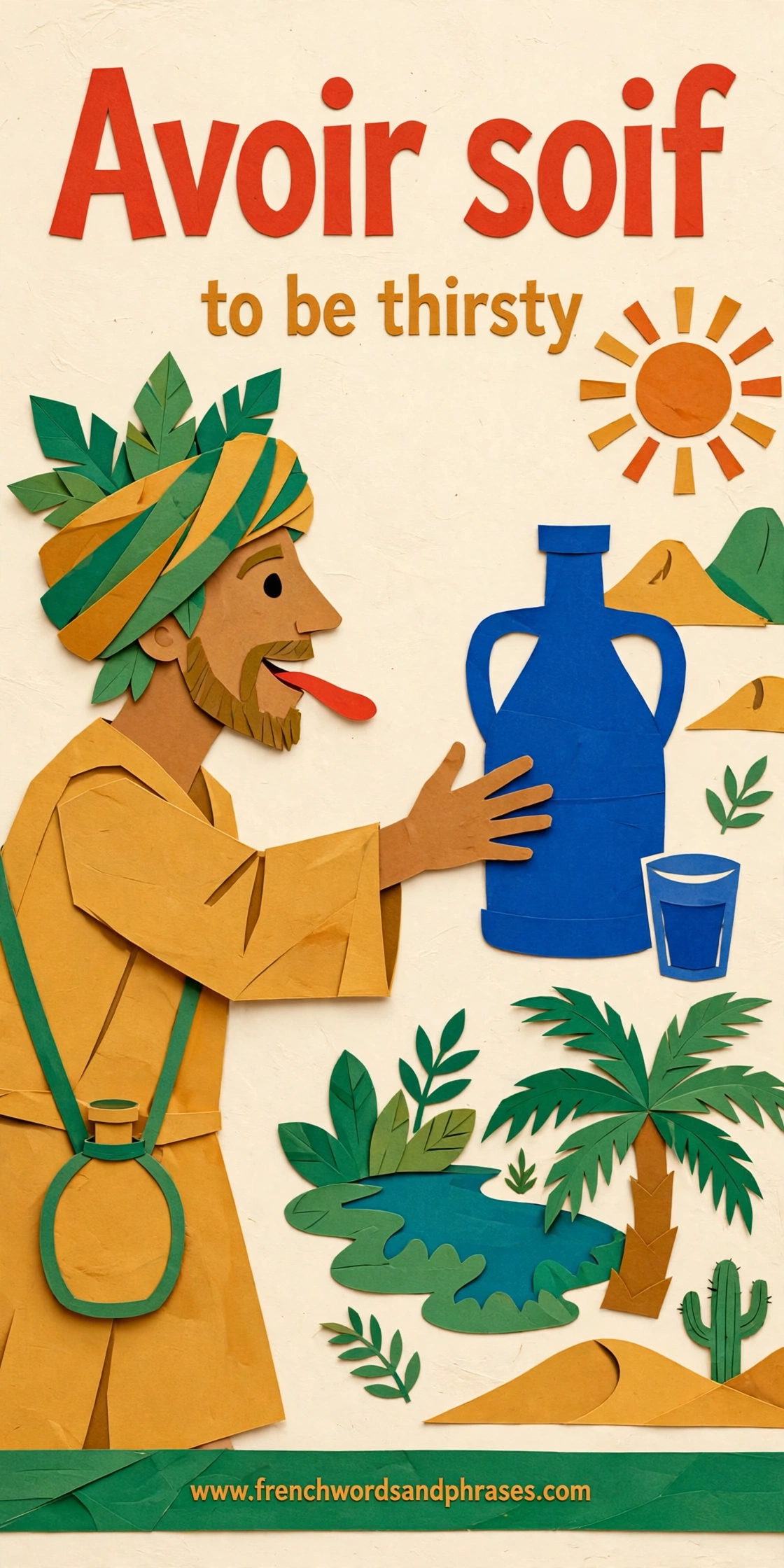
Avoir soif means to be thirsty — to need or want a drink.
The hikers reach the fountain in the village square at the top of the climb, and the youngest does not even take off his rucksack before saying it: « J’ai soif ! » In French, thirst is not what you are — it is what you have, and what you have can be dealt with: one glass of water at a time.
Let’s explore how avoir soif works in French, beginning with the whole phrase on one card.
Understanding the French Phrase Avoir soif
Avoir soif is a French expression built from avoir (to have) and la soif (thirst). It belongs to the great avoir family of body states — avoir faim, avoir chaud, avoir froid, avoir sommeil — where English uses ‘to be’ and French calmly uses ‘to have’.
It means to be thirsty. The thirst can be plain and physical, or it can take the de bridge to its object: avoir soif de + a noun — soif d’eau, thirst for water, and figuratively soif de liberté, a thirst for freedom. At the table, the polite announcement is j’ai soif; the offer that answers it is tu veux boire quelque chose ?
Type: Expression — body states (avoir + noun soif)
Answers the need: Saying you are thirsty and need a drink
Register: Neutral — everywhere, at every age and every table
Strength: Scalable — un peu soif for a dry mouth, une soif de loup for real thirst
One important usage detail: je suis soif is impossible — thirst is had, never been, in French. Soif takes no article inside the phrase (avoir soif, not avoir la soif), but the moment you qualify it, the article returns: avoir une grande soif, to be very thirsty. For animals and plants, French says the same: le chien a soif, the dog is thirsty.
Experience the Word
Avoir soif is the phrase of fountains, finish lines and long summer afternoons — the body’s simplest request, in two words.
Imagine the village fête in August, the pétanque final dragging into its third hour under a white sky. The players are too proud to stop, but the spectators’ children run the real diplomacy of the day: bottles of water, carried like treaties, to anyone who finally admits j’ai soif.
French treats thirst as luggage again. What you have can be handed a remedy — a glass, a fountain, a bottle — and the avoir phrases of the body all end the same way: by being satisfied.
How to Use Avoir soif in French: Complete Guide
Let’s explore how avoir soif works in French, beginning with the whole phrase on one card.
Avoir soif at a Glance
The Whole Phrase on One Card
Real meaning, literal picture, English twin and register — avoir soif in five lines.
| Point | Avoir soif |
|---|---|
| What it really means | to be thirsty — to need a drink |
| Word for word | to have thirst (soif = thirst) |
| English equivalent | to be thirsty |
| Register | neutral — everywhere, at every table |
| Use it for | asking for water, offering drinks, and figurative thirsts for freedom or knowledge |
Example
J’ai soif, je peux avoir un verre d’eau ?
I am thirsty, can I have a glass of water?
Word by Word: Building the Thirst
Two pieces — the verb that holds the state, and the noun that names it.
| Word | Literal meaning | Its job in the phrase |
|---|---|---|
| avoir | to have | the holder — the body’s states are possessions in French |
| soif | thirst | the noun — feminine, la soif, and article-free inside the phrase |
| de | of, for | the bridge to the object: soif d’eau, soif de liberté |
Example
Les enfants ont soif après le match.
The children are thirsty after the match.
Quick Quiz 1
Is it j’ai soif or je suis soif?
Reveal the answer
J’ai soif — body states are had in French: avoir soif, avoir faim, avoir chaud.
J’ai soif et un peu faim aussi.
I am thirsty and a bit hungry too.
When You Say It: The Thirsty Moments
Avoir soif fires at moments like these — the climb finished, the meal salty, the day hot.
| Situation | Example |
|---|---|
| After exercise | après la course, nous avons tous soif — after the run, we are all thirsty |
| At the table | j’ai soif, passe-moi la carafe — I am thirsty, pass me the water jug |
| A hot day | avec cette chaleur, les plantes aussi ont soif — in this heat, the plants are thirsty too |
| Offering a drink | tu as soif ? je te sers un jus — are you thirsty? I’ll pour you a juice |
| Figurative | une génération qui a soif de changement — a generation thirsty for change |
Example
Tu as soif ? Il reste de la limonade.
Are you thirsty? There is some lemonade left.
Make It Yours: Thirst for Every Person
Avoir bends for the person; degree words and the de bridge do the rest.
| Form | French | In English |
|---|---|---|
| I am thirsty | j’ai soif | I am thirsty |
| Very thirsty | j’ai très soif | I am very thirsty |
| A little thirsty | j’ai un peu soif | I am a little thirsty |
| In the past | il avait soif | he was thirsty |
| No longer thirsty | je n’ai plus soif | I am not thirsty anymore |
| Thirsty for something | avoir soif de liberté | to be thirsty for freedom |
Example
Après le désert, ils avaient une soif terrible.
After the desert, they were terribly thirsty.
Quick Quiz 2
How do you say ‘I am not thirsty anymore’?
Reveal the answer
Je n’ai plus soif — ne… plus wraps avoir, and soif stays untouched.
Merci, je n’ai plus soif, j’ai assez bu.
Thanks, I am not thirsty anymore, I have drunk enough.
Everyday Expressions: Building on the Thirst
Avoir soif slots into these everyday frames — each one ready to use as it stands.
| Frame | In English |
|---|---|
| avoir soif | to be thirsty |
| avoir très soif | to be very thirsty |
| avoir soif de + noun | to be thirsty for something — water, freedom, knowledge |
| mourir de soif | to be dying of thirst — the exaggeration of hot afternoons |
| étancher sa soif | to quench your thirst — the satisfying answer |
Example
Un verre d’eau fraîche a étanché sa soif.
A glass of cool water quenched his thirst.
Close Cousins: The Other Body States
French runs the body on avoir — soif is one drawer of a whole cabinet; its cousins cover hunger, heat and sleep.
| Expression | The difference |
|---|---|
| avoir soif | to be thirsty — the drink drawer |
| avoir faim | to be hungry — the food drawer, faim pairs with soif at every table |
| avoir chaud / avoir froid | to be hot / to be cold — said of the person, not the weather |
| avoir sommeil | to be sleepy — the body’s next request after food and drink |
| avoir mal | to be in pain — avoir mal à la tête, to have a headache |
Example
J’ai faim, j’ai soif, et après je dormirai.
I am hungry, I am thirsty, and afterwards I will sleep.
Quick Quiz 3
At the table, which cousin sits beside soif — faim or sommeil?
Reveal the answer
Faim — hunger and thirst are the table’s pair: avoir faim et soif.
Les voyageurs avaient faim et soif.
The travellers were hungry and thirsty.
Avoir soif and Its Neighbours
The drinks shelf around the phrase — the thirst, the drink and the relief.
| French | In English |
|---|---|
| boire | to drink — the verb that answers the thirst |
| un verre d’eau | a glass of water — the classic remedy |
| la déshydratation | dehydration — the medical end of thirst |
| une fontaine | a fountain, a drinking fountain |
| se désaltérer | to quench your thirst, to have a drink |
| assoiffé | parched, thirsty — the adjective form |
Example
Les randonneurs se sont désaltérés à la fontaine.
The hikers quenched their thirst at the fountain.
Watch Out: The Traps Around Avoir soif
The traps: being instead of having, a missing article where one belongs, and weather that is not a person.
| Trap | The truth |
|---|---|
| je suis soif | never — the body state is had: j’ai soif, like j’ai faim and j’ai sommeil |
| the returning article | bare soif inside the phrase, but avoir UNE grande soif the moment an adjective qualifies it |
| hot weather is not chaud like a person | il fait chaud is the weather; j’ai chaud is you, overheating in your coat — avoir belongs to people |
| soif de is not always water | soif de pouvoir, soif de vengeance — the figurative thirsts take de too, and no glass will cure them |
Example
Il fait chaud, et moi j’ai chaud dans ce manteau.
It is hot, and I am hot in this coat.
Quick Quiz 4
True or false: il a soif de vengeance means he needs a drink.
Reveal the answer
False — soif de + an abstract noun is figurative: he thirsts for revenge.
Ce peuple avait soif de justice.
That people thirsted for justice.
Avoir soif in Everyday French: Real-Life Examples
Now that you know the word, let’s see how avoir soif appears in everyday French.
Example 1 — At the fountain
J’ai soif, on s’arrête à la fontaine ?
I am thirsty, shall we stop at the fountain?
Example 2 — At dinner
Les enfants ont soif, donne-leur de l’eau.
The children are thirsty, give them some water.
Example 3 — After sport
Après l’entraînement, il avait très soif.
After training, he was very thirsty.
Example 4 — The offer
Tu as soif ? Je te sers un verre de jus.
Are you thirsty? I’ll pour you a glass of juice.
Example 5 — Dying of thirst
Je meurs de soif, il n’y a plus d’eau dans la gourde.
I am dying of thirst, there is no water left in the bottle.
Example 6 — The figurative one
Elle a soif de liberté depuis toujours.
She has always thirsted for freedom.
Beyond Translation: The Meaning of Avoir soif
English is thirsty the way it is tall — a property of the person. French has thirst the way it has a bag or a debt: a temporary possession, acquired on a climb and discharged at a fountain. The whole avoir family of the body carries this quiet optimism — states are holdings, and holdings change hands.
Avoir soif is thirst with a solution already implied: what you have, you can be given relief from.
It is a small grammar of hospitality, too: the first question of every French host — tu as soif ? — is asked in the certain knowledge that the state is curable within the minute.
How to Remember the French Phrase Avoir soif
Remember it this way: Avoir soif is thirst carried like an empty bottle — you have it with you on the climb, and the whole point of carrying it is to get it filled.
- You switch the verb — English is thirsty, French a soif; the body’s states are always had, never been.
- You leave soif bare — avoir soif, no article, until an adjective arrives: une grande soif.
- You follow it with de for its object — soif d’eau at the fountain, soif de liberté in the speeches.
The key idea is avoir soif means to be thirsty — a body state you have, like an empty bottle waiting to be filled.
Test Your Knowledge of Avoir soif
Let’s see how much you’ve learned. Try answering these questions before revealing the answers.
Question 1
What does avoir soif mean?
Reveal the answer
To be thirsty — literally, to have thirst.
Question 2
How do you say ‘the children are thirsty’?
Reveal the answer
Les enfants ont soif — avoir bends for the person, soif never changes.
Question 3
How do you say ‘I am not thirsty anymore’?
Reveal the answer
Je n’ai plus soif — ne… plus wraps the verb avoir.
Question 4
What does avoir soif de liberté mean?
Reveal the answer
To thirst for freedom — the figurative use: soif de + an abstract noun is a deep longing.
Question 5
Complete the sentence:
Après la marche, nous ______ soif. (After the walk, we are thirsty.)
Reveal the answer
avons
Après la marche, nous avons soif.
After the walk, we are thirsty.
Your Final Challenge
Can You Use It?
How would you say this in French?
“I am thirsty, can I have a glass of water?”
Reveal the answer
J’ai soif, je peux avoir un verre d’eau ?
I am thirsty, can I have a glass of water?
A little French. A little curiosity. A richer everyday life.
LEARN FRENCH ONE WORD AT A TIME