A French Word to Live By
Translate Avoir eu chaud to English
/a.vwaʁ y ʃo/
Avoir eu chaud means to have a narrow escape — to have a close call, to only just get away with it.
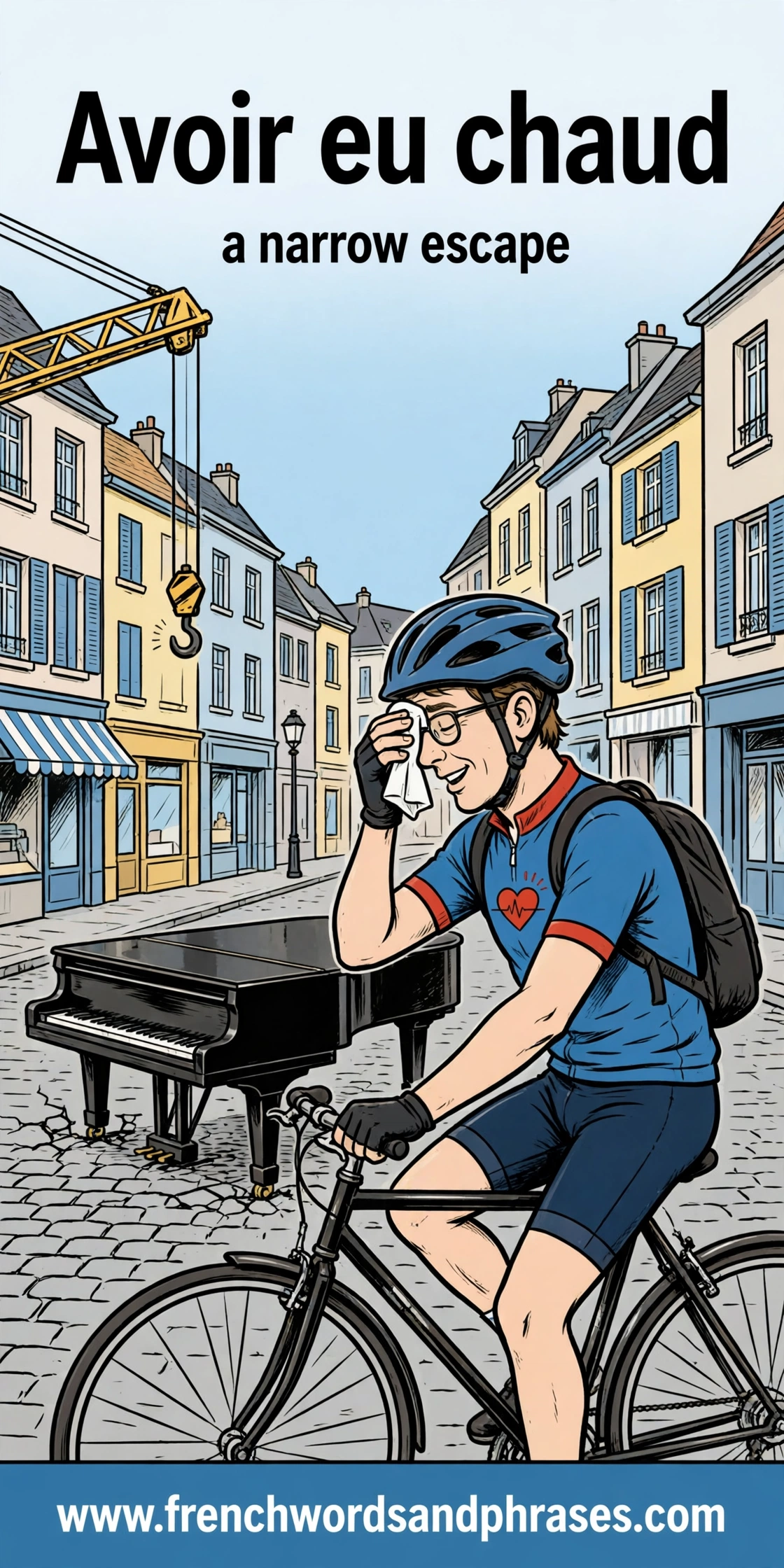
The cyclist comes round the bend a second after the lorry has passed, close enough to feel the wind of it on his arm. He stops at the café, orders a coffee with a slightly unsteady hand, and tells the owner: « J’ai eu chaud ! » He does not mean the weather.
Let’s explore how avoir eu chaud works in French, beginning with the whole phrase on one card.
Understanding the French Phrase Avoir eu chaud
Avoir eu chaud is a French idiomatic expression built from avoir chaud (to be hot, to feel hot) frozen into the past: eu is the past participle of avoir. Said after the danger has passed, it means you have had a narrow escape — the trouble missed you by a hair.
It means to have a narrow escape, a close call. The heat in the phrase is the heat of danger felt on your skin — the lorry that missed you, the exam result that scraped through, the vase that wobbled and did not fall. Some word lists gloss it loosely as ‘to be lucky’, but luck is only the background: avoir eu chaud always looks back at something that nearly went wrong.
Type: Idiomatic expression — relief (avoir chaud in the past: eu chaud)
Answers the need: Saying you escaped trouble by a hair’s breadth
Register: Informal to neutral — everyday speech, stories told afterwards
Strength: Strong — real danger or real trouble, narrowly missed
One important usage detail: the phrase lives in the past. The event is over when you say it — j’ai eu chaud, on a eu chaud. In the moment itself, French says ça va être juste or ouf afterwards. Do not confuse it with plain avoir chaud, which simply means you feel hot: with eu added, the heat is the heat of the close call, not of the room.
Experience the Word
Avoir eu chaud is relief with the adrenaline still in it — the sentence you say while your heart is still slowing down.
Imagine the trainee who sends the wrong file to the whole company, realises in one cold second — and finds the recall button in time. She sits back, exhales, and says the phrase to her screen. Nothing happened, and that nothing was very, very close.
French measures escape in temperature. The closer the danger, the hotter it felt — avoir eu chaud is the thermometer of a near miss.
How to Use Avoir eu chaud in French: Complete Guide
Let’s explore how avoir eu chaud works in French, beginning with the whole phrase on one card.
Avoir eu chaud at a Glance
The Whole Phrase on One Card
Real meaning, literal picture, English twin and register — avoir eu chaud in five lines.
| Point | Avoir eu chaud |
|---|---|
| What it really means | to have a narrow escape — trouble missed you by a hair |
| Word for word | to have had hot — the heat of danger felt on the skin |
| English equivalent | to have a narrow escape / a close call / that was close! |
| Register | informal to neutral — told afterwards, with relief |
| Use it for | near accidents, scraped-through exams, mistakes caught in time |
Example
Le camion est passé tout près : j’ai eu chaud !
The lorry passed really close: that was a narrow escape!
Word by Word: Building the Near Miss
Three small pieces — take them one by one and the danger passes within a centimetre.
| Word | Literal meaning | Its job in the phrase |
|---|---|---|
| avoir | to have | the auxiliary that carries the phrase into the past — the danger is over |
| eu | had (past participle of avoir) | the little word that does the time travel: this happened, and it is finished |
| chaud | hot | not weather — the heat of danger brushing past you, felt on the skin |
Example
Quand j’ai vu la note, j’ai su que j’avais eu chaud.
When I saw the mark, I knew I’d had a narrow escape.
Quick Quiz 1
Some lists gloss avoir eu chaud as ‘to be lucky’. What is missing from that gloss?
Reveal the answer
The danger — avoir eu chaud always looks back at something that nearly went wrong. Luck alone is avoir de la chance; the chaud is the heat of the trouble you escaped.
Il a eu de la chance, oui, mais surtout il a eu chaud.
He was lucky, yes, but above all he had a close call.
When You Say It: The Close-Call Moments
Avoir eu chaud fires at moments like these — the danger has just passed, and you are still breathing hard.
| Situation | Example |
|---|---|
| A near accident | j’ai eu chaud, la voiture a freiné au dernier moment — that was close, the car braked at the last moment |
| A scraped-through exam | il a eu chaud, il a réussi avec dix de justesse — he had a narrow escape, he passed with exactly ten |
| A mistake caught in time | on a eu chaud, l’erreur a été vue avant l’envoi — that was close, the mistake was spotted before sending |
| A near discovery | elle a eu chaud, il est entré juste après son départ — she had a close call, he came in just after she left |
| A storm avoided | nous avons eu chaud, l’orage a éclaté après notre retour — we had a narrow escape, the storm broke after we got back |
Example
Ouf, on a eu chaud : le train partait dans une minute.
Phew, that was close: the train was leaving in one minute.
Make It Yours: The Escape for Every Story
The phrase conjugates with avoir — and often arrives holding hands with ouf, the French sigh of relief.
| Form | French | In English |
|---|---|---|
| I had a close call | j’ai eu chaud | I had a narrow escape |
| We had a close call | on a eu chaud | we had a narrow escape |
| Looking back | j’avais eu chaud | I had had a close call (it could have been worse) |
| With relief | ouf, j’ai eu chaud ! | phew, that was close! |
| Really close | j’ai eu vraiment chaud | I really had a narrow escape |
| Question | tu as eu chaud, non ? | you had a close call, didn’t you? |
Example
Tu as eu chaud, non ? Encore un pas et tu tombais.
You had a close call, didn’t you? One more step and you’d have fallen.
Quick Quiz 2
The room is stuffy and you are too warm. J’ai chaud or j’ai eu chaud?
Reveal the answer
J’ai chaud — plain avoir chaud means you feel hot right now. J’ai eu chaud, with eu, is the idiom: a narrow escape, already over.
Ouvre la fenêtre, j’ai chaud — et tout à l’heure, dans la rue, j’ai eu chaud avec ce scooter !
Open the window, I’m hot — and earlier, in the street, I had a close call with that scooter!
Everyday Expressions: Building on the Escape
Avoir eu chaud slots into these everyday frames — each one ready to use as it stands.
| Frame | In English |
|---|---|
| j’ai eu chaud ! | that was close! I had a narrow escape! |
| on a eu chaud | we had a close call |
| avoir eu chaud aux fesses | to have a really narrow escape (informal, humorous — heat at your backside) |
| il a eu chaud, le pauvre | he had a close call, poor thing |
| de justesse | by a hair’s breadth — the measure of the escape |
Example
Il est passé de justesse, il a eu chaud aux fesses.
He scraped through — a really narrow escape.
Close Cousins: The Other Escapes
French escapes in several keys — avoir eu chaud is the hot one; its cousins are luckier, calmer or more dramatic.
| Expression | The difference |
|---|---|
| avoir eu chaud | to have a narrow escape — the heat of danger, felt afterwards |
| l’échapper belle | to have a narrow escape — the elegant twin: you got away with it beautifully |
| avoir de la chance | to be lucky — fortune smiled, with or without danger nearby |
| s’en tirer de justesse | to get through by the skin of your teeth — the escape described step by step |
| passer à deux doigts de… | to come within an inch of… — the miss measured in finger-widths |
Example
Il l’a échappé belle : la branche est tombée juste derrière lui.
He had a narrow escape: the branch fell just behind him.
Quick Quiz 3
Which cousin measures the escape in finger-widths — de justesse or à deux doigts de?
Reveal the answer
À deux doigts de — two fingers from the disaster: il est passé à deux doigts de tomber. De justesse says ‘only just’, without the measure.
Le vase est passé à deux doigts de tomber de la table.
The vase came within an inch of falling off the table.
Avoir eu chaud and Its Neighbours
The relief shelf around the phrase — danger on one side, safety on the other.
| French | In English |
|---|---|
| ouf ! | phew! — the sigh that opens the story |
| un accident évité de peu | an accident narrowly avoided |
| sain et sauf | safe and sound — how you end up |
| plus de peur que de mal | more fright than harm — the verdict after a scare |
| avoir peur | to be afraid — the feeling before the escape |
| être tiré d’affaire | to be out of trouble, in the clear |
Example
Plus de peur que de mal : tout le monde est sain et sauf.
More fright than harm: everyone is safe and sound.
Watch Out: The Traps Around Avoir eu chaud
The traps: weather that is not weather, a lucky gloss that loses the danger, and saying it too early.
| Trap | The truth |
|---|---|
| the weather trap | il fait chaud is the weather; j’ai chaud is you feeling hot; j’ai eu chaud is the idiom — three different sentences, one word |
| the ‘lucky’ gloss | avoir eu chaud is not simply ‘to be lucky’ — without a danger escaped, French says avoir de la chance |
| too early | the phrase looks backwards — while the danger is still coming, say attention ! or ça va être juste; the chaud comes after the ouf |
| word for word in English | ‘to have had hot’ means nothing — English says a narrow escape, a close call, that was close |
Example
Il fait chaud aujourd’hui, mais hier, au volant, j’ai eu chaud pour de vrai.
It is hot today, but yesterday, at the wheel, I had a real close call.
Quick Quiz 4
True or false: you can say j’ai eu chaud about a danger that is still approaching.
Reveal the answer
False — the phrase is a look backwards, said once you are safe. During the danger, French warns first and tells the chaud story afterwards.
Attends que ce soit fini, tu raconteras ton « j’ai eu chaud » après.
Wait until it is over — you’ll tell your ‘that was close’ story afterwards.
Avoir eu chaud in Everyday French: Real-Life Examples
Now that you know the word, let’s see how avoir eu chaud appears in everyday French.
Example 1 — On the bike
Le bus m’a frôlé, j’ai eu chaud !
The bus brushed past me — that was close!
Example 2 — The exam results
Dix de justesse : il a eu chaud, ton frère.
Exactly ten, a scrape-through: your brother had a narrow escape.
Example 3 — The wrong email
On a eu chaud, le message n’était pas encore parti.
That was close — the message hadn’t been sent yet.
Example 4 — The falling tile
La tuile est tombée à côté de lui, il a eu chaud.
The tile fell beside him — he had a narrow escape.
Example 5 — At the airport
On a attrapé l’avion à la dernière minute, on a eu chaud.
We caught the plane at the last minute — that was close.
Example 6 — The surprise visit
Elle a eu chaud : sa mère est arrivée juste après le départ des invités.
She had a close call: her mother arrived just after the guests left.
Beyond Translation: The Meaning of Avoir eu chaud
Every language keeps a sentence for the second after danger passes. English counts the distance — a close call, a narrow escape. French takes the temperature: the danger came so close it warmed your skin. It is a bodily, almost cheerful way to remember fear.
To say j’ai eu chaud is to turn a fright into a story while your pulse is still settling.
That is why the phrase so often arrives with ouf and a laugh — the heat is already leaving, and what remains is the pleasure of still being here.
How to Remember the French Phrase Avoir eu chaud
Remember it this way: Avoir eu chaud is danger measured in heat — the trouble passed so close that you felt it warm your skin.
- You keep the three chauds apart — il fait chaud is weather, j’ai chaud is feeling hot, j’ai eu chaud is the escape.
- You wait for the ouf — the phrase is always told afterwards, once you are safe.
- You distrust the ‘lucky’ gloss — no danger escaped, no chaud: luck alone is avoir de la chance.
The key idea is avoir eu chaud means to have a narrow escape — the heat of a danger that missed you by a hair.
Test Your Knowledge of Avoir eu chaud
Let’s see how much you’ve learned. Try answering these questions before revealing the answers.
Question 1
What does avoir eu chaud mean?
Reveal the answer
To have a narrow escape — a close call: trouble missed you by a hair.
Question 2
Why is ‘to be lucky’ an incomplete translation?
Reveal the answer
Because the phrase needs a danger — luck alone is avoir de la chance; eu chaud is the heat of the trouble escaped.
Question 3
How do you say ‘that was close, we had a narrow escape’?
Reveal the answer
Ouf, on a eu chaud ! — the sigh of relief first, then the phrase.
Question 4
What is the difference between j’ai chaud and j’ai eu chaud?
Reveal the answer
J’ai chaud is feeling hot now; j’ai eu chaud is the idiom — a danger already escaped.
Question 5
Complete the sentence:
Le cycliste a freiné au dernier moment : il a ______ chaud ! (The cyclist braked at the last moment: that was close!)
Reveal the answer
eu
Le cycliste a freiné au dernier moment : il a eu chaud !
The cyclist braked at the last moment: that was a narrow escape!
Your Final Challenge
Can You Use It?
How would you say this in French?
“That was close — I had a narrow escape.”
Reveal the answer
Ouf, j’ai eu chaud !
That was close — I had a narrow escape.
A little French. A little curiosity. A richer everyday life.
LEARN FRENCH ONE WORD AT A TIME