A French Word to Live By
Translate Avoir beau to English
/a.vwaʁ bo/
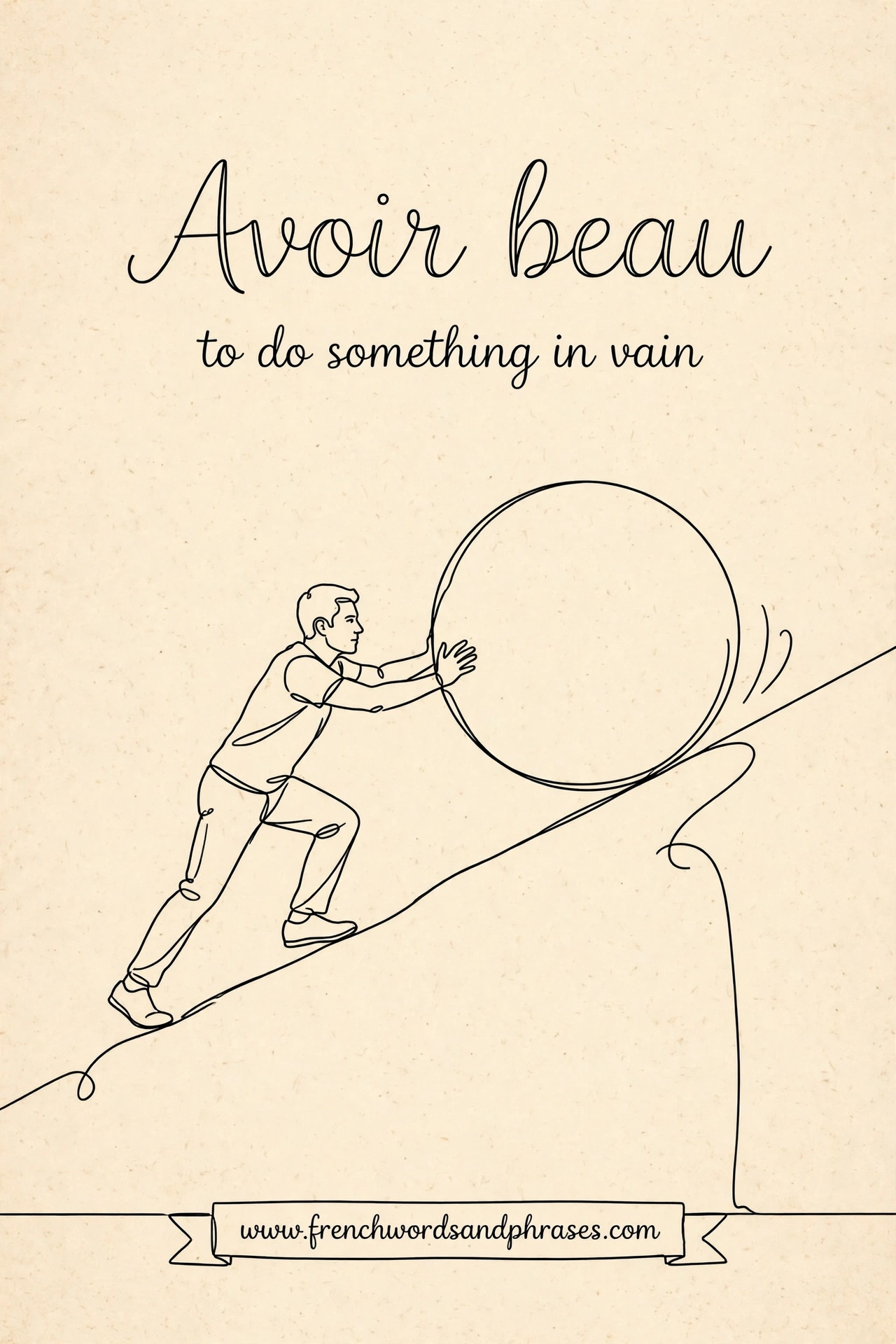
Avoir beau means to do something in vain — avoir beau + infinitive means however much you do it, it makes no difference.
The front door has swollen in the winter damp, and the concierge pushes it with her shoulder, then with her whole weight, then with a laugh of defeat. « J’ai beau pousser, elle ne bouge pas. » However much I push, it does not move. The door wins; the phrase for its victory is avoir beau.
Let’s explore how avoir beau works in French, beginning with the whole phrase on one card.
Understanding the French Phrase Avoir beau
Avoir beau is a French set phrase built from avoir (to have) and beau (beautiful, fine), always followed by an infinitive. The beau is an old fossil: centuries ago it carried the sense of ‘in fine style, to fine effect’ — and the irony stuck. To avoir beau do something is to do it beautifully, completely, and to no effect at all.
It means to do something in vain: however much you do it, nothing changes. J’ai beau crier, personne n’entend — I can shout all I like, nobody hears. The phrase almost always travels with its result: the effort first, then the flat outcome it failed to move. It is the grammar of stubborn doors, unanswered phones and umbrellas in hurricanes.
Type: Set phrase — futility (avoir beau + infinitive)
Answers the need: Saying an effort, however great, changes nothing
Register: Neutral to elegant — at home in speech, novels and newspapers alike
Strength: Wry and resigned — effort admitted, defeat accepted, a shrug built in
One important usage detail: avoir beau is never finished on its own — an infinitive must follow it, and the sentence usually completes the picture with the unchanged result, often after a comma or mais: j’ai beau essayer, je n’y arrive pas. Avoir conjugates for the person; beau never changes, for anyone, ever: elle a beau, ils ont beau.
Experience the Word
Avoir beau is the phrase of every honest effort that the world politely ignored.
Imagine the fisherman casting his net at dawn in the same grey water, the student rereading the same page at midnight, the mother explaining the same rule for the fortieth time. Each of them has a sentence waiting, and it begins with the same two words.
French keeps a special tenderness for effort without reward. Avoir beau says: the trying was real, even if the result was not.
How to Use Avoir beau in French: Complete Guide
Let’s explore how avoir beau works in French, beginning with the whole phrase on one card.
Avoir beau at a Glance
The Whole Phrase on One Card
Real meaning, literal picture, English twin and register — avoir beau in five lines.
| Point | Avoir beau |
|---|---|
| What it really means | to do something in vain — however much you do it, it changes nothing |
| Word for word | to have beautiful/fine — an old fossil phrase, the beauty long turned ironic |
| English equivalent | however much… / …all I like / it is no use …-ing |
| Register | neutral to elegant — speech, literature and journalism |
| Use it for | stubborn doors, unanswered calls, unheeded advice, hopeless weather |
Example
J’ai beau frapper, personne n’ouvre.
However much I knock, nobody opens.
Word by Word: Building the Futility
Two small pieces — and a third, the infinitive, that does all the work and wins nothing.
| Word | Literal meaning | Its job in the phrase |
|---|---|---|
| avoir | to have | the verb that conjugates — j’ai beau, tu as beau, ils ont beau |
| beau | beautiful, fine | the fossil: it never changes form, and its ‘fine’ is deeply ironic |
| + infinitive | to push, to shout, to try… | the effort itself — the verb that follows is the action that fails |
Example
Elle a beau chercher, ses clés restent introuvables.
However much she searches, her keys remain nowhere to be found.
Quick Quiz 1
Does beau agree with a female subject — elle a beau or elle a belle?
Reveal the answer
Elle a beau — beau is a fossil in this phrase and never changes, whoever is trying.
Elle a beau répéter, les enfants n’écoutent pas.
However much she repeats it, the children don’t listen.
When You Say It: The Useless-Effort Moments
Avoir beau fires at moments like these — the effort is real, and so is the wall it hits.
| Situation | Example |
|---|---|
| A stuck door | j’ai beau pousser, elle ne s’ouvre pas — however much I push, it won’t open |
| An unanswered phone | j’ai beau l’appeler, il ne répond jamais — I can call him all I like, he never answers |
| Advice ignored | tu as beau lui dire, il n’écoute personne — you can tell him all you like, he listens to nobody |
| Weather winning | j’ai beau tenir mon parapluie, le vent le retourne — however tightly I hold my umbrella, the wind turns it inside out |
| Studying without progress | elle a beau relire, elle ne retient rien ce soir — however much she rereads, nothing sticks tonight |
Example
On a beau chercher la télécommande, elle a disparu.
We can search for the remote all we like, it has vanished.
Make It Yours: The Effort for Every Person
Avoir bends for every person and tense; beau and the infinitive stay exactly as they are.
| Form | French | In English |
|---|---|---|
| I try in vain | j’ai beau essayer | however much I try |
| You explain in vain | tu as beau expliquer | you can explain all you like |
| He waits in vain | il a beau attendre | however long he waits |
| We knocked in vain (past) | nous avons beau frapper | however much we knock |
| In the past tense | j’avais beau crier | however much I shouted |
| With a double effort | j’ai beau pousser et tirer | however much I push and pull |
Example
J’avais beau crier, le train partait déjà.
However much I shouted, the train was already leaving.
Quick Quiz 2
Can avoir beau stand alone, with no verb after it?
Reveal the answer
No — an infinitive must follow: j’ai beau essayer, j’ai beau attendre. Without it, the sentence is a door with no house.
Il a beau attendre, le magasin n’ouvre pas.
However long he waits, the shop does not open.
Everyday Expressions: Building on the Shrug
Avoir beau slots into these everyday frames — each one ready to use as it stands.
| Frame | In English |
|---|---|
| avoir beau + infinitive | however much you do it, in vain |
| j’ai beau dire | I can say it all I like (nobody listens) |
| avoir beau faire | to do everything one can, to no effect |
| tu as beau dire | say what you like (it changes nothing) |
| il a beau être riche | rich as he may be (even his wealth doesn’t help) |
Example
Il a beau être riche, il ne peut pas acheter le beau temps.
Rich as he may be, he cannot buy good weather.
Close Cousins: The Other Ways to Fail Well
French shrugs in several ways — avoir beau is the elegant one; its cousins are plainer, stronger or more formal.
| Expression | The difference |
|---|---|
| avoir beau + infinitive | however much you do it — the effort and the shrug in one frame |
| ça ne sert à rien de + infinitive | it’s no use doing it — plainer, more direct, slightly blunter |
| en vain | in vain — short, formal, often written: attendre en vain |
| inutile de + infinitive | no point doing it — a cool judgement before you even start |
| malgré tous ses efforts | despite all his efforts — narrates the failure from outside |
Example
Ça ne sert à rien de courir, le bus est parti.
It’s no use running, the bus has gone.
Quick Quiz 3
Which cousin judges the effort useless before it starts — avoir beau or inutile de?
Reveal the answer
Inutile de — inutile d’essayer, no point trying. Avoir beau reports an effort actually made.
Inutile de téléphoner, elle a coupé son portable.
No point phoning, she has switched her mobile off.
Avoir beau and Its Neighbours
The stubbornness shelf around the phrase — effort on one side, surrender on the other.
| French | In English |
|---|---|
| insister | to insist, to keep trying |
| persévérer | to persevere — the noble version of not stopping |
| quand même | all the same, anyway — doing it despite everything |
| laisser tomber | to give up, to drop it — the white flag |
| à quoi bon ? | what’s the point? — the question avoir beau answers |
Example
À quoi bon insister ? J’ai beau téléphoner, elle ne décroche pas.
What’s the point of insisting? However much I phone, she doesn’t pick up.
Watch Out: The Traps Around Avoir beau
The traps: a beautiful misunderstanding, a missing infinitive, and a beau that wanders off.
| Trap | The truth |
|---|---|
| beau means beautiful here? | no — in avoir beau, beau is a fossil with an ironic ‘fine’; nobody is praising anyone’s looks |
| forgetting the infinitive | j’ai beau is unfinished — the effort must be named: j’ai beau pousser, j’ai beau crier |
| changing beau’s form | never belle, never beaux: elle a beau, ils ont beau — the word is frozen |
| using it for success | avoir beau always reports failure of the effort; if it worked, French says à force de — à force de pousser, la porte s’est ouverte |
Example
À force de pousser ensemble, la porte s’est enfin ouverte.
By pushing together repeatedly, the door finally opened.
Quick Quiz 4
True or false: j’ai beau pousser can mean the pushing finally worked.
Reveal the answer
False — avoir beau always ends in the shrug: the effort failed. Success by repetition is à force de.
J’ai beau pousser, rien ne bouge.
However much I push, nothing moves.
Avoir beau in Everyday French: Real-Life Examples
Now that you know the word, let’s see how avoir beau appears in everyday French.
Example 1 — The stuck window
J’ai beau tirer, cette fenêtre ne s’ouvre pas.
However much I pull, this window won’t open.
Example 2 — The unanswered phone
Elle a beau l’appeler, il ne répond jamais.
She can call him all she likes, he never answers.
Example 3 — The ignored advice
Tu as beau lui expliquer, il fait ce qu’il veut.
You can explain to him all you like, he does what he wants.
Example 4 — The umbrella
J’ai beau tenir mon parapluie, je suis trempé.
However tightly I hold my umbrella, I’m soaked.
Example 5 — The midnight page
Il a beau relire sa leçon, il ne comprend pas ce chapitre.
However much he rereads his lesson, he doesn’t understand this chapter.
Example 6 — The proud rich man
Elle a beau être célèbre, elle fait la queue comme tout le monde.
Famous as she may be, she queues like everyone else.
Beyond Translation: The Meaning of Avoir beau
Every language needs a way to honour wasted effort. English gives up flatly — it’s no use. French, characteristically, makes it beautiful: avoir beau dresses the failed attempt in its best clothes, as if to say the effort deserved better tailoring than the result.
Avoir beau is a medal struck for defeats: the trying was fine, even if the world declined to notice.
That is why the phrase so often carries a smile. It complains, but it compliments the complainer at the same time.
How to Remember the French Phrase Avoir beau
Remember it this way: Avoir beau is effort in its Sunday best — you did it beautifully, completely, and the door still didn’t move.
- You hear beau and think irony — the ‘fine’ effort is the one that changed nothing.
- You never let it stand alone — an infinitive follows, always: j’ai beau essayer.
- You freeze beau — elle a beau, ils ont beau; the word never agrees with anyone.
The key idea is avoir beau + infinitive means however much you do it, it makes no difference.
Test Your Knowledge of Avoir beau
Let’s see how much you’ve learned. Try answering these questions before revealing the answers.
Question 1
What does j’ai beau pousser mean?
Reveal the answer
However much I push, it makes no difference — the effort is real, the result is nothing.
Question 2
What must always follow avoir beau?
Reveal the answer
An infinitive — j’ai beau essayer, elle a beau attendre; the phrase never stands alone.
Question 3
How do you say ‘she can shout all she likes’?
Reveal the answer
Elle a beau crier — beau never changes, even for a female subject.
Question 4
What is the difference between avoir beau and à force de?
Reveal the answer
Avoir beau reports an effort that failed; à force de reports one that finally succeeded through repetition.
Question 5
Complete the sentence:
J’ai ______ appeler, personne ne répond. (However much I call, nobody answers.)
Reveal the answer
beau
J’ai beau appeler, personne ne répond.
However much I call, nobody answers.
Your Final Challenge
Can You Use It?
How would you say this in French?
“However much I call him, he never answers.”
Reveal the answer
J’ai beau l’appeler, il ne répond jamais.
However much I call him, he never answers.
A little French. A little curiosity. A richer everyday life.
LEARN FRENCH ONE WORD AT A TIME