A French Word to Live By
Translate Ennui to English
/ɑ̃.nɥi/
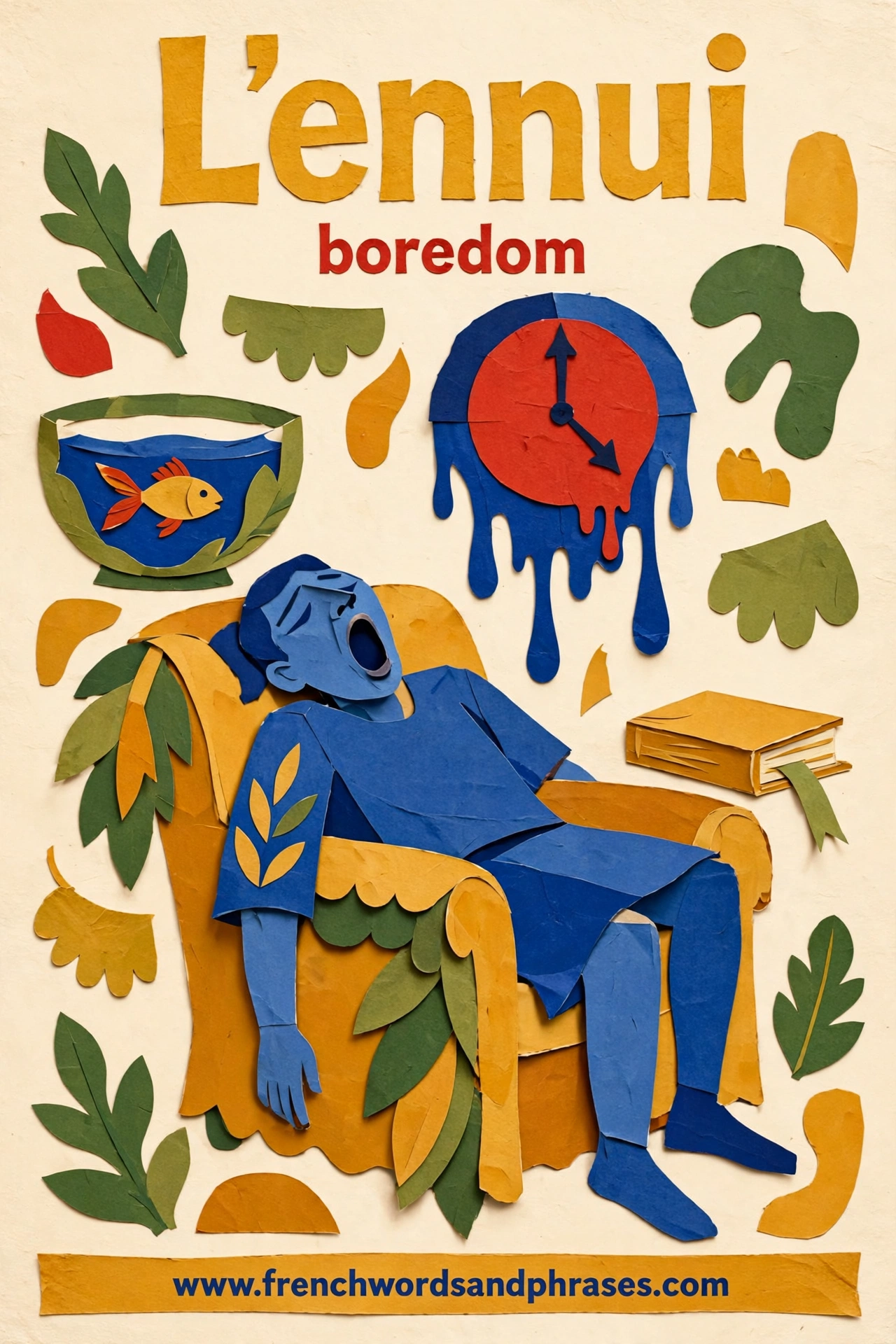
L’ennui means boredom.
Rain on the windows, Sunday afternoon, the clock ticking louder than the radio. A teenager sighs at the ceiling, a grandfather sighs at his newspaper, and nobody in the house can name a single thing worth doing. They are all drowning in the same grey water — l’ennui.
In this guide, you’ll learn what ennui means in English, how to use it with its articles, how to form its plural, and how it appears in everyday French. Explore French examples, English translations, and practice quizzes.
Understanding the French Noun Ennui
Ennui is a masculine French noun. Because it begins with a vowel, the definite article shrinks: l’ennui, un ennui. The word comes from the Latin phrase in odio — ‘it is hateful to me’ — which is exactly how a long rainy afternoon feels.
It means boredom — the heavy, empty feeling of time that will not move: mourir d’ennui, to be bored to death. But ennui leads a double life: in the plural, des ennuis are troubles, worries, problems — avoir des ennuis is to have problems, and un ennui de santé is a health problem. One word for the emptiness, and one for everything that fills it badly.
Gender: Masculine
Definite article: l’ — l’ennui (boredom)
Indefinite article: un — un ennui (a boredom; also a worry, a trouble)
Plural: les ennuis — often meaning troubles, problems
English equivalents: Boredom; in the plural, troubles, worries, problems.
One important usage detail: watch the number. Singular, l’ennui is the feeling — boredom itself. Plural, les ennuis are almost always problems: des ennuis d’argent, money troubles; des ennuis de voiture, car trouble. And the verb ennuyer does double duty too: ce film m’ennuie, this film bores me; cela m’ennuie can also mean it bothers me, it annoys me.
Experience the Word
Ennui is more than having nothing to do. It is time gone thick — the afternoon that stretches, the waiting room, the rain that outlasts every plan.
Imagine a small provincial station in 1960: one train gone, the next in three hours, a dog asleep on the platform and a boy counting the cracks in the wall. France’s great writers knew this platform well — ennui is the national literary weather.
You have not just waited. You have felt time stop — that is ennui.
How to Use Ennui in French: Complete Guide
Let’s explore how ennui works in French, beginning with its articles.
Ennui with the Definite Article (L’, Les)
Ennui begins with a vowel, so le shrinks to l’ — l’ennui — while the plural is les ennuis.
| Number | French |
|---|---|
| Singular | l’ennui |
| Plural | les ennuis |
Example
L’ennui rend les dimanches interminables.
Boredom makes Sundays endless.
Ennui with the Indefinite Article (Un, Des)
Un ennui can be one dull stretch — or one single worry. Des ennuis are usually troubles lining up.
| Number | French |
|---|---|
| Singular | un ennui |
| Plural | des ennuis |
Example
Un ennui de santé l’oblige à rester chez lui.
A health problem forces him to stay at home.
Ennui in Action: Boredom and Troubles
The feeling on one side, the problems on the other — the frames that carry both lives of the word.
| French | In English |
|---|---|
| mourir d’ennui | to be bored to death |
| tromper l’ennui | to relieve boredom, to pass the time |
| s’ennuyer | to be bored |
| avoir des ennuis | to have troubles, problems |
| causer des ennuis | to cause trouble |
| un ennui de santé | a health problem |
Example
Pour tromper l’ennui, elle apprend le piano à cinquante ans.
To relieve the boredom, she is learning the piano at fifty.
Quick Quiz 1
What do des ennuis usually mean in everyday French?
Reveal the answer
Troubles, problems — not boredoms. Des ennuis d’argent are money troubles.
Il a des ennuis de voiture depuis un mois.
He has had car trouble for a month.
The Plural of Ennui
Ennui adds an -s in the plural — les ennuis — and, as you have seen, the plural prefers to mean problems.
| Number | French |
|---|---|
| Singular | l’ennui |
| Plural | les ennuis |
Example
Les ennuis arrivent souvent tous en même temps.
Troubles often all arrive at the same time.
Ennui with Possessive Adjectives (Mon, Ton, Son…)
Ennui is masculine, so it takes mon, ton, son — which the vowel start would demand anyway.
| Owner | French |
|---|---|
| my | mon ennui |
| your (tu) | ton ennui |
| his / her | son ennui |
| our | notre ennui |
| your (vous) | votre ennui |
| their | leur ennui |
Example
Il trompe son ennui en jardinant tout le week-end.
He relieves his boredom by gardening all weekend.
Quick Quiz 2
Complete the sentence:
Il trompe ______ ennui en lisant des romans. (his)
Reveal the answer
son
Il trompe son ennui en lisant des romans.
He relieves his boredom by reading novels.
Ennui with Demonstrative Adjectives (Cet, Ces)
Before a vowel, ce becomes cet — cet ennui — while the plural is ces ennuis.
| Number | French |
|---|---|
| Singular | cet ennui |
| Plural | ces ennuis |
Example
Cet ennui des jours de pluie finit par peser.
This boredom of rainy days ends up weighing on you.
Ennui with Adjectives
Adjectives agree with ennui, masculine — profond, mortel, passager.
| Adjective | With Ennui |
|---|---|
| profond (deep) | un ennui profond |
| mortel (deadly) | un ennui mortel |
| terrible (terrible) | un ennui terrible |
| passager (passing) | un ennui passager |
| léger (slight) | un léger ennui |
Example
Un ennui mortel règne dans la salle d’attente.
A deadly boredom reigns in the waiting room.
Quick Quiz 3
Complete the sentence:
L’après-midi passe dans un ennui ______. (deadly)
Reveal the answer
mortel
L’après-midi passe dans un ennui mortel.
The afternoon passes in deadly boredom.
Everyday Expressions with Ennui
Waiting rooms, rainy days and repair bills — the ennui phrases of French life.
| Expression | In English |
|---|---|
| mourir d’ennui | to be bored to death |
| tromper l’ennui | to relieve boredom |
| chasser l’ennui | to drive away boredom |
| s’ennuyer à mourir | to be bored to death |
| un ennui profond | a deep boredom |
| des ennuis d’argent | money troubles |
Example
Les enfants chassent l’ennui en construisant une cabane.
The children drive away boredom by building a den.
Words from the Same Family as Ennui
Boring, bored and bothered — the words that travel with ennui.
| French | In English |
|---|---|
| ennuyer | to bore; to bother |
| ennuyeux | boring, tedious |
| s’ennuyer | to be bored |
| ennuyé | bored; worried, bothered |
| le souci | the worry, the care |
| l’attente | the wait, waiting |
Example
Ce long discours ennuyeux a endormi la salle.
That long, boring speech put the room to sleep.
Quick Quiz 4
Your friend says « Je suis ennuyé » to announce that she is bored. What do French speakers usually say instead?
Reveal the answer
Je m’ennuie — the reflexive verb is the everyday way to say I am bored; je suis ennuyé sounds more like I am bothered or worried.
Je m’ennuie à la maison quand il pleut.
I get bored at home when it rains.
Ennui in Everyday French: Real-Life Examples
Now that you know the word, let’s see how ennui appears in everyday French.
Example 1 — A rainy Sunday
Les enfants meurent d’ennui les jours de pluie.
The children are bored to death on rainy days.
Example 2 — The waiting room
Un ennui profond règne dans la salle d’attente du médecin.
A deep boredom reigns in the doctor’s waiting room.
Example 3 — Money troubles
Depuis l’hiver, ils ont des ennuis d’argent.
Since winter, they have had money troubles.
Example 4 — Passing the time
Pour tromper l’ennui, il fait des mots croisés.
To relieve the boredom, he does crosswords.
Example 5 — Car trouble
Encore un ennui de voiture sur la route des vacances !
Another car problem on the holiday road!
Example 6 — A long meeting
Pendant la réunion, l’ennui gagne toute la salle.
During the meeting, boredom takes over the whole room.
Beyond Translation: The Meaning of Ennui
Ennui is France’s great literary export: a boredom so refined it needed its own philosophy. Baudelaire put it at the head of his sins — the monster that would swallow the world between two yawns — and provincial novels are unthinkable without it: the long afternoons of Emma Bovary are made of ennui. The word’s own history agrees with the poets: it descends from in odio, it is hateful to me, the sigh of someone for whom the world has gone flat.
To say ennui is to feel time stop.
It evokes the rain on the Sunday window, the station platform and the counting of cracks — and, in its plural disguise, the very troubles we invent to escape it.
How to Remember the French Noun Ennui
Remember it this way: Ennui is masculine with l’ — l’ennui — boredom in the singular, and troubles in the plural: des ennuis are problems.
- You shrink the article — l’ennui, because of the vowel, and cet ennui to point.
- You split the number — l’ennui is the feeling, les ennuis are the problems.
- You say you are bored — je m’ennuie, the reflexive, like everyone else.
The key idea is l’ennui is boredom — les ennuis are troubles.
Test Your Knowledge of Ennui
Let’s see how much you’ve learned. Try answering these questions before revealing the answers.
Question 1
Is ennui masculine or feminine?
Reveal the answer
Masculine — but with l’: l’ennui, un ennui.
Question 2
How do you say ‘to be bored to death’?
Reveal the answer
Mourir d’ennui — or, with the reflexive: s’ennuyer à mourir.
Question 3
Translate: They have money troubles.
Reveal the answer
Ils ont des ennuis d’argent.
Question 4
Why do we say cet ennui and not ce ennui?
Reveal the answer
Because ennui begins with a vowel sound — ce becomes cet before a masculine noun starting with a vowel.
Question 5
Complete the sentence:
Pour tromper ______ ennui, elle téléphone à une amie. (the)
Reveal the answer
l’
Pour tromper l’ennui, elle téléphone à une amie.
To relieve the boredom, she phones a friend.
Your Final Challenge
Can You Use It?
How would you say this in French?
“The children are dying of boredom on rainy days.”
Reveal the answer
Les enfants meurent d’ennui les jours de pluie.
The children are dying of boredom on rainy days.
A little French. A little curiosity. A richer everyday life.
LEARN FRENCH ONE WORD AT A TIME