A French Word to Live By
Translate Nostalgie to English
/nɔs.tal.ʒi/
La nostalgie means nostalgia.
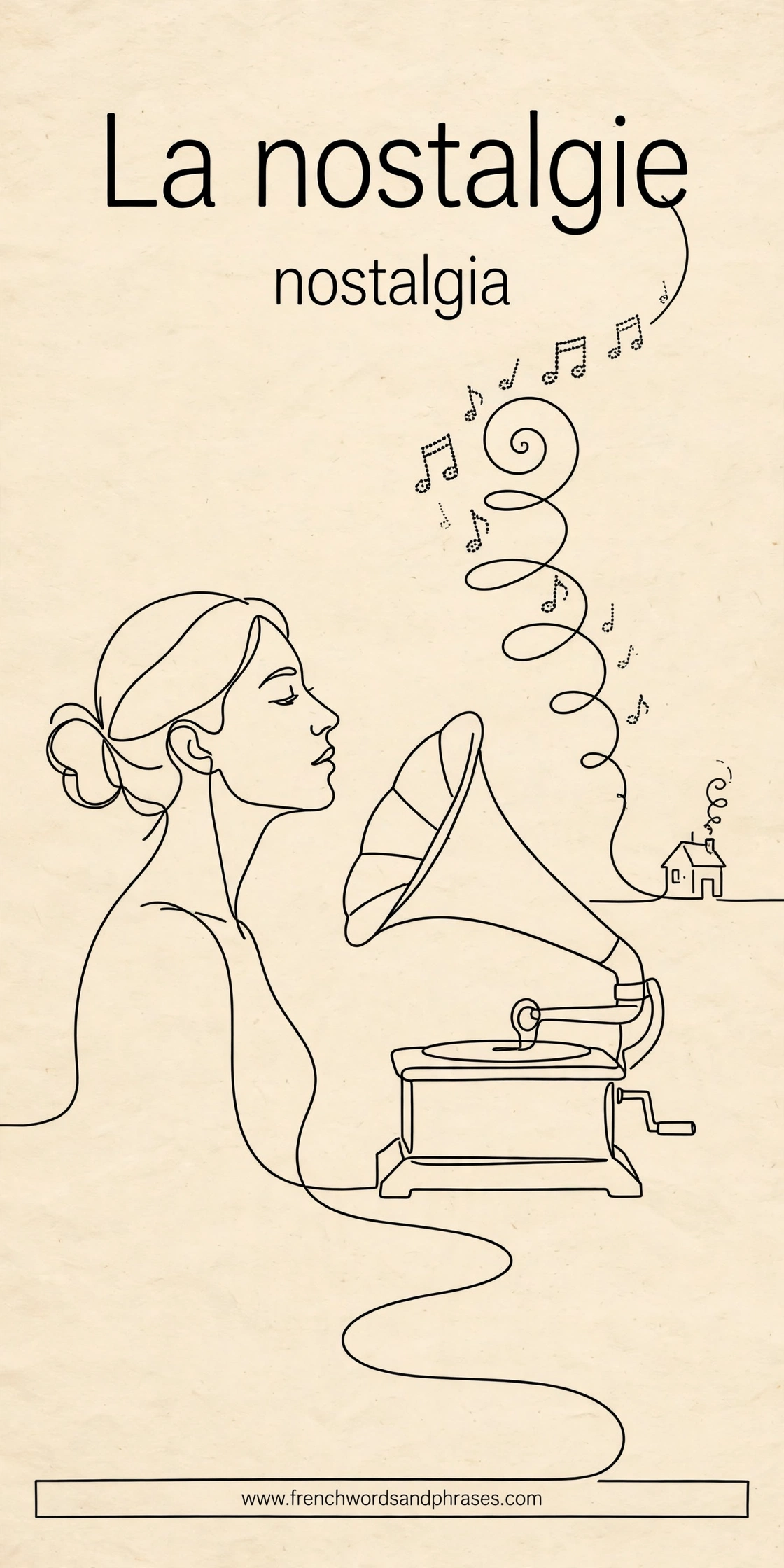
A song from twenty years ago drifts out of a café radio, and the woman at the next table stops mid-sentence, spoon in hand, smiling at something nobody else can see. The past has just walked in — la nostalgie.
In this guide, you’ll learn what nostalgie means in English, how to use it with its articles, how to form its plural, and how it appears in everyday French. Explore French examples, English translations, and practice quizzes.
Understanding the French Noun Nostalgie
Nostalgie is a feminine French noun. It is learned together with its article: la nostalgie, une nostalgie. The word was coined from two Greek pieces: nostos, the return home, and algos, pain — literally, the pain of coming home.
It means nostalgia — the sweet ache for a time, a place or a person that is gone: la nostalgie de l’enfance (nostalgia for childhood), la nostalgie du passé (nostalgia for the past). But keep its first meaning in sight: la nostalgie du pays is homesickness, longing for your own country or village — the sense the word was born with.
Gender: Feminine
Definite article: la — la nostalgie (nostalgia)
Indefinite article: une — une nostalgie (a nostalgia)
Plural: les nostalgies — rare; the word is usually uncountable
English equivalents: Nostalgia; and, in its oldest sense, homesickness.
One important usage detail: nostalgie behaves like a mass noun — French almost always keeps it in the singular, with la: avoir la nostalgie de quelque chose, to feel nostalgia for something. For the person, French uses the adjective nostalgique: elle est nostalgique, she is feeling nostalgic. The plural les nostalgies exists on paper but is hardly ever heard.
Experience the Word
Nostalgie is more than remembering. It is remembering with the heart switched on — the past returning not as information but as weather.
Imagine a grandfather showing his granddaughter the street where he grew up, pointing at a bakery that is now a phone shop. He is not sad, exactly. He is visiting a country that exists only in him.
You have not just recalled the past. You have felt it ache — that is nostalgie.
How to Use Nostalgie in French: Complete Guide
Let’s explore how nostalgie works in French, beginning with its articles.
Nostalgie with the Definite Article (La, Les)
Used for the feeling itself, the one everyone knows — la nostalgie, the ache for what is gone.
| Number | French |
|---|---|
| Singular | la nostalgie |
| Plural | les nostalgies (rare) |
Example
La nostalgie l’envahit chaque fois qu’il rentre au village.
Nostalgia washes over him every time he returns to the village.
Nostalgie with the Indefinite Article (Une, Des)
Une nostalgie names one particular wave of the feeling — a nostalgia for one place, one time.
| Number | French |
|---|---|
| Singular | une nostalgie |
| Plural | des nostalgies (rare) |
Example
Une nostalgie douce la prend devant les vieilles photos.
A gentle nostalgia takes hold of her in front of the old photos.
What Nostalgie Longs For
Childhood, the home country, the past itself — the great objects of French longing.
| French | In English |
|---|---|
| la nostalgie de l’enfance | nostalgia for childhood |
| la nostalgie du pays | homesickness, longing for home |
| la nostalgie du passé | nostalgia for the past |
| avoir la nostalgie de | to feel nostalgia for |
| être nostalgique | to be nostalgic |
| un souvenir nostalgique | a nostalgic memory |
Example
Loin de chez lui, il souffre de la nostalgie du pays.
Far from home, he suffers from homesickness.
Quick Quiz 1
What did nostalgie mean before it meant longing for the past?
Reveal the answer
Homesickness — the word was coined as a medical name for the pain of being far from home.
La nostalgie du pays rendait les soldats malades.
Homesickness made the soldiers ill.
The Plural of Nostalgie
Honestly stated: the plural les nostalgies exists, but French almost never uses it — nostalgia is a mass feeling, counted in waves, not in units.
| Number | French |
|---|---|
| Singular | la nostalgie |
| Plural | les nostalgies (rare) |
Example
On ne compte pas la nostalgie, on la ressent.
You do not count nostalgia, you feel it.
Nostalgie with Possessive Adjectives (Ma, Ta, Sa…)
Possessives agree with the noun, not with the owner — and nostalgie is feminine, so it takes ma, ta, sa.
| Owner | French |
|---|---|
| my | ma nostalgie |
| your (tu) | ta nostalgie |
| his / her | sa nostalgie |
| our | notre nostalgie |
| your (vous) | votre nostalgie |
| their | leur nostalgie |
Example
Sa nostalgie pour le village grandit avec les années.
Her nostalgia for the village grows with the years.
Quick Quiz 2
Complete the sentence:
______ nostalgie de l’enfance ne la quitte jamais. (Her)
Reveal the answer
Sa
Sa nostalgie de l’enfance ne la quitte jamais.
Her nostalgia for childhood never leaves her.
Nostalgie with Demonstrative Adjectives (Cette, Ces)
Used to point: this nostalgia here, the one this song just woke up.
| Number | French |
|---|---|
| Singular | cette nostalgie |
| Plural | ces nostalgies (rare) |
Example
Cette nostalgie-là revient chaque automne.
That nostalgia comes back every autumn.
Nostalgie with Adjectives
Adjectives agree with nostalgie, feminine — douce, profonde, douloureuse.
| Adjective | With Nostalgie |
|---|---|
| douce (gentle, sweet) | une nostalgie douce |
| profonde (deep) | une nostalgie profonde |
| douloureuse (painful) | une nostalgie douloureuse |
| légère (slight) | une légère nostalgie |
| immense (immense) | une nostalgie immense |
Example
Une nostalgie douce l’accompagne depuis son départ.
A gentle nostalgia has accompanied her since she left.
Quick Quiz 3
Complete the sentence:
Une nostalgie ______ l’envahit devant la maison de son enfance. (gentle)
Reveal the answer
douce
Une nostalgie douce l’envahit devant la maison de son enfance.
A gentle nostalgia washes over him in front of his childhood home.
Everyday Expressions with Nostalgie
Old songs, old streets and old photographs — the nostalgie phrases of daily life.
| Expression | In English |
|---|---|
| avoir la nostalgie de | to feel nostalgia for |
| être pris de nostalgie | to be seized by nostalgia |
| un accès de nostalgie | a wave of nostalgia |
| avec nostalgie | with nostalgia, nostalgically |
| la nostalgie du bon vieux temps | nostalgia for the good old days |
| se laisser aller à la nostalgie | to give in to nostalgia |
Example
En écoutant cette chanson, il est pris de nostalgie.
Listening to that song, he is seized by nostalgia.
Words from the Same Family as Nostalgie
Memory, absence and return — the words that travel with nostalgie.
| French | In English |
|---|---|
| nostalgique | nostalgic |
| le souvenir | the memory, the souvenir |
| le passé | the past |
| le mal du pays | homesickness |
| manquer | to miss (tu me manques, I miss you) |
| autrefois | in the old days, formerly |
Example
Ce quartier éveille en elle mille souvenirs nostalgiques.
That neighbourhood wakes a thousand nostalgic memories in her.
Quick Quiz 4
A Swiss soldier in 1688 was diagnosed with « nostalgie ». What was wrong with him?
Reveal the answer
He was homesick — the word began as a doctor’s name for the illness of soldiers far from home.
La nostalgie était alors une maladie des soldats loin du pays.
Nostalgia was then an illness of soldiers far from home.
Nostalgie in Everyday French: Real-Life Examples
Now that you know the word, let’s see how nostalgie appears in everyday French.
Example 1 — An old song
Cette chanson réveille en lui une douce nostalgie.
That song wakes a gentle nostalgia in him.
Example 2 — Homesickness
Loin de sa famille, elle souffre de la nostalgie du pays.
Far from her family, she suffers from homesickness.
Example 3 — Old photographs
Ils regardent les albums avec nostalgie.
They look at the albums with nostalgia.
Example 4 — A childhood street
Il repasse dans sa rue avec une nostalgie profonde.
He walks down his street again with a deep nostalgia.
Example 5 — The good old days
Les anciens parlent du bon vieux temps avec nostalgie.
The old folk speak of the good old days with nostalgia.
Example 6 — A sudden wave
Un accès de nostalgie la prend devant la gare fermée.
A wave of nostalgia takes her in front of the closed station.
Beyond Translation: The Meaning of Nostalgie
Nostalgie is a young word with an old soul: a Swiss doctor, Johannes Hofer, invented it in 1688 to name the sickness of mercenaries pining for their mountains — men who could waste away from sheer longing for home. From the clinic the word escaped into poetry, and its meaning widened from a place to a time: we are all exiles now, not from a village but from our own past.
To say nostalgie is to be homesick for a time.
It evokes the song that stops a conversation, the bakery replaced by a phone shop, the grandfather pointing at a street only he can still see — the sweet, incurable pain of return, nostos, that never quite arrives.
How to Remember the French Noun Nostalgie
Remember it this way: Nostalgie is feminine — la nostalgie — built from nostos, the return home, and algos, pain: the ache of coming back to what is gone.
- You build the word — nostos, homecoming, plus algos, pain.
- You keep it singular — la nostalgie, a mass feeling, hardly ever counted.
- You remember its first job — la nostalgie du pays, homesickness.
The key idea is la nostalgie is homesickness for a time.
Test Your Knowledge of Nostalgie
Let’s see how much you’ve learned. Try answering these questions before revealing the answers.
Question 1
Is nostalgie masculine or feminine?
Reveal the answer
Feminine — la nostalgie, une nostalgie.
Question 2
What are the two Greek pieces inside nostalgie?
Reveal the answer
Nostos, the return home, and algos, pain.
Question 3
Translate: She feels nostalgia for her childhood.
Reveal the answer
Elle a la nostalgie de son enfance.
Question 4
How do you say ‘he is nostalgic’ in French?
Reveal the answer
Il est nostalgique — the adjective is nostalgique, for men and women alike in this form.
Question 5
Complete the sentence:
Il parle de son village avec ______ nostalgie profonde. (a)
Reveal the answer
une
Il parle de son village avec une nostalgie profonde.
He speaks of his village with a deep nostalgia.
Your Final Challenge
Can You Use It?
How would you say this in French?
“She speaks of her childhood village with nostalgia.”
Reveal the answer
Elle parle du village de son enfance avec nostalgie.
She speaks of her childhood village with nostalgia.
A little French. A little curiosity. A richer everyday life.
LEARN FRENCH ONE WORD AT A TIME