A French Word to Live By
Translate Remords to English
/ʁə.mɔʁ/
Le remords means remorse.
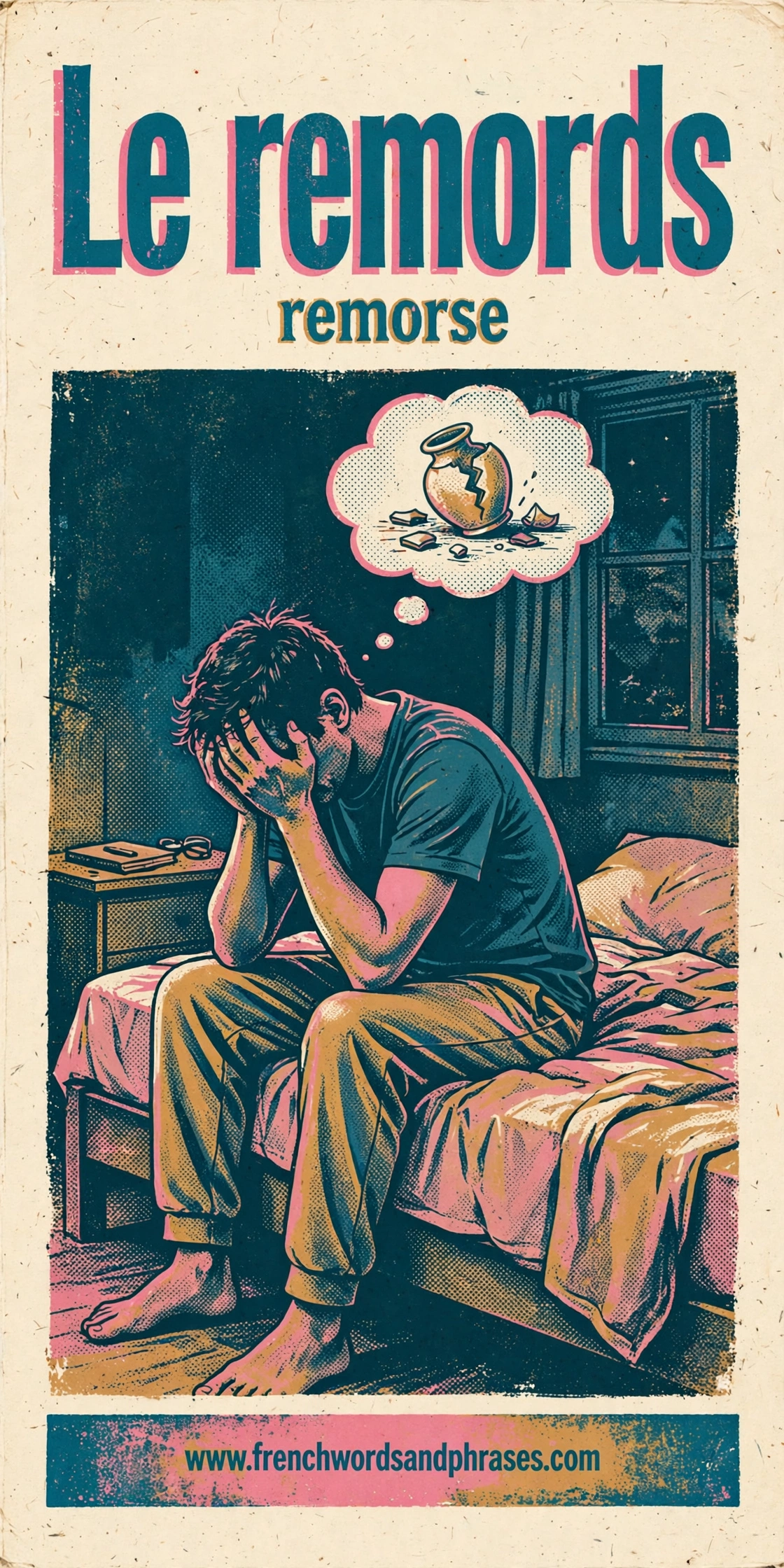
Three in the morning. He has been awake for an hour, replaying the words he said to his brother ten years ago — words never taken back, never forgiven. Sleep will not come. This is heavier than regret: this is le remords.
In this guide, you’ll learn what remords means in English, how to use it with its articles, how to form its plural, and how it appears in everyday French. Explore French examples, English translations, and practice quizzes.
Understanding the French Noun Remords
Remords is a masculine French noun — and a strange one: it is written with a final -s even in the singular, le remords, exactly as in the plural, les remords. In practice French uses it most often in the plural, des remords, for the pangs of a guilty conscience.
It means remorse — not the gentle sadness of le regret, but moral pain: the guilt of someone who has done harm and knows it. Avoir des remords is to feel remorse, to be eaten by guilt; un homme sans remords is a man without remorse, a remorseless man. Where regret looks back at a missed chance, remords looks back at a wrong.
Gender: Masculine
Definite article: le — le remords (remorse)
Indefinite article: un — un remords (a pang of remorse)
Plural: les remords — spelled exactly like the singular
English equivalents: Remorse; pangs of conscience, guilt that bites.
One important usage detail: the spelling never changes. Singular or plural, the word is always remords, with its -s — only the article and the verb reveal the number: le remords le ronge (remorse gnaws at him), les remords le rongent (his pangs of remorse gnaw at him). Dropping the -s, writing « remord », is always a mistake.
Experience the Word
Remords is more than guilt. It is conscience with teeth — the feeling that returns at night, uninvited, and will not be argued away.
Imagine a retired judge walking past the old courthouse, slowing at the steps. One case, one sentence, still follows him home after forty years. He has been acquitted by everyone except himself.
You have not just done wrong. Your conscience has bitten back — that is remords.
How to Use Remords in French: Complete Guide
Let’s explore how remords works in French, beginning with its articles.
Remords with the Definite Article (Le, Les)
The article does all the work here: le for the singular, les for the plural — the noun itself never changes.
| Number | French |
|---|---|
| Singular | le remords |
| Plural | les remords |
Example
Le remords l’empêche de dormir depuis des années.
Remorse has kept him from sleeping for years.
Remords with the Indefinite Article (Un, Des)
Un remords is one single pang; des remords is the usual, heavier plural — guilt in waves.
| Number | French |
|---|---|
| Singular | un remords |
| Plural | des remords |
Example
Après son mensonge, il a eu des remords terribles.
After his lie, he felt terrible remorse.
Remords at Work: the Guilt Frames
Remorse bites, gnaws and pursues — these are the frames French reaches for when conscience speaks.
| French | In English |
|---|---|
| avoir des remords | to feel remorse |
| être rongé par les remords | to be eaten up by remorse |
| un remords de conscience | a pang of conscience |
| sans remords | without remorse, remorseless |
| le remords le poursuit | remorse haunts him |
| étouffer ses remords | to stifle one’s remorse |
Example
Rongé par les remords, il a fini par tout avouer.
Eaten up by remorse, he ended up confessing everything.
Quick Quiz 1
What is the difference between un regret and un remords?
Reveal the answer
The weight of the fault — a regret is a missed chance or a sad memory; a remords is moral guilt over a wrong you have done.
Un regret pour le train manqué, des remords pour les paroles blessantes.
A regret for the missed train, remorse for the hurtful words.
The Plural of Remords
Honestly stated: remords has no second shape. Singular and plural are spelled identically — le remords, les remords — and only the article and the verb show the number.
| Number | French |
|---|---|
| Singular | le remords |
| Plural | les remords |
Example
Ses remords sont plus forts la nuit que le jour.
His feelings of remorse are stronger at night than in the day.
Remords with Possessive Adjectives (Mon, Ton, Son…)
Possessives agree with the noun, not with the owner — remords is masculine, so it takes mon, ton, son in the singular.
| Owner | French |
|---|---|
| my | mon remords |
| your (tu) | ton remords |
| his / her | son remords |
| our | notre remords |
| your (vous) | votre remords |
| their | leur remords |
Example
Son remords secret le suit depuis l’enfance.
His secret remorse has followed him since childhood.
Quick Quiz 2
Complete the sentence:
______ remords ne le laissent pas dormir. (His)
Reveal the answer
Ses — the verb laissent is plural, so his remords here is plural: ses remords.
Ses remords ne le laissent pas dormir.
His remorse does not let him sleep.
Remords with Demonstrative Adjectives (Ce, Ces)
Used to point: this remorse here, those pangs there — again, the adjective carries the number.
| Number | French |
|---|---|
| Singular | ce remords |
| Plural | ces remords |
Example
Ce remords-là date de sa jeunesse.
That remorse dates from his youth.
Remords with Adjectives
Adjectives agree in number even though the noun hides it — watch the endings: un remords cuisant, des remords cuisants.
| Adjective | With Remords |
|---|---|
| cuisant (biting) | des remords cuisants |
| profond (deep) | un profond remords |
| tardif (late-coming) | des remords tardifs |
| sincère (sincere) | un remords sincère |
| éternel (eternal) | un éternel remords |
Example
Des remords cuisants l’ont poussé à demander pardon.
Biting remorse pushed him to ask for forgiveness.
Quick Quiz 3
Complete the sentence:
Elle éprouve des remords ______ depuis son départ. (biting)
Reveal the answer
cuisants — plural, to agree with des remords.
Elle éprouve des remords cuisants depuis son départ.
She has felt biting remorse since she left.
Everyday Expressions with Remords
Confessions, sleepless nights and cold hearts — the remords phrases of French life.
| Expression | In English |
|---|---|
| avoir des remords | to feel remorse |
| être rongé par les remords | to be eaten up by remorse |
| sans aucun remords | without any remorse |
| un homme sans remords | a remorseless man |
| avoir des remords de conscience | to have pangs of conscience |
| le remords de toute une vie | the remorse of a whole lifetime |
Example
Il a menti sans aucun remords.
He lied without any remorse.
Words from the Same Family as Remords
Conscience, guilt and repentance — the words that travel with remords.
| French | In English |
|---|---|
| la conscience | the conscience |
| la culpabilité | guilt, guiltiness |
| coupable | guilty |
| se repentir | to repent |
| le repentir | repentance |
| le regret | regret (its lighter cousin) |
Example
Sa conscience ne lui laisse aucun repos.
His conscience gives him no rest.
Quick Quiz 4
Your friend writes the plural as « les remord ». What is wrong?
Reveal the answer
Remords never loses its -s — it keeps the same spelling in the singular and the plural: le remords, les remords.
Les remords le rongent, jamais « les remord ».
Remorse gnaws at him — and the word always keeps its s.
Remords in Everyday French: Real-Life Examples
Now that you know the word, let’s see how remords appears in everyday French.
Example 1 — A sleepless night
Ses remords l’ont tenu éveillé jusqu’au matin.
His remorse kept him awake until morning.
Example 2 — A confession
Rongé par les remords, il est allé voir son frère.
Eaten up by remorse, he went to see his brother.
Example 3 — No remorse
Elle a tout pris sans aucun remords.
She took everything without any remorse.
Example 4 — An old fault
Un remords de jeunesse le poursuit encore.
A remorse from his youth still haunts him.
Example 5 — Asking pardon
Ses remords sincères ont touché toute la famille.
His sincere remorse touched the whole family.
Example 6 — Conscience
Le remords est la voix de la conscience.
Remorse is the voice of conscience.
Beyond Translation: The Meaning of Remords
Remords is built from Latin remordere — to bite again. The image is exact: a wrong deed is a bite taken out of someone, and remorse is conscience biting back, again and again, at the one who did it. French moralists loved the word for precisely this violence, so much gentler in regret and so much sharper here.
To say remords is to hear conscience bite.
It evokes the sleepless third hour of the night, the confession finally made after years, the judge, the brother, the friend — everyone who has ever been kept awake by the knowledge of a wrong that cannot be undone, only confessed.
How to Remember the French Noun Remords
Remember it this way: Remords is remorse — masculine, always written with its -s, and heavier than regret because a wrong was done.
- You hear the bite — remords, from remordere, to bite again.
- You keep the -s — le remords, les remords, jamais sans s.
- You weigh the fault — un regret pour une chance manquée, des remords pour un tort fait.
The key idea is le remords bites back — and it never drops its s.
Test Your Knowledge of Remords
Let’s see how much you’ve learned. Try answering these questions before revealing the answers.
Question 1
Is remords masculine or feminine?
Reveal the answer
Masculine — le remords, un remords.
Question 2
How is the plural of remords spelled?
Reveal the answer
Remords — exactly like the singular; only the article changes: les remords.
Question 3
Translate: He feels remorse.
Reveal the answer
Il a des remords.
Question 4
What does être rongé par les remords mean?
Reveal the answer
To be eaten up by remorse — gnawed by guilt, without rest.
Question 5
Complete the sentence:
Elle agit toujours sans ______ remords. (any)
Reveal the answer
aucun
Elle agit toujours sans aucun remords.
She always acts without any remorse.
Your Final Challenge
Can You Use It?
How would you say this in French?
“His remorse kept him awake all night.”
Reveal the answer
Ses remords l’ont empêché de dormir toute la nuit.
His remorse kept him awake all night.
A little French. A little curiosity. A richer everyday life.
LEARN FRENCH ONE WORD AT A TIME