A French Word to Live By
Translate Beauté to English
/bo.te/
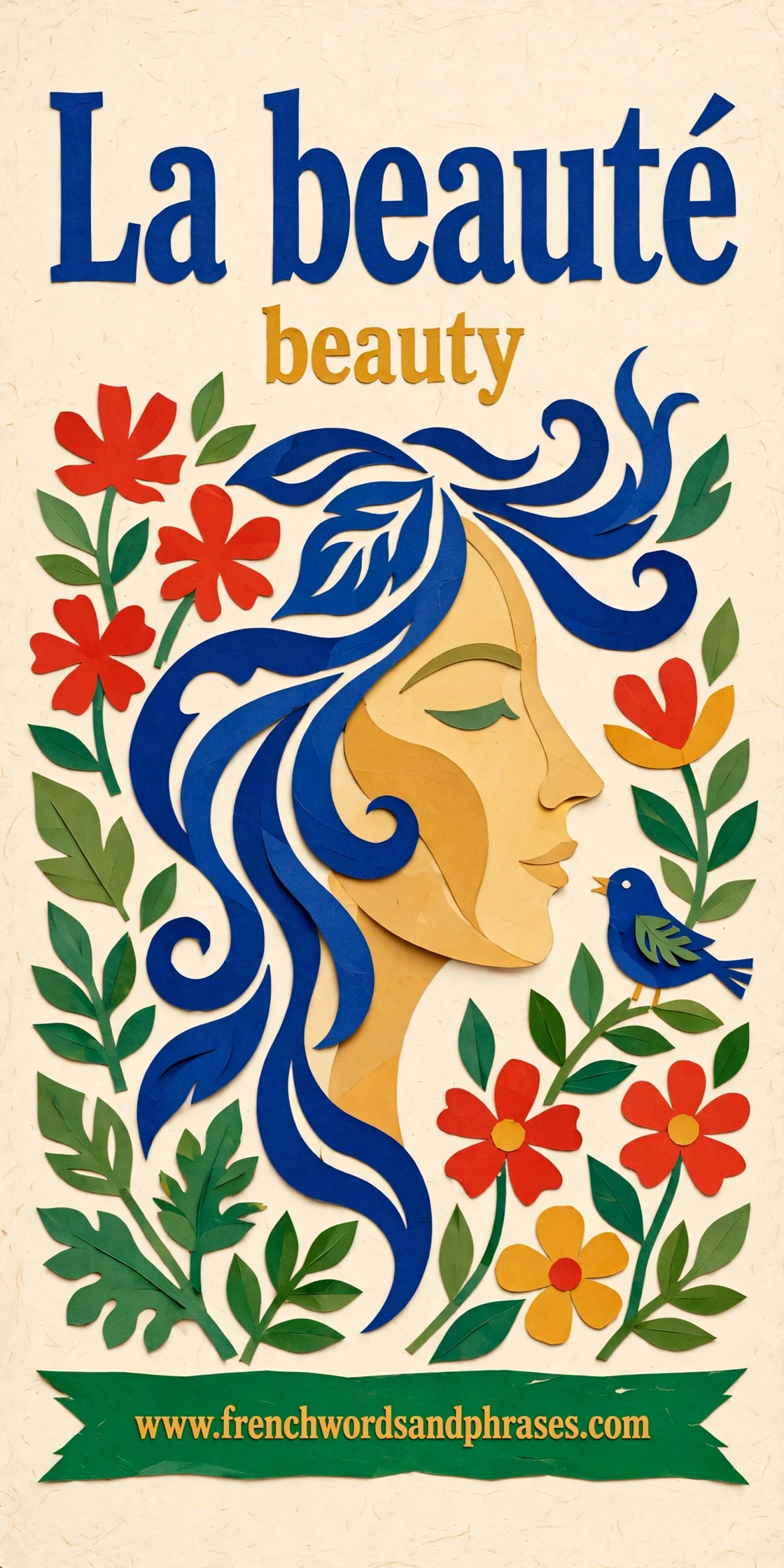
La beauté means beauty.
A spring morning in the Jardin du Luxembourg: the chestnut trees are in flower, an old man is feeding the pigeons, and a little girl stops in front of a rose bed and whispers, « Oh, la beauté ! » — la beauté, the quality that makes her stop.
In this guide, you’ll learn what beauté means in English, how to use it with its articles, how to form its plural, and how it appears in everyday French. Explore French examples, English translations, and practice quizzes.
Understanding the French Noun Beauté
Beauté is a feminine French noun. It is learned together with its article: la beauté, une beauté. It is an abstract noun — the quality of being beautiful — built from the adjective beau (beautiful) with the suffix -té, the same ending that gives French la liberté and la fierté.
It means beauty — the quality that pleases the eye, the ear or the heart: la beauté d’un paysage (the beauty of a landscape), la beauté d’un poème (the beauty of a poem). French uses it for faces, places, works of art and even actions: la beauté du geste, the beauty of the gesture, is a much-loved compliment for a generous act.
Gender: Feminine
Definite article: la — la beauté (the beauty)
Indefinite article: une — une beauté (a beauty)
Plural: les beautés (rare — beauties, beautiful women or things)
English equivalents: Beauty; in the plural, beauties.
One important usage detail: like most abstract nouns, beauté usually stays singular and works with the partitive — de la beauté, some beauty. The plural exists but changes the sense: les beautés de la nature are the individual beautiful things of nature, and une beauté can even mean a beautiful woman.
Experience the Word
Beauté is more than a pretty face. It is the word French reaches for when something stops you in your tracks — a cathedral window, a line of poetry, a sunset over the Loire.
Imagine a painter in Provence setting up her easel before a field of lavender. She is not painting flowers, she tells you. She is trying to keep a little of the morning’s beauty before the light changes.
You have not just seen something pretty. You have met la beauté — and she never stays long.
How to Use Beauté in French: Complete Guide
Let’s explore how beauté works in French, beginning with its articles.
Beauté with the Definite Article (La, Les)
Used for the beauty of a specific person, place or thing — the beauty we are looking at now.
| Number | French |
|---|---|
| Singular | la beauté |
| Plural | les beautés |
Example
La beauté de ce jardin étonne tous les visiteurs.
The beauty of this garden amazes all the visitors.
Beauté with the Indefinite Article (Une, Des)
Used for one striking beauty among others — often a person or a work of art.
| Number | French |
|---|---|
| Singular | une beauté |
| Plural | des beautés |
Example
Ce tableau est une beauté, on ne peut pas le quitter des yeux.
This painting is a beauty, you cannot take your eyes off it.
Beauté with the Partitive Article (De la)
Abstract nouns love the partitive: de la beauté is some beauty, an amount of the quality.
| Quantity | French |
|---|---|
| some | de la beauté |
| a lot of | beaucoup de beauté |
| so much | tant de beauté |
| a little | un peu de beauté |
| no, none | pas de beauté |
Example
Il y a tant de beauté dans ce petit village.
There is so much beauty in this little village.
Quick Quiz 1
How do you say ‘so much beauty’ in French?
Reveal the answer
Tant de beauté — the partitive de follows words of quantity like tant, beaucoup and un peu.
Tant de beauté dans un seul jardin !
So much beauty in a single garden!
The Plural of Beauté
Beauté adds an -s in the plural — les beautés — but the plural counts individual beautiful things rather than the quality itself.
| Number | French |
|---|---|
| Singular | la beauté |
| Plural | les beautés |
Example
Les beautés de la Provence attirent les peintres depuis toujours.
The beauties of Provence have always attracted painters.
Beauté with Possessive Adjectives (Ma, Ta, Sa…)
Possessives agree with the noun, not with the owner — and beauté is feminine, so it takes ma, ta, sa.
| Owner | French |
|---|---|
| my | ma beauté |
| your (tu) | ta beauté |
| his / her | sa beauté |
| our | notre beauté |
| your (vous) | votre beauté |
| their | leur beauté |
Example
Sa beauté ne laisse personne indifférent.
Her beauty leaves no one indifferent.
Quick Quiz 2
Complete the sentence:
______ beauté est célèbre dans le monde entier. (Her)
Reveal the answer
Sa
Sa beauté est célèbre dans le monde entier.
Her beauty is famous all over the world.
Beauté with Demonstrative Adjectives (Cette, Ces)
Used to point: this beauty here, those beauties there.
| Number | French |
|---|---|
| Singular | cette beauté |
| Plural | ces beautés |
Example
Cette beauté simple plaît plus que tous les bijoux.
This simple beauty pleases more than all the jewels.
Beauté with Adjectives
Adjectives agree with beauté, feminine — rare, grande, naturelle.
| Adjective | With Beauté |
|---|---|
| grande (great) | une grande beauté |
| rare (rare) | une beauté rare |
| naturelle (natural) | une beauté naturelle |
| simple (simple) | une beauté simple |
| extraordinaire (extraordinary) | une beauté extraordinaire |
Example
Elle a une beauté naturelle qui n’a pas besoin de maquillage.
She has a natural beauty that needs no make-up.
Quick Quiz 3
Complete the sentence:
C’est une beauté ______, sans maquillage et sans effort. (natural)
Reveal the answer
naturelle
C’est une beauté naturelle, sans maquillage et sans effort.
It’s a natural beauty, without make-up and without effort.
Everyday Expressions with Beauté
Compliments, salons and proverbs — the beauté phrases of daily life.
| Expression | In English |
|---|---|
| la beauté du geste | the beauty of the gesture (a generous act) |
| un institut de beauté | a beauty salon |
| la beauté intérieure | inner beauty |
| resplendir de beauté | to glow with beauty |
| la beauté est dans l’œil de celui qui regarde | beauty is in the eye of the beholder |
| un concours de beauté | a beauty contest |
Example
Elle a ouvert un institut de beauté près de la mairie.
She opened a beauty salon near the town hall.
Words from the Same Family as Beauté
Beautiful people and beautiful things — the words that travel with beauté.
| French | In English |
|---|---|
| beau / belle | beautiful, handsome |
| embellir | to embellish, to make more beautiful |
| joli | pretty |
| magnifique | magnificent |
| laid | ugly |
| admirer | to admire |
Example
Le printemps embellit toute la ville, quelle beauté !
Spring makes the whole town more beautiful — what beauty!
Quick Quiz 4
A friend offers you her umbrella in the rain and says nothing about it. Which expression praises her act?
Reveal the answer
La beauté du geste — the beauty of the gesture, the French compliment for a generous, elegant act.
Tu m’as prêté ton parapluie sans hésiter : la beauté du geste !
You lent me your umbrella without hesitating: the beauty of the gesture!
Beauté in Everyday French: Real-Life Examples
Now that you know the word, let’s see how beauté appears in everyday French.
Example 1 — In the garden
La beauté de ces roses me rend heureux chaque matin.
The beauty of these roses makes me happy every morning.
Example 2 — At the museum
Les visiteurs admirent la beauté de ce tableau du matin au soir.
The visitors admire the beauty of this painting from morning to night.
Example 3 — A compliment
Tu as une beauté qui ne passe pas inaperçue.
You have a beauty that does not go unnoticed.
Example 4 — In the mountains
Rien n’égale la beauté des Alpes sous la neige.
Nothing equals the beauty of the Alps under the snow.
Example 5 — At the salon
Elle travaille dans un institut de beauté depuis cinq ans.
She has worked in a beauty salon for five years.
Example 6 — A kind act
Il a payé le repas de la vieille dame : la beauté du geste.
He paid for the old lady’s meal: the beauty of the gesture.
Beyond Translation: The Meaning of Beauté
French philosophers and poets have argued about la beauté for centuries — is it in the thing itself, or in the eye that looks? The language quietly answers with its own grammar: beauté is abstract, uncountable, something you have de la, some of, never all of it.
To say beauté is to name the quality that survives when you forget the details.
It evokes the rose bed and the cathedral window, the compliment murmured at a wedding, the salon on the corner, and the beauty of a generous gesture that has nothing to do with faces at all.
How to Remember the French Noun Beauté
Remember it this way: Beauté is beauty — feminine, built from beau with the -té ending, and mostly used in the singular with de la.
- You build the word — beau plus -té, like liberté and fierté.
- You measure it — tant de beauté, un peu de beauté, never a full cup.
- You praise the act — la beauté du geste for something generously done.
The key idea is la beauté — the quality you can only ever have some of.
Test Your Knowledge of Beauté
Let’s see how much you’ve learned. Try answering these questions before revealing the answers.
Question 1
Is beauté masculine or feminine?
Reveal the answer
Feminine — la beauté, une beauté.
Question 2
From which adjective is beauté built?
Reveal the answer
Beau — beautiful, with the abstract ending -té.
Question 3
Translate: The beauty of this landscape is famous.
Reveal the answer
La beauté de ce paysage est célèbre.
Question 4
What is un institut de beauté?
Reveal the answer
A beauty salon — a place for facials, manicures and care.
Question 5
Complete the sentence:
Il y a tant de ______ dans ce poème.
Reveal the answer
beauté
Il y a tant de beauté dans ce poème.
There is so much beauty in this poem.
Your Final Challenge
Can You Use It?
How would you say this in French?
“The beauty of the garden amazes all the visitors.”
Reveal the answer
La beauté du jardin étonne tous les visiteurs.
The beauty of the garden amazes all the visitors.
A little French. A little curiosity. A richer everyday life.
LEARN FRENCH ONE WORD AT A TIME