A French Word to Live By
Translate En prendre de la graine to English
/ɑ̃ pʁɑ̃dʁ də la ɡʁɛn/
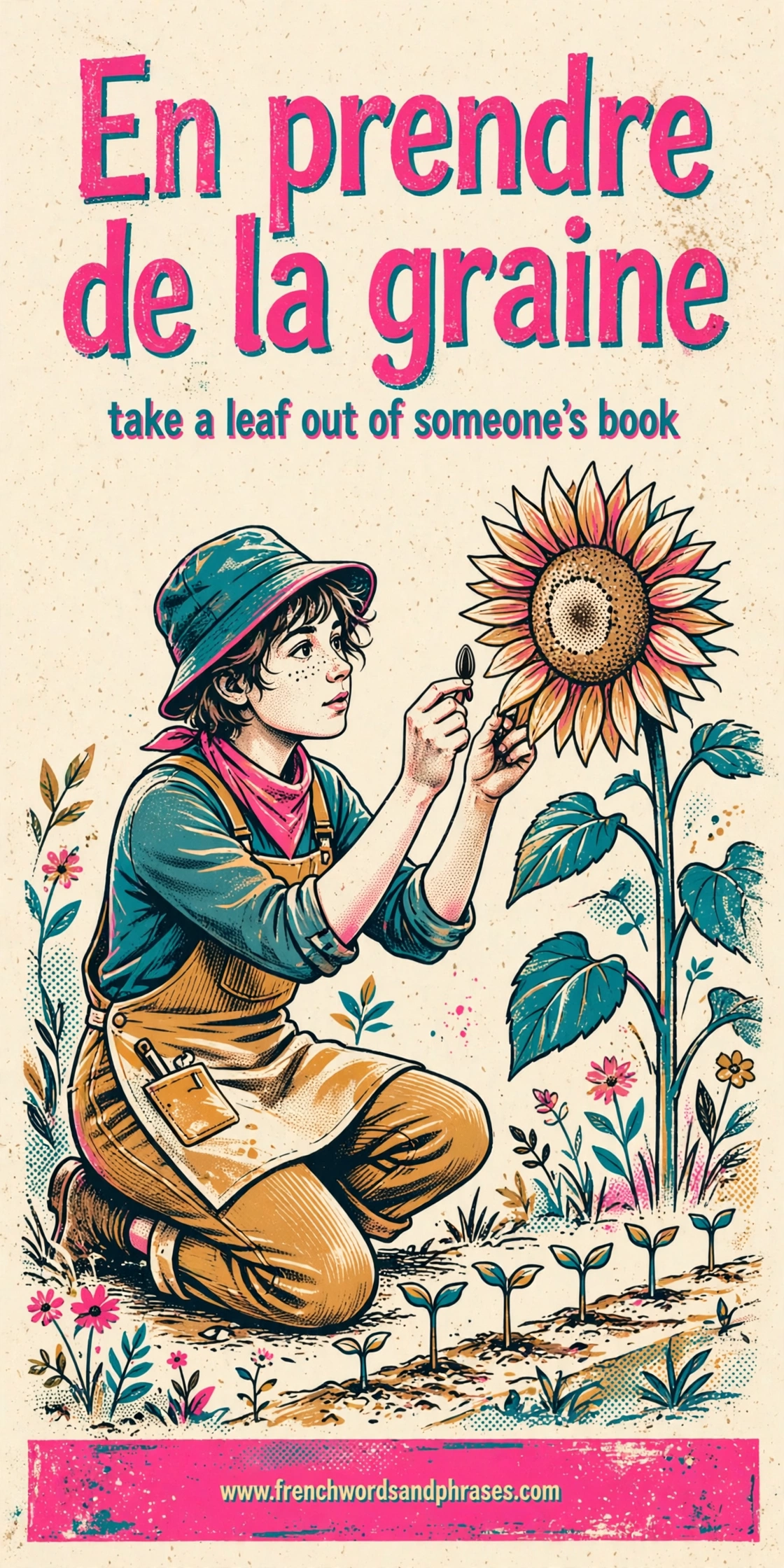
En prendre de la graine means to take a leaf out of someone’s book — to learn from a good example and follow it.
Your little brother has just watched your older sister practise the piano every morning for a month, without being asked, without complaining. At breakfast he pushes his bowl away, sits down at the piano himself and announces: « Moi aussi, je vais m’entraîner tous les jours. » Your mother smiles: he has taken seed from a good plant. In French, she would say: « Il en prend de la graine. »
Let’s explore how en prendre de la graine works in French, beginning with the whole phrase on one card.
Understanding the French Phrase En prendre de la graine
En prendre de la graine is a French idiom — a verb phrase built on prendre (to take) and graine (a seed). The picture is from the garden: you take seed from a plant that grew well so you can grow the same thing yourself. Said of a person, it means learning from someone’s good example and copying it.
It means to take a leaf out of someone’s book — to watch what someone does well and quietly decide to do the same. English says ‘follow someone’s example’; French plants a seed. The phrase is almost always approving: the example is a good one, and taking the seed is a compliment to both the model and the learner.
Type: Idiom — verb phrase (prendre + graine, a seed)
Answers the need: Praising a good example, or urging someone to learn from one
Register: Neutral and warm — everyday French, safe in most company
Strength: Gentle encouragement — advice with a smile, never an order
One important usage detail: the little word en is not decoration. It means ‘from it / from that’ — from that example, from that person — and the phrase cannot drop it. You will most often hear the phrase as friendly advice in the imperative: « Prends-en de la graine ! » — take a leaf out of their book!
Experience the Word
En prendre de la graine is what happens in kitchens, workshops and classrooms whenever someone watches a master at work and thinks: I want to do it like that.
Imagine a young cook who spends a whole service watching the old chef season a sauce — no measuring, no fuss, always right. The next day the young cook’s sauce tastes different. Nobody taught a lesson. The seed simply travelled.
French likes its advice to grow rather than to lecture. You do not copy a person — you plant what they did well and grow your own version.
How to Use En prendre de la graine in French: Complete Guide
Let’s explore how en prendre de la graine works in French, beginning with the whole phrase on one card.
En prendre de la graine at a Glance
The Whole Phrase on One Card
Real meaning, literal building blocks, English twin and register — en prendre de la graine in five lines.
| Point | En prendre de la graine |
|---|---|
| What it really means | to learn from a good example and follow it |
| Word for word | to take some seed from it (en = from it, graine = seed) |
| English equivalent | to take a leaf out of someone’s book |
| Register | neutral and warm — everyday French |
| Use it for | good examples worth copying — work, study, sport, cooking |
Example
Regarde comme elle s’organise — prends-en de la graine !
Look how organised she is — take a leaf out of her book!
Word by Word: Building the Garden Picture
Four pieces — take them one by one and the gardening picture adds up.
| Word | Literal meaning | Its job in the phrase |
|---|---|---|
| en | from it, of it | points back at the example — the seed comes FROM someone’s good behaviour |
| prendre | to take | the verb — you actively take the lesson, nobody forces it on you |
| de la | some (feminine) | the partitive — a portion of seed, not the whole plant |
| graine | a seed | the heart of the image — the small beginning that grows into a habit |
Example
Ton frère révise un peu chaque jour : en prends-tu de la graine ?
Your brother revises a little every day: are you taking a leaf out of his book?
Quick Quiz 1
What does the little word en add to the phrase?
Reveal the answer
It means ‘from it’ — the seed is taken from someone’s example. It is part of the idiom and cannot be dropped.
Prends-en de la graine !
Take a leaf out of their book!
When You Say It: The Learning Moments
En prendre de la graine belongs to moments where a good example is right in front of someone.
| Situation | Example |
|---|---|
| A sibling to copy | ta sœur ne se plaint jamais, prends-en de la graine — your sister never complains, take a leaf out of her book |
| A colleague’s method | il en a pris de la graine et maintenant il finit toujours à l’heure — he learned from the example and now he always finishes on time |
| In the kitchen | regarde la cheffe goûter chaque plat, prends-en de la graine — watch the chef taste every dish, take a leaf out of her book |
| At training | elle s’échauffe toujours sérieusement, j’en prends de la graine — she always warms up properly, I’m following her example |
| Gentle advice to a child | ton copain partage ses affaires, prends-en de la graine — your friend shares his things, take a leaf out of his book |
Example
Depuis qu’il travaille avec elle, il en prend de la graine.
Since he started working with her, he’s been following her example.
Make It Yours: Persons, Tenses and the Imperative
Prendre conjugates, the possessive picture stays — and the en moves in front of the verb, or sticks to the imperative.
| Form | French | In English |
|---|---|---|
| Advice (tu) | prends-en de la graine ! | take a leaf out of their book! |
| Advice (vous) | prenez-en de la graine ! | take a leaf out of their book! |
| I / me | j’en prends de la graine | I’m following the example |
| Past | elle en a pris de la graine | she took a leaf out of their book |
| Negative | il n’en prend pas de la graine | he isn’t learning from the example at all |
| Question | tu en prends de la graine, toi ? | are you following their example, then? |
Example
J’ai regardé son carnet de notes et j’en ai pris de la graine.
I looked at her notebook and I took a leaf out of her book.
Quick Quiz 2
How do you tell a friend: ‘Take a leaf out of his book!’?
Reveal the answer
« Prends-en de la graine ! » — in the imperative, en attaches to the verb with a hyphen.
Prends-en de la graine, il ne rend jamais un travail en retard.
Take a leaf out of his book, he never hands work in late.
Everyday Expressions: Frames Built on the Phrase
The set frames French speakers actually reach for — advice, reports and gentle nudges.
| Frame | What it does |
|---|---|
| Prends-en de la graine ! | the classic nudge — copy that good example |
| Il / elle en a pris de la graine | reporting that someone learned the lesson |
| Tu devrais en prendre de la graine | softer advice — you could learn from that |
| J’en prends de la graine | announcing that you are following the example yourself |
| En prendre de la graine, de quelqu’un | naming the model at the end — ‘take a leaf out of X’s book’ |
Example
Tu devrais en prendre de la graine, de ta collègue : elle ne panique jamais.
You should take a leaf out of your colleague’s book: she never panics.
Close Cousins Compared
Several French phrases live near this one — here is exactly how they differ.
| Cousin | How it differs |
|---|---|
| prendre exemple sur quelqu’un | the plain, neutral twin — ‘to follow someone’s example’, no garden picture |
| suivre l’exemple de quelqu’un | even plainer — following the example, often in formal or written French |
| s’inspirer de quelqu’un | broader — to draw inspiration from someone, not necessarily copying a habit |
| copier quelqu’un | just ‘to copy someone’ — can sound negative, like cheating or imitation without thought |
| marcher dans les pas de quelqu’un | to walk in someone’s footsteps — a whole career or life path, grander than one habit |
Example
Elle ne copie personne : elle en prend de la graine et elle adapte.
She doesn’t copy anyone: she takes a leaf out of their book and adapts it.
Quick Quiz 3
Which cousin means ‘to walk in someone’s footsteps’ over a whole career?
Reveal the answer
Marcher dans les pas de quelqu’un — much grander than en prendre de la graine, which is about one good habit.
Il marche dans les pas de son père, médecin comme lui.
He is following in his father’s footsteps, a doctor like him.
En prendre de la graine and Its Neighbours
Same family — learning, examples and habits — plus the opposites.
| Neighbour | Meaning |
|---|---|
| donner l’exemple | to set the example — the other end of the exchange |
| un modèle à suivre | a role model, an example to follow |
| apprendre de ses erreurs | to learn from your mistakes — the seed from failures |
| faire ses preuves | to prove yourself — what happens after the seed grows |
| donner le mauvais exemple | OPPOSITE — to set a bad example |
| ne rien apprendre de ses erreurs | OPPOSITE — to learn nothing from your mistakes |
Example
Les grands frères donnent l’exemple ; les petits en prennent de la graine.
Older brothers set the example; the little ones take a leaf out of their book.
Watch Out: The Traps Around En prendre de la graine
Three traps: a word you cannot drop, a seed that is not a grain, and a picture you must not translate flatly.
| Trap | The truth |
|---|---|
| Dropping the en | « prendre de la graine » alone sounds unfinished — the en (from the example) is part of the idiom |
| graine = ‘grain’? | graine is a seed you plant — the picture is gardening, not breakfast cereal |
| Word-for-word English | ‘to take some seed from it’ means nothing in English — use ‘take a leaf out of someone’s book’ |
| A bad example | the phrase is approving by nature — for bad examples French says donner le mauvais exemple or ne fais pas comme lui |
Example
On ne dit pas « prends de la graine » : il faut le en — prends-en de la graine.
You don’t say ‘prends de la graine’: you need the en — prends-en de la graine.
Quick Quiz 4
True or false: you can drop the en and just say « prends de la graine »?
Reveal the answer
False — the en means ‘from it (the example)’ and belongs to the idiom. Without it the sentence sounds unfinished.
Regarde-la travailler et prends-en de la graine.
Watch her work and take a leaf out of her book.
En prendre de la graine in Everyday French: Real-Life Examples
Now that you know the word, let’s see how en prendre de la graine appears in everyday French.
Example 1 — The organised sister
Ma sœur range son bureau chaque soir ; j’en prends de la graine.
My sister tidies her desk every evening; I’m taking a leaf out of her book.
Example 2 — Advice to a friend
Prends-en de la graine : lui, il relit toujours ses messages avant de les envoyer.
Take a leaf out of his book: he always re-reads his messages before sending them.
Example 3 — The new apprentice
Le nouvel apprenti regarde tout et en prend de la graine.
The new apprentice watches everything and follows the example.
Example 4 — Sport training
Elle arrive toujours en avance à l’entraînement, on en prend tous de la graine.
She always arrives early at training, we all take a leaf out of her book.
Example 5 — A softer suggestion
Tu devrais en prendre de la graine, de ton voisin : son jardin est magnifique.
You should take a leaf out of your neighbour’s book: his garden is magnificent.
Example 6 — It worked
Il en a pris de la graine et, cette fois, il a réussi du premier coup.
He followed the example and, this time, he succeeded first try.
Beyond Translation: The Meaning of En prendre de la graine
The picture comes from the kitchen garden, where French families kept seed from the best plants of the summer to sow the following spring. A good habit, in this idiom, is exactly that: something living that can be carried from one person to another and grown again.
To say en prendre de la graine is to treat good behaviour as something that reproduces.
That is why the phrase is warm rather than scolding — you are not ordering someone to change, you are handing them a seed.
How to Remember the French Phrase En prendre de la graine
Remember it this way: Picture a gardener saving seed from the best tomato plant of the summer. The seed is small, but next year’s harvest is inside it. En prendre de la graine works the same way: you take the small seed of someone’s good habit and grow your own.
- You hear graine and think seed — something small that grows into a habit.
- You keep the en — the seed always comes FROM an example.
- You say it with a smile — the phrase praises the model as much as it advises the learner.
The key idea is en prendre de la graine means to take a leaf out of someone’s book — to learn from a good example, like saving seed from the best plant.
Test Your Knowledge of En prendre de la graine
Let’s see how much you’ve learned. Try answering these questions before revealing the answers.
Question 1
What does en prendre de la graine mean?
Reveal the answer
To take a leaf out of someone’s book — to learn from a good example and follow it.
Question 2
Why is there a seed (graine) in the phrase?
Reveal the answer
Because the image is gardening — you take seed from a plant that grew well so you can grow the same thing yourself.
Question 3
Translate: Take a leaf out of her book!
Reveal the answer
Prends-en de la graine !
Question 4
Can the word en be dropped from the phrase?
Reveal the answer
No — en means ‘from it’, from the example, and the idiom needs it.
Question 5
Complete the sentence:
Elle en ______ de la graine et maintenant elle se lève tôt. (She took a leaf out of their book and now she gets up early.)
Reveal the answer
a pris
Elle en a pris de la graine et maintenant elle se lève tôt.
She took a leaf out of their book and now she gets up early.
Your Final Challenge
Can You Use It?
How would you say this in French?
“Your brother never panics before an exam, so take a leaf out of his book!”
Reveal the answer
Ton frère ne panique jamais avant un examen, alors prends-en de la graine !
Your brother never panics before an exam, so take a leaf out of his book!
A little French. A little curiosity. A richer everyday life.
LEARN FRENCH ONE WORD AT A TIME