A French Word to Live By
Translate En avoir ras le bol to English
/ɑ̃n avwaʁ ʁɑ lə bɔl/
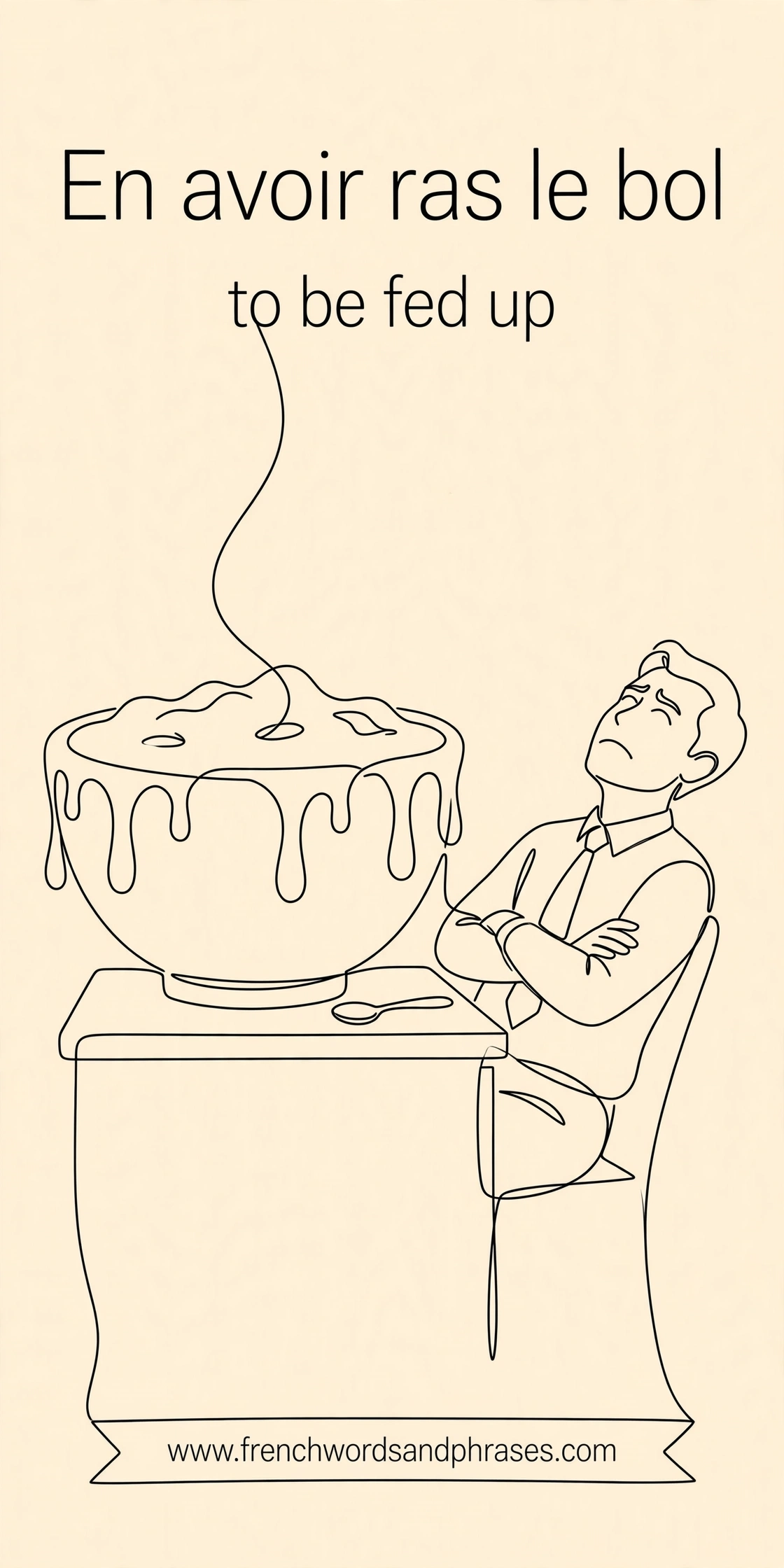
En avoir ras le bol means to be fed up, sick of it.
Third week of roadworks outside a Lyon apartment block. At seven in the morning the drills start again, the windows rattle, and from the balcony above comes the cry of the whole street: « J’en ai ras le bol ! »
Let’s explore how en avoir ras le bol works in French, beginning with the whole phrase on one card.
Understanding the French Phrase En avoir ras le bol
En avoir ras le bol is a French idiom — en (of it) plus avoir (to have) plus ras le bol, a bowl filled ras, level with the brim. One more drop and it overflows. It is the stronger big brother of en avoir marre: the fed-up phrase for when the measure is truly full.
It means to be fed up, sick of it — completely, to the brim, with no room for one drop more. English says ‘I’ve had it up to here’ or ‘I’m sick to death of this’; French fills the bowl to the very edge and shows you the surface trembling.
Type: Idiom — verb phrase (en + avoir + ras le bol)
Answers the need: Saying you are utterly fed up — the strongest everyday version
Register: Informal — spoken French with force; keep it out of polite writing
Strength: Very strong — one step beyond en avoir marre
One important usage detail: ras le bol also lives a second life as a noun — le ras-le-bol, with hyphens, is the fed-up feeling itself, and French headlines love it: le ras-le-bol des infirmières, the nurses’ fed-up-ness. The verb phrase vents your own feeling; the noun names a whole country’s.
Experience the Word
En avoir ras le bol is the bowl at the trembling brim — the whole street hears the drill at seven, and the phrase arrives before the coffee does.
Imagine the commuter whose train has been ‘delayed by twenty minutes’ for the ninth day running. She does not shout. She says it flatly, to the platform in general, the way you state a fact of weather: j’en ai ras le bol. Everyone within earshot nods. The bowl is collective.
French fills containers with its feelings. A heart can overflow with joy — and a bowl, filled ras with nonsense, overflows with this.
How to Use En avoir ras le bol in French: Complete Guide
Let’s explore how en avoir ras le bol works in French, beginning with the whole phrase on one card.
En avoir ras le bol at a Glance
The Whole Phrase on One Card
Real meaning, literal building blocks, English twin and register — en avoir ras le bol in five lines.
| Point | En avoir ras le bol |
|---|---|
| What it really means | to be utterly fed up — sick of it, with no room for more |
| Word for word | to have it level with the brim of the bowl (ras = flush, level) |
| English equivalent | to be fed up to the back teeth / I’ve had it up to here |
| Register | informal and forceful — speech, not polite writing |
| Use it for | the last straw — noise, delays, prices, politics |
Example
J’en ai ras le bol de ce bruit !
I’m fed up to the back teeth with this noise!
Word by Word: Building the Brim
Four pieces — take them one by one and the bowl fills itself.
| Word | Literal meaning | Its job in the phrase |
|---|---|---|
| en | of it, about it | the pronoun that points at the cause — essential, as in en avoir marre |
| avoir | to have | the engine — conjugated for the person: j’en ai, on en a |
| ras | level, flush with the edge | the measure word — filled exactly to the top, from the verb raser, to skim level |
| le bol | the bowl | the container of your patience — a full bowl has room for nothing more |
Example
On en a ras le bol des retards.
We’re fed up to the back teeth with the delays.
Quick Quiz 1
What does ras add to the bowl?
Reveal the answer
Level with the brim — ras means filled exactly to the edge, so one drop more overflows.
J’en ai ras le bol, vraiment ras le bol.
I’m fed up, really fed up to the brim.
When You Say It: The Last Straw
En avoir ras le bol belongs to the ninth delay, the third week of drills — the moment the measure fills.
| Situation | Example |
|---|---|
| Endless roadworks | j’en ai ras le bol de ces travaux — I’m sick of these roadworks |
| Rising prices | les gens en ont ras le bol des prix — people are fed up with the prices |
| The same excuse again | j’en ai ras le bol de tes excuses — I’ve had it up to here with your excuses |
| Rain for a month | on en a ras le bol de la pluie — we’re sick to death of the rain |
| Speaking for a crowd | tout le quartier en a ras le bol — the whole neighbourhood has had enough |
Example
Les usagers en ont ras le bol des trains annulés.
Passengers are fed up with the cancelled trains.
Make It Yours: Brimming in Every Form
Avoir conjugates and en stays — and the noun ras-le-bol lets you name the feeling itself.
| Form | French | In English |
|---|---|---|
| Naming the cause | j’en ai ras le bol de ce bruit | I’m fed up to the brim with this noise |
| With an infinitive | j’en ai ras le bol d’attendre | I’m sick of waiting |
| In the past | j’en ai eu ras le bol et j’ai démissionné | I got completely fed up and resigned |
| Everyone | on en a tous ras le bol | we’ve all had it up to here |
| The noun form | le ras-le-bol des infirmières | the nurses’ exasperation (headline French) |
| Asking | tu en as ras le bol, toi aussi ? | are you fed up to the brim too? |
Example
Le ras-le-bol monte dans tout le pays.
Exasperation is rising across the whole country.
Quick Quiz 2
How do you say ‘I’m sick of waiting’ with this idiom?
Reveal the answer
J’en ai ras le bol d’attendre — de plus an infinitive names the cause.
J’en ai ras le bol d’attendre ce médecin.
I’m sick of waiting for this doctor.
Everyday Expressions: Building on the Bowl
En avoir ras le bol slots into these everyday frames — each one ready to use as it stands.
| Frame | In English |
|---|---|
| j’en ai ras le bol | I’ve had it up to here |
| j’en ai vraiment ras le bol | I’m really, truly fed up |
| en avoir ras le bol de + nom | to be sick of + noun |
| le ras-le-bol général | the general fed-up feeling (the noun) |
| ras le bol ! | enough! (the short cry on its own) |
Example
Ras le bol de ces embouteillages !
Enough of these traffic jams!
Close Cousins: The Fed-Up Scale
The fed-up family graded — ras le bol stands near the top; know exactly where.
| Expression | The difference |
|---|---|
| en avoir ras le bol | the brim-full version — very strong, informal, for the last straw |
| en avoir marre | the classic twin — fed up, strong but a notch below ras le bol |
| en avoir plein le dos | your back is full of it — very informal, utterly sick of something |
| en avoir par-dessus la tête | over your head in it — fed up and submerged |
| en avoir assez | I’ve had enough — the neutral one, safe in careful writing |
Example
J’en ai marre des retards, et même ras le bol.
I’m fed up with the delays — fed up to the brim, in fact.
Quick Quiz 3
Which is stronger: en avoir marre or en avoir ras le bol?
Reveal the answer
En avoir ras le bol — the bowl is at the brim; marre is the everyday classic a notch below.
Au début j’en avais marre, maintenant j’en ai ras le bol.
At first I was fed up, now I’ve had it up to here.
En avoir ras le bol and Its Neighbours
The overflow shelf around en avoir ras le bol — brims, drops and last straws.
| French | In English |
|---|---|
| la goutte de trop | the last straw (literally: the drop too many) |
| faire déborder le vase | to make the vase overflow — to be the final straw |
| déborder | to overflow — what a ras bowl does next |
| avoir du bol | to be lucky — same bowl, opposite world (see Watch Out) |
| supporter | to put up with — what you did before the brim |
| craquer | to crack — what happens after the brim |
Example
Cette dernière augmentation, c’est la goutte de trop.
This latest rise is the last straw.
Watch Out: The Traps Around En avoir ras le bol
The traps: a bowl that also means luck, and force that needs the right room.
| Trap | The truth |
|---|---|
| confusing the two bols | in ras le bol, bol is the bowl; but avoir du bol means to be lucky and pas de bol means bad luck — context decides |
| dropping the en | j’en ai ras le bol is the idiom — the en points at the cause and cannot be dropped |
| using it in a formal complaint | it is forceful speech — in a letter, en avoir assez keeps your dignity and your landlord |
| spelling ras with an accent or an s at the end | it is ras, short and flat like the brim it describes — ras le bol |
Example
Pas de bol, ce retard… j’en ai ras le bol !
Bad luck, this delay… I’ve had it up to here!
Quick Quiz 4
True or false: avoir du bol means to have a lot of bowls.
Reveal the answer
False — avoir du bol means to be lucky. The bowl of ras le bol is patience; the bol of luck is a different slang story.
Tu as du bol, le train est en retard aussi.
You’re in luck, the train is late too.
En avoir ras le bol in Everyday French: Real-Life Examples
Now that you know the word, let’s see how en avoir ras le bol appears in everyday French.
Example 1 — The roadworks
J’en ai ras le bol de ces travaux devant chez moi.
I’m sick of these roadworks outside my house.
Example 2 — The rain
On en a ras le bol de cette pluie, vivement l’été.
We’re fed up to the brim with this rain, roll on summer.
Example 3 — The excuses
J’en ai ras le bol de tes excuses, dis-moi la vérité.
I’ve had it up to here with your excuses, tell me the truth.
Example 4 — The headline
Le ras-le-bol des usagers grandit chaque semaine.
Passengers’ exasperation grows every week.
Example 5 — The prices
Les familles en ont ras le bol de la vie chère.
Families are fed up with the cost of living.
Example 6 — The resignation
Il en a eu ras le bol et il a quitté son poste.
He got completely fed up and quit his job.
Beyond Translation: The Meaning of En avoir ras le bol
A bowl filled ras is a perfect instrument: it measures patience in millimetres. French could have chosen a barrel or a bucket for its biggest fed-up phrase; it chose the breakfast bowl, the most domestic object in the house — because exasperation, in real life, is rarely about revolutions. It is about drills at seven, trains at never, prices at always more.
To have ras le bol is to watch your own patience reach the brim — and to say so before it spills.
And when a whole country feels it, the noun takes over the headlines: le ras-le-bol, the moment millions of small bowls fill at once.
How to Remember the French Phrase En avoir ras le bol
Remember it this way: En avoir ras le bol fills the bowl of your patience ras — level with the brim, one drop from spilling.
- You picture the brim — ras means level with the edge, no room for one drop more.
- You keep the en — it points at the cause, exactly as in en avoir marre.
- You remember the noun twin — le ras-le-bol, with hyphens, is the feeling itself in headlines.
The key idea is en avoir ras le bol means to be utterly fed up — the bowl of patience filled to the brim, stronger than marre.
Test Your Knowledge of En avoir ras le bol
Let’s see how much you’ve learned. Try answering these questions before revealing the answers.
Question 1
What does en avoir ras le bol mean?
Reveal the answer
To be utterly fed up, sick of it — patience filled to the brim.
Question 2
What does ras mean in the phrase?
Reveal the answer
Level with the brim — filled exactly to the edge, so one drop more overflows.
Question 3
How does it compare with en avoir marre?
Reveal the answer
It is stronger — marre is the everyday classic; ras le bol is the last-straw version.
Question 4
Translate: I’m sick of this rain!
Reveal the answer
J’en ai ras le bol de cette pluie !
Question 5
Complete the sentence:
Les usagers en ont ras ______ bol des annulations. (Passengers are fed up with the cancellations.)
Reveal the answer
le
Les usagers en ont ras le bol des annulations.
Passengers are fed up with the cancellations.
Your Final Challenge
Can You Use It?
How would you say this in French?
“I’m sick of this rain!”
Reveal the answer
J’en ai ras le bol de cette pluie !
I’m sick of this rain!
A little French. A little curiosity. A richer everyday life.
LEARN FRENCH ONE WORD AT A TIME