A French Word to Live By
Translate Avoir le cafard to English
/a.vwaʁ lə ka.faʁ/
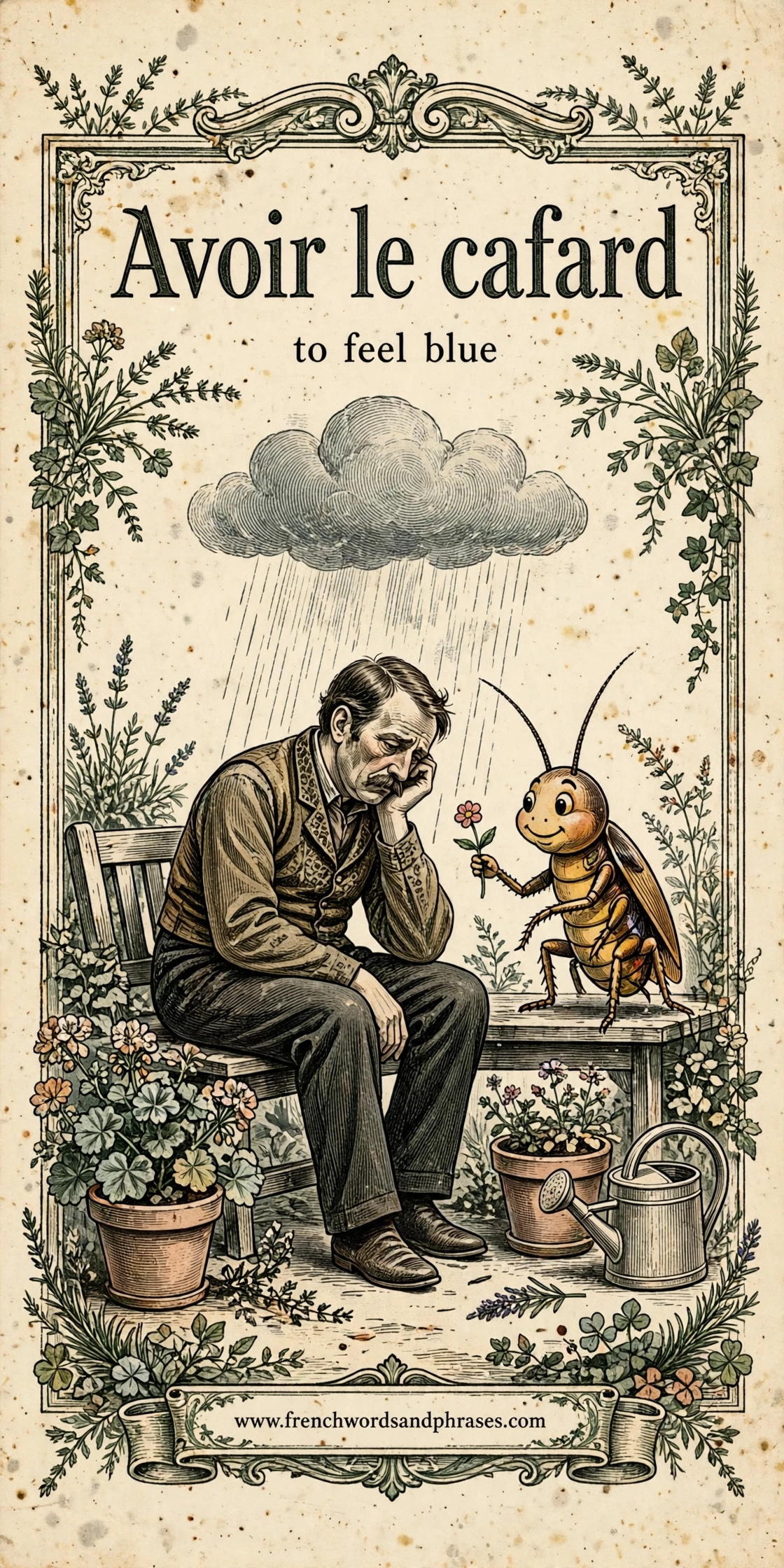
Avoir le cafard means to feel blue — to feel down and gloomy.
Sunday evening, rain on the windows, and your flatmate has been staring at the same page of his novel for an hour. The weekend is ending, work starts tomorrow, and nothing is exactly wrong — which is exactly the point. He closes the book and admits: « Je sais pas, j’ai le cafard. »
Let’s explore how avoir le cafard works in French, beginning with the whole phrase on one card.
Understanding the French Phrase Avoir le cafard
Avoir le cafard is a French idiomatic expression built from avoir (to have) and le cafard — a word that names both a cockroach and this creeping gloom. It means to feel blue: down, low and out of sorts, for no single reason you can point to.
It means to feel blue — down in the everyday, passing sense: heavy, gloomy, unable to shake it off. Nobody has insects in the house: the cafard is the dark mood itself, pictured as something that creeps in uninvited, the way a cockroach slips under a door. Baudelaire’s generation already used the word for exactly this spleen.
Type: Idiomatic expression — mood (avoir + noun)
Answers the need: Saying you feel down, blue and gloomy
Register: Informal to neutral — everyday speech and writing
Strength: Moderate — a real gloom, but the passing kind, not a diagnosis
One important usage detail: things as well as days can hand you the cafard — ce temps me donne le cafard, this weather gives me the blues; le dimanche soir donne le cafard à tout le monde. And French can chase it away: chasser le cafard, to drive the gloom off, usually with friends, music or sunshine.
Experience the Word
Avoir le cafard is the greyness with a name — and naming it, in French, is already half the cure.
Imagine the last evening of a holiday: suitcases by the door, the sea still audible through the window, nobody speaking. Nothing is wrong, and everything is ending. The French look at that silence and give it a small black insect to carry it away.
The phrase is gentle with the sufferer. It blames the insect, never the person.
How to Use Avoir le cafard in French: Complete Guide
Let’s explore how avoir le cafard works in French, beginning with the whole phrase on one card.
Avoir le cafard at a Glance
The Whole Phrase on One Card
Real meaning, literal picture, English twin and register — avoir le cafard in five lines.
| Point | Avoir le cafard |
|---|---|
| What it really means | to feel blue — down, gloomy, out of sorts |
| Word for word | to have the cockroach |
| English equivalent | to feel blue / to have the blues / to feel down |
| Register | informal to neutral — everyday speech and writing |
| Use it for | grey days, Sunday evenings, homesickness, low moods with no single cause |
Example
J’ai le cafard depuis ce matin.
I’ve been feeling blue since this morning.
Word by Word: Building the Gloom
Three small pieces — take them one by one and the little black insect creeps in.
| Word | Literal meaning | Its job in the phrase |
|---|---|---|
| avoir | to have | the verb of possession — the mood is something you carry, like le cafard itself |
| le | the | one particular gloom, the well-known one |
| cafard | a cockroach | the star of the phrase: the insect, and the creeping gloom named after it; older slang adds a sneak, a tell-tale |
Example
Ce temps gris me donne le cafard.
This grey weather gives me the blues.
Quick Quiz 1
What is a cafard when it is not a mood?
Reveal the answer
A cockroach — the gloom borrows the insect’s creeping, unwelcome way of arriving.
Un cafard a traversé la cuisine.
A cockroach crossed the kitchen.
When You Say It: The Grey Moments
Avoir le cafard fires at moments like these — nothing broken, everything heavy.
| Situation | Example |
|---|---|
| Sunday evening | le dimanche soir, j’ai souvent le cafard — on Sunday evenings, I often feel blue |
| Grey weather | ce temps me donne le cafard — this weather gives me the blues |
| Homesickness | loin de sa famille, elle a le cafard — far from her family, she feels down |
| A friend checks in | tu as le cafard ? ça se voit — are you feeling down? it shows |
| After the holidays | au retour des vacances, tout le monde a le cafard — after the holidays, everyone feels blue |
Example
Loin de chez elle, elle a le cafard le soir.
Far from home, she feels blue in the evenings.
Make It Yours: The Gloom in Every Form
The cafard can be had, given, caught in a bout, and chased away.
| Form | French | In English |
|---|---|---|
| I feel blue | j’ai le cafard | I feel blue |
| A bout of it | un coup de cafard | a fit of the blues |
| It gives me the blues | ça me donne le cafard | it gets me down |
| She’s down | elle a le cafard | she’s feeling blue |
| Chase it away | chasser le cafard | to drive the blues away |
| Question | tu as le cafard ? | are you feeling down? |
Example
Un coup de cafard, et elle appelle sa meilleure amie.
A fit of the blues, and she calls her best friend.
Quick Quiz 2
The rain is making you gloomy. Do you say the rain a le cafard or donne le cafard?
Reveal the answer
Donne — things give you the cafard: ce temps me donne le cafard. People have it.
Les dimanches pluvieux me donnent le cafard.
Rainy Sundays give me the blues.
Everyday Expressions: Building on the Gloom
Avoir le cafard slots into these everyday frames — each one ready to use as it stands.
| Frame | In English |
|---|---|
| avoir le cafard | to feel blue |
| avoir un coup de cafard | to have a fit of the blues |
| donner le cafard à quelqu’un | to give someone the blues |
| chasser le cafard | to chase the blues away |
| le cafard du dimanche soir | the Sunday-evening blues |
Example
Un dîner entre amis, rien de mieux pour chasser le cafard.
A dinner with friends — nothing better to chase the blues away.
Close Cousins: The Other Shades of Low
French has a whole shelf of low-mood phrases — le cafard is the everyday one; its cousins chew, sink or borrow from English.
| Expression | The difference |
|---|---|
| avoir le cafard | to feel blue — the everyday gloom, insect and all |
| broyer du noir | to dwell on dark thoughts — literally ‘to grind black’; the gloom you chew over and over |
| avoir le moral à zéro | morale at zero — flat, discouraged, nothing left in the tank |
| être déprimé | to be depressed — stronger than the cafard, and the clinical word too |
| avoir un coup de blues | a touch of the blues — modern, borrowed from English, a shade lighter |
Example
Arrête de broyer du noir, viens prendre l’air.
Stop dwelling on dark thoughts, come and get some air.
Quick Quiz 3
Which cousin is the heavy, clinical one — avoir le cafard or être déprimé?
Reveal the answer
Être déprimé — it borders on depression itself. Le cafard is the passing cloud, not the climate.
Il est déprimé depuis des mois, ce n’est plus un simple cafard.
He has been depressed for months — it is no longer a simple bout of the blues.
Avoir le cafard and Its Neighbours
The mood shelf around the phrase — and its sunny opposite at the far end.
| French | In English |
|---|---|
| la déprime | the doldrums, a low patch (informal) |
| le moral dans les chaussettes | morale in your socks — at rock bottom, humorous |
| avoir le cafard | to feel blue |
| retrouver le sourire | to find your smile again — the way out |
| avoir la pêche | to feel great — the sunny opposite |
| être en pleine forme | to be in great shape, full of energy |
Example
Après une semaine de cafard, elle a enfin retrouvé le sourire.
After a week of feeling blue, she finally found her smile again.
Watch Out: The Traps Around Avoir le cafard
The traps: a real insect, an old sneak, and a gloom that is given, not had, by the weather.
| Trap | The truth |
|---|---|
| the insect trap | un cafard in the kitchen is a cockroach; avoir le cafard is a mood — you cannot spray for it |
| the sneak | in older slang, un cafard is a tell-tale, someone who reports you — the mood keeps the creeping, unwelcome feel of both |
| not a diagnosis | for real depression, French says la dépression — le cafard is the passing cloud, and the phrase stays kind by keeping it that way |
| the verb that gives it | things donnent le cafard — a sad film does not ‘have’ the cafard about you, it gives it: ce film m’a donné le cafard |
Example
Ce vieux film en noir et blanc m’a donné le cafard.
That old black-and-white film gave me the blues.
Quick Quiz 4
True or false: avoir le cafard means there is a cockroach in your house.
Reveal the answer
False — it means you feel blue. The insect only lends the mood its creeping, unwelcome character.
J’ai le cafard, mais ma cuisine est propre.
I feel blue, but my kitchen is clean.
Avoir le cafard in Everyday French: Real-Life Examples
Now that you know the word, let’s see how avoir le cafard appears in everyday French.
Example 1 — Sunday evening
Le dimanche soir, j’ai toujours un peu le cafard.
On Sunday evenings, I always feel a bit blue.
Example 2 — Grey weather
Ce temps gris me donne le cafard.
This grey weather gives me the blues.
Example 3 — Homesick
Loin de sa famille, elle a le cafard.
Far from her family, she feels down.
Example 4 — Checking on a friend
Tu as le cafard ? On va se promener, ça te changera les idées.
Are you feeling down? Let’s go for a walk, it’ll take your mind off it.
Example 5 — After the holidays
Au retour des vacances, tout le bureau a le cafard.
Back from the holidays, the whole office feels blue.
Example 6 — Chasing it away
Pour chasser le cafard, il met de la musique et il danse.
To chase the blues away, he puts on music and dances.
Beyond Translation: The Meaning of Avoir le cafard
English is blue; French has an insect. The English colour is distant and poetic, but the French picture is domestic and faintly comic — your despair is a cockroach, and a cockroach can be chased out of the house.
To avoir le cafard is to be visited, not defeated: the phrase itself promises the visitor will leave.
Poets gave the word its dignity — Baudelaire’s spleen is the cafard in evening dress — but the phrase stayed in the kitchen, where most glooms live.
How to Remember the French Phrase Avoir le cafard
Remember it this way: Avoir le cafard is the gloom as a cockroach — it creeps in uninvited, and it can be chased out.
- You picture the insect — cafard is a cockroach, and the mood creeps in exactly the same way.
- You let things give it — ce temps me donne le cafard; people have it, weather gives it.
- You keep it light — real depression is la dépression; the cafard is the passing cloud.
The key idea is avoir le cafard means to feel blue — a gloom that creeps in like a cockroach.
Test Your Knowledge of Avoir le cafard
Let’s see how much you’ve learned. Try answering these questions before revealing the answers.
Question 1
What does avoir le cafard mean?
Reveal the answer
To feel blue — to feel down, gloomy and out of sorts, in the passing, everyday sense.
Question 2
What is a cafard, literally?
Reveal the answer
A cockroach — the mood borrows the insect’s creeping, unwelcome arrival.
Question 3
How do you say ‘this weather gives me the blues’?
Reveal the answer
Ce temps me donne le cafard — things donnent le cafard; people l’ont.
Question 4
How do you chase the blues away, in French?
Reveal the answer
Chasser le cafard — literally, to hunt the cockroach out.
Question 5
Complete the sentence:
Le dimanche soir, j’ai souvent le ______. (On Sunday evenings, I often feel blue.)
Reveal the answer
cafard
Le dimanche soir, j’ai souvent le cafard.
On Sunday evenings, I often feel blue.
Your Final Challenge
Can You Use It?
How would you say this in French?
“This weather gives me the blues.”
Reveal the answer
Ce temps me donne le cafard.
This weather gives me the blues.
A little French. A little curiosity. A richer everyday life.
LEARN FRENCH ONE WORD AT A TIME