A French Word to Live By
Translate Avoir la pêche to English
/a.vwaʁ la pɛʃ/
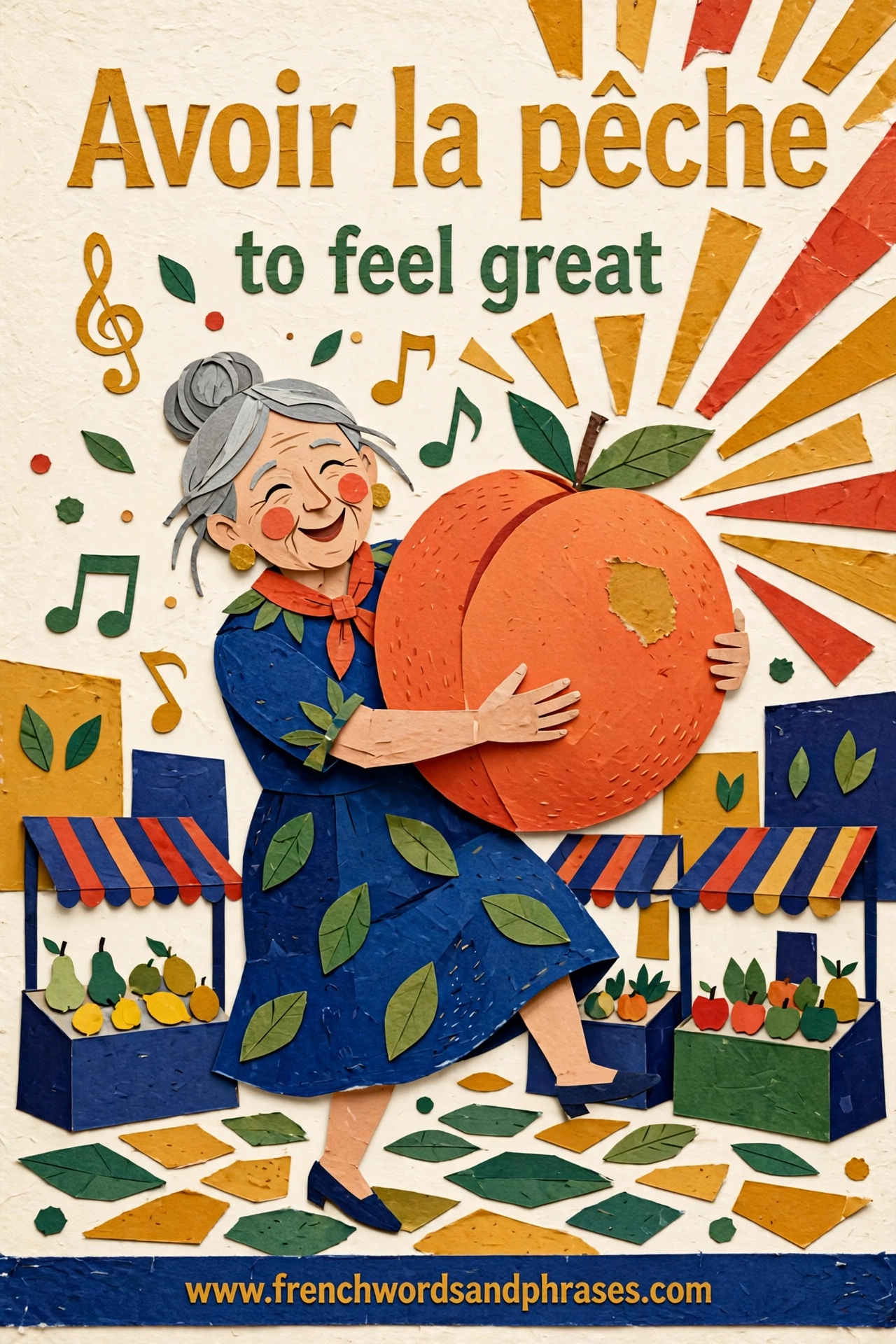
Avoir la pêche means to feel great — to be full of energy and good spirits.
Monday, eight in the morning, and while the whole office is yawning over its coffee, Nadia from accounts is already laughing, sorting files and planning lunch. Three children, a marathon on Sunday, and still this energy. Someone asks her secret, and she just shrugs: « J’ai la pêche, c’est tout. »
Let’s explore how avoir la pêche works in French, beginning with the whole phrase on one card.
Understanding the French Phrase Avoir la pêche
Avoir la pêche is a French idiomatic expression built from avoir (to have) and la pêche (the peach). It means to feel great — full of energy, bright and ready for anything. Its twins, avoir la banane and avoir la patate, swap the peach for a banana or a potato and mean exactly the same thing.
It means to feel great — energetic, cheerful, on form. Nobody is holding fruit: the peach stands for freshness and colour, the banana for the shape of a smile, and the potato, somehow, for solid good form. Said of yourself or of a friend, the phrase is a small celebration: today, everything works.
Type: Idiomatic expression — energy (avoir + fruit)
Answers the need: Saying you feel great, full of energy and bounce
Register: Informal and cheerful — friends, family, the office corridor
Strength: Sunny — real energy and good mood, not just ‘fine’
One important usage detail: the fruit is interchangeable — la pêche, la banane and la patate all carry the same meaning, and Belgium adds a fourth, la frite, the chip. What never changes is avoir: you have the peach, just as you have le cafard when the sky is grey. The two phrases are the weather vanes of the French mood.
Experience the Word
Avoir la pêche is energy you can hear — it is in the voice before it is in the legs.
Imagine the grandfather who arrives at the family lunch with a crate of vegetables from his garden, tells three stories before the soup, and beats his grandson at ping-pong after it. Nobody asks his age. The table simply agrees: il a la pêche, le grand-père.
French measures mood in groceries. A peach, a banana, a potato — the market stall becomes a battery gauge.
How to Use Avoir la pêche in French: Complete Guide
Let’s explore how avoir la pêche works in French, beginning with the whole phrase on one card.
Avoir la pêche at a Glance
The Whole Phrase on One Card
Real meaning, literal picture, English twin and register — avoir la pêche in five lines.
| Point | Avoir la pêche |
|---|---|
| What it really means | to feel great — full of energy, bright and cheerful |
| Word for word | to have the peach |
| English equivalent | to feel great / to be full of beans / to be on form |
| Register | informal and cheerful — everyday speech |
| Use it for | mornings with energy, comebacks after illness, anyone visibly thriving |
Example
Après ses vacances, elle a la pêche.
After her holidays, she feels great.
Word by Word: Building the Fruit Bowl
Three small pieces, plus the stand-ins — take them one by one and the energy appears.
| Word | Literal meaning | Its job in the phrase |
|---|---|---|
| avoir | to have | the verb of possession — energy is something you carry with you |
| la | the | the one and only peach — the famous one |
| pêche | a peach | the star fruit: freshness, colour, summer; the same word also means fishing, which is another story |
| banane / patate | a banana / a potato | the stand-ins — the banana for the shape of a smile, the potato for solid good form |
Example
Ce matin, j’ai la banane, rien ne peut m’arrêter.
This morning I feel great, nothing can stop me.
Quick Quiz 1
Your Belgian friend says j’ai la frite. Is she hungry, or full of energy?
Reveal the answer
Full of energy — in Belgium, la frite (the chip) does the same job as la pêche, la banane and la patate.
Après son café, il a la frite pour toute la journée.
After his coffee, he has energy for the whole day.
When You Say It: The Bright Moments
Avoir la pêche fires at moments like these — energy noticed, and celebrated out loud.
| Situation | Example |
|---|---|
| Monday morning | un lundi matin et déjà la pêche — Monday morning and already full of energy |
| After a holiday | les vacances lui ont donné la pêche — the holidays gave her a real boost |
| Before a match | toute l’équipe a la pêche ce soir — the whole team is on form tonight |
| About a lively child | ce petit a la patate du matin au soir — that little one has energy from morning to night |
| Recovering well | après sa grippe, il a retrouvé la pêche — after his flu, he got his energy back |
Example
Toute l’équipe a la pêche, le match va être beau.
The whole team is on form, it’s going to be a great match.
Make It Yours: Swapping the Fruit
One phrase, three fruits (four in Belgium) — the meaning never moves, only the picture changes.
| Form | French | In English |
|---|---|---|
| I feel great | j’ai la pêche | I feel great |
| The banana twin | j’ai la banane | I feel great (lit. I have the banana) |
| The potato twin | j’ai la patate | I feel great (lit. I have the potato) |
| Keep it | garder la pêche | to stay full of energy |
| It perks you up | ça donne la pêche | it gives you a boost |
| Off the scale | avoir une pêche d’enfer | to have boundless energy (lit. a hell of a peach) |
Example
Garde la pêche, la journée n’est pas finie.
Keep that energy up, the day isn’t over.
Quick Quiz 2
Which of these is NOT a real variant — la pêche, la banane, la patate, la poire?
Reveal the answer
La poire — the pear never joined the team. The energy fruits are the peach, the banana and the potato.
Lui, il a toujours la patate, même le lundi.
He always feels great, even on Mondays.
Everyday Expressions: Building on the Peach
Avoir la pêche slots into these everyday frames — each one ready to use as it stands.
| Frame | In English |
|---|---|
| avoir la pêche | to feel great, to be full of energy |
| avoir la banane / la patate | to feel great — the banana and potato twins |
| garder la pêche | to keep your energy up |
| ça donne la pêche | it gives you a boost, it perks you up |
| avoir une pêche d’enfer | to have boundless energy |
Example
Ce café me donne la pêche pour toute la matinée.
This coffee gives me a boost for the whole morning.
Close Cousins: The Other Ways to Feel Great
French has a whole shelf of energy phrases — la pêche is the fruity one; its cousins are calmer, stronger or ruder.
| Expression | The difference |
|---|---|
| avoir la pêche | to feel great — informal, fruity, cheerful |
| être en pleine forme | to be in great shape — neutral, the safe version for any company |
| avoir la forme | to be on form — everyday, a shade calmer than the peach |
| péter la forme | to be bursting with energy — very informal; péter is ‘to fart, to burst’, so keep it for close friends |
| avoir le moral au beau fixe | morale set fair — the mood version, a weather picture rather than a body one |
Example
À quatre-vingts ans, elle est en pleine forme et elle a la pêche.
At eighty, she’s in great shape and full of energy.
Quick Quiz 3
You are writing a formal email about a colleague’s excellent health. Elle a la pêche or elle est en pleine forme?
Reveal the answer
Elle est en pleine forme — the peach belongs to conversation; pleine forme is the register that survives in writing.
Après son congé, elle est revenue en pleine forme.
After her leave, she came back in great shape.
Avoir la pêche and Its Neighbours
The energy shelf around the phrase — from full battery to completely flat.
| French | In English |
|---|---|
| en forme | in shape, fit |
| plein d’énergie | full of energy |
| la banane | the banana — the smile-shaped twin |
| avoir la pêche | to feel great |
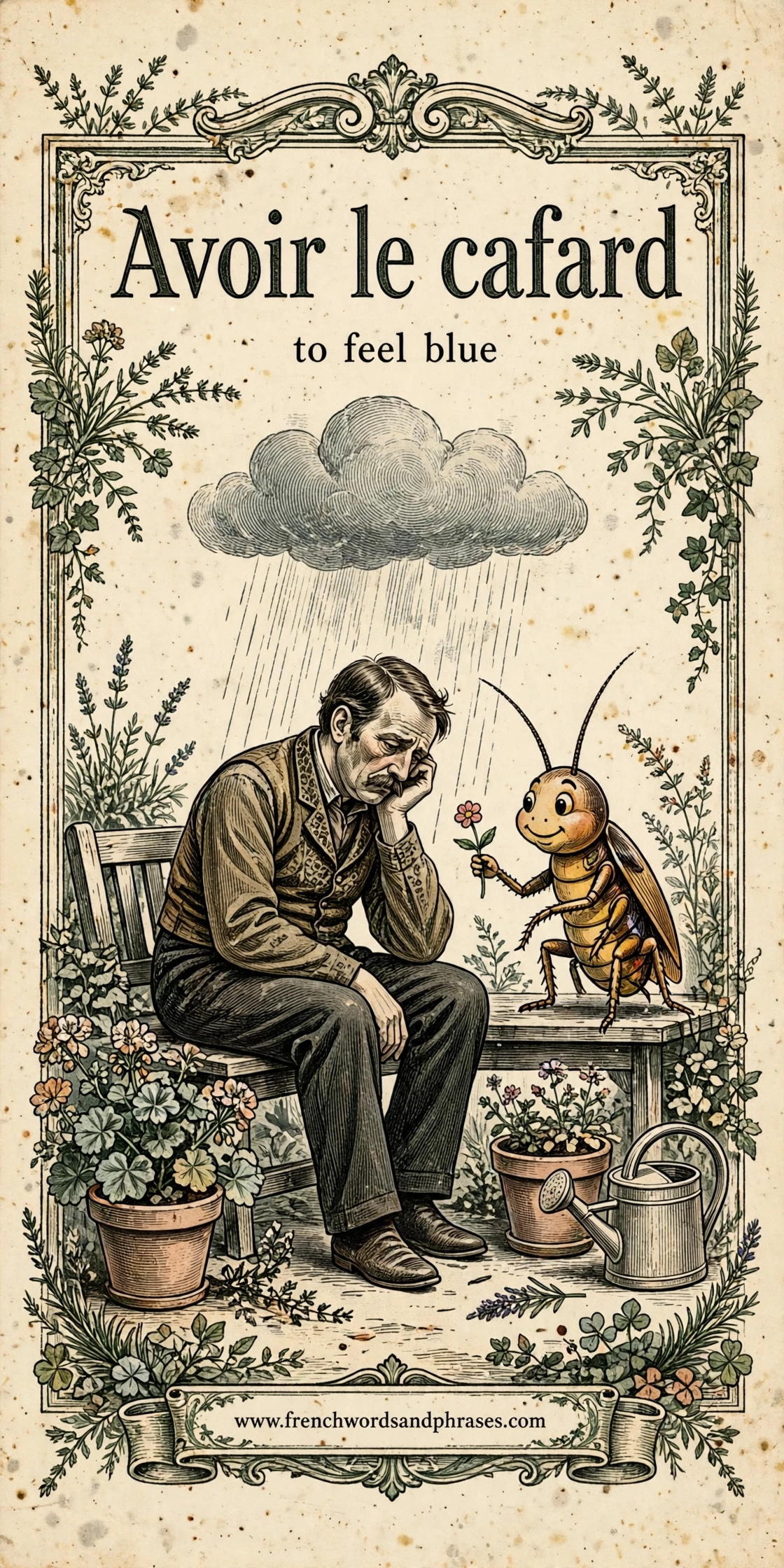
| avoir le cafard | to feel blue — the grey opposite |
| être crevé | to be exhausted — the battery at zero |
Example
Hier il était crevé, aujourd’hui il a la pêche.
Yesterday he was exhausted, today he feels great.
Watch Out: The Traps Around Avoir la pêche
The traps: a fishing trip, a sin that sounds like a fruit, and fruit salad of your own invention.
| Trap | The truth |
|---|---|
| the fishing trap | la pêche is also fishing — aller à la pêche is to go fishing, and no mood is involved; avoir la pêche is the idiom |
| the sin trap | une pêche (a peach, /pɛʃ/) and un péché (a sin, /pe.ʃe/) are neighbours in sound only — mind the ending |
| fruit salad | the variants are pêche, banane, patate — and frite in Belgium; inventing la pomme or la poire just sounds like lunch |
| not for formal writing | in a report, write en pleine forme — the peach lives in conversation |
Example
Le dimanche, il va à la pêche ; le lundi, il a la pêche.
On Sundays he goes fishing; on Mondays he feels great.
Quick Quiz 4
True or false: aller à la pêche means to go and feel great.
Reveal the answer
False — aller à la pêche is to go fishing. The idiom of energy is avoir la pêche.
Ils vont à la pêche au bord de la rivière.
They go fishing by the river.
Avoir la pêche in Everyday French: Real-Life Examples
Now that you know the word, let’s see how avoir la pêche appears in everyday French.
Example 1 — Monday morning
Un lundi matin, et elle a déjà la pêche.
A Monday morning, and she already feels great.
Example 2 — After the holidays
Les vacances m’ont donné la pêche pour un mois.
The holidays gave me energy for a month.
Example 3 — The potato twin
Ce petit a la patate du matin au soir.
That little one has energy from morning to night.
Example 4 — The banana twin
Il a la banane, il vient d’avoir une bonne nouvelle.
He’s beaming — he’s just had good news.
Example 5 — Before the match
Toute l’équipe a la pêche ce soir.
The whole team is on form tonight.
Example 6 — Keeping it up
Garde la pêche, on arrive au bout de la journée.
Keep that energy up, we’re nearly through the day.
Beyond Translation: The Meaning of Avoir la pêche
English is full of beans; French is full of fruit. The two languages agree that energy is something edible and slightly absurd — and the French picture is the prettier one: a peach is summer itself, colour and juice and sun in a single word.
To avoir la pêche is to carry your own summer around with you.
And the system is complete: the same market stall that gives you the peach for your best days keeps a cockroach — le cafard — for your worst.
How to Remember the French Phrase Avoir la pêche
Remember it this way: Avoir la pêche is energy measured in fruit — a peach for freshness, a banana for the smile, a potato for staying power.
- You picture the market stall — pêche, banane, patate: three fruits, one meaning, all energy.
- You keep the verb — it is always avoir: j’ai la pêche, never je suis la pêche.
- You mind the neighbours — aller à la pêche is fishing, and un péché is a sin, not a peach.
The key idea is avoir la pêche means to feel great — full of energy, with a banana and a potato as understudies.
Test Your Knowledge of Avoir la pêche
Let’s see how much you’ve learned. Try answering these questions before revealing the answers.
Question 1
What does avoir la pêche mean?
Reveal the answer
To feel great — to be full of energy, bright and cheerful.
Question 2
What are the two twin variants, and what do they mean?
Reveal the answer
Avoir la banane and avoir la patate — the banana (the smile’s shape) and the potato mean exactly the same: to feel great.
Question 3
How does Belgium say it?
Reveal the answer
Avoir la frite — the chip carries the same energy across the border.
Question 4
What does aller à la pêche mean?
Reveal the answer
To go fishing — la pêche is also the word for fishing; only avoir la pêche is the idiom of energy.
Question 5
Complete the sentence:
Après une semaine de vacances, j’ai la ______ ! (After a week’s holiday, I feel great!)
Reveal the answer
pêche
Après une semaine de vacances, j’ai la pêche !
After a week’s holiday, I feel great!
Your Final Challenge
Can You Use It?
How would you say this in French?
“I feel great this morning.”
Reveal the answer
J’ai la pêche ce matin.
I feel great this morning.
A little French. A little curiosity. A richer everyday life.
LEARN FRENCH ONE WORD AT A TIME