A French Word to Live By
Translate Poser un lapin à quelqu’un to English
/po.ze œ̃ la.pɛ̃ a kɛl.kœ̃/
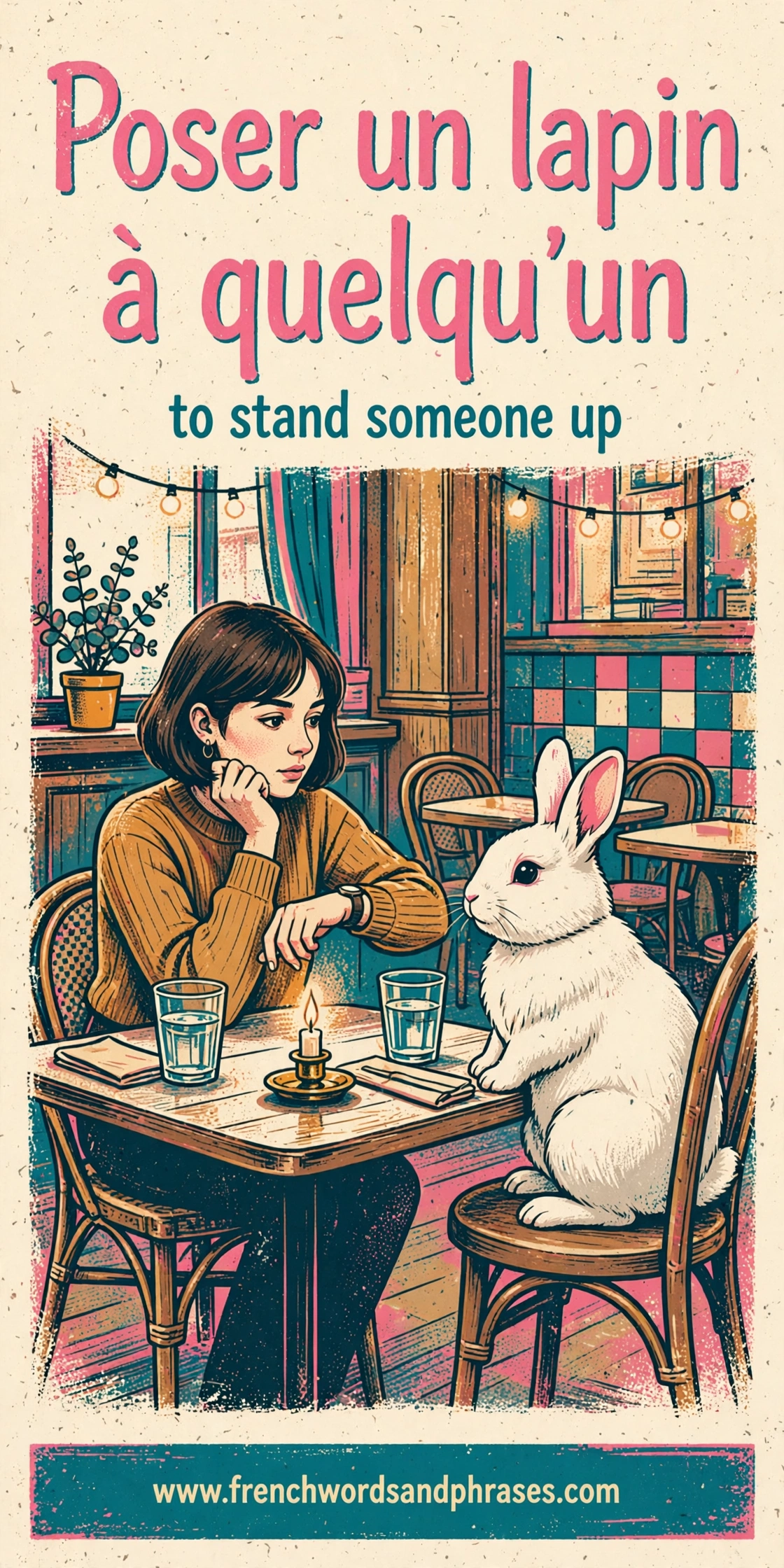
Poser un lapin à quelqu’un means to stand somebody up — to fail to turn up for a date or a meeting.
Eight o’clock at the little restaurant near the station. Your cousin has checked her phone twenty times; the second glass of water is still full, and the waiter has stopped asking. Her date never arrives, and never writes. She laughs, a bit tightly, and says: « Il m’a posé un lapin. »
Let’s explore how poser un lapin à quelqu’un works in French, beginning with the whole phrase on one card.
Understanding the French Phrase Poser un lapin à quelqu’un
Poser un lapin à quelqu’un is a French idiomatic expression built from poser (to put down, to place), un lapin (a rabbit) and à quelqu’un (to someone). It means to stand somebody up — to leave them waiting for a meeting or a date you never attend.
It means to stand someone up — you agree to meet, and you simply do not come. Nobody is giving anyone a rabbit: the picture is of a stand-in left in your place, a lapin set down on the chair where you should have been sitting. The person left waiting says it of you: tu m’as posé un lapin.
Type: Idiomatic expression — appointments (verb + noun + à quelqu’un)
Answers the need: Saying someone failed to show up for a date or a meeting
Register: Informal to neutral — everyday speech, with a note of reproach
Strength: Annoyed but not furious — a complaint, usually with a sigh
One important usage detail: the lapin is always posed à someone — poser un lapin à un ami, à sa sœur. Turn the phrase around and the victim’s version appears: se faire poser un lapin, to be stood up. Dates are its first home, but any missed appointment can earn one — even a dentist gets lapins.
Experience the Word
Poser un lapin à quelqu’un is the smallest betrayal of everyday life — no drama, just an empty chair and a phone that stays silent.
Imagine the table set for two, the good shirt ironed, the restaurant chosen with care. Nine o’clock. Half past nine. The waiter begins to look at you with pity, and pity is the worst part. That whole evening is inside this one light, funny, unforgiving phrase.
French could have made it heavy. Instead it chose a rabbit — because mockery heals faster than anger.
How to Use Poser un lapin à quelqu’un in French: Complete Guide
Let’s explore how poser un lapin à quelqu’un works in French, beginning with the whole phrase on one card.
Poser un lapin à quelqu’un at a Glance
The Whole Phrase on One Card
Real meaning, literal picture, English twin and register — poser un lapin in five lines.
| Point | Poser un lapin à quelqu’un |
|---|---|
| What it really means | to stand somebody up — not to come to a date or meeting |
| Word for word | to put down a rabbit to someone |
| English equivalent | to stand someone up / to be a no-show |
| Register | informal to neutral — everyday, reproachful |
| Use it for | dates that never happen, friends who never arrive, missed appointments |
Example
Il m’a posé un lapin hier soir.
He stood me up last night.
Word by Word: Building the Empty Chair
Four small pieces — take them one by one and the empty chair appears.
| Word | Literal meaning | Its job in the phrase |
|---|---|---|
| poser | to put down, to place | the same verb as poser une question, to ask a question — here it sets the rabbit down in your place |
| un | a | one rabbit, one empty chair |
| lapin | a rabbit | the stand-in left where you should have been sitting |
| à quelqu’un | to someone | the person left waiting — the phrase is incomplete without the victim |
Example
Elle a posé un lapin à son collègue.
She stood her colleague up.
Quick Quiz 1
In poser un lapin, who or what is the rabbit?
Reveal the answer
A stand-in — the imaginary substitute left on the chair of the person who never came. Nobody receives a real animal.
À sa place, il n’y avait qu’un lapin.
In his place, there was only a rabbit.
When You Say It: The Waiting Moments
Poser un lapin fires at moments like these — someone waited, and someone else never came.
| Situation | Example |
|---|---|
| A date | il m’a posé un lapin au restaurant — he stood me up at the restaurant |
| A friend | elle a posé un lapin à sa meilleure amie — she stood her best friend up |
| A work meeting | le candidat a posé un lapin à l’entretien — the candidate was a no-show for the interview |
| A tradesman | le plombier nous a posé un lapin — the plumber never turned up |
| Twice running | deux lapins de suite, c’est fini — stood up twice in a row, that’s the end |
Example
Le plombier nous a posé un lapin pour la deuxième fois.
The plumber has failed to turn up for the second time.
Make It Yours: The Rabbit for Every Person
The à-phrase shrinks to a pronoun — me, lui, nous — and the victim’s version uses se faire.
| Form | French | In English |
|---|---|---|
| He stood me up | il m’a posé un lapin | he stood me up |
| She stood him up | elle lui a posé un lapin | she stood him up |
| I was stood up | je me suis fait poser un lapin | I got stood up |
| To a friend | poser un lapin à un ami | to stand a friend up |
| At the last minute | poser un lapin au dernier moment | to stand someone up at the last minute |
| Question | il t’a posé un lapin ? | did he stand you up? |
Example
Je me suis fait poser un lapin, alors je suis rentré chez moi.
I got stood up, so I went home.
Quick Quiz 2
How do you say “I got stood up” — the victim’s version?
Reveal the answer
Je me suis fait poser un lapin — se faire turns the phrase around onto the person who waited.
Elle s’est fait poser un lapin deux fois par le même garçon.
She got stood up twice by the same boy.
Everyday Expressions: Building on the Rabbit
Poser un lapin slots into these everyday frames — each one ready to use as it stands.
| Frame | In English |
|---|---|
| poser un lapin à quelqu’un | to stand someone up |
| se faire poser un lapin | to get stood up |
| poser un lapin au dernier moment | to stand someone up at the last minute |
| attendre et se faire poser un lapin | to wait and get stood up |
| un spécialiste du lapin | a serial stander-upper — humorous |
Example
Attendre une heure et se faire poser un lapin, quelle soirée !
Waiting an hour and getting stood up — what an evening!
Close Cousins: The Other Ways to Not Arrive
French has a whole shelf of no-show phrases — the lapin is the famous one; its cousins widen or formalise the idea.
| Expression | The difference |
|---|---|
| poser un lapin à quelqu’un | to stand someone up — the classic, dates first, appointments too |
| faire faux bond | to fail to show, to let someone down — a shade more formal, for engagements of all kinds |
| planter quelqu’un | to ditch someone, to leave them standing there — informal and blunter |
| ne pas venir | to not come — the plain, flat description, no idiom at all |
| laisser tomber | to let drop, to let down — broader: plans, projects and people |
Example
Il nous a plantés devant le cinéma, sans prévenir.
He ditched us outside the cinema, without a word of warning.
Quick Quiz 3
Which cousin suits a formal letter about a missed official engagement — poser un lapin or faire faux bond?
Reveal the answer
Faire faux bond — it carries the same failure to appear, without the rabbit’s wink.
Le témoin a fait faux bond au tribunal.
The witness failed to appear in court.
Poser un lapin à quelqu’un and Its Neighbours
The appointment shelf around the phrase — the meeting, the wait, and the message that never comes.
| French | In English |
|---|---|
| un rendez-vous | a meeting, an appointment |
| un rencard | a date (informal) |
| attendre | to wait |
| se faire poser un lapin | to get stood up |
| un texto | a text — the message that never comes |
| arriver en retard | to arrive late — the forgivable version |
Example
Au rendez-vous de vingt heures, elle a attendu un texto qui n’est jamais venu.
At the eight o’clock date, she waited for a text that never came.
Watch Out: The Traps Around Poser un lapin
The traps: a darling with the same name, a doctor’s technical term, and the blame pointing the wrong way.
| Trap | The truth |
|---|---|
| mon lapin is a darling | said with love, mon petit lapin means ‘my little bunny’ — an affectionate nickname; the same animal, the opposite feeling |
| the doctor’s lapin | in clinics and offices, un lapin is the working word for a no-show appointment — le lapin de quinze heures, the three o’clock patient who never came |
| who holds the rabbit? | the one who fails to come pose le lapin; the one who waits se fait poser un lapin — mixing them up reverses the blame |
| not a real gift | poser un lapin never means actually giving a rabbit — for that, French says offrir un lapin |
Example
Mon petit lapin, tu m’as posé un lapin hier, c’est un comble !
My little bunny, you stood me up yesterday — that’s rich!
Quick Quiz 4
True or false: in a dentist’s diary, un lapin can mean a patient who never arrived.
Reveal the answer
True — professionals use un lapin for a no-show appointment of any kind.
Trois lapins cette semaine, le cabinet perd de l’argent.
Three no-shows this week — the practice is losing money.
Poser un lapin à quelqu’un in Everyday French: Real-Life Examples
Now that you know the word, let’s see how poser un lapin à quelqu’un appears in everyday French.
Example 1 — At the restaurant
Il m’a posé un lapin au restaurant, j’ai dîné seul.
He stood me up at the restaurant, I had dinner alone.
Example 2 — The best friend
Elle a posé un lapin à sa meilleure amie, qui l’attendait au café.
She stood her best friend up, who was waiting for her at the café.
Example 3 — Stood up
Je me suis fait poser un lapin pour la première fois de ma vie.
I got stood up for the first time in my life.
Example 4 — The plumber
Le plombier nous a posé un lapin, la fuite attendra.
The plumber never turned up — the leak will have to wait.
Example 5 — Twice in a row
Deux lapins de suite, elle a supprimé son numéro.
Stood up twice in a row, she deleted his number.
Example 6 — The apology that never came
Il m’a posé un lapin et il ne s’est même pas excusé.
He stood me up and didn’t even apologise.
Beyond Translation: The Meaning of Poser un lapin à quelqu’un
Other languages leave the stood-up person standing — the English phrase keeps them on their feet, alone, in public. French sits a rabbit down in the empty chair, and the absurdity is a small act of mercy: your evening was ruined by a bunny, not by a villain.
To poser un lapin is to fail someone — but the phrase itself refuses to let the failure turn solemn.
That lightness is why the expression survives every telling, including the ones told through gritted teeth.
How to Remember the French Phrase Poser un lapin à quelqu’un
Remember it this way: Poser un lapin is the empty-chair idiom — a rabbit sits where your date should have been.
- You picture the chair — a lapin set down in the place of the person who never came.
- You aim it with à — poser un lapin à quelqu’un; the victim is part of the phrase.
- You turn it with se faire — the one who waited says je me suis fait poser un lapin.
The key idea is poser un lapin à quelqu’un means to stand somebody up — a rabbit left in the empty chair.
Test Your Knowledge of Poser un lapin à quelqu’un
Let’s see how much you’ve learned. Try answering these questions before revealing the answers.
Question 1
What does poser un lapin à quelqu’un mean?
Reveal the answer
To stand somebody up — to fail to turn up for a date or a meeting you had agreed to.
Question 2
How do you say ‘I got stood up’?
Reveal the answer
Je me suis fait poser un lapin — se faire turns the phrase onto the person who waited.
Question 3
What does mon petit lapin mean when said with a smile?
Reveal the answer
‘My little bunny’ — an affectionate nickname, the opposite of the idiom’s reproach.
Question 4
In a clinic’s diary, what is un lapin?
Reveal the answer
A no-show — a patient who booked an appointment and never arrived.
Question 5
Complete the sentence:
Il m’a ______ un lapin hier soir. (He stood me up last night.)
Reveal the answer
posé
Il m’a posé un lapin hier soir.
He stood me up last night.
Your Final Challenge
Can You Use It?
How would you say this in French?
“He stood me up last night.”
Reveal the answer
Il m’a posé un lapin hier soir.
He stood me up last night.
A little French. A little curiosity. A richer everyday life.
LEARN FRENCH ONE WORD AT A TIME