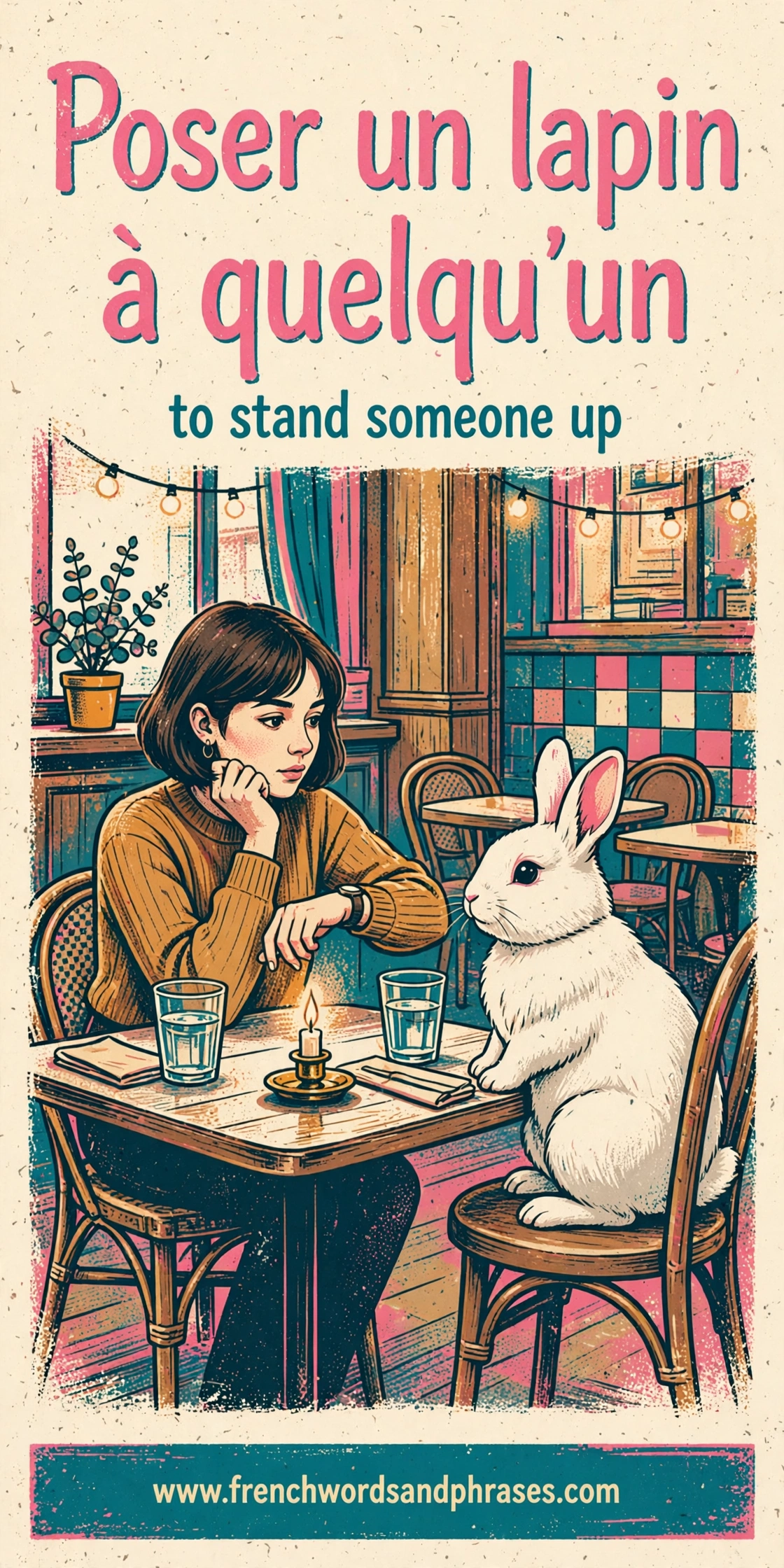
A French Word to Live By
Translate Se prendre un râteau to English
/sə pʁɑ̃dʁ œ̃ ʁa.to/
Se prendre un râteau means to get knocked back — to be rejected when you make a romantic move.
At the end of the evening, your flatmate walks over to the woman he has been glancing at all night, says his best line — and comes back two minutes later, staring at the floor. He does not need to explain. In French, his face says it for him: « Je me suis pris un râteau. »
Let’s explore how se prendre un râteau works in French, beginning with the whole phrase on one card.
Understanding the French Phrase Se prendre un râteau
Se prendre un râteau is a French idiomatic expression built from se prendre (to take for oneself, to get) and un râteau (a rake). It is the humorous French way to say a romantic approach was rejected — you made your move, and the answer was no.
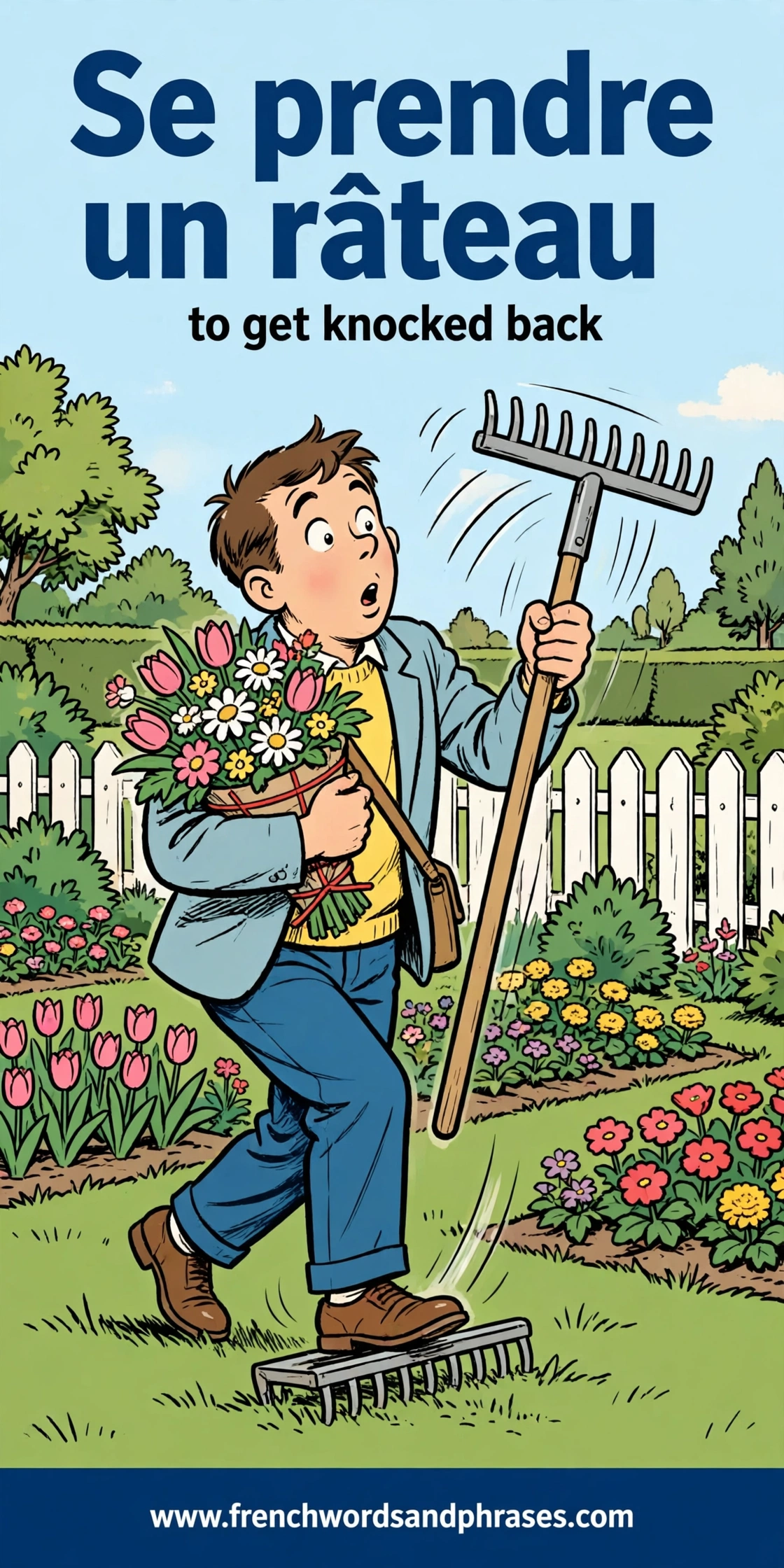
It means to get knocked back — to be rejected when you chat someone up or ask them out. The picture comes straight from the garden: step on the teeth of a rake lying in the grass, and the handle flies up and hits you in the face. The rejection lands just as fast, and just as flat.
Type: Idiomatic expression — rejection (se prendre + noun)
Answers the need: Saying your approach was refused — with humour, not tears
Register: Informal and humorous — friends, stories, jokes at your own expense
Strength: Light — a knock-back you can laugh about, not a heartbreak
One important usage detail: the past participle does not agree while the rake is still in the sentence — elle s’est pris un râteau, with pris unchanged, because un râteau is the real object of the verb. The phrase is almost always told afterwards, laughing, rather than in the painful moment itself.
Experience the Word
Se prendre un râteau is rejection with the sting taken out — the rake turns a small humiliation into a cartoon.
Imagine the walk back across the bar: ten steps that feel like a hundred, your friends already reading your face. By the time you sit down, the phrase has done its work — everyone is laughing, including you, and the evening is saved.
French is merciful to wounded pride. It hands you a joke exactly when you need one most.
How to Use Se prendre un râteau in French: Complete Guide
Let’s explore how se prendre un râteau works in French, beginning with the whole phrase on one card.
Se prendre un râteau at a Glance
The Whole Phrase on One Card
Real meaning, literal picture, English twin and register — se prendre un râteau in five lines.
| Point | Se prendre un râteau |
|---|---|
| What it really means | to get knocked back — your romantic approach is rejected |
| Word for word | to take a rake for oneself — the handle hits you in the face |
| English equivalent | to get knocked back / to strike out / to be shot down |
| Register | informal and humorous — a story you tell on yourself |
| Use it for | refused numbers, declined invitations, failed chat-up lines |
Example
Je me suis pris un râteau, mais au moins j’ai essayé.
I got knocked back, but at least I tried.
Word by Word: Building the Knock-Back
Four small pieces — take them one by one and the rake handle starts to swing.
| Word | Literal meaning | Its job in the phrase |
|---|---|---|
| se | for oneself | marks the blow landing on you — you collect it yourself |
| prendre | to take | here, to get, to receive — the same prendre as in prendre un coup, to take a hit |
| un | a | one single rake, one single refusal |
| râteau | a rake | the garden tool whose handle does the hitting |
Example
Il s’est pris un râteau en demandant son numéro.
He got knocked back asking for her number.
Quick Quiz 1
Why a rake? What is the picture inside se prendre un râteau?
Reveal the answer
The garden accident — step on a rake’s teeth and the handle flies up into your face: fast, flat and impossible to dodge.
Elle a ri, puis elle lui a dit non : un beau râteau.
She laughed, then said no: a fine knock-back.
When You Say It: The Refusal Moments
Se prendre un râteau fires at moments like these — the move was made, and the answer came back no.
| Situation | Example |
|---|---|
| At a bar | je me suis pris un râteau au comptoir — I got knocked back at the bar |
| Asking for a number | il s’est pris un râteau en demandant son numéro — he got knocked back asking for her number |
| Asking someone to dance | un râteau dès la première danse — knocked back at the first dance |
| Telling friends the next day | je me suis pris un râteau, racontez-moi vos réussites — I struck out, tell me your successes |
| By message | se prendre un râteau par message, c’est moderne — getting knocked back by message is the modern way |
Example
Trois râteaux en une soirée, il a fini par en rire.
Three knock-backs in one evening — he ended up laughing about it.
Make It Yours: The Rake for Every Person
Prendre is irregular, and pris stays pris while the rake follows it.
| Form | French | In English |
|---|---|---|
| I got knocked back | je me suis pris un râteau | I got knocked back |
| He got knocked back | il s’est pris un râteau | he got knocked back |
| She got knocked back | elle s’est pris un râteau | she got knocked back |
| We struck out | on s’est pris un râteau | we got knocked back |
| Risking one | risquer un râteau | to risk a knock-back |
| Question | tu t’es pris un râteau ? | did you get knocked back? |
Example
Elle s’est pris un râteau, mais elle garde le sourire.
She got knocked back, but she’s still smiling.
Quick Quiz 2
She got knocked back: elle s’est pris or elle s’est prise un râteau?
Reveal the answer
Elle s’est pris un râteau — the object, un râteau, follows the verb, so pris does not agree.
Elle s’est pris un râteau et elle est rentrée chez elle.
She got knocked back and went home.
Everyday Expressions: Building on the Rake
Se prendre un râteau slots into these everyday frames — each one ready to use as it stands.
| Frame | In English |
|---|---|
| se prendre un râteau | to get knocked back |
| râteau sur râteau | knock-back after knock-back |
| éviter le râteau | to dodge the knock-back |
| le râteau de sa vie | the knock-back of his life — humorous exaggeration |
| se prendre un râteau en beauté | to get knocked back spectacularly |
Example
Râteau sur râteau, il a fini par changer de bar.
Knock-back after knock-back, he ended up changing bars.
Close Cousins: The Other Refusals
French has a whole shelf of refusal phrases — the râteau is the funny one; its cousins are colder, sharper or more formal.
| Expression | The difference |
|---|---|
| se prendre un râteau | to get knocked back — humorous, the flirt’s refusal |
| se prendre un vent | to be completely ignored — they behave as if you were not there; colder than a no |
| essuyer un refus | to meet with a refusal — neutral, a little formal, for any kind of request |
| se faire rembarrer | to be sent packing, sharply told off — informal and rougher |
| se faire éconduire | to be politely but firmly shown the door — formal, with an old-fashioned flavour |
Example
Il a essayé de l’inviter, mais il s’est pris un vent.
He tried to invite her out, but he got completely blanked.
Quick Quiz 3
Which cousin means you were ignored completely, as if you were invisible — un râteau or un vent?
Reveal the answer
Un vent — a ‘wind’: the person sweeps past you like air. A râteau at least acknowledges you with a no.
Elle lui a fait un vent devant tout le monde.
She blanked him in front of everyone.
Se prendre un râteau and Its Neighbours
The flirting shelf around the phrase — the attempt, the refusal, and the heavier disaster that can follow.
| French | In English |
|---|---|
| draguer | to chat up, to flirt — the attempt itself |
| tenter sa chance | to try your luck |
| un refus | a refusal |
| un rencard | a date — the prize that was refused |
| se prendre un râteau | to get knocked back |
| se faire larguer | to get dumped — the later, heavier disaster |
Example
À force de draguer, il a tenté sa chance et pris un râteau.
After all that flirting, he tried his luck and got knocked back.
Watch Out: The Traps Around Se prendre un râteau
The traps: a real garden tool, an agreement that does not happen, and humour used one moment too early.
| Trap | The truth |
|---|---|
| the garden trap | acheter un râteau is shopping for a real rake — the se and the story of rejection are what make the idiom |
| pris does not agree | elle s’est pris un râteau — with the object following, pris stays pris |
| humour has a timing | the phrase laughs at the wound — tell it on yourself freely, but give a friend an hour before joking about his râteau |
| not for job refusals | for a rejected application, French says essuyer un refus or être refusé — the râteau lives in the world of flirting |
Example
Son dossier a été refusé, mais ça, ce n’est pas un râteau, c’est le travail.
His application was refused — but that is not a knock-back, that is work.
Quick Quiz 4
True or false: you can say je me suis pris un râteau about a rejected job application.
Reveal the answer
False — the râteau belongs to flirting and romance. For work, say essuyer un refus.
Elle a essuyé un refus, puis elle a trouvé mieux.
She met with a refusal, then she found something better.
Se prendre un râteau in Everyday French: Real-Life Examples
Now that you know the word, let’s see how se prendre un râteau appears in everyday French.
Example 1 — At the bar
Je me suis pris un râteau au comptoir, devant tout le monde.
I got knocked back at the bar, in front of everyone.
Example 2 — The phone number
Il s’est pris un râteau en demandant son numéro.
He got knocked back asking for her number.
Example 3 — The next day
Je me suis pris un râteau hier soir, ne m’en parle pas.
I got knocked back last night, don’t remind me.
Example 4 — At the dance
Elle s’est pris un râteau dès la première danse.
She got knocked back at the very first dance.
Example 5 — Laughing it off
Encore un râteau, et il commande un verre pour oublier.
Another knock-back, and he orders a drink to forget it.
Example 6 — Encouraging a friend
Un râteau, ce n’est pas grave, retente ta chance.
One knock-back is no big deal, try your luck again.
Beyond Translation: The Meaning of Se prendre un râteau
Every language protects the rejected. English strikes out, borrowing baseball’s mercy of three chances; French steps on a rake, borrowing the garden’s slapstick. The picture is pure cartoon — and that is the point: a cartoon wound does not bleed.
To se prendre un râteau is to convert a no into an anecdote before it can become a scar.
Tell it at dinner the next day and the table laughs with you — the rake has done its kind work.
How to Remember the French Phrase Se prendre un râteau
Remember it this way: Se prendre un râteau is the garden accident of love — you step forward, and the handle of refusal flies up.
- You picture the rake in the grass — one step, one swing of the handle, one very fast no.
- You keep pris unchanged — elle s’est pris un râteau, because the rake follows the verb.
- You save it for romance — job refusals take essuyer un refus, never the rake.
The key idea is se prendre un râteau means to get knocked back — rejected, with a cartoon rake to the face.
Test Your Knowledge of Se prendre un râteau
Let’s see how much you’ve learned. Try answering these questions before revealing the answers.
Question 1
What does se prendre un râteau mean?
Reveal the answer
To get knocked back — to be rejected when you chat someone up or ask them out.
Question 2
Where does the picture come from?
Reveal the answer
From the garden — step on a rake’s teeth and the handle flies up and hits you in the face.
Question 3
How do you say ‘she got knocked back’?
Reveal the answer
Elle s’est pris un râteau — pris does not agree, because un râteau follows the verb.
Question 4
What does se prendre un vent mean, and how is it different?
Reveal the answer
To be completely ignored — colder than a râteau: there is not even a refusal, just air.
Question 5
Complete the sentence:
Je me suis ______ un râteau devant tout le bar. (I got knocked back in front of the whole bar.)
Reveal the answer
pris
Je me suis pris un râteau devant tout le bar.
I got knocked back in front of the whole bar.
Your Final Challenge
Can You Use It?
How would you say this in French?
“He got knocked back at the party.”
Reveal the answer
Il s’est pris un râteau à la fête.
He got knocked back at the party.
A little French. A little curiosity. A richer everyday life.
LEARN FRENCH ONE WORD AT A TIME