A French Word to Live By
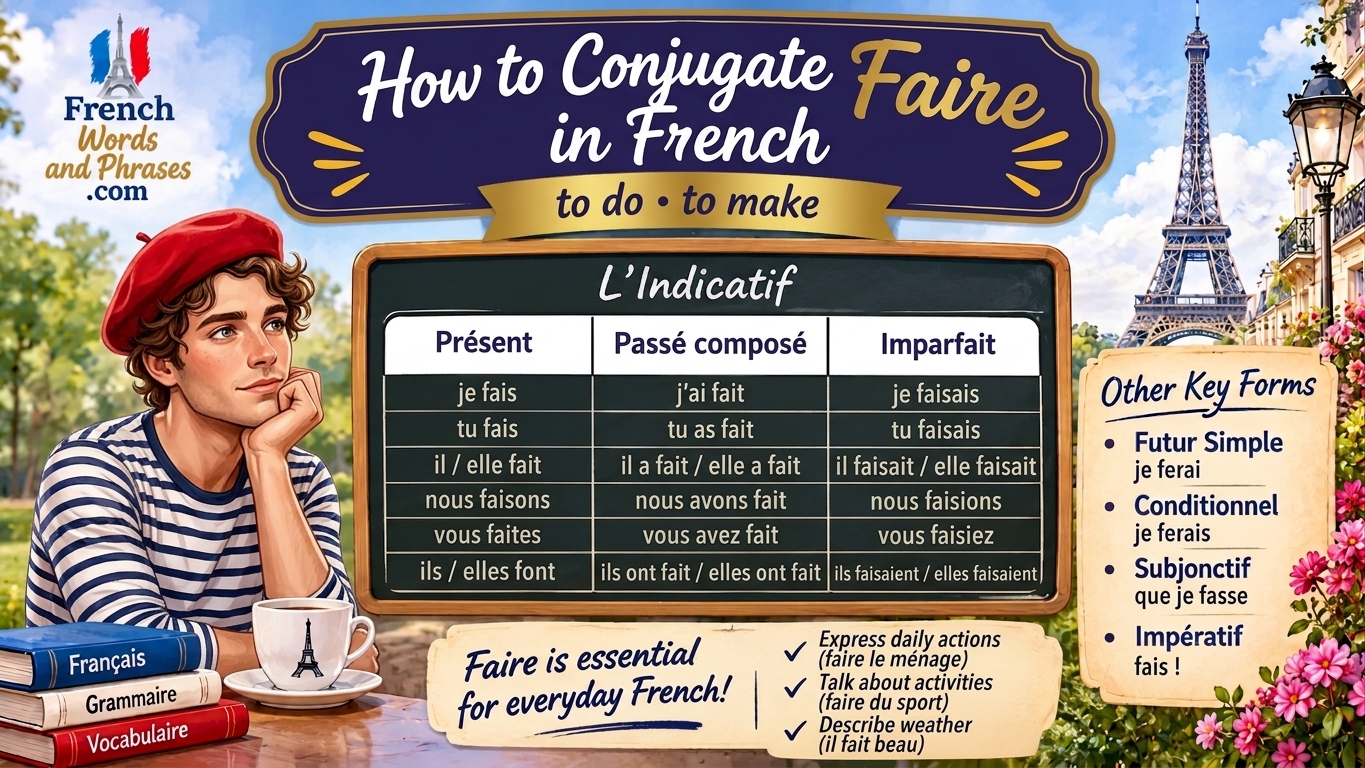
How to Conjugate Faire in French
/fɛʁ/
Faire means to do or to make. It is one of the most frequently used and versatile verbs in the French language.
Whether you’re talking about work, household chores, cooking, sports, or the weather, you’ll find the verb faire everywhere in everyday French conversation.
In this guide, you’ll learn how to conjugate faire in all the major French tenses and moods. Explore complete conjugation tables, French examples, English translations, pronunciation links, and practice quizzes.
Understanding the French Verb Faire
Faire is an irregular French verb belonging to the third group of verbs. Its conjugations do not follow a regular pattern, so the different forms must be learned through practice.
Faire has two primary English meanings: to do and to make. It also appears in many common French expressions, including expressions about the weather, sports, and everyday activities.
Verb classification: Third group (irregular verb)
Auxiliary verb: Avoir
Past participle: fait
Present participle: faisant
English equivalent: To do / To make.
One important feature of faire is that its present-tense forms are quite different from one another. Pay special attention to nous faisons, vous faites, and ils font.
Experience the Word
Faire is one of those French verbs that you’ll encounter almost everywhere.
You can use it to describe your daily activities: Je fais mes devoirs (I do my homework). You can talk about cooking: Je fais un gâteau (I am making a cake). You can even talk about the weather: Il fait beau (The weather is nice).
You’ll also hear it when people discuss sports and hobbies. For example, faire du sport means to play sports or exercise.
Master faire, and you’ll have one of the most useful verbs in your French vocabulary.
How to Conjugate Faire: Complete French Conjugation Guide
Let’s explore every major conjugation of faire, beginning with the indicative mood.
How to Conjugate Faire in the Indicative Mood
The indicative mood is used to express facts, observations, situations, and events.
How to Conjugate Faire in the Present Tense (Présent)
The present tense is used to describe what someone does, makes, or is doing now. It is also used in many common French expressions.
| Subject | Conjugation |
|---|---|
| je | fais |
| tu | fais |
| il / elle | fait |
| nous | faisons |
| vous | faites |
| ils / elles | font |
Example
Je fais mes devoirs après le dîner.
I do my homework after dinner.
Quick Quiz 1
Complete the sentence:
Nous ______ du sport tous les matins.
Reveal the answer
faisons
Nous faisons du sport tous les matins.
We exercise every morning.
How to Conjugate Faire in the Passé Composé
Used to describe completed actions in the past. Faire uses the auxiliary verb avoir and the past participle fait.
| Subject | Conjugation |
|---|---|
| j’ | ai fait |
| tu | as fait |
| il / elle | a fait |
| nous | avons fait |
| vous | avez fait |
| ils / elles | ont fait |
Example
J’ai fait un gâteau pour mon anniversaire.
I made a cake for my birthday.
How to Conjugate Faire in the Imparfait (Imperfect Tense)
Used to describe habitual past activities, ongoing actions, and things someone used to do or make.
| Subject | Conjugation |
|---|---|
| je | faisais |
| tu | faisais |
| il / elle | faisait |
| nous | faisions |
| vous | faisiez |
| ils / elles | faisaient |
Example
Quand j’étais jeune, je faisais du vélo tous les jours.
When I was young, I rode my bicycle every day.
Quick Quiz 2
Choose the correct form:
When we were children, we did our homework together.
Quand nous étions enfants, nous ______ nos devoirs ensemble.
Reveal the answer
faisions
Quand nous étions enfants, nous faisions nos devoirs ensemble.
How to Conjugate Faire in the Plus-que-parfait
Used to describe an action that had already been completed before another past event.
| Subject | Conjugation |
|---|---|
| j’ | avais fait |
| tu | avais fait |
| il / elle | avait fait |
| nous | avions fait |
| vous | aviez fait |
| ils / elles | avaient fait |
Example
J’avais déjà fait le travail avant son arrivée.
I had already done the work before his arrival.
How to Conjugate Faire in the Passé Simple
Primarily used in formal writing, literature, and historical narratives. It is rarely used in everyday conversation.
| Subject | Conjugation |
|---|---|
| je | fis |
| tu | fis |
| il / elle | fit |
| nous | fîmes |
| vous | fîtes |
| ils / elles | firent |
Example
Il fit tout son possible pour réussir.
He did everything possible to succeed.
How to Conjugate Faire in the Passé Antérieur
A literary tense used to express an action completed before another past action, generally in the passé simple.
| Subject | Conjugation |
|---|---|
| j’ | eus fait |
| tu | eus fait |
| il / elle | eut fait |
| nous | eûmes fait |
| vous | eûtes fait |
| ils / elles | eurent fait |
Example
Dès qu’il eut fait son travail, il rentra chez lui.
As soon as he had done his work, he went home.
How to Conjugate Faire in the Future Tense (Futur Simple)
Used to describe what someone will do or make in the future.
| Subject | Conjugation |
|---|---|
| je | ferai |
| tu | feras |
| il / elle | fera |
| nous | ferons |
| vous | ferez |
| ils / elles | feront |
Example
Demain, je ferai les courses.
Tomorrow, I will do the shopping.
How to Conjugate Faire in the Futur Antérieur (Future Perfect)
Used to describe an action that will have been completed before a particular point in the future.
| Subject | Conjugation |
|---|---|
| j’ | aurai fait |
| tu | auras fait |
| il / elle | aura fait |
| nous | aurons fait |
| vous | aurez fait |
| ils / elles | auront fait |
Example
À midi, j’aurai fait tout le ménage.
By noon, I will have done all the cleaning.
How to Conjugate Faire in the Near Future (Futur Proche)
Used to describe something that is going to happen soon. It is formed with aller + infinitive.
| Subject | Conjugation |
|---|---|
| je | vais faire |
| tu | vas faire |
| il / elle | va faire |
| nous | allons faire |
| vous | allez faire |
| ils / elles | vont faire |
Example
Nous allons faire une promenade ce soir.
We are going to take a walk this evening.
How to Conjugate Faire in the Conditional Mood
The conditional mood expresses what would happen under certain circumstances. It is also used to make polite requests, express wishes, and describe hypothetical situations.
How to Conjugate Faire in the Present Conditional
| Subject | Conjugation |
|---|---|
| je | ferais |
| tu | ferais |
| il / elle | ferait |
| nous | ferions |
| vous | feriez |
| ils / elles | feraient |
Example
Je ferais un voyage en France si j’avais assez d’argent.
I would take a trip to France if I had enough money.
How to Conjugate Faire in the Past Conditional
| Subject | Conjugation |
|---|---|
| j’ | aurais fait |
| tu | aurais fait |
| il / elle | aurait fait |
| nous | aurions fait |
| vous | auriez fait |
| ils / elles | auraient fait |
Example
J’aurais fait le travail si j’avais eu le temps.
I would have done the work if I had had the time.
Faire in the Literary Past Conditional Form
This less common literary form uses the imperfect subjunctive of avoir. It is also known as the second form of the past conditional.
| Subject | Conjugation |
|---|---|
| j’ | eusse fait |
| tu | eusses fait |
| il / elle | eût fait |
| nous | eussions fait |
| vous | eussiez fait |
| ils / elles | eussent fait |
Example
Il eût fait davantage pour elle s’il l’avait pu.
He would have done more for her if he had been able to.
How to Conjugate Faire in the Subjunctive Mood
The subjunctive is used to express wishes, emotions, doubts, necessity, and uncertainty. It frequently follows expressions such as il faut que (it is necessary that) or bien que (although).
How to Conjugate Faire in the Present Subjunctive
| Subject | Conjugation |
|---|---|
| que je | fasse |
| que tu | fasses |
| qu’il / qu’elle | fasse |
| que nous | fassions |
| que vous | fassiez |
| qu’ils / qu’elles | fassent |
Example
Il faut que je fasse mes devoirs.
I have to do my homework.
Quick Quiz 3
Complete the sentence using the subjunctive:
Il faut que nous ______ attention.
Reveal the answer
fassions
Il faut que nous fassions attention.
We must pay attention.
How to Conjugate Faire in the Imperfect Subjunctive
A literary tense, rarely encountered in modern spoken French.
| Subject | Conjugation |
|---|---|
| que je | fisse |
| que tu | fisses |
| qu’il / qu’elle | fît |
| que nous | fissions |
| que vous | fissiez |
| qu’ils / qu’elles | fissent |
Example
Il souhaitait que je fisse un effort.
He wished that I make an effort.
How to Conjugate Faire in the Plus-que-parfait du Subjonctif
A literary construction used to express an action completed before another past action.
| Subject | Conjugation |
|---|---|
| que j’ | eusse fait |
| que tu | eusses fait |
| qu’il / qu’elle | eût fait |
| que nous | eussions fait |
| que vous | eussiez fait |
| qu’ils / qu’elles | eussent fait |
Example
Il regrettait que nous eussions fait cette erreur.
He regretted that we had made that mistake.
How to Conjugate Faire in the Past Subjunctive
Used to express a completed action following an expression that requires the subjunctive.
| Subject | Conjugation |
|---|---|
| que j’ | aie fait |
| que tu | aies fait |
| qu’il / qu’elle | ait fait |
| que nous | ayons fait |
| que vous | ayez fait |
| qu’ils / qu’elles | aient fait |
Example
Je suis heureux que tu aies fait ce choix.
I am happy that you made this choice.
How to Conjugate Faire in the Imperative
The imperative is used to give commands, instructions, invitations, or suggestions. Subject pronouns are omitted.
How to Conjugate Faire in the Present Imperative
| Person | Conjugation |
|---|---|
| (tu) | fais |
| (nous) | faisons |
| (vous) | faites |
Example
Faites attention !
Pay attention!
Quick Quiz 4
How would you say “Do your homework!” when speaking to one person informally?
Reveal the answer
Fais tes devoirs !
French Participles of Faire
Participles are verb forms that can be used in compound tenses and other grammatical constructions.
Present Participle of Faire
faisant
Example
En faisant du sport, on reste en bonne santé.
By exercising, one stays healthy.
Past Participle of Faire
fait
The standard past participle is fait. Depending on the grammatical context, it can also take different agreement forms:
- fait — masculine singular
- faits — masculine plural
- faite — feminine singular
- faites — feminine plural
Example
Elle a fait une excellente présentation.
She gave an excellent presentation.
Faire in Everyday French: Real-Life Examples
Now that you know the conjugations, let’s see how faire appears in everyday French.
Example 1 — Present
Je fais du café tous les matins.
I make coffee every morning.
Example 2 — Passé composé
Nous avons fait une belle promenade.
We took a lovely walk.
Example 3 — Imparfait
Il faisait du piano quand il était jeune.
He used to play the piano when he was young.
Example 4 — Future
Ils feront leurs valises demain.
They will pack their bags tomorrow.
Example 5 — Conditional
Je ferais n’importe quoi pour t’aider.
I would do anything to help you.
Example 6 — Subjunctive
Bien qu’il fasse froid, nous allons sortir.
Although it is cold, we are going out.
Beyond Translation: The Many Uses of Faire
The verb faire has a wide variety of uses in French. In addition to meaning “to do” and “to make,” it appears in expressions that don’t translate literally into English.
Here are some of the most common examples:
- Faire du sport — To play sports / To exercise.
- Faire la cuisine — To cook.
- Faire les courses — To do the shopping.
- Faire le ménage — To do the housework.
- Faire attention — To pay attention / To be careful.
- Faire une promenade — To take a walk.
- Faire la fête — To party / To celebrate.
- Faire connaissance — To get acquainted.
- Faire peur — To frighten / To scare.
- Faire semblant — To pretend.
- Faire confiance — To trust.
- Faire des progrès — To make progress.
For example:
Nous faisons la cuisine ensemble le dimanche.
We cook together on Sundays.
Faire and the Weather
One particularly useful feature of faire is its use in expressions about the weather.
- Il fait beau. — The weather is nice.
- Il fait mauvais. — The weather is bad.
- Il fait chaud. — It is hot.
- Il fait froid. — It is cold.
- Il fait frais. — It is cool.
- Il fait du vent. — It is windy.
Notice that French uses il fait in these expressions. The subject il is impersonal; it does not refer to a particular person.
Il fait beau aujourd’hui.
The weather is nice today.
Faire in Common French Expressions
Faire is also used in many expressions where its meaning is not immediately obvious from a direct translation.
- Ça fait longtemps ! — It’s been a long time!
- Ça fait du bien. — It feels good.
- Qu’est-ce que tu fais ? — What are you doing?
- Comment ça se fait ? — How come? / How is that possible?
- Faire exprès — To do something on purpose.
Learning these expressions will help you recognize faire in natural conversations and use it more confidently.
How to Remember the French Verb Faire
Remember it this way: Faire is the verb you use when talking about doing something, making something, or carrying out an activity.
- Je fais du café. — I make coffee.
- Tu fais tes devoirs. — You do your homework.
- Elle fait du sport. — She exercises.
- Nous faisons un gâteau. — We are making a cake.
- Vous faites attention. — You pay attention.
- Ils font la cuisine. — They are cooking.
The key to mastering faire is repetition. Pay particular attention to its irregular present-tense forms and its future stem, fer-.
Remember these especially important forms:
- Nous faisons
- Vous faites
- Ils font
- Je ferai
- Que je fasse
Test Your Knowledge of Faire
Let’s see how much you’ve learned. Try answering these questions before revealing the answers.
Question 1
What is the past participle of faire?
Reveal the answer
Fait.
Question 2
How do you say “I will do” in French?
Reveal the answer
Je ferai.
Question 3
Translate: “We did our homework.”
Reveal the answer
Nous avons fait nos devoirs.
Question 4
What is the present participle of faire?
Reveal the answer
Faisant.
Question 5
Complete the sentence:
Il faut que tu ______ attention.
Reveal the answer
Fasses.
Il faut que tu fasses attention.
You must pay attention.
Your Final Challenge
Can You Use It?
How would you say this in French?
“Tomorrow, we are going to make a delicious meal.”
Reveal the answer
Demain, nous allons faire un délicieux repas.
Tomorrow, we are going to make a delicious meal.
A little French. A little curiosity. A richer everyday life.
LEARN FRENCH ONE WORD AT A TIME