A French Word to Live By
How to Conjugate Dire in French
/diʁ/
Dire means to say or to tell. It is one of the most useful and frequently used verbs in the French language.
Whether you’re sharing an opinion, telling a story, asking someone what they said, or simply expressing yourself, dire is an essential part of everyday French communication.
In this guide, you’ll learn how to conjugate dire in all the major French tenses and moods. Explore complete conjugation tables, French examples, English translations, pronunciation links, and practice quizzes.
Understanding the French Verb Dire
Dire is an irregular French verb belonging to the third group of verbs. Although it ends in -re, its conjugations do not follow the regular pattern used by many other -re verbs.
Its primary meanings are to say and to tell. It is used when reporting information, expressing thoughts, giving instructions, and communicating with others.
Verb classification: Third group (irregular -re verb)
Auxiliary verb: Avoir
Past participle: dit
Present participle: disant
English equivalent: To say / To tell.
One interesting feature of dire is its present-tense form vous dites. Unlike many other verbs ending in -dire, dire uses this distinctive form rather than *vous disez*.
Experience the Word
Dire is a verb you’ll encounter almost immediately when learning French. It helps you communicate what people say, what you think, and what you want others to know.
Imagine asking a friend what someone said: Qu’est-ce qu’il dit ? (What is he saying?). You might express your opinion: Je dis la vérité (I am telling the truth). Or tell someone what to do: Dis-moi ! (Tell me!).
From casual conversations to formal discussions, dire is everywhere.
Master dire, and you’ll have another essential tool for expressing yourself naturally in French.
How to Conjugate Dire: Complete French Conjugation Guide
Let’s explore every major conjugation of dire, beginning with the indicative mood.
How to Conjugate Dire in the Indicative Mood
The indicative mood is used to express facts, observations, statements, and events.
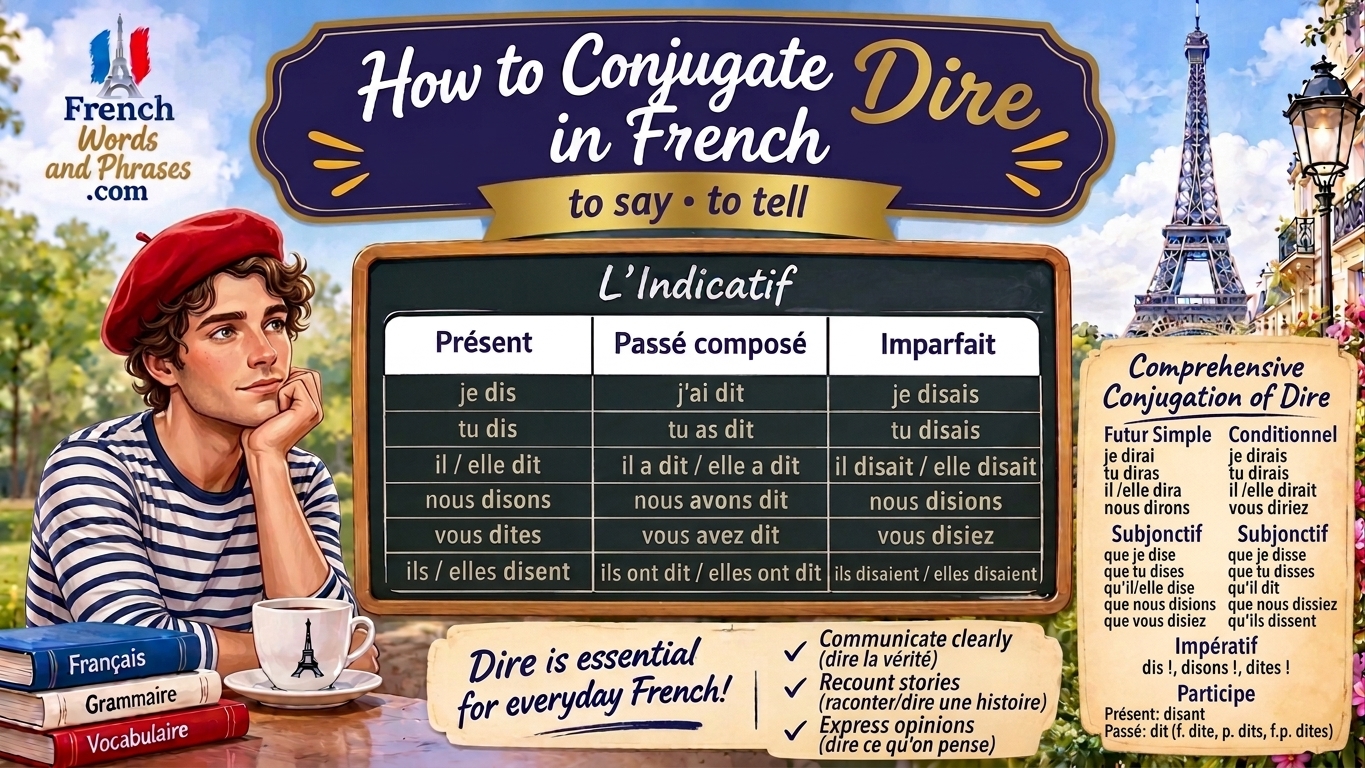
How to Conjugate Dire in the Present Tense (Présent)
Used to describe what someone says, tells another person, or expresses in the present.
| Subject | Conjugation |
|---|---|
| je | dis |
| tu | dis |
| il / elle | dit |
| nous | disons |
| vous | dites |
| ils / elles | disent |
Example
Je dis toujours la vérité.
I always tell the truth.
Quick Quiz 1
Complete the sentence:
Vous ______ toujours la même chose.
Reveal the answer
dites
Vous dites toujours la même chose.
You always say the same thing.
How to Conjugate Dire in the Passé Composé
Used for completed statements or things someone said in the past. Dire uses the auxiliary verb avoir to form the passé composé.
| Subject | Conjugation |
|---|---|
| j’ | ai dit |
| tu | as dit |
| il / elle | a dit |
| nous | avons dit |
| vous | avez dit |
| ils / elles | ont dit |
Example
J’ai dit quelque chose d’important.
I said something important.
How to Conjugate Dire in the Imparfait (Imperfect Tense)
Used to describe habitual statements, repeated conversations, or things someone used to say in the past.
| Subject | Conjugation |
|---|---|
| je | disais |
| tu | disais |
| il / elle | disait |
| nous | disions |
| vous | disiez |
| ils / elles | disaient |
Example
Quand j’étais jeune, je disais toujours ce que je pensais.
When I was young, I always said what I thought.
Quick Quiz 2
Choose the correct form:
When we were children, we said everything.
Quand nous étions enfants, nous ______ tout.
Reveal the answer
disions
Quand nous étions enfants, nous disions tout.
How to Conjugate Dire in the Plus-que-parfait
Used to describe something someone had said before another event in the past.
| Subject | Conjugation |
|---|---|
| j’ | avais dit |
| tu | avais dit |
| il / elle | avait dit |
| nous | avions dit |
| vous | aviez dit |
| ils / elles | avaient dit |
Example
J’avais déjà dit la même chose auparavant.
I had already said the same thing before.
How to Conjugate Dire in the Passé Simple
Primarily used in formal writing, literature, and historical narratives. It is rarely used in everyday conversation.
| Subject | Conjugation |
|---|---|
| je | dis |
| tu | dis |
| il / elle | dit |
| nous | dîmes |
| vous | dîtes |
| ils / elles | dirent |
Example
Il dit quelques mots avant de partir.
He said a few words before leaving.
How to Conjugate Dire in the Passé Antérieur
A literary tense used to express something completed before another past action, generally in the passé simple.
| Subject | Conjugation |
|---|---|
| j’ | eus dit |
| tu | eus dit |
| il / elle | eut dit |
| nous | eûmes dit |
| vous | eûtes dit |
| ils / elles | eurent dit |
Example
Dès qu’il eut dit ces mots, le silence s’installa.
As soon as he had said those words, silence fell.
How to Conjugate Dire in the Future Tense (Futur Simple)
Used to describe what someone will say or tell another person in the future.
| Subject | Conjugation |
|---|---|
| je | dirai |
| tu | diras |
| il / elle | dira |
| nous | dirons |
| vous | direz |
| ils / elles | diront |
Example
Je te dirai la vérité demain.
I will tell you the truth tomorrow.
How to Conjugate Dire in the Futur Antérieur (Future Perfect)
Used to describe something that someone will have said before a particular point in the future.
| Subject | Conjugation |
|---|---|
| j’ | aurai dit |
| tu | auras dit |
| il / elle | aura dit |
| nous | aurons dit |
| vous | aurez dit |
| ils / elles | auront dit |
Example
À midi, j’aurai déjà dit tout ce que je voulais.
By noon, I will have already said everything I wanted to.
How to Conjugate Dire in the Near Future (Futur Proche)
Used to describe something that someone is going to say soon. Formed with aller + infinitive.
| Subject | Conjugation |
|---|---|
| je | vais dire |
| tu | vas dire |
| il / elle | va dire |
| nous | allons dire |
| vous | allez dire |
| ils / elles | vont dire |
Example
Je vais dire quelque chose d’intéressant.
I am going to say something interesting.
How to Conjugate Dire in the Conditional Mood
The conditional mood expresses what someone would say under certain circumstances. It is also frequently used to make polite requests, express possibilities, or describe hypothetical situations.
How to Conjugate Dire in the Present Conditional
| Subject | Conjugation |
|---|---|
| je | dirais |
| tu | dirais |
| il / elle | dirait |
| nous | dirions |
| vous | diriez |
| ils / elles | diraient |
Example
Je dirais oui si j’étais à votre place.
I would say yes if I were in your position.
How to Conjugate Dire in the Past Conditional
| Subject | Conjugation |
|---|---|
| j’ | aurais dit |
| tu | aurais dit |
| il / elle | aurait dit |
| nous | aurions dit |
| vous | auriez dit |
| ils / elles | auraient dit |
Example
J’aurais dit la vérité si j’avais su.
I would have told the truth if I had known.
Dire in the Literary Past Conditional Form
This less common literary form uses the imperfect subjunctive of avoir. It is also known as the second form of the past conditional.
| Subject | Conjugation |
|---|---|
| j’ | eusse dit |
| tu | eusses dit |
| il / elle | eût dit |
| nous | eussions dit |
| vous | eussiez dit |
| ils / elles | eussent dit |
Example
Il eût dit la même chose dans d’autres circonstances.
He would have said the same thing under different circumstances.
How to Conjugate Dire in the Subjunctive Mood
The subjunctive is used to express wishes, emotions, doubts, necessity, and uncertainty. It frequently follows expressions such as il faut que (it is necessary that) or bien que (although).
How to Conjugate Dire in the Present Subjunctive
| Subject | Conjugation |
|---|---|
| que je | dise |
| que tu | d ises |
| qu’il / qu’elle | dise |
| que nous | disions |
| que vous | disiez |
| qu’ils / qu’elles | disent |
Example
Il faut que je dise la vérité.
I must tell the truth.
Quick Quiz 3
Complete the sentence using the subjunctive:
Il faut que tu ______ ce que tu penses.
Reveal the answer
dises
Il faut que tu dises ce que tu penses.
You must say what you think.
How to Conjugate Dire in the Imperfect Subjunctive
A literary tense, rarely encountered in modern spoken French.
| Subject | Conjugation |
|---|---|
| que je | disse |
| que tu | disses |
| qu’il / qu’elle | dît |
| que nous | dissions |
| que vous | dissiez |
| qu’ils / qu’elles | dissent |
Example
Il souhaitait que je disse la vérité.
He wished that I would tell the truth.
How to Conjugate Dire in the Pluperfect Subjunctive
A literary construction used to express something that had been said before another past action.
| Subject | Conjugation |
|---|---|
| que j’ | eusse dit |
| que tu | eusses dit |
| qu’il / qu’elle | eût dit |
| que nous | eussions dit |
| que vous | eussiez dit |
| qu’ils / qu’elles | eussent dit |
Example
Il regrettait que nous eussions dit ces paroles.
He regretted that we had said those words.
How to Conjugate Dire in the Past Subjunctive
Used to express something that has been said or told before the time of another action or feeling.
| Subject | Conjugation |
|---|---|
| que j’ | aie dit |
| que tu | aies dit |
| qu’il / qu’elle | ait dit |
| que nous | ayons dit |
| que vous | ayez dit |
| qu’ils / qu’elles | aient dit |
Example
Je suis heureux que tu aies dit la vérité.
I am happy that you told the truth.
How to Conjugate Dire in the Imperative
The imperative is used to give commands, instructions, invitations, or suggestions. Subject pronouns are omitted.
How to Conjugate Dire in the Present Imperative
| Person | Conjugation |
|---|---|
| (tu) | dis |
| (nous) | disons |
| (vous) | dites |
Example
Dis-moi la vérité !
Tell me the truth!
Quick Quiz 4
How would you say “Tell me!” when speaking to one person informally?
Reveal the answer
Dis-moi !
French Participles of Dire
Participles are verb forms that can be used in compound tenses and other grammatical constructions.
Present Participle of Dire
disant
En disant cela, il a surpris tout le monde.
By saying that, he surprised everyone.
Past Participle of Dire
dit
The standard past participle is dit. Depending on grammatical agreement, it can also appear in these forms:
- dit — masculine singular
- dits — masculine plural
- dite — feminine singular
- dites — feminine plural
Example
J’ai dit quelque chose de gentil.
I said something nice.
Dire in Everyday French: Real-Life Examples
Now that you know the conjugations, let’s see how dire appears in everyday French.
Example 1 — Present
Que dis-tu ?
What are you saying?
Example 2 — Passé composé
Elle a dit qu’elle était fatiguée.
She said that she was tired.
Example 3 — Imparfait
Mon père disait toujours la même chose.
My father always used to say the same thing.
Example 4 — Future
Nous dirons tout demain.
We will tell everything tomorrow.
Example 5 — Conditional
Je dirais oui, mais je ne suis pas certain.
I would say yes, but I’m not sure.
Example 6 — Subjunctive
Il faut qu’il dise la vérité.
He must tell the truth.
Beyond Translation: Common Expressions with Dire
Like many frequently used French verbs, dire appears in a number of expressions that are worth learning as complete phrases.
- Dire bonjour — To say hello.
- Dire au revoir — To say goodbye.
- Dire merci — To say thank you.
- Dire la vérité — To tell the truth.
- Dire un mensonge — To tell a lie.
- Dire son avis — To give one’s opinion.
- Dire quelque chose — To say something.
- Ça veut dire quoi ? — What does that mean?
- Qu’est-ce que tu veux dire ? — What do you mean?
- Autrement dit — In other words.
For example:
Je voudrais te dire quelque chose.
I would like to tell you something.
Learning these expressions will help you use dire more naturally and understand how French speakers communicate in everyday situations.
Dire and Its Importance in French Communication
Dire is also important because it introduces reported speech. When you want to explain what someone else said, this verb is often the starting point.
For example:
- Il dit qu’il est fatigué. — He says that he is tired.
- Elle a dit qu’elle viendrait. — She said that she would come.
- Je te dirai ce qui s’est passé. — I will tell you what happened.
As you become more comfortable with dire, you’ll find it easier to share information, report conversations, and express your thoughts in French.
How to Remember the French Verb Dire
Remember it this way: Dire is the verb you use whenever you want to say something, tell someone something, or communicate what another person has said.
- Je dis la vérité. — I tell the truth.
- Tu dis bonjour. — You say hello.
- Elle dit merci. — She says thank you.
- Nous disons oui. — We say yes.
- Vous dites non. — You say no.
- Ils disent la même chose. — They say the same thing.
The key to mastering dire is repetition. Pay particular attention to its irregular present-tense forms, especially nous disons, vous dites, and ils disent.
Test Your Knowledge of Dire
Let’s see how much you’ve learned. Try answering these questions before revealing the answers.
Question 1
What is the past participle of dire?
Reveal the answer
Dit.
Question 2
How do you say “I will tell you” in French?
Reveal the answer
Je te dirai.
Question 3
Translate: “We have told the truth.”
Reveal the answer
Nous avons dit la vérité.
Question 4
What is the present participle of dire?
Reveal the answer
Disant.
Question 5
Complete the sentence:
Si j’étais à ta place, je ______ la vérité.
Reveal the answer
dirais
Si j’étais à ta place, je dirais la vérité.
If I were in your position, I would tell the truth.
Your Final Challenge
Can You Use It?
How would you say this in French?
“Tomorrow, I will tell you everything that happened.”
Reveal the answer
Demain, je te dirai tout ce qui s’est passé.
Tomorrow, I will tell you everything that happened.
A little French. A little curiosity. A richer everyday life.
LEARN FRENCH ONE WORD AT A TIME