A French Word to Live By
How to Conjugate User in French
/y.ze/
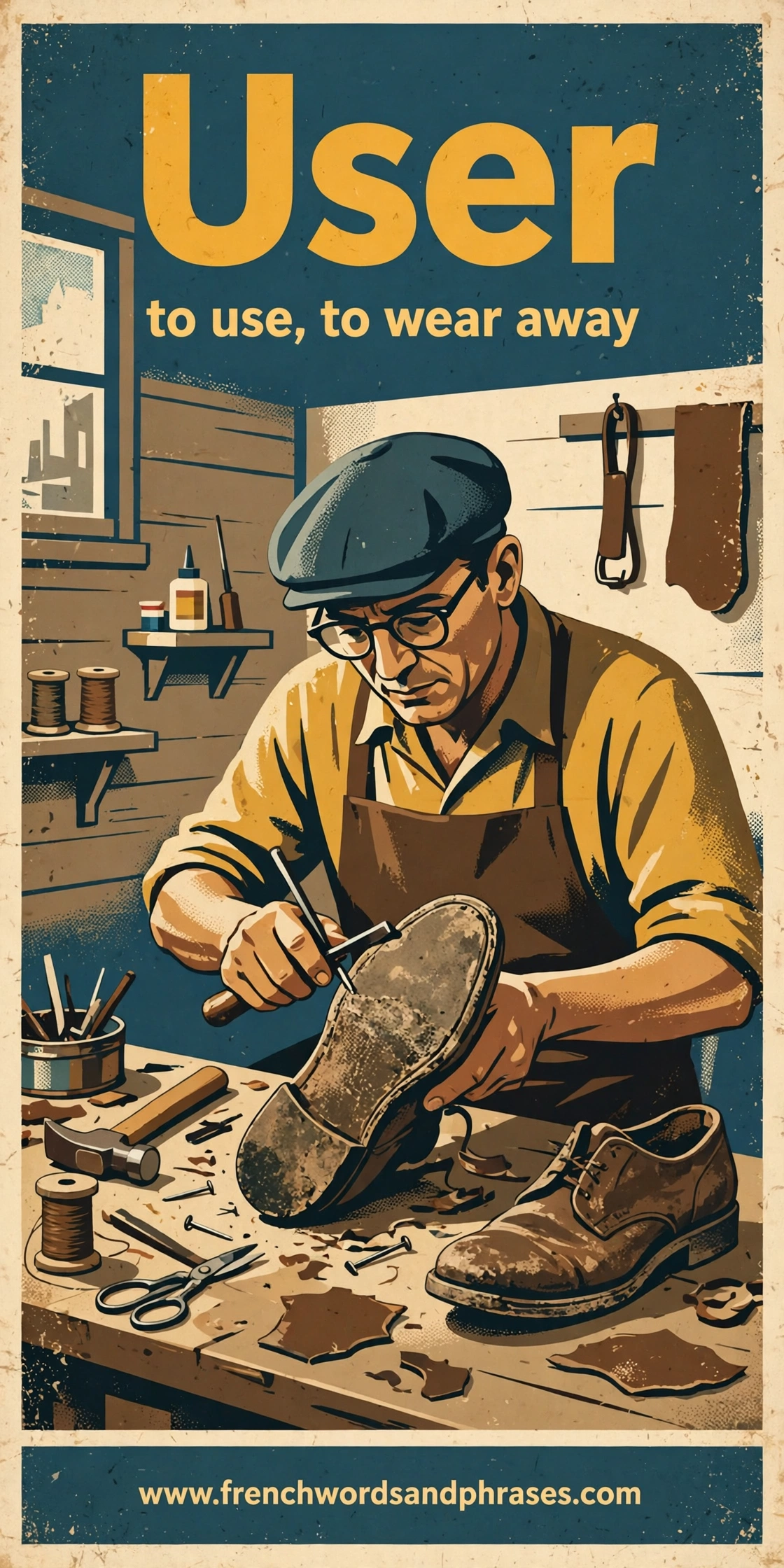
User means to use and to wear away — to consume a thing slowly by using it.
A stone step hollowed by centuries of feet, a jacket thin at the elbows, a road eaten by a million wheels — user is the verb of slow wearing: things used, and used, until use itself has worn them away.
In this guide, you’ll learn how to conjugate user in all the major French tenses and moods. Explore complete conjugation tables, French examples, English translations, and practice quizzes.
Understanding the French Verb User
User is a regular French verb belonging to the first group of verbs, those ending in -er.
It means to use, to wear away. It is commonly used in formal writing with de for rights, influence, patience and authority, everywhere in the reflexive for clothes, tyres, shoes, ropes and stone steps wearing thin, and for health and eyesight worn away by work, reading or worry.
Verb classification: First group (-er)
Auxiliary verb: Avoir
Past participle: usé
Present participle: usant
English equivalents: To use, to wear out, to wear away; user de + noun (formal) — to make use of (user de patience, user de son droit); s’user — to wear out (des pneus qui s’usent — tyres wearing out; s’user les yeux — to strain one’s eyes); usé — worn out.
One important detail: user has two lives. The formal one takes de: user de patience, user de son droit, user de son influence — to make use of patience, of one’s right, of one’s influence, the language of letters and law. The everyday life is wearing things down, and there the reflexive rules: les pneus s’usent (the tyres wear out), s’user les yeux à lire (to wear one’s eyes out reading), s’user la santé au travail (to wear one’s health away at work) — always with être in compound tenses: les pneus se sont usés. For plain ‘use a tool’, French usually reaches for its everyday twin utiliser; user de and s’user are where user itself is irreplaceable.
Experience the Word
User is the verb of time working through friction — nothing breaks, everything thins.
Imagine the steps of an old church, each one dished in the middle like a shallow bowl. No hammer ever struck them; ten thousand Sundays of feet ont usé the stone, a grain at a time, until the staircase keeps the shape of everyone who climbed it.
The stone has not been destroyed, only used. It has been worn away — usé — by pure repetition.
How to Conjugate User: Complete French Conjugation Guide
Let’s explore every major conjugation of user, beginning with the indicative mood.
How to Conjugate User in the Indicative Mood
The indicative mood is used to express facts, observations, actions, and events.
How to Conjugate User in the Present Tense (Présent)
Used for actions happening now, habitual actions, and general truths.
| Subject | Conjugation |
|---|---|
| je | use |
| tu | uses |
| il / elle | use |
| nous | usons |
| vous | usez |
| ils / elles | usent |
Example
Le frottement use la corde peu à peu.
The friction wears the rope away little by little.
Quick Quiz 1
Complete the sentence:
Nous ______ de notre droit de réponse.
Reveal the answer
usons
Nous usons de notre droit de réponse.
We are exercising our right of reply.
How to Conjugate User in the Passé Composé
Used for completed actions in the past. User takes the auxiliary verb avoir.
| Subject | Conjugation |
|---|---|
| j’ | ai usé |
| tu | as usé |
| il / elle | a usé |
| nous | avons usé |
| vous | avez usé |
| ils / elles | ont usé |
Example
Elle a usé trois paires de chaussures sur ce chantier.
She wore out three pairs of shoes on this building site.
How to Conjugate User in the Imparfait (Imperfect Tense)
Used for habitual past actions, descriptions, and ongoing situations in the past.
| Subject | Conjugation |
|---|---|
| je | usais |
| tu | usais |
| il / elle | usait |
| nous | usions |
| vous | usiez |
| ils / elles | usaient |
Example
Les marches s’usaient sous les pas des pèlerins.
The steps used to wear away under the pilgrims’ feet.
Quick Quiz 2
Choose the correct form:
The tyres have worn out.
Les pneus ______ . (se sont usés / ont usé)
Reveal the answer
se sont usés
Les pneus se sont usés.
S’user takes être.
How to Conjugate User in the Plus-que-parfait
Used to describe an action that had already been completed before another past event.
| Subject | Conjugation |
|---|---|
| j’ | avais usé |
| tu | avais usé |
| il / elle | avait usé |
| nous | avions usé |
| vous | aviez usé |
| ils / elles | avaient usé |
Example
Il avait usé ses pneus jusqu’à la corde.
He had worn his tyres down to the fabric.
How to Conjugate User in the Passé Simple
Primarily used in formal writing, literature, and historical narratives. It is rarely used in everyday conversation.
| Subject | Conjugation |
|---|---|
| je | usai |
| tu | usas |
| il / elle | usa |
| nous | usâmes |
| vous | usâtes |
| ils / elles | usèrent |
Example
Le torrent usa les rochers en quelques siècles.
The torrent wore the rocks away in a few centuries.
How to Conjugate User in the Passé Antérieur
A literary tense used to express an action completed immediately before another past action, generally in the passé simple.
| Subject | Conjugation |
|---|---|
| j’ | eus usé |
| tu | eus usé |
| il / elle | eut usé |
| nous | eûmes usé |
| vous | eûtes usé |
| ils / elles | eurent usé |
Example
Quand elle eut usé sa deuxième paire de bottes, la route était finie.
When she had worn out her second pair of boots, the road was finished.
How to Conjugate User in the Future Tense (Futur Simple)
Used to describe actions that will take place in the future.
| Subject | Conjugation |
|---|---|
| je | userai |
| tu | useras |
| il / elle | usera |
| nous | userons |
| vous | userez |
| ils / elles | useront |
Example
Ce chemin usera tes semelles en un été.
This path will wear out your soles in one summer.
How to Conjugate User in the Futur Antérieur (Future Perfect)
Used for an action that will have been completed before a particular point in the future.
| Subject | Conjugation |
|---|---|
| j’ | aurai usé |
| tu | auras usé |
| il / elle | aura usé |
| nous | aurons usé |
| vous | aurez usé |
| ils / elles | auront usé |
Example
À ce rythme, vous aurez usé la machine avant l’hiver.
At this rate, you will have worn the machine out before winter.
How to Conjugate User in the Near Future (Futur Proche)
Used to describe something that is going to happen soon. Formed with aller + infinitive.
| Subject | Conjugation |
|---|---|
| je | vais user |
| tu | vas user |
| il / elle | va user |
| nous | allons user |
| vous | allez user |
| ils / elles | vont user |
Example
Attention, cette lime va user la pièce.
Careful, that file is going to wear the part away.
How to Conjugate User in the Conditional Mood
The conditional mood expresses what would happen under certain circumstances. It is also frequently used to make polite requests or express wishes.
How to Conjugate User in the Present Conditional
| Subject | Conjugation |
|---|---|
| je | userais |
| tu | userais |
| il / elle | userait |
| nous | userions |
| vous | useriez |
| ils / elles | useraient |
Example
Sans graisse, la chaîne userait l’engrenage.
Without grease, the chain would wear the gear away.
How to Conjugate User in the Past Conditional
| Subject | Conjugation |
|---|---|
| j’ | aurais usé |
| tu | aurais usé |
| il / elle | aurait usé |
| nous | aurions usé |
| vous | auriez usé |
| ils / elles | auraient usé |
Example
Il aurait usé de son droit si le délai n’avait pas expiré.
He would have made use of his right if the deadline had not expired.
User in the Literary Past Conditional Form
This less common literary form uses the imperfect subjunctive of avoir.
| Subject | Conjugation |
|---|---|
| j’ | eusse usé |
| tu | eusses usé |
| il / elle | eût usé |
| nous | eussions usé |
| vous | eussiez usé |
| ils / elles | eussent usé |
Example
Le fleuve eût usé la falaise avant l’âge des hommes.
The river would have worn the cliff away before the age of men.
How to Conjugate User in the Subjunctive Mood
The subjunctive is used to express wishes, emotions, doubts, necessity, and uncertainty. It frequently follows expressions such as il faut que (it is necessary that) or bien que (although).
How to Conjugate User in the Present Subjunctive
| Subject | Conjugation |
|---|---|
| que je | use |
| que tu | uses |
| qu’il / qu’elle | use |
| que nous | usions |
| que vous | usiez |
| qu’ils / qu’elles | usent |
Example
Il faut que vous usiez de patience avec cet enfant.
You must make use of patience with this child.
Quick Quiz 3
Complete the sentence using the subjunctive:
Il faut que vous ______ de patience.
Reveal the answer
usiez
Il faut que vous usiez de patience.
You must make use of patience.
How to Conjugate User in the Imperfect Subjunctive
A literary tense, rarely encountered in modern spoken French.
| Subject | Conjugation |
|---|---|
| que je | usasse |
| que tu | usasses |
| qu’il / qu’elle | usât |
| que nous | usassions |
| que vous | usassiez |
| qu’ils / qu’elles | usassent |
Example
Le juge souhaitait que l’avocat usât de son droit avec mesure.
The judge wished the lawyer to exercise his right with restraint.
How to Conjugate User in the Pluperfect Subjunctive
A literary construction used to express an action completed before another past action.
| Subject | Conjugation |
|---|---|
| que j’ | eusse usé |
| que tu | eusses usé |
| qu’il / qu’elle | eût usé |
| que nous | eussions usé |
| que vous | eussiez usé |
| qu’ils / qu’elles | eussent usé |
Example
On s’étonnait que les pneus se fussent usés trop vite sur cette route.
People were surprised the tyres had worn out too fast on this road.
How to Conjugate User in the Past Subjunctive
| Subject | Conjugation |
|---|---|
| que j’ | aie usé |
| que tu | aies usé |
| qu’il / qu’elle | ait usé |
| que nous | ayons usé |
| que vous | ayez usé |
| qu’ils / qu’elles | aient usé |
Example
Je regrette que tu te sois usé les yeux sur ces écrans.
I am sorry you have strained your eyes on those screens.
How to Conjugate User in the Imperative
The imperative is used to give commands, instructions, invitations, or suggestions. Subject pronouns are omitted.
How to Conjugate User in the Present Imperative
| Person | Conjugation |
|---|---|
| (tu) | use |
| (nous) | usons |
| (vous) | usez |
Example
Use de patience, le dossier avance lentement.
Make use of patience, the file is moving slowly.
Quick Quiz 4
How would you say Make use of patience (tu form)?
Reveal the answer
Use de patience !
French Participles of User
Participles are verb forms that can be used in compound tenses and other grammatical constructions.
Present Participle of User
usant
En usant de son influence, elle a obtenu le permis.
By making use of her influence, she obtained the permit.
Past Participle of User
usé
Usées par les pas, les marches racontent des siècles de dimanches.
Worn by footsteps, the steps tell of centuries of Sundays.
User in Everyday French: Real-Life Examples
Now that you know the conjugations, let’s see how user appears in everyday French.
Example 1 — Present
Les pneus s’usent plus vite sur cette route.
The tyres wear out faster on this road.
Example 2 — Passé composé
Elle s’est usé les yeux à force de lire.
She strained her eyes from reading so much.
Example 3 — Imparfait
Les marches s’usaient sous les pas des pèlerins.
The steps used to wear away under the pilgrims’ feet.
Example 4 — Future
Ce chemin usera tes semelles en un été.
This path will wear your soles out in one summer.
Example 5 — Conditional
Il userait de son droit si le délai le permettait.
He would exercise his right if the deadline allowed it.
Example 6 — Imperative
Use de patience avec lui.
Be patient with him — make use of patience.
Beyond Translation: The Meaning of User
English separates use and wear out into two verbs; French user holds them in one word, because in its world they are the same act seen from two ends.
To use a thing long enough is to wear it away.
That is why the same verb serves the lawyer (user de son droit) and the stone step (usé par les pas) — and why its everyday twin utiliser handles the tools while user keeps the poetry and the law.
How to Remember the French Verb User
Remember it this way: User is about use stretched over time until the thing wears away.
- User de + noun is formal: user de patience, user de son droit — to make use of.
- S’user is to wear out: les pneus s’usent, s’user les yeux — with être in compound tenses.
- Regular -er: j’use, nous usons, past participle usé; for plain tool-use, utiliser is the everyday twin.
The key idea is use stretched over time until the thing wears away.
Test Your Knowledge of User
Let’s see how much you’ve learned. Try answering these questions before revealing the answers.
Question 1
How do you say The tyres are wearing out in French?
Reveal the answer
Les pneus s’usent.
Question 2
What does user de patience mean?
Reveal the answer
To make use of patience — the formal user de + noun construction.
Question 3
Translate: She strained her eyes from reading so much.
Reveal the answer
Elle s’est usé les yeux à force de lire.
Question 4
What is the past participle of user?
Reveal the answer
Usé.
Question 5
Complete the sentence:
Il faut que vous ______ de patience avec cet enfant.
Reveal the answer
usiez
Il faut que vous usiez de patience avec cet enfant.
You must make use of patience with this child.
Your Final Challenge
Can You Use It?
How would you say this in French?
The church steps have been wearing away for a thousand years, and every footstep writes the next part of the story.
Reveal the answer
Les marches de l’église s’usent depuis mille ans, et chaque pas écrit la suite de l’histoire.
The church steps have been wearing away for a thousand years, and every footstep writes the next part of the story.
A little French. A little curiosity. A richer everyday life.
LEARN FRENCH ONE WORD AT A TIME