A French Word to Live By
How to Conjugate Usiner in French
/y.zi.ne/
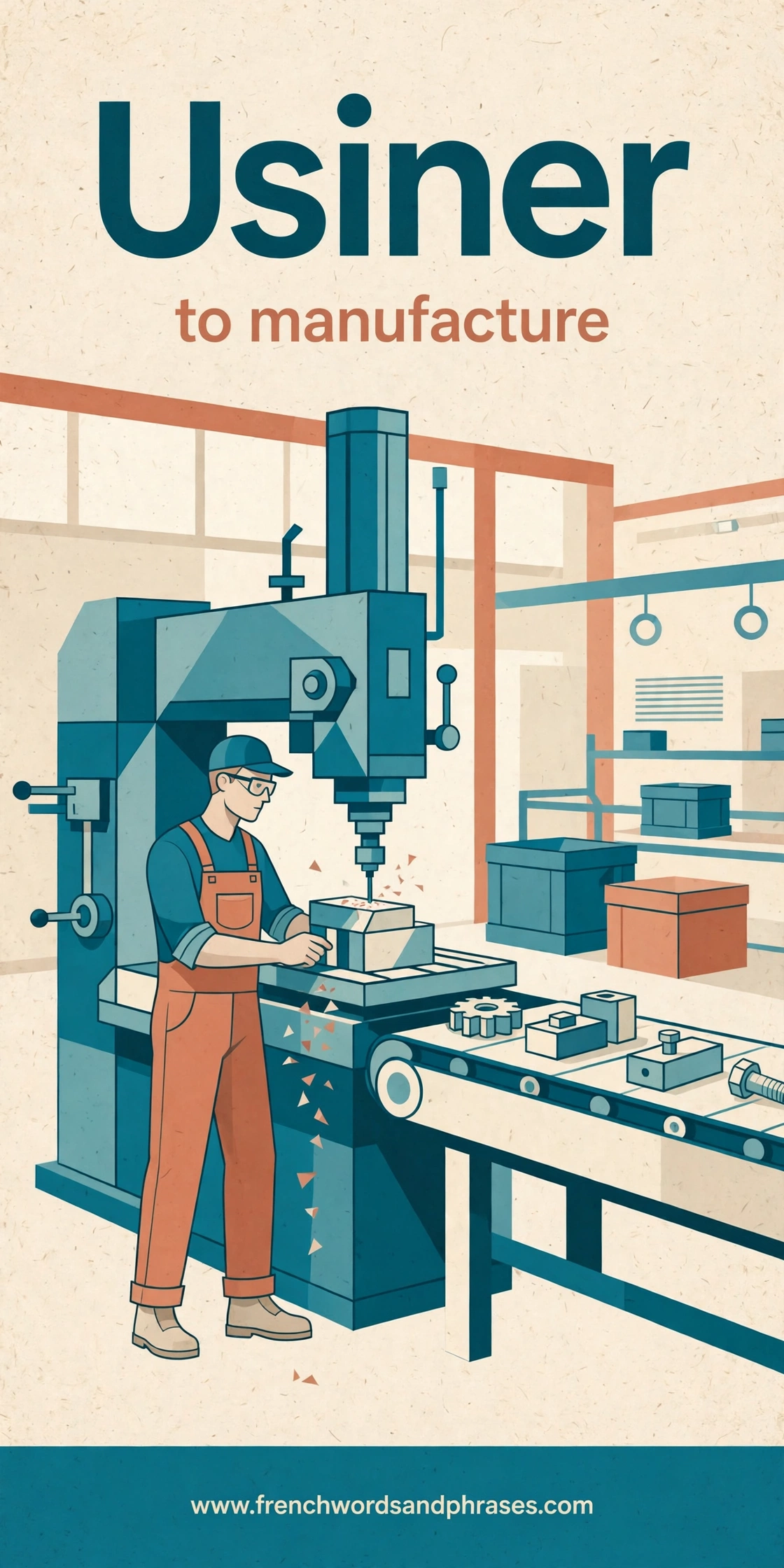
Usiner means to manufacture — to machine a part to its exact shape in a factory.
A lathe turning in a shower of sparks, a block of steel becoming a gear tooth by tooth — usiner is the verb of the factory floor, of raw metal machined into precise, useful things.
In this guide, you’ll learn how to conjugate usiner in all the major French tenses and moods. Explore complete conjugation tables, French examples, English translations, and practice quizzes.
Understanding the French Verb Usiner
Usiner is a regular French verb belonging to the first group of verbs, those ending in -er.
It means to manufacture. It is commonly used in engineering and industry for parts machined on lathes, mills and CNC machines, for factories producing components in series, and familiarly for anything — essays, songs, graduates — produced in large, rapid quantities.
Verb classification: First group (-er)
Auxiliary verb: Avoir
Past participle: usiné
Present participle: usinant
English equivalents: To machine, to manufacture; usiner une pièce — to machine a part; une usine — a factory; l’usinage — machining; (familiar) usiner — to churn out in quantity.
One important detail: usiner is built on une usine, a factory, and its home ground is the machine shop: usiner une pièce is to machine a part — cutting, drilling and milling it to the exact millimetre. In familiar French the verb escapes the factory and means churning things out in industrial quantities: cette école usine des diplômés, said with a smile. The conjugation is a plain regular -er: j’usine, nous usinons, past participle usiné.
Experience the Word
Usiner is the verb of precision at scale — one perfect part, then ten thousand more exactly like it.
Imagine a factory at dawn in the industrial east. The machines wake one by one; a technician fixes a steel bar in the lathe, and the first pièce is usinée — measured, turned, measured again — while the day’s order of five thousand waits on the chart behind her.
The raw bar has become a component. It has been machined — usiné — to the last tenth of a millimetre.
How to Conjugate Usiner: Complete French Conjugation Guide
Let’s explore every major conjugation of usiner, beginning with the indicative mood.
How to Conjugate Usiner in the Indicative Mood
The indicative mood is used to express facts, observations, actions, and events.
How to Conjugate Usiner in the Present Tense (Présent)
Used for actions happening now, habitual actions, and general truths.
| Subject | Conjugation |
|---|---|
| je | usine |
| tu | usines |
| il / elle | usine |
| nous | usinons |
| vous | usinez |
| ils / elles | usinent |
Example
Cette machine usine les pièces en quelques minutes.
This machine manufactures the parts in a few minutes.
Quick Quiz 1
Complete the sentence:
Nous ______ les pièces du nouveau moteur.
Reveal the answer
usinons
Nous usinons les pièces du nouveau moteur.
We are machining the parts of the new engine.
How to Conjugate Usiner in the Passé Composé
Used for completed actions in the past. Usiner takes the auxiliary verb avoir.
| Subject | Conjugation |
|---|---|
| j’ | ai usiné |
| tu | as usiné |
| il / elle | a usiné |
| nous | avons usiné |
| vous | avez usiné |
| ils / elles | ont usiné |
Example
L’usine a usiné mille engrenages ce mois-ci.
The factory machined a thousand gears this month.
How to Conjugate Usiner in the Imparfait (Imperfect Tense)
Used for habitual past actions, descriptions, and ongoing situations in the past.
| Subject | Conjugation |
|---|---|
| je | usinais |
| tu | usinais |
| il / elle | usinait |
| nous | usinions |
| vous | usiniez |
| ils / elles | usinaient |
Example
Autrefois, on usinait chaque pièce à la main.
In the old days, every part was machined by hand.
Quick Quiz 2
Choose the correct form:
The factory machined the gears.
L’usine ______ les engrenages. (a usiné / est usinée)
Reveal the answer
a usiné
L’usine a usiné les engrenages.
Usiner takes avoir.
How to Conjugate Usiner in the Plus-que-parfait
Used to describe an action that had already been completed before another past event.
| Subject | Conjugation |
|---|---|
| j’ | avais usiné |
| tu | avais usiné |
| il / elle | avait usiné |
| nous | avions usiné |
| vous | aviez usiné |
| ils / elles | avaient usiné |
Example
Ils avaient usiné les axes avant l’assemblage.
They had machined the shafts before assembly.
How to Conjugate Usiner in the Passé Simple
Primarily used in formal writing, literature, and historical narratives. It is rarely used in everyday conversation.
| Subject | Conjugation |
|---|---|
| je | usinai |
| tu | usinas |
| il / elle | usina |
| nous | usinâmes |
| vous | usinâtes |
| ils / elles | usinèrent |
Example
L’atelier usina les pièces du prototype en une semaine.
The workshop machined the prototype’s parts in one week.
How to Conjugate Usiner in the Passé Antérieur
A literary tense used to express an action completed immediately before another past action, generally in the passé simple.
| Subject | Conjugation |
|---|---|
| j’ | eus usiné |
| tu | eus usiné |
| il / elle | eut usiné |
| nous | eûmes usiné |
| vous | eûtes usiné |
| ils / elles | eurent usiné |
Example
Quand l’ouvrier eut usiné la dernière pièce, la sirène sonna.
When the worker had machined the last part, the siren sounded.
How to Conjugate Usiner in the Future Tense (Futur Simple)
Used to describe actions that will take place in the future.
| Subject | Conjugation |
|---|---|
| je | usinerai |
| tu | usineras |
| il / elle | usinera |
| nous | usinerons |
| vous | usinerez |
| ils / elles | usineront |
Example
Demain, nous usinerons les supports du nouveau moteur.
Tomorrow, we will machine the brackets for the new engine.
How to Conjugate Usiner in the Futur Antérieur (Future Perfect)
Used for an action that will have been completed before a particular point in the future.
| Subject | Conjugation |
|---|---|
| j’ | aurai usiné |
| tu | auras usiné |
| il / elle | aura usiné |
| nous | aurons usiné |
| vous | aurez usiné |
| ils / elles | auront usiné |
Example
À la fin du mois, l’usine aura usiné dix mille pièces.
By the end of the month, the factory will have machined ten thousand parts.
How to Conjugate Usiner in the Near Future (Futur Proche)
Used to describe something that is going to happen soon. Formed with aller + infinitive.
| Subject | Conjugation |
|---|---|
| je | vais usiner |
| tu | vas usiner |
| il / elle | va usiner |
| nous | allons usiner |
| vous | allez usiner |
| ils / elles | vont usiner |
Example
Je vais usiner un axe de rechange.
I am going to machine a spare shaft.
How to Conjugate Usiner in the Conditional Mood
The conditional mood expresses what would happen under certain circumstances. It is also frequently used to make polite requests or express wishes.
How to Conjugate Usiner in the Present Conditional
| Subject | Conjugation |
|---|---|
| je | usinerais |
| tu | usinerais |
| il / elle | usinerait |
| nous | usinerions |
| vous | usineriez |
| ils / elles | usineraient |
Example
Avec une machine moderne, on usinerait deux fois plus vite.
With a modern machine, we would machine twice as fast.
How to Conjugate Usiner in the Past Conditional
| Subject | Conjugation |
|---|---|
| j’ | aurais usiné |
| tu | aurais usiné |
| il / elle | aurait usiné |
| nous | aurions usiné |
| vous | auriez usiné |
| ils / elles | auraient usiné |
Example
Ils auraient usiné les pièces sur place si le tour avait fonctionné.
They would have machined the parts on site if the lathe had worked.
Usiner in the Literary Past Conditional Form
This less common literary form uses the imperfect subjunctive of avoir.
| Subject | Conjugation |
|---|---|
| j’ | eusse usiné |
| tu | eusses usiné |
| il / elle | eût usiné |
| nous | eussions usiné |
| vous | eussiez usiné |
| ils / elles | eussent usiné |
Example
L’usine eût usiné les canons avant l’hiver.
The factory would have machined the cannons before winter.
How to Conjugate Usiner in the Subjunctive Mood
The subjunctive is used to express wishes, emotions, doubts, necessity, and uncertainty. It frequently follows expressions such as il faut que (it is necessary that) or bien que (although).
How to Conjugate Usiner in the Present Subjunctive
| Subject | Conjugation |
|---|---|
| que je | usine |
| que tu | usines |
| qu’il / qu’elle | usine |
| que nous | usinions |
| que vous | usiniez |
| qu’ils / qu’elles | usinent |
Example
Il faut que vous usiniez cette pièce au dixième de millimètre.
You must machine this part to a tenth of a millimetre.
Quick Quiz 3
Complete the sentence using the subjunctive:
Il faut que vous ______ les axes avant vendredi.
Reveal the answer
usiniez
Il faut que vous usiniez les axes avant vendredi.
You must machine the shafts before Friday.
How to Conjugate Usiner in the Imperfect Subjunctive
A literary tense, rarely encountered in modern spoken French.
| Subject | Conjugation |
|---|---|
| que je | usinasse |
| que tu | usinasses |
| qu’il / qu’elle | usinât |
| que nous | usinassions |
| que vous | usinassiez |
| qu’ils / qu’elles | usinassent |
Example
Le chef voulait que l’atelier usinât les axes avant vendredi.
The foreman wanted the workshop to machine the shafts before Friday.
How to Conjugate Usiner in the Pluperfect Subjunctive
A literary construction used to express an action completed before another past action.
| Subject | Conjugation |
|---|---|
| que j’ | eusse usiné |
| que tu | eusses usiné |
| qu’il / qu’elle | eût usiné |
| que nous | eussions usiné |
| que vous | eussiez usiné |
| qu’ils / qu’elles | eussent usiné |
Example
On admirait qu’ils eussent usiné un prototype si précis.
People admired that they had machined such a precise prototype.
How to Conjugate Usiner in the Past Subjunctive
| Subject | Conjugation |
|---|---|
| que j’ | aie usiné |
| que tu | aies usiné |
| qu’il / qu’elle | ait usiné |
| que nous | ayons usiné |
| que vous | ayez usiné |
| qu’ils / qu’elles | aient usiné |
Example
Je suis content que vous ayez usiné les pièces à temps.
I am glad you machined the parts in time.
How to Conjugate Usiner in the Imperative
The imperative is used to give commands, instructions, invitations, or suggestions. Subject pronouns are omitted.
How to Conjugate Usiner in the Present Imperative
| Person | Conjugation |
|---|---|
| (tu) | usine |
| (nous) | usinons |
| (vous) | usinez |
Example
Usinez les supports, puis vérifiez chaque mesure !
Machine the brackets, then check every measurement!
Quick Quiz 4
How would you say Machine the brackets (vous form)?
Reveal the answer
Usinez les supports !
French Participles of Usiner
Participles are verb forms that can be used in compound tenses and other grammatical constructions.
Present Participle of Usiner
usinant
En usinant la pièce, il contrôle la cote à chaque passe.
While machining the part, he checks the dimension at every pass.
Past Participle of Usiner
usiné
Usinée avec précision, la pièce s’ajuste parfaitement.
Machined with precision, the part fits perfectly.
Usiner in Everyday French: Real-Life Examples
Now that you know the conjugations, let’s see how usiner appears in everyday French.
Example 1 — Present
Cette machine usine les pièces en quelques minutes.
This machine manufactures the parts in a few minutes.
Example 2 — Passé composé
L’usine a usiné mille engrenages ce mois-ci.
The factory machined a thousand gears this month.
Example 3 — Imparfait
On usinait chaque pièce à la main.
Every part used to be machined by hand.
Example 4 — Future
Nous usinerons les supports demain.
We will machine the brackets tomorrow.
Example 5 — Conditional
On usinerait plus vite avec une machine moderne.
We would machine faster with a modern machine.
Example 6 — Imperative
Usinez les supports et vérifiez les mesures !
Machine the brackets and check the measurements!
Beyond Translation: The Meaning of Usiner
English manufacture sounds grand and general; French usiner smells of cutting oil and hot metal — it is manufacture at the level of the lathe, one measured part at a time.
Fabriquer makes things; usiner machines them.
And when French speakers joke that a school or a studio usine its graduates or its hits, they borrow the factory’s image of cheerful, unstoppable quantity.
How to Remember the French Verb Usiner
Remember it this way: Usiner is about the lathe turning raw steel into a precise part.
- Une usine is a factory — usiner is what the factory does to metal.
- Usiner une pièce — to machine a part, to the tenth of a millimetre.
- Regular -er: j’usine, nous usinons, past participle usiné.
The key idea is the lathe turning raw steel into a precise part.
Test Your Knowledge of Usiner
Let’s see how much you’ve learned. Try answering these questions before revealing the answers.
Question 1
What is une usine?
Reveal the answer
A factory — the home of usiner.
Question 2
How do you say The factory machined a thousand gears in French?
Reveal the answer
L’usine a usiné mille engrenages.
Question 3
Translate: You must machine this part to a tenth of a millimetre.
Reveal the answer
Il faut que vous usiniez cette pièce au dixième de millimètre.
Question 4
What is the past participle of usiner?
Reveal the answer
Usiné.
Question 5
Complete the sentence:
Il faut que vous ______ cette pièce avec précision.
Reveal the answer
usiniez
Il faut que vous usiniez cette pièce avec précision.
You must machine this part with precision.
Your Final Challenge
Can You Use It?
How would you say this in French?
The worker machines the last part, measures it once more, and smiles: it is perfect.
Reveal the answer
L’ouvrier usine la dernière pièce, la mesure une fois encore, et sourit : elle est parfaite.
The worker machines the last part, measures it once more, and smiles: it is perfect.
A little French. A little curiosity. A richer everyday life.
LEARN FRENCH ONE WORD AT A TIME