A French Word to Live By
How to Conjugate Trousser in French
/tʁu.se/
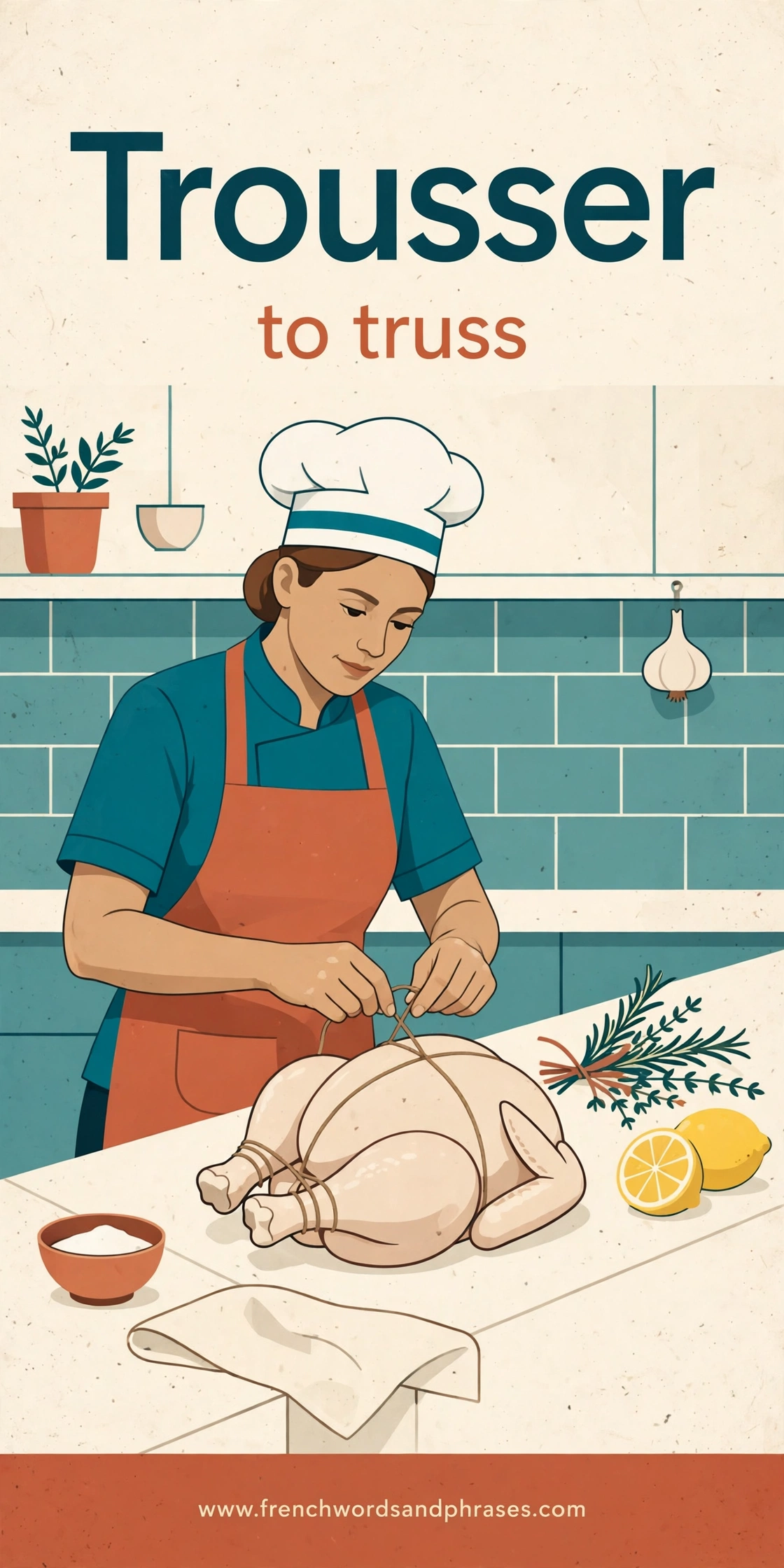
Trousser means to truss — to tie up a bird neatly before it roasts.
Kitchen string, a plump chicken, and a cook’s quick fingers winding and knotting until the bird sits compact and elegant — trousser is the verb of tying things up tight and tidy before the oven does its work.
In this guide, you’ll learn how to conjugate trousser in all the major French tenses and moods. Explore complete conjugation tables, French examples, English translations, and practice quizzes.
Understanding the French Verb Trousser
Trousser is a regular French verb belonging to the first group of verbs, those ending in -er.
It means to truss. It is commonly used in the kitchen for trussing poultry and joints of meat with string, in older texts for tucking up skirts and sleeves, and in the set literary phrase trousser un compliment — a compliment neatly turned and promptly delivered.
Verb classification: First group (-er)
Auxiliary verb: Avoir
Past participle: troussé
Present participle: troussant
English equivalents: To truss (a chicken); trousser une volaille — to truss a bird; trousser sa robe — to tuck up one’s dress; trousser un compliment — to deliver a neat compliment (old-fashioned).
One important detail: trousser ties things up and in — a chicken’s legs and wings bound close to the body so it roasts evenly. It also tucks clothing up: trousser sa jupe, to hitch up one’s skirt (the commoner modern cousin is retrousser, as in retrousser ses manches, to roll up one’s sleeves). In older, gallant French, a gentleman could even trousser un compliment — deliver a compliment as neatly tied as a chicken. The noun une trousse is a kit or case — une trousse de toilette, a washbag — another little bundle tied up for travel.
Experience the Word
Trousser is the verb of the tidy bundle — string, knots, and nothing sticking out.
Imagine a farmhouse kitchen on Christmas morning. The capon lies on the board while the cook works the string around it — troussant, serrant, nouant — until the bird is one smooth, compact parcel ready for the oven.
Legs tucked, wings folded, string knotted. The bird has been trussed — troussé — and it will roast to an even gold.
How to Conjugate Trousser: Complete French Conjugation Guide
Let’s explore every major conjugation of trousser, beginning with the indicative mood.
How to Conjugate Trousser in the Indicative Mood
The indicative mood is used to express facts, observations, actions, and events.
How to Conjugate Trousser in the Present Tense (Présent)
Used for actions happening now, habitual actions, and general truths.
| Subject | Conjugation |
|---|---|
| je | trousse |
| tu | trousses |
| il / elle | trousse |
| nous | troussons |
| vous | troussez |
| ils / elles | troussent |
Example
Le boucher trousse les poulets avant la vente.
The butcher trusses the chickens before selling them.
Quick Quiz 1
Complete the sentence:
Nous ______ les poulets avant la vente.
Reveal the answer
troussons
Nous troussons les poulets avant la vente.
We truss the chickens before selling them.
How to Conjugate Trousser in the Passé Composé
Used for completed actions in the past. Trousser takes the auxiliary verb avoir.
| Subject | Conjugation |
|---|---|
| j’ | ai troussé |
| tu | as troussé |
| il / elle | a troussé |
| nous | avons troussé |
| vous | avez troussé |
| ils / elles | ont troussé |
Example
Elle a troussé le poulet avec de la ficelle de cuisine.
She trussed the chicken with kitchen string.
How to Conjugate Trousser in the Imparfait (Imperfect Tense)
Used for habitual past actions, descriptions, and ongoing situations in the past.
| Subject | Conjugation |
|---|---|
| je | troussais |
| tu | troussais |
| il / elle | troussait |
| nous | troussions |
| vous | troussiez |
| ils / elles | troussaient |
Example
Autrefois, on troussait les volailles avant de les rôtir.
In the old days, people trussed poultry before roasting it.
Quick Quiz 2
Choose the correct form:
She trussed the turkey.
Elle ______ la dinde. (a troussé / est troussée)
Reveal the answer
a troussé
Elle a troussé la dinde.
Trousser takes avoir.
How to Conjugate Trousser in the Plus-que-parfait
Used to describe an action that had already been completed before another past event.
| Subject | Conjugation |
|---|---|
| j’ | avais troussé |
| tu | avais troussé |
| il / elle | avait troussé |
| nous | avions troussé |
| vous | aviez troussé |
| ils / elles | avaient troussé |
Example
Il avait troussé la dinde dès le matin.
He had trussed the turkey first thing in the morning.
How to Conjugate Trousser in the Passé Simple
Primarily used in formal writing, literature, and historical narratives. It is rarely used in everyday conversation.
| Subject | Conjugation |
|---|---|
| je | troussai |
| tu | troussas |
| il / elle | troussa |
| nous | troussâmes |
| vous | troussâtes |
| ils / elles | troussèrent |
Example
Le cuisinier troussa le canard en un instant.
The cook trussed the duck in a moment.
How to Conjugate Trousser in the Passé Antérieur
A literary tense used to express an action completed immediately before another past action, generally in the passé simple.
| Subject | Conjugation |
|---|---|
| j’ | eus troussé |
| tu | eus troussé |
| il / elle | eut troussé |
| nous | eûmes troussé |
| vous | eûtes troussé |
| ils / elles | eurent troussé |
Example
Quand elle eut troussé le poulet, elle le mit au four.
When she had trussed the chicken, she put it in the oven.
How to Conjugate Trousser in the Future Tense (Futur Simple)
Used to describe actions that will take place in the future.
| Subject | Conjugation |
|---|---|
| je | trousserai |
| tu | trousseras |
| il / elle | troussera |
| nous | trousserons |
| vous | trousserez |
| ils / elles | trousseront |
Example
Demain, je trousserai le rôti avant l’arrivée des invités.
Tomorrow, I will truss the joint before the guests arrive.
How to Conjugate Trousser in the Futur Antérieur (Future Perfect)
Used for an action that will have been completed before a particular point in the future.
| Subject | Conjugation |
|---|---|
| j’ | aurai troussé |
| tu | auras troussé |
| il / elle | aura troussé |
| nous | aurons troussé |
| vous | aurez troussé |
| ils / elles | auront troussé |
Example
À midi, ils auront troussé toutes les volailles.
By noon, they will have trussed all the poultry.
How to Conjugate Trousser in the Near Future (Futur Proche)
Used to describe something that is going to happen soon. Formed with aller + infinitive.
| Subject | Conjugation |
|---|---|
| je | vais trousser |
| tu | vas trousser |
| il / elle | va trousser |
| nous | allons trousser |
| vous | allez trousser |
| ils / elles | vont trousser |
Example
Je vais trousser ce poulet, passe-moi la ficelle.
I am going to truss this chicken, hand me the string.
How to Conjugate Trousser in the Conditional Mood
The conditional mood expresses what would happen under certain circumstances. It is also frequently used to make polite requests or express wishes.
How to Conjugate Trousser in the Present Conditional
| Subject | Conjugation |
|---|---|
| je | trousserais |
| tu | trousserais |
| il / elle | trousserait |
| nous | trousserions |
| vous | trousseriez |
| ils / elles | trousseraient |
Example
Avec de la ficelle fine, tu trousserais mieux ce rôti.
With fine string, you would truss this joint better.
How to Conjugate Trousser in the Past Conditional
| Subject | Conjugation |
|---|---|
| j’ | aurais troussé |
| tu | aurais troussé |
| il / elle | aurait troussé |
| nous | aurions troussé |
| vous | auriez troussé |
| ils / elles | auraient troussé |
Example
Il aurait troussé la dinde si on le lui avait demandé.
He would have trussed the turkey if he had been asked.
Trousser in the Literary Past Conditional Form
This less common literary form uses the imperfect subjunctive of avoir.
| Subject | Conjugation |
|---|---|
| j’ | eusse troussé |
| tu | eusses troussé |
| il / elle | eût troussé |
| nous | eussions troussé |
| vous | eussiez troussé |
| ils / elles | eussent troussé |
Example
Elle eût troussé le poulet avant même l’aube.
She would have trussed the chicken before dawn itself.
How to Conjugate Trousser in the Subjunctive Mood
The subjunctive is used to express wishes, emotions, doubts, necessity, and uncertainty. It frequently follows expressions such as il faut que (it is necessary that) or bien que (although).
How to Conjugate Trousser in the Present Subjunctive
| Subject | Conjugation |
|---|---|
| que je | trousse |
| que tu | trousses |
| qu’il / qu’elle | trousse |
| que nous | troussions |
| que vous | troussiez |
| qu’ils / qu’elles | troussent |
Example
Il faut que vous troussiez la volaille fermement.
You must truss the bird firmly.
Quick Quiz 3
Complete the sentence using the subjunctive:
Il faut que vous ______ la volaille fermement.
Reveal the answer
troussiez
Il faut que vous troussiez la volaille fermement.
You must truss the bird firmly.
How to Conjugate Trousser in the Imperfect Subjunctive
A literary tense, rarely encountered in modern spoken French.
| Subject | Conjugation |
|---|---|
| que je | troussasse |
| que tu | troussasses |
| qu’il / qu’elle | troussât |
| que nous | troussassions |
| que vous | troussassiez |
| qu’ils / qu’elles | troussassent |
Example
Le chef voulait qu’il troussât le canard lui-même.
The chef wanted him to truss the duck himself.
How to Conjugate Trousser in the Pluperfect Subjunctive
A literary construction used to express an action completed before another past action.
| Subject | Conjugation |
|---|---|
| que j’ | eusse troussé |
| que tu | eusses troussé |
| qu’il / qu’elle | eût troussé |
| que nous | eussions troussé |
| que vous | eussiez troussé |
| qu’ils / qu’elles | eussent troussé |
Example
On admirait qu’ils eussent troussé les poulets si vite.
People admired that they had trussed the chickens so quickly.
How to Conjugate Trousser in the Past Subjunctive
| Subject | Conjugation |
|---|---|
| que j’ | aie troussé |
| que tu | aies troussé |
| qu’il / qu’elle | ait troussé |
| que nous | ayons troussé |
| que vous | ayez troussé |
| qu’ils / qu’elles | aient troussé |
Example
Je suis ravi que tu aies troussé le rôti comme un chef.
I am delighted you trussed the joint like a chef.
How to Conjugate Trousser in the Imperative
The imperative is used to give commands, instructions, invitations, or suggestions. Subject pronouns are omitted.
How to Conjugate Trousser in the Present Imperative
| Person | Conjugation |
|---|---|
| (tu) | trousse |
| (nous) | troussons |
| (vous) | troussez |
Example
Trousse le poulet, puis mets-le au four !
Truss the chicken, then put it in the oven!
Quick Quiz 4
How would you say Truss the chicken (tu form)?
Reveal the answer
Trousse le poulet !
French Participles of Trousser
Participles are verb forms that can be used in compound tenses and other grammatical constructions.
Present Participle of Trousser
troussant
En troussant la volaille, il serrait bien la ficelle.
As he trussed the bird, he pulled the string tight.
Past Participle of Trousser
troussé
Troussée avec soin, la dinde rôtissait lentement.
Trussed with care, the turkey roasted slowly.
Trousser in Everyday French: Real-Life Examples
Now that you know the conjugations, let’s see how trousser appears in everyday French.
Example 1 — Present
Le boucher trousse les poulets du marché.
The butcher trusses the market chickens.
Example 2 — Passé composé
J’ai troussé le poulet pour le rôti du dimanche.
I trussed the chicken for the Sunday roast.
Example 3 — Imparfait
Ma grand-mère troussait la dinde de Noël.
My grandmother used to truss the Christmas turkey.
Example 4 — Future
Nous trousserons le chapon demain matin.
We will truss the capon tomorrow morning.
Example 5 — Conditional
Tu trousserais mieux avec une aiguille à brider.
You would truss better with a trussing needle.
Example 6 — Imperative
Troussez la volaille avant de l’enfourner !
Truss the bird before putting it in the oven!
Beyond Translation: The Meaning of Trousser
English truss and French trousser do the same kitchen job, but the French verb wandered further: up skirts, up sleeves, and into the drawing room.
Trousser un compliment is the giveaway — in old French, elegance was a kind of tying-up: nothing loose, nothing trailing, everything presented in a neat, tight parcel.
Even the washbag on your shelf, une trousse, is the same idea: a bundle, bound and ready.
How to Remember the French Verb Trousser
Remember it this way: Trousser is about string, knots, and a chicken tied into a tidy parcel.
- Trousser ties a bird up tight with string so it roasts evenly.
- Une trousse is a kit or washbag — another tidy bundle from the same family.
- Regular -er: je trousse, nous troussons, past participle troussé.
The key idea is string, knots, and a chicken tied into a tidy parcel.
Test Your Knowledge of Trousser
Let’s see how much you’ve learned. Try answering these questions before revealing the answers.
Question 1
How do you say to truss a chicken in French?
Reveal the answer
Trousser un poulet.
Question 2
How do you say She trussed the chicken with kitchen string in French?
Reveal the answer
Elle a troussé le poulet avec de la ficelle de cuisine.
Question 3
What does the old-fashioned phrase trousser un compliment mean?
Reveal the answer
To deliver a neat compliment — tied up as tidily as a chicken.
Question 4
What is the past participle of trousser?
Reveal the answer
Troussé.
Question 5
Complete the sentence:
Il faut que vous ______ la volaille fermement.
Reveal the answer
troussiez
Il faut que vous troussiez la volaille fermement.
You must truss the bird firmly.
Your Final Challenge
Can You Use It?
How would you say this in French?
He trusses the capon with care, ties the string, and the oven can begin its work.
Reveal the answer
Il trousse le chapon avec soin, noue la ficelle, et le four peut commencer son travail.
He trusses the capon with care, ties the string, and the oven can begin its work.
A little French. A little curiosity. A richer everyday life.
LEARN FRENCH ONE WORD AT A TIME