A French Word to Live By
How to Conjugate Trinquer in French
/tʁɛ̃.ke/
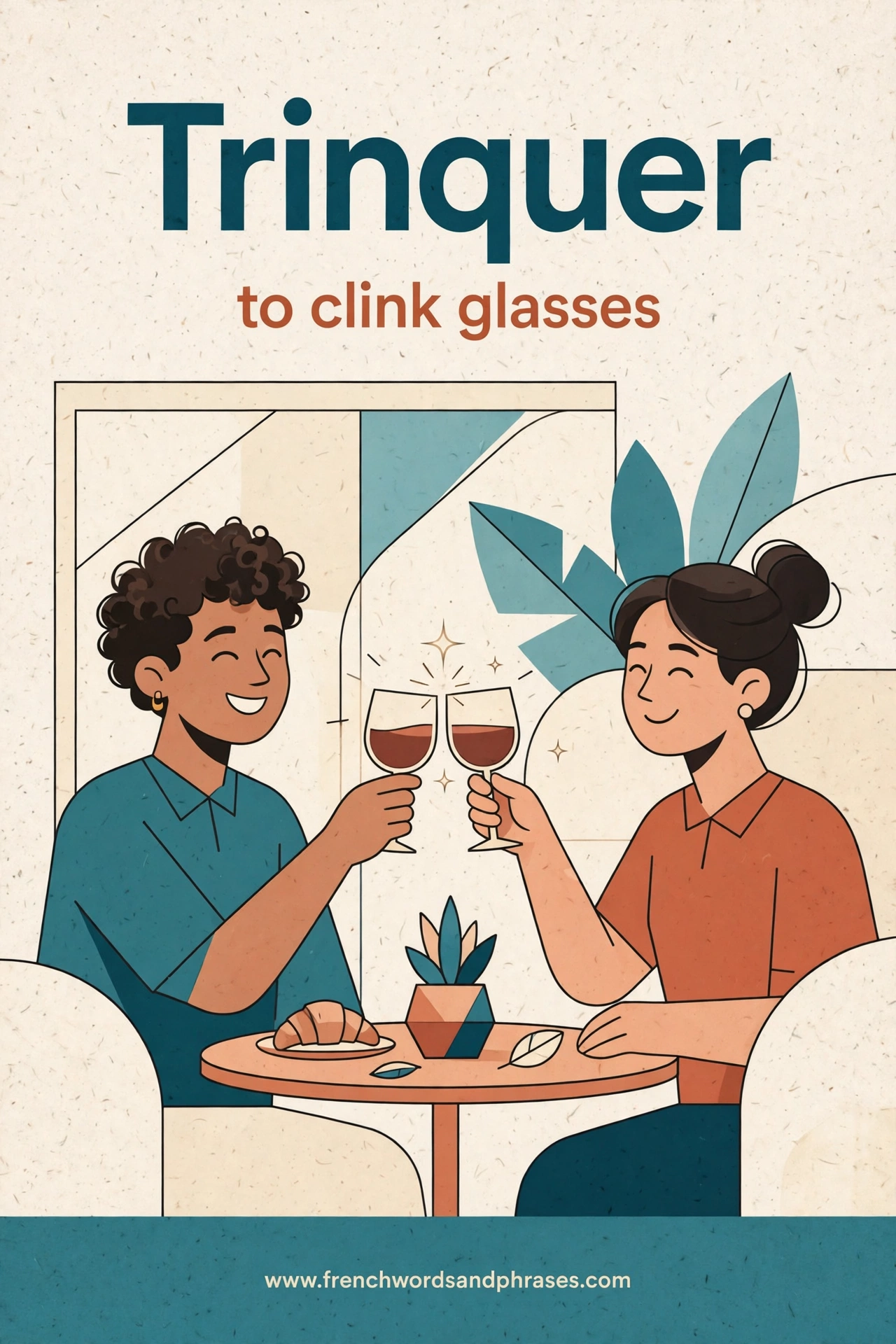
Trinquer means to clink glasses — to tap glasses together in a toast before drinking.
Glasses raised, eyes meeting over the rims, that small bright clink before the first sip — trinquer is the verb of the toast, the sound of friendship in French. But the same word has a second, rueful life: when things go wrong, someone always has to trinquer — to catch it, to pay for everyone else.
In this guide, you’ll learn how to conjugate trinquer in all the major French tenses and moods. Explore complete conjugation tables, French examples, English translations, and practice quizzes.
Understanding the French Verb Trinquer
Trinquer is a regular French verb belonging to the first group of verbs, those ending in -er.
It means to clink glasses. It is commonly used at birthdays, weddings, New Year and every apéritif where glasses are raised to someone’s health, and in its familiar second sense whenever a bill, a punishment or a round of bad luck lands on the same shoulders as always.
Verb classification: First group (-er)
Auxiliary verb: Avoir
Past participle: trinqué
Present participle: trinquant
English equivalents: To clink glasses, to toast; trinquer à la santé de quelqu’un — to drink to someone’s health; trinquer avec quelqu’un — to clink glasses with someone; (fam.) c’est moi qui trinque — I am the one who catches it, who pays the price.
One important detail: trinquer keeps its qu in every form — je trinque, nous trinquons, je trinquais — the u is never dropped, so the hard k sound survives everywhere. The verb has two lives: at the table it is all celebration, glasses meeting in a toast; in familiar speech it means to be the one who suffers the consequences — quand ça tourne mal, c’est toujours les mêmes qui trinquent, when things go wrong, it is always the same people who catch it.
Experience the Word
Trinquer is the verb of the raised glass — celebration in one sense, resignation in the other.
Imagine a long table on New Year’s Eve. At midnight the corks pop, everyone stands, and the whole room trinqe à la nouvelle année, glass against glass, nobody drinking before that little clink has blessed the year to come.
The glasses meet, the sound rings out. They have toasted — trinqué — and the year can begin.
How to Conjugate Trinquer: Complete French Conjugation Guide
Let’s explore every major conjugation of trinquer, beginning with the indicative mood.
How to Conjugate Trinquer in the Indicative Mood
The indicative mood is used to express facts, observations, actions, and events.
How to Conjugate Trinquer in the Present Tense (Présent)
Used for actions happening now, habitual actions, and general truths.
| Subject | Conjugation |
|---|---|
| je | trinque |
| tu | trinques |
| il / elle | trinque |
| nous | trinquons |
| vous | trinquez |
| ils / elles | trinquent |
Example
À minuit, tout le monde trinque à la nouvelle année.
At midnight, everyone clinks glasses to the New Year.
Quick Quiz 1
Complete the sentence:
Nous ______ à ton nouveau travail.
Reveal the answer
trinquons
Nous trinquons à ton nouveau travail.
We clink glasses to your new job.
How to Conjugate Trinquer in the Passé Composé
Used for completed actions in the past. Trinquer takes the auxiliary verb avoir.
| Subject | Conjugation |
|---|---|
| j’ | ai trinqué |
| tu | as trinqué |
| il / elle | a trinqué |
| nous | avons trinqué |
| vous | avez trinqué |
| ils / elles | ont trinqué |
Example
Nous avons trinqué à sa réussite avec un verre de champagne.
We clinked glasses to his success with a glass of champagne.
How to Conjugate Trinquer in the Imparfait (Imperfect Tense)
Used for habitual past actions, descriptions, and ongoing situations in the past.
| Subject | Conjugation |
|---|---|
| je | trinquais |
| tu | trinquais |
| il / elle | trinquait |
| nous | trinquions |
| vous | trinquiez |
| ils / elles | trinquaient |
Example
Chaque vendredi, les collègues trinquaient après le travail.
Every Friday, the colleagues used to clink glasses after work.
Quick Quiz 2
Choose the correct form:
They clinked glasses at midnight.
Ils ______ à minuit. (ont trinqué / sont trinqués)
Reveal the answer
ont trinqué
Ils ont trinqué à minuit.
Trinquer takes avoir.
How to Conjugate Trinquer in the Plus-que-parfait
Used to describe an action that had already been completed before another past event.
| Subject | Conjugation |
|---|---|
| j’ | avais trinqué |
| tu | avais trinqué |
| il / elle | avait trinqué |
| nous | avions trinqué |
| vous | aviez trinqué |
| ils / elles | avaient trinqué |
Example
Ils avaient déjà trinqué quand les derniers invités sont arrivés.
They had already clinked glasses when the last guests arrived.
How to Conjugate Trinquer in the Passé Simple
Primarily used in formal writing, literature, and historical narratives. It is rarely used in everyday conversation.
| Subject | Conjugation |
|---|---|
| je | trinquai |
| tu | trinquas |
| il / elle | trinqua |
| nous | trinquâmes |
| vous | trinquâtes |
| ils / elles | trinquèrent |
Example
Les deux amis trinquèrent à leur vieille amitié.
The two friends clinked glasses to their old friendship.
How to Conjugate Trinquer in the Passé Antérieur
A literary tense used to express an action completed immediately before another past action, generally in the passé simple.
| Subject | Conjugation |
|---|---|
| j’ | eus trinqué |
| tu | eus trinqué |
| il / elle | eut trinqué |
| nous | eûmes trinqué |
| vous | eûtes trinqué |
| ils / elles | eurent trinqué |
Example
Quand ils eurent trinqué, le repas commença.
When they had clinked glasses, the meal began.
How to Conjugate Trinquer in the Future Tense (Futur Simple)
Used to describe actions that will take place in the future.
| Subject | Conjugation |
|---|---|
| je | trinquerai |
| tu | trinqueras |
| il / elle | trinquera |
| nous | trinquerons |
| vous | trinquerez |
| ils / elles | trinqueront |
Example
Ce soir, nous trinquerons à ton nouveau travail.
Tonight, we will clink glasses to your new job.
How to Conjugate Trinquer in the Futur Antérieur (Future Perfect)
Used for an action that will have been completed before a particular point in the future.
| Subject | Conjugation |
|---|---|
| j’ | aurai trinqué |
| tu | auras trinqué |
| il / elle | aura trinqué |
| nous | aurons trinqué |
| vous | aurez trinqué |
| ils / elles | auront trinqué |
Example
À minuit, nous aurons trinqué trois fois.
By midnight, we will have clinked glasses three times.
How to Conjugate Trinquer in the Near Future (Futur Proche)
Used to describe something that is going to happen soon. Formed with aller + infinitive.
| Subject | Conjugation |
|---|---|
| je | vais trinquer |
| tu | vas trinquer |
| il / elle | va trinquer |
| nous | allons trinquer |
| vous | allez trinquer |
| ils / elles | vont trinquer |
Example
Je vais trinquer avec toi, sers-moi un verre.
I am going to clink glasses with you, pour me a glass.
How to Conjugate Trinquer in the Conditional Mood
The conditional mood expresses what would happen under certain circumstances. It is also frequently used to make polite requests or express wishes.
How to Conjugate Trinquer in the Present Conditional
| Subject | Conjugation |
|---|---|
| je | trinquerais |
| tu | trinquerais |
| il / elle | trinquerait |
| nous | trinquerions |
| vous | trinqueriez |
| ils / elles | trinqueraient |
Example
Sans la musique, on trinquerait moins gaiement.
Without the music, we would clink glasses less merrily.
How to Conjugate Trinquer in the Past Conditional
| Subject | Conjugation |
|---|---|
| j’ | aurais trinqué |
| tu | aurais trinqué |
| il / elle | aurait trinqué |
| nous | aurions trinqué |
| vous | auriez trinqué |
| ils / elles | auraient trinqué |
Example
Elle aurait trinqué avec nous si elle n’avait pas dû conduire.
She would have clinked glasses with us if she had not had to drive.
Trinquer in the Literary Past Conditional Form
This less common literary form uses the imperfect subjunctive of avoir.
| Subject | Conjugation |
|---|---|
| j’ | eusse trinqué |
| tu | eusses trinqué |
| il / elle | eût trinqué |
| nous | eussions trinqué |
| vous | eussiez trinqué |
| ils / elles | eussent trinqué |
Example
Ils eussent trinqué à la victoire avant le banquet.
They would have clinked glasses to victory before the banquet.
How to Conjugate Trinquer in the Subjunctive Mood
The subjunctive is used to express wishes, emotions, doubts, necessity, and uncertainty. It frequently follows expressions such as il faut que (it is necessary that) or bien que (although).
How to Conjugate Trinquer in the Present Subjunctive
| Subject | Conjugation |
|---|---|
| que je | trinque |
| que tu | trinques |
| qu’il / qu’elle | trinque |
| que nous | trinquions |
| que vous | trinquiez |
| qu’ils / qu’elles | trinquent |
Example
Il faut que tout le monde trinque à la santé des mariés.
Everyone must clink glasses to the health of the newlyweds.
Quick Quiz 3
Complete the sentence using the subjunctive:
Il faut que vous ______ à la santé des mariés.
Reveal the answer
trinquiez
Il faut que vous trinquiez à la santé des mariés.
You must clink glasses to the health of the newlyweds.
How to Conjugate Trinquer in the Imperfect Subjunctive
A literary tense, rarely encountered in modern spoken French.
| Subject | Conjugation |
|---|---|
| que je | trinquasse |
| que tu | trinquasses |
| qu’il / qu’elle | trinquât |
| que nous | trinquassions |
| que vous | trinquassiez |
| qu’ils / qu’elles | trinquassent |
Example
Je voulais qu’on trinquât avant le discours.
I wanted us to clink glasses before the speech.
How to Conjugate Trinquer in the Pluperfect Subjunctive
A literary construction used to express an action completed before another past action.
| Subject | Conjugation |
|---|---|
| que j’ | eusse trinqué |
| que tu | eusses trinqué |
| qu’il / qu’elle | eût trinqué |
| que nous | eussions trinqué |
| que vous | eussiez trinqué |
| qu’ils / qu’elles | eussent trinqué |
Example
On raconta qu’ils eussent trinqué jusqu’au matin.
People told how they had clinked glasses until morning.
How to Conjugate Trinquer in the Past Subjunctive
| Subject | Conjugation |
|---|---|
| que j’ | aie trinqué |
| que tu | aies trinqué |
| qu’il / qu’elle | ait trinqué |
| que nous | ayons trinqué |
| que vous | ayez trinqué |
| qu’ils / qu’elles | aient trinqué |
Example
Je suis heureux que nous ayons trinqué ensemble ce soir.
I am happy that we clinked glasses together tonight.
How to Conjugate Trinquer in the Imperative
The imperative is used to give commands, instructions, invitations, or suggestions. Subject pronouns are omitted.
How to Conjugate Trinquer in the Present Imperative
| Person | Conjugation |
|---|---|
| (tu) | trinque |
| (nous) | trinquons |
| (vous) | trinquez |
Example
Trinquons à l’amitié !
Let us clink glasses to friendship!
Quick Quiz 4
How would you say Let us clink glasses to friendship?
Reveal the answer
Trinquons à l’amitié !
French Participles of Trinquer
Participles are verb forms that can be used in compound tenses and other grammatical constructions.
Present Participle of Trinquer
trinquant
En trinquant, il a renversé un peu de vin sur la nappe.
While clinking glasses, he spilled a little wine on the tablecloth.
Past Participle of Trinquer
trinqué
Les verres trinqués, les invités passèrent à table.
The glasses clinked, the guests sat down to eat.
Trinquer in Everyday French: Real-Life Examples
Now that you know the conjugations, let’s see how trinquer appears in everyday French.
Example 1 — Present
On trinque à ta santé !
We drink to your health!
Example 2 — Passé composé
Nous avons trinqué au champagne pour son départ.
We clinked champagne glasses for his leaving.
Example 3 — Imparfait
Le dimanche, la famille trinquait avant le repas.
On Sundays, the family used to clink glasses before the meal.
Example 4 — Future
Ce soir, nous trinquerons à votre mariage.
Tonight, we will clink glasses to your wedding.
Example 5 — Conditional
Je trinquerais bien avec un jus de fruits.
I would happily clink glasses with a fruit juice.
Example 6 — Imperative
Trinquez avec moi, c’est ma tournée !
Clink glasses with me, this round is on me!
Beyond Translation: The Meaning of Trinquer
English to toast names the speech; French trinquer names the sound — the clink itself, borrowed long ago from the German soldiers’ trinken, to drink.
And then there is the trinquer of bad days.
When the project fails and one department pays for everyone’s mistakes, the French shrug and say c’est nous qui trinquons — we are the ones who catch it. One verb, two fates: the toast, and the bill.
How to Remember the French Verb Trinquer
Remember it this way: Trinquer is about the clink of glasses at midnight — and the same people catching it when things go wrong.
- Trinquer is the clink of glasses in a toast — trinquer à la santé de quelqu’un, to drink to someone’s health.
- Familiar second sense: c’est moi qui trinque — I am the one who catches it, who pays.
- The qu never loses its u: je trinque, nous trinquons, past participle trinqué.
The key idea is the clink of glasses at midnight — and the same people catching it when things go wrong.
Test Your Knowledge of Trinquer
Let’s see how much you’ve learned. Try answering these questions before revealing the answers.
Question 1
How do you say to clink glasses in French?
Reveal the answer
Trinquer.
Question 2
How do you say Everyone clinks glasses at midnight in French?
Reveal the answer
Tout le monde trinque à minuit.
Question 3
Translate: We clinked glasses to his success.
Reveal the answer
Nous avons trinqué à sa réussite.
Question 4
What is the past participle of trinquer?
Reveal the answer
Trinqué.
Question 5
Complete the sentence:
Il faut que tout le monde ______ à la santé des mariés.
Reveal the answer
trinque
Il faut que tout le monde trinque à la santé des mariés.
Everyone must clink glasses to the health of the newlyweds.
Your Final Challenge
Can You Use It?
How would you say this in French?
At midnight, the whole family clinks champagne glasses, and the touching glasses ring in the New Year.
Reveal the answer
À minuit, toute la famille trinque au champagne, et les verres qui se touchent font sonner la nouvelle année.
At midnight, the whole family clinks champagne glasses, and the touching glasses ring in the New Year.
A little French. A little curiosity. A richer everyday life.
LEARN FRENCH ONE WORD AT A TIME