
A French Word to Live By
How to Conjugate Tringler in French
/tʁɛ̃.ɡle/
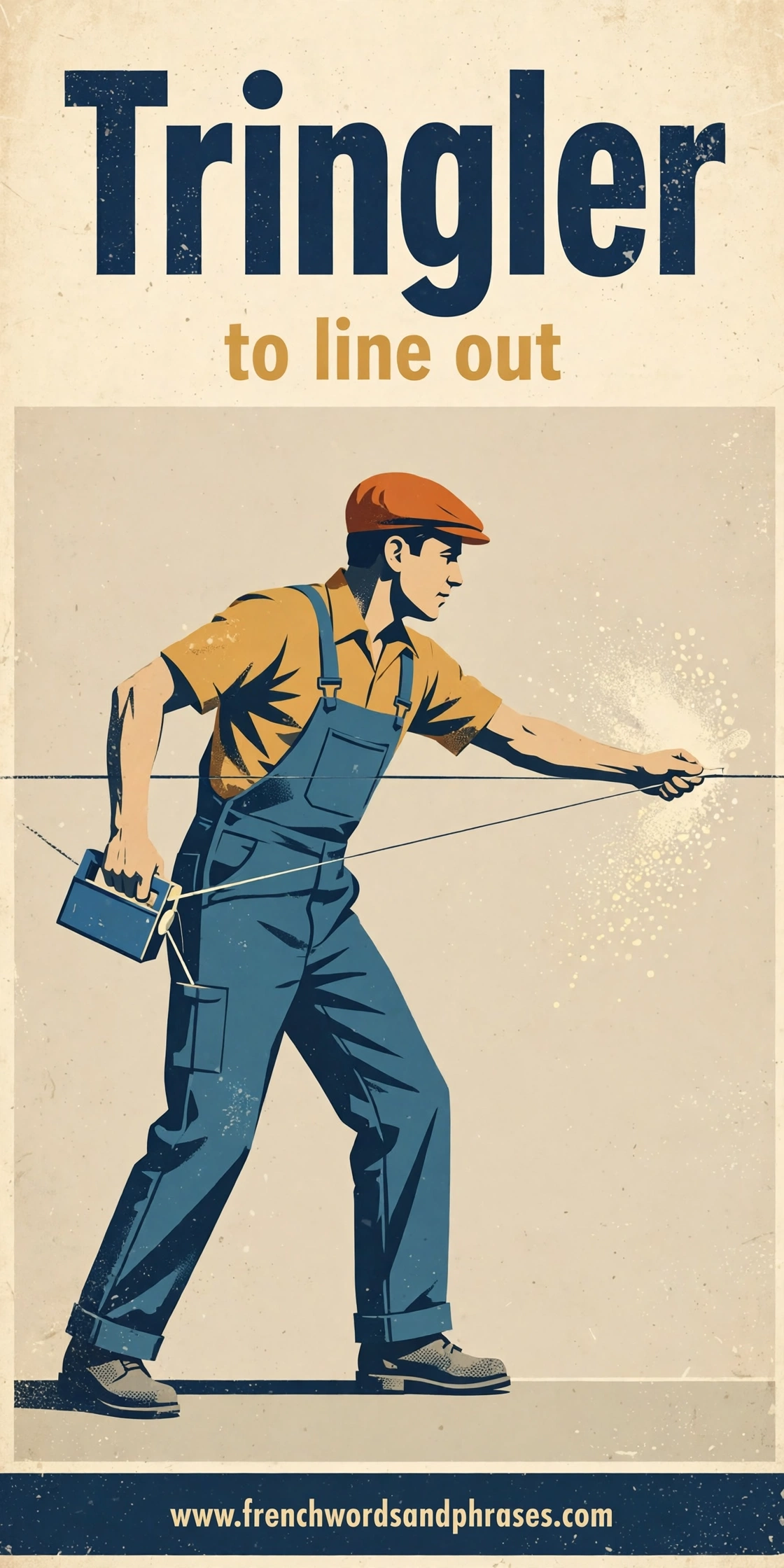
Tringler means to line out — to mark straight lines on a wall or floor with a chalk line before building.
A cord stretched tight across a bare floor, dusted with blue powder, lifted and snapped — ping! A perfect straight line appears where there was nothing. Tringler is the builder’s verb for that small magic: marking out the lines that a wall, a row of tiles or a partition will follow.
In this guide, you’ll learn how to conjugate tringler in all the major French tenses and moods. Explore complete conjugation tables, French examples, English translations, and practice quizzes.
Understanding the French Verb Tringler
Tringler is a regular French verb belonging to the first group of verbs, those ending in -er.
It means to line out. It is commonly used on building sites and in renovation work for marking the position of walls, partitions, tiles and trenches on floors and walls, always with a chalk line before the real work of building, tiling or digging begins.
Verb classification: First group (-er)
Auxiliary verb: Avoir
Past participle: tringlé
Present participle: tringlant
English equivalents: To line out, to mark out with a chalk line; un cordeau (à tracer) — a chalk line; tringler un mur — to snap the lines on a wall; une tringle — a rod, a curtain rod.
One important detail: tringler belongs to the building site. The tool is le cordeau, a cord wound in a case full of coloured powder: you stretch it, pinch it, let it snap, and the line is marked. The same family gives une tringle, a slim rod — the curtain rod above a window. Tringler is a regular -er verb: je tringle, nous tringlons, past participle tringlé. Be aware that the word also has a crude slang sense best recognised, not used.
Experience the Word
Tringler is the verb of the first straight line — the moment a plan becomes marks on the floor.
Imagine an empty room waiting to become a bathroom. Before a single tile is laid, the tiler kneels, stretches his cordeau from wall to wall, and snap after snap the blue lines appear — he tringle the whole grid that his hands will follow all week.
Nothing is built yet, but everything is decided. The lines have been snapped — tringlées — and the room knows its future.
How to Conjugate Tringler: Complete French Conjugation Guide
Let’s explore every major conjugation of tringler, beginning with the indicative mood.
How to Conjugate Tringler in the Indicative Mood
The indicative mood is used to express facts, observations, actions, and events.
How to Conjugate Tringler in the Present Tense (Présent)
Used for actions happening now, habitual actions, and general truths.
| Subject | Conjugation |
|---|---|
| je | tringle |
| tu | tringles |
| il / elle | tringle |
| nous | tringlons |
| vous | tringlez |
| ils / elles | tringlent |
Example
Le maçon tringle le mur avant de poser les briques.
The mason marks out the wall with a chalk line before laying the bricks.
Quick Quiz 1
Complete the sentence:
Nous ______ les lignes du sol au cordeau.
Reveal the answer
tringlons
Nous tringlons les lignes du sol au cordeau.
We mark out the lines on the floor with the chalk line.
How to Conjugate Tringler in the Passé Composé
Used for completed actions in the past. Tringler takes the auxiliary verb avoir.
| Subject | Conjugation |
|---|---|
| j’ | ai tringlé |
| tu | as tringlé |
| il / elle | a tringlé |
| nous | avons tringlé |
| vous | avez tringlé |
| ils / elles | ont tringlé |
Example
Nous avons tringlé toutes les lignes du sol ce matin.
We marked out all the lines on the floor this morning.
How to Conjugate Tringler in the Imparfait (Imperfect Tense)
Used for habitual past actions, descriptions, and ongoing situations in the past.
| Subject | Conjugation |
|---|---|
| je | tringlais |
| tu | tringlais |
| il / elle | tringlait |
| nous | tringlions |
| vous | tringliez |
| ils / elles | tringlaient |
Example
Autrefois, on tringlait les murs au cordeau enduit de poudre bleue.
In the old days, people used to mark walls with a line coated in blue powder.
Quick Quiz 2
Choose the correct form:
He marked out the terrace.
Il ______ la terrasse. (a tringlé / est tringlé)
Reveal the answer
a tringlé
Il a tringlé la terrasse.
Tringler takes avoir.
How to Conjugate Tringler in the Plus-que-parfait
Used to describe an action that had already been completed before another past event.
| Subject | Conjugation |
|---|---|
| j’ | avais tringlé |
| tu | avais tringlé |
| il / elle | avait tringlé |
| nous | avions tringlé |
| vous | aviez tringlé |
| ils / elles | avaient tringlé |
Example
Il avait tringlé le tracé avant l’arrivée des ouvriers.
He had marked out the line before the workers arrived.
How to Conjugate Tringler in the Passé Simple
Primarily used in formal writing, literature, and historical narratives. It is rarely used in everyday conversation.
| Subject | Conjugation |
|---|---|
| je | tringlai |
| tu | tringlas |
| il / elle | tringla |
| nous | tringlâmes |
| vous | tringlâtes |
| ils / elles | tringlèrent |
Example
Le chef de chantier tringla l’emplacement des cloisons.
The site foreman marked out the position of the partitions.
How to Conjugate Tringler in the Passé Antérieur
A literary tense used to express an action completed immediately before another past action, generally in the passé simple.
| Subject | Conjugation |
|---|---|
| j’ | eus tringlé |
| tu | eus tringlé |
| il / elle | eut tringlé |
| nous | eûmes tringlé |
| vous | eûtes tringlé |
| ils / elles | eurent tringlé |
Example
Quand ils eurent tringlé le sol, ils commencèrent à creuser.
When they had marked out the floor, they began to dig.
How to Conjugate Tringler in the Future Tense (Futur Simple)
Used to describe actions that will take place in the future.
| Subject | Conjugation |
|---|---|
| je | tringlerai |
| tu | tringleras |
| il / elle | tringlera |
| nous | tringlerons |
| vous | tringlerez |
| ils / elles | tringleront |
Example
Demain, je tringlerai l’emplacement de la terrasse.
Tomorrow, I will mark out the position of the terrace.
How to Conjugate Tringler in the Futur Antérieur (Future Perfect)
Used for an action that will have been completed before a particular point in the future.
| Subject | Conjugation |
|---|---|
| j’ | aurai tringlé |
| tu | auras tringlé |
| il / elle | aura tringlé |
| nous | aurons tringlé |
| vous | aurez tringlé |
| ils / elles | auront tringlé |
Example
À midi, ils auront tringlé tout le rez-de-chaussée.
By noon, they will have marked out the whole ground floor.
How to Conjugate Tringler in the Near Future (Futur Proche)
Used to describe something that is going to happen soon. Formed with aller + infinitive.
| Subject | Conjugation |
|---|---|
| je | vais tringler |
| tu | vas tringler |
| il / elle | va tringler |
| nous | allons tringler |
| vous | allez tringler |
| ils / elles | vont tringler |
Example
Je vais tringler la ligne, tiens le cordeau bien tendu.
I am going to snap the line, hold the cord taut.
How to Conjugate Tringler in the Conditional Mood
The conditional mood expresses what would happen under certain circumstances. It is also frequently used to make polite requests or express wishes.
How to Conjugate Tringler in the Present Conditional
| Subject | Conjugation |
|---|---|
| je | tringlerais |
| tu | tringlerais |
| il / elle | tringlerait |
| nous | tringlerions |
| vous | tringleriez |
| ils / elles | tringleraient |
Example
Avec un laser, tu tringlerais plus droit.
With a laser, you would mark out straighter lines.
How to Conjugate Tringler in the Past Conditional
| Subject | Conjugation |
|---|---|
| j’ | aurais tringlé |
| tu | aurais tringlé |
| il / elle | aurait tringlé |
| nous | aurions tringlé |
| vous | auriez tringlé |
| ils / elles | auraient tringlé |
Example
Il aurait tringlé le mur si le cordeau n’avait pas cassé.
He would have marked out the wall if the line had not snapped.
Tringler in the Literary Past Conditional Form
This less common literary form uses the imperfect subjunctive of avoir.
| Subject | Conjugation |
|---|---|
| j’ | eusse tringlé |
| tu | eusses tringlé |
| il / elle | eût tringlé |
| nous | eussions tringlé |
| vous | eussiez tringlé |
| ils / elles | eussent tringlé |
Example
Le maçon eût tringlé le tracé avant la pluie.
The mason would have marked out the line before the rain.
How to Conjugate Tringler in the Subjunctive Mood
The subjunctive is used to express wishes, emotions, doubts, necessity, and uncertainty. It frequently follows expressions such as il faut que (it is necessary that) or bien que (although).
How to Conjugate Tringler in the Present Subjunctive
| Subject | Conjugation |
|---|---|
| que je | tringle |
| que tu | tringles |
| qu’il / qu’elle | tringle |
| que nous | tringlions |
| que vous | tringliez |
| qu’ils / qu’elles | tringlent |
Example
Il faut que vous tringliez la ligne au millimètre près.
You must mark the line to the nearest millimetre.
Quick Quiz 3
Complete the sentence using the subjunctive:
Il faut que vous ______ le tracé avant midi.
Reveal the answer
tringliez
Il faut que vous tringliez le tracé avant midi.
You must mark out the line before noon.
How to Conjugate Tringler in the Imperfect Subjunctive
A literary tense, rarely encountered in modern spoken French.
| Subject | Conjugation |
|---|---|
| que je | tringlasse |
| que tu | tringlasses |
| qu’il / qu’elle | tringlât |
| que nous | tringlassions |
| que vous | tringlassiez |
| qu’ils / qu’elles | tringlassent |
Example
Je voulais qu’il tringlât le mur avant de peindre.
I wanted him to mark out the wall before painting.
How to Conjugate Tringler in the Pluperfect Subjunctive
A literary construction used to express an action completed before another past action.
| Subject | Conjugation |
|---|---|
| que j’ | eusse tringlé |
| que tu | eusses tringlé |
| qu’il / qu’elle | eût tringlé |
| que nous | eussions tringlé |
| que vous | eussiez tringlé |
| qu’ils / qu’elles | eussent tringlé |
Example
On vérifia qu’ils eussent tringlé le bon emplacement.
They checked that the men had marked out the right spot.
How to Conjugate Tringler in the Past Subjunctive
| Subject | Conjugation |
|---|---|
| que j’ | aie tringlé |
| que tu | aies tringlé |
| qu’il / qu’elle | ait tringlé |
| que nous | ayons tringlé |
| que vous | ayez tringlé |
| qu’ils / qu’elles | aient tringlé |
Example
Je suis content que tu aies tringlé tout le chantier.
I am glad you marked out the whole site.
How to Conjugate Tringler in the Imperative
The imperative is used to give commands, instructions, invitations, or suggestions. Subject pronouns are omitted.
How to Conjugate Tringler in the Present Imperative
| Person | Conjugation |
|---|---|
| (tu) | tringle |
| (nous) | tringlons |
| (vous) | tringlez |
Example
Tringle cette ligne et vérifie l’équerre !
Mark this line and check the square!
Quick Quiz 4
How would you say Mark this line (tu form)?
Reveal the answer
Tringle cette ligne !
French Participles of Tringler
Participles are verb forms that can be used in compound tenses and other grammatical constructions.
Present Participle of Tringler
tringlant
En tringlant le sol, il a découvert une ancienne canalisation.
While marking out the floor, he discovered an old pipe.
Past Participle of Tringler
tringlé
Tringlées au cordeau, les lignes guidaient les maçons.
Snapped with the chalk line, the lines guided the masons.
Tringler in Everyday French: Real-Life Examples
Now that you know the conjugations, let’s see how tringler appears in everyday French.
Example 1 — Present
Le carreleur tringle le sol avant de poser le carrelage.
The tiler marks out the floor before laying the tiles.
Example 2 — Passé composé
J’ai tringlé l’emplacement des cloisons ce matin.
I marked out the position of the partitions this morning.
Example 3 — Imparfait
On tringlait les murs au cordeau bleu.
People used to mark walls with the blue chalk line.
Example 4 — Future
Nous tringlerons la terrasse demain matin.
We will mark out the terrace tomorrow morning.
Example 5 — Conditional
Avec un laser, tu tringlerais plus vite.
With a laser, you would mark out faster.
Example 6 — Imperative
Tringlez les lignes avant de creuser !
Mark out the lines before digging!
Beyond Translation: The Meaning of Tringler
English builders snap a line or chalk a line; French tringler packs the whole gesture into one trade verb.
Every craft has verbs like this.
They live on building sites and in workshops, rarely in textbooks — and they are exactly the words that make a learner sound like an insider the first time a French builder hears them used correctly.
How to Remember the French Verb Tringler
Remember it this way: Tringler is about the chalk line snapping a blue line across an empty floor.
- Tringler is the builder’s verb: to mark out straight lines with a chalk line, le cordeau.
- Une tringle is a slim rod — the same family of long straight things.
- Regular -er: je tringle, nous tringlons, past participle tringlé.
The key idea is the chalk line snapping a blue line across an empty floor.
Test Your Knowledge of Tringler
Let’s see how much you’ve learned. Try answering these questions before revealing the answers.
Question 1
How do you say to mark out with a chalk line in French?
Reveal the answer
Tringler.
Question 2
How do you say The mason marks out the wall in French?
Reveal the answer
Le maçon tringle le mur.
Question 3
Translate: We marked out all the lines this morning.
Reveal the answer
Nous avons tringlé toutes les lignes ce matin.
Question 4
What is the past participle of tringler?
Reveal the answer
Tringlé.
Question 5
Complete the sentence:
Il faut que vous ______ la ligne au millimètre près.
Reveal the answer
tringliez
Il faut que vous tringliez la ligne au millimètre près.
You must mark the line to the nearest millimetre.
Your Final Challenge
Can You Use It?
How would you say this in French?
He marks out the floor of the future kitchen, and the blue lines already draw tomorrow’s room.
Reveal the answer
Il tringle le sol de la future cuisine, et les lignes bleues dessinent déjà la pièce de demain.
He marks out the floor of the future kitchen, and the blue lines already draw tomorrow’s room.
A little French. A little curiosity. A richer everyday life.
LEARN FRENCH ONE WORD AT A TIME




