
A French Word to Live By
How to Conjugate Traîner in French
/tʁɛ.ne/
Traîner means to drag, to pull, to trail — to pull something heavy along the ground, and much more besides.
A suitcase bumping down the stairs, a child dragging his feet on the way to school, papers left lying on every table — traîner is the verb of everything that drags: heavy loads, slow walkers, untidy rooms and stories that never seem to end.
In this guide, you’ll learn how to conjugate traîner in all the major French tenses and moods. Explore complete conjugation tables, French examples, English translations, and practice quizzes.
Understanding the French Verb Traîner
Traîner is a regular French verb belonging to the first group of verbs, those ending in -er.
It means to drag, to pull, to trail. It is commonly used for dragging heavy bags and furniture, for children and teenagers hanging around, for things left lying around the house, for business and illnesses that drag on, and in the reflexive for anyone who hauls himself along when exhausted, ill or unwilling.
Verb classification: First group (-er)
Auxiliary verb: Avoir
Past participle: traîné
Present participle: traînant
English equivalents: To drag, to pull, to trail; se traîner — to drag oneself along, to crawl along; traîner la patte — to limp, to drag one’s feet; laisser traîner — to leave lying around; traîner dans les rues — to hang around in the streets.
One important detail: traîner keeps its circumflex on the î, the mark of an old lost s (it was once traisner). Watch the reflexive: se traîner, to drag oneself along, is conjugated with être in compound tenses — il s’est traîné jusqu’à la porte — while plain traîner takes avoir: il a traîné sa valise. And when a dog or a tired walker limps along, French says traîner la patte, to drag one’s paw.
Experience the Word
Traîner is the verb of weight and slowness — everything in its world is heavy, late or left lying around.
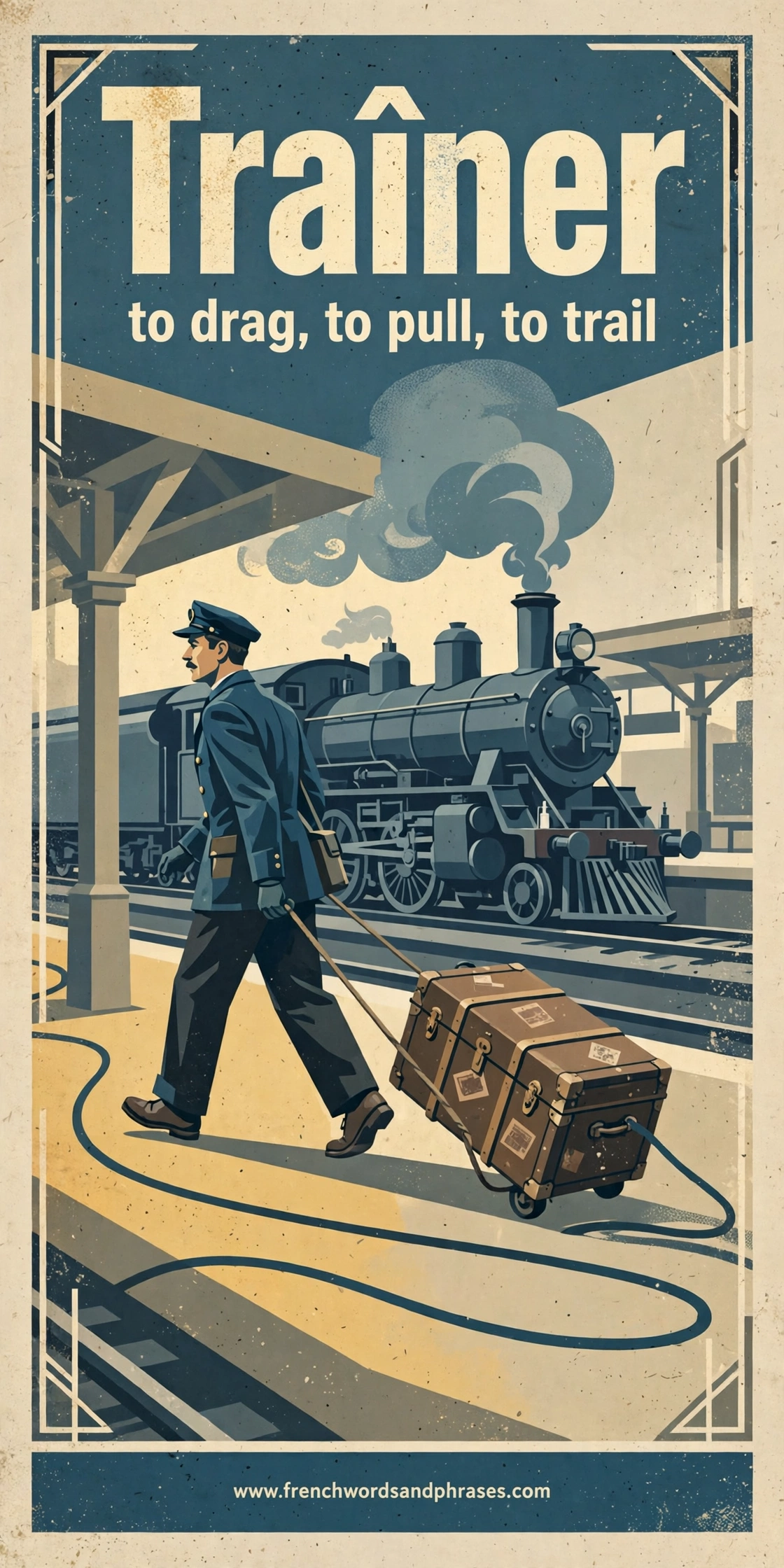
Imagine a small station at the end of the holidays. A father traîne two enormous suitcases along the platform while behind him his son se traîne, dragging his feet, traînant his schoolbag in the dust — the holidays are over, and everything drags.
The bags, the boy, the whole day seem pulled along the ground. Everything has been dragged — traîné — to its reluctant end.
How to Conjugate Traîner: Complete French Conjugation Guide
Let’s explore every major conjugation of traîner, beginning with the indicative mood.
How to Conjugate Traîner in the Indicative Mood
The indicative mood is used to express facts, observations, actions, and events.
How to Conjugate Traîner in the Present Tense (Présent)
Used for actions happening now, habitual actions, and general truths.
| Subject | Conjugation |
|---|---|
| je | traîne |
| tu | traînes |
| il / elle | traîne |
| nous | traînons |
| vous | traînez |
| ils / elles | traînent |
Example
Il traîne sa valise dans l’escalier.
He drags his suitcase up the stairs.
Quick Quiz 1
Complete the sentence:
Nous ______ nos valises jusqu’à la gare.
Reveal the answer
traînons
Nous traînons nos valises jusqu’à la gare.
We drag our suitcases to the station.
How to Conjugate Traîner in the Passé Composé
Used for completed actions in the past. Traîner takes the auxiliary verb avoir.
| Subject | Conjugation |
|---|---|
| j’ | ai traîné |
| tu | as traîné |
| il / elle | a traîné |
| nous | avons traîné |
| vous | avez traîné |
| ils / elles | ont traîné |
Example
Épuisé, il s’est traîné jusqu’à son lit.
Exhausted, he dragged himself to his bed.
How to Conjugate Traîner in the Imparfait (Imperfect Tense)
Used for habitual past actions, descriptions, and ongoing situations in the past.
| Subject | Conjugation |
|---|---|
| je | traînais |
| tu | traînais |
| il / elle | traînait |
| nous | traînions |
| vous | traîniez |
| ils / elles | traînaient |
Example
Les enfants traînaient dans les rues après l’école.
The children used to hang around in the streets after school.
Quick Quiz 2
Choose the correct form:
He dragged the chair to the window.
Il ______ la chaise jusqu’à la fenêtre. (a traîné / s’est traîné)
Reveal the answer
a traîné
Il a traîné la chaise jusqu’à la fenêtre.
Traîner takes avoir; se traîner takes être.
How to Conjugate Traîner in the Plus-que-parfait
Used to describe an action that had already been completed before another past event.
| Subject | Conjugation |
|---|---|
| j’ | avais traîné |
| tu | avais traîné |
| il / elle | avait traîné |
| nous | avions traîné |
| vous | aviez traîné |
| ils / elles | avaient traîné |
Example
Elle avait traîné sa valise sur tout le quai.
She had dragged her suitcase the whole length of the platform.
How to Conjugate Traîner in the Passé Simple
Primarily used in formal writing, literature, and historical narratives. It is rarely used in everyday conversation.
| Subject | Conjugation |
|---|---|
| je | traînai |
| tu | traînas |
| il / elle | traîna |
| nous | traînâmes |
| vous | traînâtes |
| ils / elles | traînèrent |
Example
Il traîna la chaise jusqu’à la fenêtre.
He dragged the chair to the window.
How to Conjugate Traîner in the Passé Antérieur
A literary tense used to express an action completed immediately before another past action, generally in the passé simple.
| Subject | Conjugation |
|---|---|
| j’ | eus traîné |
| tu | eus traîné |
| il / elle | eut traîné |
| nous | eûmes traîné |
| vous | eûtes traîné |
| ils / elles | eurent traîné |
Example
Quand il eut traîné le sac au grenier, il s’assit enfin.
When he had dragged the bag up to the attic, he finally sat down.
How to Conjugate Traîner in the Future Tense (Futur Simple)
Used to describe actions that will take place in the future.
| Subject | Conjugation |
|---|---|
| je | traînerai |
| tu | traîneras |
| il / elle | traînera |
| nous | traînerons |
| vous | traînerez |
| ils / elles | traîneront |
Example
Cette réunion traînera encore en longueur.
This meeting will drag on yet again.
How to Conjugate Traîner in the Futur Antérieur (Future Perfect)
Used for an action that will have been completed before a particular point in the future.
| Subject | Conjugation |
|---|---|
| j’ | aurai traîné |
| tu | auras traîné |
| il / elle | aura traîné |
| nous | aurons traîné |
| vous | aurez traîné |
| ils / elles | auront traîné |
Example
À midi, il aura traîné tous les cartons au garage.
By noon, he will have dragged all the boxes to the garage.
How to Conjugate Traîner in the Near Future (Futur Proche)
Used to describe something that is going to happen soon. Formed with aller + infinitive.
| Subject | Conjugation |
|---|---|
| je | vais traîner |
| tu | vas traîner |
| il / elle | va traîner |
| nous | allons traîner |
| vous | allez traîner |
| ils / elles | vont traîner |
Example
Je vais traîner un peu au café avant le train.
I am going to hang around at the café for a while before the train.
How to Conjugate Traîner in the Conditional Mood
The conditional mood expresses what would happen under certain circumstances. It is also frequently used to make polite requests or express wishes.
How to Conjugate Traîner in the Present Conditional
| Subject | Conjugation |
|---|---|
| je | traînerais |
| tu | traînerais |
| il / elle | traînerait |
| nous | traînerions |
| vous | traîneriez |
| ils / elles | traîneraient |
Example
Sans ce sac trop lourd, tu traînerais moins les pieds.
Without that heavy bag, you would drag your feet less.
How to Conjugate Traîner in the Past Conditional
| Subject | Conjugation |
|---|---|
| j’ | aurais traîné |
| tu | aurais traîné |
| il / elle | aurait traîné |
| nous | aurions traîné |
| vous | auriez traîné |
| ils / elles | auraient traîné |
Example
Il aurait traîné des heures si son ami ne l’avait pas appelé.
He would have hung around for hours if his friend had not called him.
Traîner in the Literary Past Conditional Form
This less common literary form uses the imperfect subjunctive of avoir.
| Subject | Conjugation |
|---|---|
| j’ | eusse traîné |
| tu | eusses traîné |
| il / elle | eût traîné |
| nous | eussions traîné |
| vous | eussiez traîné |
| ils / elles | eussent traîné |
Example
Il eût traîné la charrette jusqu’au village.
He would have dragged the cart all the way to the village.
How to Conjugate Traîner in the Subjunctive Mood
The subjunctive is used to express wishes, emotions, doubts, necessity, and uncertainty. It frequently follows expressions such as il faut que (it is necessary that) or bien que (although).
How to Conjugate Traîner in the Present Subjunctive
| Subject | Conjugation |
|---|---|
| que je | traîne |
| que tu | traînes |
| qu’il / qu’elle | traîne |
| que nous | traînions |
| que vous | traîniez |
| qu’ils / qu’elles | traînent |
Example
Il ne faut pas que les enfants traînent dans la rue le soir.
The children must not hang around in the street in the evening.
Quick Quiz 3
Complete the sentence using the subjunctive:
Il ne faut pas que vous ______ dans les couloirs.
Reveal the answer
traîniez
Il ne faut pas que vous traîniez dans les couloirs.
You must not hang around in the corridors.
How to Conjugate Traîner in the Imperfect Subjunctive
A literary tense, rarely encountered in modern spoken French.
| Subject | Conjugation |
|---|---|
| que je | traînasse |
| que tu | traînasses |
| qu’il / qu’elle | traînât |
| que nous | traînassions |
| que vous | traînassiez |
| qu’ils / qu’elles | traînassent |
Example
Je ne voulais pas qu’il traînât sa valise dans la boue.
I did not want him to drag his suitcase through the mud.
How to Conjugate Traîner in the Pluperfect Subjunctive
A literary construction used to express an action completed before another past action.
| Subject | Conjugation |
|---|---|
| que j’ | eusse traîné |
| que tu | eusses traîné |
| qu’il / qu’elle | eût traîné |
| que nous | eussions traîné |
| que vous | eussiez traîné |
| qu’ils / qu’elles | eussent traîné |
Example
On craignait qu’il eût traîné son sac dans la boue.
People feared he had dragged his bag through the mud.
How to Conjugate Traîner in the Past Subjunctive
| Subject | Conjugation |
|---|---|
| que j’ | aie traîné |
| que tu | aies traîné |
| qu’il / qu’elle | ait traîné |
| que nous | ayons traîné |
| que vous | ayez traîné |
| qu’ils / qu’elles | aient traîné |
Example
Je suis content que tu aies traîné le carton jusqu’ici.
I am glad you dragged the box all the way here.
How to Conjugate Traîner in the Imperative
The imperative is used to give commands, instructions, invitations, or suggestions. Subject pronouns are omitted.
How to Conjugate Traîner in the Present Imperative
| Person | Conjugation |
|---|---|
| (tu) | traîne |
| (nous) | traînons |
| (vous) | traînez |
Example
Ne traîne pas dans les couloirs, rentre en classe !
Do not hang around in the corridors, get back to class!
Quick Quiz 4
How would you say Do not drag your feet (tu form)?
Reveal the answer
Ne traîne pas les pieds !
French Participles of Traîner
Participles are verb forms that can be used in compound tenses and other grammatical constructions.
Present Participle of Traîner
traînant
En traînant les pieds, il est entré dans le bureau du directeur.
Dragging his feet, he went into the headmaster’s office.
Past Participle of Traîner
traîné
Traînée sur le gravier, la valise a perdu une roulette.
Dragged over the gravel, the suitcase lost a little wheel.
Traîner in Everyday French: Real-Life Examples
Now that you know the conjugations, let’s see how traîner appears in everyday French.
Example 1 — Present
Des jouets traînent partout dans le salon.
Toys are lying all over the living room.
Example 2 — Passé composé
Il s’est traîné jusqu’à la porte.
He dragged himself to the door.
Example 3 — Imparfait
Nous traînions au café après les cours.
We used to hang around at the café after classes.
Example 4 — Future
Cette histoire traînera encore des semaines.
This business will drag on for weeks more.
Example 5 — Conditional
Sans ses amis, il traînerait seul dans le parc.
Without his friends, he would hang around alone in the park.
Example 6 — Imperative
Ne traîne pas les pieds !
Do not drag your feet!
Beyond Translation: The Meaning of Traîner
English needs a shelf of verbs — drag, trail, hang around, drag on, lie around; French traîner does all of it with one word.
One verb for the whole physics of reluctance.
Loads traînent, teenagers traînent, colds traînent and meetings traînent — if it is heavy, slow or endless, French reaches for traîner.
How to Remember the French Verb Traîner
Remember it this way: Traîner is about everything that drags — loads, feet, teenagers and meetings.
- Traîner drags things; se traîner drags yourself — il s’est traîné, with être.
- Traîner la patte — to drag one’s feet, to limp along.
- Regular -er: je traîne, nous traînons, past participle traîné.
The key idea is everything that drags — loads, feet, teenagers and meetings.
Test Your Knowledge of Traîner
Let’s see how much you’ve learned. Try answering these questions before revealing the answers.
Question 1
How do you say to drag oneself along in French?
Reveal the answer
Se traîner.
Question 2
How do you say He dragged himself to the door in French?
Reveal the answer
Il s’est traîné jusqu’à la porte.
Question 3
Translate: Toys are lying all over the living room.
Reveal the answer
Des jouets traînent partout dans le salon.
Question 4
What is the past participle of traîner?
Reveal the answer
Traîné.
Question 5
Complete the sentence:
Il ne faut pas que les enfants ______ dans la rue le soir.
Reveal the answer
traînent
Il ne faut pas que les enfants traînent dans la rue le soir.
The children must not hang around in the street in the evening.
Your Final Challenge
Can You Use It?
How would you say this in French?
Exhausted, he drags himself to his bed while his suitcase still lies in the hallway.
Reveal the answer
Épuisé, il se traîne jusqu’à son lit pendant que sa valise traîne encore dans l’entrée.
Exhausted, he drags himself to his bed while his suitcase still lies in the hallway.
A little French. A little curiosity. A richer everyday life.
LEARN FRENCH ONE WORD AT A TIME




