
A French Word to Live By
How to Conjugate Traire in French
/tʁɛʁ/
Traire means to milk — a cow, a goat, by hand or by machine.
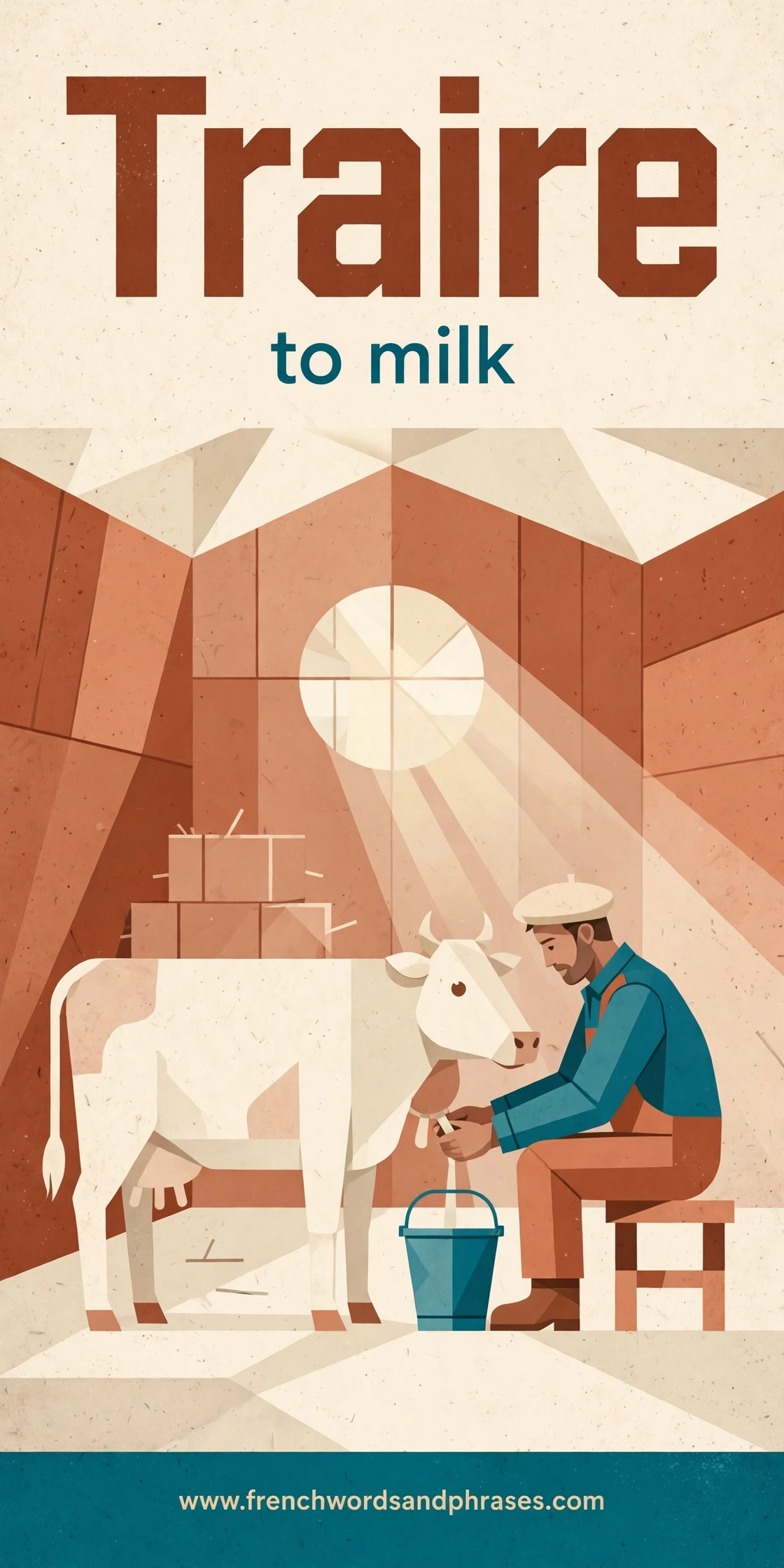
A barn warm with animals at dawn, a stool, a bucket, and the rhythmic hiss of milk hitting the pail — traire is the farmer’s verb of milking, one of the oldest gestures in the countryside, and a verb with two tenses simply missing.
In this guide, you’ll learn how to conjugate traire in all the major French tenses and moods. Explore complete conjugation tables, French examples, English translations, and practice quizzes.
Understanding the French Verb Traire
Traire is an irregular French verb ending in -re: it has no passé simple and no imperfect subjunctive.
It means to milk. It is commonly used on farms for milking cows, goats and sheep, by hand in the traditional way (traire à la main) or with a milking machine (la trayeuse), twice a day, every day — the rhythm that organises dairy life.
Verb classification: Irregular (-re)
Auxiliary verb: Avoir
Past participle: trait
Present participle: trayant
English equivalents: To milk (a cow, a goat); la traite — the milking; une trayeuse — a milking machine; traire à la main — to milk by hand.
One important detail: traire is a defective verb in disguise — its present runs on the stem tray- (nous trayons, en trayant), its past participle is the short, sharp trait, and two whole tenses are missing: traire has no passé simple and no imperfect subjunctive. Where a story would want them, French simply reaches for the passé composé instead: elle a trait les chèvres. The milking itself is a noun of the same family: la traite.
Experience the Word
Traire is the verb of dawn in the barn — warm flanks, patient animals, and a bucket slowly filling.
Imagine a small farm in the hills before sunrise. The farmer settles on his stool, forehead against the cow’s warm side, and trait in long, steady pulls while the cat waits for its share and the sky turns grey, then gold.
No machine, no hurry, no noise but the milk itself. The cow has been milked — traite — as cows have been milked for a thousand years.
How to Conjugate Traire: Complete French Conjugation Guide
Let’s explore every major conjugation of traire, beginning with the indicative mood.
How to Conjugate Traire in the Indicative Mood
The indicative mood is used to express facts, observations, actions, and events.
How to Conjugate Traire in the Present Tense (Présent)
Used for actions happening now, habitual actions, and general truths.
| Subject | Conjugation |
|---|---|
| je | trais |
| tu | trais |
| il / elle | trait |
| nous | trayons |
| vous | trayez |
| ils / elles | traient |
Example
Chaque matin, le fermier trait ses chèvres à l’aube.
Every morning, the farmer milks his goats at dawn.
Quick Quiz 1
Complete the sentence:
Nous ______ les chèvres à l’aube.
Reveal the answer
trayons
Nous trayons les chèvres à l’aube.
We milk the goats at dawn.
How to Conjugate Traire in the Passé Composé
Used for completed actions in the past. Traire takes the auxiliary verb avoir.
| Subject | Conjugation |
|---|---|
| j’ | ai trait |
| tu | as trait |
| il / elle | a trait |
| nous | avons trait |
| vous | avez trait |
| ils / elles | ont trait |
Example
Elle a trait les vaches avant le petit-déjeuner.
She milked the cows before breakfast.
How to Conjugate Traire in the Imparfait (Imperfect Tense)
Used for habitual past actions, descriptions, and ongoing situations in the past.
| Subject | Conjugation |
|---|---|
| je | trayais |
| tu | trayais |
| il / elle | trayait |
| nous | trayions |
| vous | trayiez |
| ils / elles | trayaient |
Example
Autrefois, on trayait les vaches à la main, assis sur un tabouret.
In the old days, people milked the cows by hand, sitting on a stool.
Quick Quiz 2
Choose the correct form:
She milked the cows.
Elle ______ les vaches. (a trait / est traite)
Reveal the answer
a trait
Elle a trait les vaches.
Traire takes avoir.
How to Conjugate Traire in the Plus-que-parfait
Used to describe an action that had already been completed before another past event.
| Subject | Conjugation |
|---|---|
| j’ | avais trait |
| tu | avais trait |
| il / elle | avait trait |
| nous | avions trait |
| vous | aviez trait |
| ils / elles | avaient trait |
Example
Il avait déjà trait les chèvres quand je suis arrivé.
He had already milked the goats when I arrived.
How to Conjugate Traire in the Passé Simple
Primarily used in formal writing, literature, and historical narratives. It is rarely used in everyday conversation.
| Subject | Conjugation |
|---|---|
| je | — |
| tu | — |
| il / elle | — |
| nous | — |
| vous | — |
| ils / elles | — |
Example
Traire n’a pas de passé simple : on dit « elle a trait les chèvres ».
Traire has no passé simple: you say ‘she milked the goats’ with the passé composé.
How to Conjugate Traire in the Passé Antérieur
A literary tense used to express an action completed immediately before another past action, generally in the passé simple.
| Subject | Conjugation |
|---|---|
| j’ | eus trait |
| tu | eus trait |
| il / elle | eut trait |
| nous | eûmes trait |
| vous | eûtes trait |
| ils / elles | eurent trait |
Example
Quand il eut trait les vaches, il rentra.
When he had milked the cows, he went back inside.
How to Conjugate Traire in the Future Tense (Futur Simple)
Used to describe actions that will take place in the future.
| Subject | Conjugation |
|---|---|
| je | trairai |
| tu | trairas |
| il / elle | traira |
| nous | trairons |
| vous | trairez |
| ils / elles | trairont |
Example
Demain, je trairai les chèvres plus tôt.
Tomorrow, I will milk the goats earlier.
How to Conjugate Traire in the Futur Antérieur (Future Perfect)
Used for an action that will have been completed before a particular point in the future.
| Subject | Conjugation |
|---|---|
| j’ | aurai trait |
| tu | auras trait |
| il / elle | aura trait |
| nous | aurons trait |
| vous | aurez trait |
| ils / elles | auront trait |
Example
À six heures, elle aura trait toutes les vaches.
By six o’clock, she will have milked all the cows.
How to Conjugate Traire in the Near Future (Futur Proche)
Used to describe something that is going to happen soon. Formed with aller + infinitive.
| Subject | Conjugation |
|---|---|
| je | vais traire |
| tu | vas traire |
| il / elle | va traire |
| nous | allons traire |
| vous | allez traire |
| ils / elles | vont traire |
Example
Je vais traire la dernière chèvre, attends-moi.
I am going to milk the last goat, wait for me.
How to Conjugate Traire in the Conditional Mood
The conditional mood expresses what would happen under certain circumstances. It is also frequently used to make polite requests or express wishes.
How to Conjugate Traire in the Present Conditional
| Subject | Conjugation |
|---|---|
| je | trairais |
| tu | trairais |
| il / elle | trairait |
| nous | trairions |
| vous | trairiez |
| ils / elles | trairaient |
Example
Avec une machine, on trairait vingt chèvres en une heure.
With a machine, we would milk twenty goats in an hour.
How to Conjugate Traire in the Past Conditional
| Subject | Conjugation |
|---|---|
| j’ | aurais trait |
| tu | aurais trait |
| il / elle | aurait trait |
| nous | aurions trait |
| vous | auriez trait |
| ils / elles | auraient trait |
Example
Il aurait trait les vaches si la machine était tombée en panne.
He would have milked the cows if the machine had broken down.
Traire in the Literary Past Conditional Form
This less common literary form uses the imperfect subjunctive of avoir.
| Subject | Conjugation |
|---|---|
| j’ | eusse trait |
| tu | eusses trait |
| il / elle | eût trait |
| nous | eussions trait |
| vous | eussiez trait |
| ils / elles | eussent trait |
Example
Il eût trait les chèvres avant l’aube, selon l’ancienne coutume.
He would have milked the goats before dawn, according to the old custom.
How to Conjugate Traire in the Subjunctive Mood
The subjunctive is used to express wishes, emotions, doubts, necessity, and uncertainty. It frequently follows expressions such as il faut que (it is necessary that) or bien que (although).
How to Conjugate Traire in the Present Subjunctive
| Subject | Conjugation |
|---|---|
| que je | traie |
| que tu | traies |
| qu’il / qu’elle | traie |
| que nous | trayions |
| que vous | trayiez |
| qu’ils / qu’elles | traient |
Example
Il faut que tu traies les chèvres avant la nuit.
You must milk the goats before nightfall.
Quick Quiz 3
Complete the sentence using the subjunctive:
Il faut que tu ______ les chèvres.
Reveal the answer
traies
Il faut que tu traies les chèvres.
You must milk the goats.
How to Conjugate Traire in the Imperfect Subjunctive
A literary tense, rarely encountered in modern spoken French.
| Subject | Conjugation |
|---|---|
| que je | — |
| que tu | — |
| qu’il / qu’elle | — |
| que nous | — |
| que vous | — |
| qu’ils / qu’elles | — |
Example
Traire n’a pas d’imparfait du subjonctif : la langue moderne tourne la phrase autrement.
Traire has no imperfect subjunctive: modern French phrases the sentence another way.
How to Conjugate Traire in the Pluperfect Subjunctive
A literary construction used to express an action completed before another past action.
| Subject | Conjugation |
|---|---|
| que j’ | eusse trait |
| que tu | eusses trait |
| qu’il / qu’elle | eût trait |
| que nous | eussions trait |
| que vous | eussiez trait |
| qu’ils / qu’elles | eussent trait |
Example
Je doutais qu’il eût trait les vaches à temps.
I doubted he had milked the cows in time.
How to Conjugate Traire in the Past Subjunctive
| Subject | Conjugation |
|---|---|
| que j’ | aie trait |
| que tu | aies trait |
| qu’il / qu’elle | ait trait |
| que nous | ayons trait |
| que vous | ayez trait |
| qu’ils / qu’elles | aient trait |
Example
Je suis content que vous ayez trait les chèvres ce matin.
I am glad you milked the goats this morning.
How to Conjugate Traire in the Imperative
The imperative is used to give commands, instructions, invitations, or suggestions. Subject pronouns are omitted.
How to Conjugate Traire in the Present Imperative
| Person | Conjugation |
|---|---|
| (tu) | trais |
| (nous) | trayons |
| (vous) | trayez |
Example
Trais les chèvres doucement, elles sont nerveuses !
Milk the goats gently, they are nervous!
Quick Quiz 4
How would you say Milk the goats (tu form)?
Reveal the answer
Trais les chèvres !
French Participles of Traire
Participles are verb forms that can be used in compound tenses and other grammatical constructions.
Present Participle of Traire
trayant
En trayant les vaches, il écoute la radio du matin.
While milking the cows, he listens to the morning radio.
Past Participle of Traire
trait
Traites au petit matin, les chèvres rentrent tranquillement à l’étable.
Milked in the early morning, the goats go quietly back into the barn.
Traire in Everyday French: Real-Life Examples
Now that you know the conjugations, let’s see how traire appears in everyday French.
Example 1 — Present
Le fermier trait ses chèvres à l’aube.
The farmer milks his goats at dawn.
Example 2 — Passé composé
Elle a trait les vaches ce matin.
She milked the cows this morning.
Example 3 — Imparfait
Ma grand-mère trayait ses chèvres à la main.
My grandmother used to milk her goats by hand.
Example 4 — Future
Demain, nous trairons les vaches plus tôt.
Tomorrow, we will milk the cows earlier.
Example 5 — Conditional
Avec une trayeuse, on trairait plus vite.
With a milking machine, we would milk faster.
Example 6 — Imperative
Trayons les chèvres avant l’orage !
Let us milk the goats before the storm!
Beyond Translation: The Meaning of Traire
English milk is both noun and verb, plain and everyday; French splits the work — le lait is the milk, and traire is the milking, a verb that belongs to the barn and keeps farm hours.
A verb with two tenses missing.
Traire reminds you that conjugation tables are not sacred: some verbs simply never grew a passé simple, and French speakers have milked their cows in the passé composé ever since.
How to Remember the French Verb Traire
Remember it this way: Traire is about the dawn milking — a verb that lives in the barn and skips two tenses.
- La traite is the milking; une trayeuse is the milking machine.
- The stem is tray-: nous trayons, en trayant — but the past participle is short: trait.
- Traire has no passé simple and no imperfect subjunctive: say elle a trait les chèvres.
The key idea is the dawn milking — a verb that lives in the barn and skips two tenses.
Test Your Knowledge of Traire
Let’s see how much you’ve learned. Try answering these questions before revealing the answers.
Question 1
Which two tenses does traire not have?
Reveal the answer
The passé simple and the imperfect subjunctive — French uses the passé composé instead.
Question 2
How do you say She milked the cows in French?
Reveal the answer
Elle a trait les vaches.
Question 3
Translate: The farmer milks his goats at dawn.
Reveal the answer
Le fermier trait ses chèvres à l’aube.
Question 4
What is the past participle of traire?
Reveal the answer
Trait.
Question 5
Complete the sentence:
Il faut que tu ______ les chèvres avant la nuit.
Reveal the answer
traies
Il faut que tu traies les chèvres avant la nuit.
You must milk the goats before nightfall.
Your Final Challenge
Can You Use It?
How would you say this in French?
The farmer milks his goats at dawn, and the morning milk already fills the churns.
Reveal the answer
Le fermier trait ses chèvres à l’aube, et le lait du matin emplit déjà les bidons.
The farmer milks his goats at dawn, and the morning milk already fills the churns.
A little French. A little curiosity. A richer everyday life.
LEARN FRENCH ONE WORD AT A TIME




