
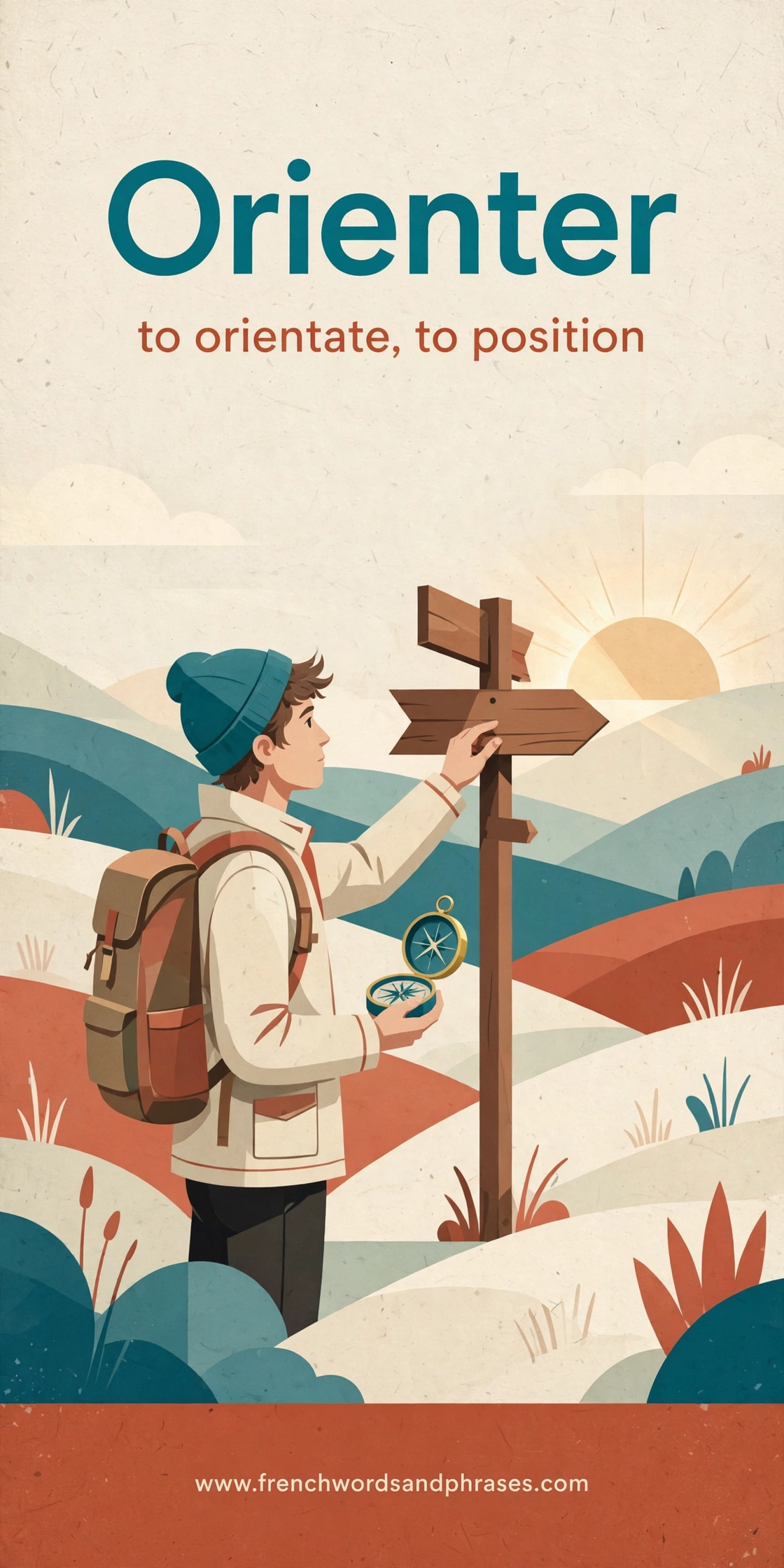
A French Word to Live By
How to Conjugate Orienter in French
/ɔ.ʁjɑ̃.te/
Orienter means to orient — to position something in a chosen direction, or to guide someone the right way.
A map on a rock, a compass needle settling, a house turned to catch the morning sun — orienter is the verb of facing the right way, and of showing others the way to face.
In this guide, you’ll learn how to conjugate orienter in all the major French tenses and moods. Explore complete conjugation tables, French examples, English translations, and practice quizzes.
Understanding the French Verb Orienter
Orienter is a regular French verb belonging to the first group of verbs, those ending in -er.
It means to orientate, to position. It is commonly used for positioning houses, tents, aerials and solar panels towards the sun or the signal, for directing visitors and travellers, and in schools for guiding pupils towards studies and careers.
Verb classification: First group (-er)
Auxiliary verb: Avoir
Past participle: orienté
Present participle: orientant
English equivalents: To orient, to position, to point; to guide, to direct; orienter une maison vers le sud — to face a house south; s’orienter — to find one’s bearings; l’orientation — bearings, guidance, careers advice.
One important detail: orienter comes from l’Orient — the east, where the sun rises — because the first maps put east at the top. Its reflexive s’orienter is the hiker’s essential verb: to find your bearings with a map, a compass or the sun — je ne sais plus m’orienter dans cette ville, I can’t find my way around this town any more. The plain verb also guides people: a conseiller d’orientation is the school careers adviser.
Experience the Word
Orienter is the verb of facing the right way — a house to the sun, a traveller to the road.
Imagine a hiker above the tree line, map spread on a flat rock. He turns it slowly until the lines match the ridges — il oriente sa carte — and the whole mountain suddenly makes sense.
Nothing in the landscape has changed. He has oriented himself — and now he knows the way.
How to Conjugate Orienter: Complete French Conjugation Guide
Let’s explore every major conjugation of orienter, beginning with the indicative mood.
How to Conjugate Orienter in the Indicative Mood
The indicative mood is used to express facts, observations, actions, and events.
How to Conjugate Orienter in the Present Tense (Présent)
Used for actions happening now, habitual actions, and general truths.
| Subject | Conjugation |
|---|---|
| je | oriente |
| tu | orientes |
| il / elle | oriente |
| nous | orientons |
| vous | orientez |
| ils / elles | orientent |
Example
Elle oriente les visiteurs vers l’accueil.
She directs visitors to the reception desk.
Quick Quiz 1
Complete the sentence:
Le conseiller ______ les élèves vers les métiers de la santé.
Reveal the answer
oriente
Le conseiller oriente les élèves vers les métiers de la santé.
The adviser guides the pupils towards careers in healthcare.
How to Conjugate Orienter in the Passé Composé
Used for completed actions in the past. Orienter takes the auxiliary verb avoir.
| Subject | Conjugation |
|---|---|
| j’ | ai orienté |
| tu | as orienté |
| il / elle | a orienté |
| nous | avons orienté |
| vous | avez orienté |
| ils / elles | ont orienté |
Example
Nous avons orienté l’antenne vers le satellite.
We pointed the aerial towards the satellite.
How to Conjugate Orienter in the Imparfait (Imperfect Tense)
Used for habitual past actions, descriptions, and ongoing situations in the past.
| Subject | Conjugation |
|---|---|
| je | orientais |
| tu | orientais |
| il / elle | orientait |
| nous | orientions |
| vous | orientiez |
| ils / elles | orientaient |
Example
Le panneau orientait les randonneurs vers le refuge.
The sign used to direct hikers towards the refuge.
Quick Quiz 2
Choose the correct form:
She positioned her desk facing the window.
Elle ______ son bureau face à la fenêtre. (a orienté / est orientée)
Reveal the answer
a orienté
Elle a orienté son bureau face à la fenêtre.
Orienter takes avoir.
How to Conjugate Orienter in the Plus-que-parfait
Used to describe an action that had already been completed before another past event.
| Subject | Conjugation |
|---|---|
| j’ | avais orienté |
| tu | avais orienté |
| il / elle | avait orienté |
| nous | avions orienté |
| vous | aviez orienté |
| ils / elles | avaient orienté |
Example
Elle avait orienté son bureau face à la fenêtre.
She had positioned her desk facing the window.
How to Conjugate Orienter in the Passé Simple
Primarily used in formal writing, literature, and historical narratives. It is rarely used in everyday conversation.
| Subject | Conjugation |
|---|---|
| je | orientai |
| tu | orientas |
| il / elle | orienta |
| nous | orientâmes |
| vous | orientâtes |
| ils / elles | orientèrent |
Example
Le guide orienta le groupe vers la sortie.
The guide directed the group towards the exit.
How to Conjugate Orienter in the Passé Antérieur
A literary tense used to express an action completed immediately before another past action, generally in the passé simple.
| Subject | Conjugation |
|---|---|
| j’ | eus orienté |
| tu | eus orienté |
| il / elle | eut orienté |
| nous | eûmes orienté |
| vous | eûtes orienté |
| ils / elles | eurent orienté |
Example
Quand il eut orienté la carte, il trouva le nord.
When he had oriented the map, he found north.
How to Conjugate Orienter in the Future Tense (Futur Simple)
Used to describe actions that will take place in the future.
| Subject | Conjugation |
|---|---|
| je | orienterai |
| tu | orienteras |
| il / elle | orientera |
| nous | orienterons |
| vous | orienterez |
| ils / elles | orienteront |
Example
Demain, nous orienterons les panneaux solaires vers le sud.
Tomorrow, we will angle the solar panels towards the south.
How to Conjugate Orienter in the Futur Antérieur (Future Perfect)
Used for an action that will have been completed before a particular point in the future.
| Subject | Conjugation |
|---|---|
| j’ | aurai orienté |
| tu | auras orienté |
| il / elle | aura orienté |
| nous | aurons orienté |
| vous | aurez orienté |
| ils / elles | auront orienté |
Example
À la fin du stage, elle aura orienté vingt étudiants.
By the end of the placement, she will have guided twenty students.
How to Conjugate Orienter in the Near Future (Futur Proche)
Used to describe something that is going to happen soon. Formed with aller + infinitive.
| Subject | Conjugation |
|---|---|
| je | vais orienter |
| tu | vas orienter |
| il / elle | va orienter |
| nous | allons orienter |
| vous | allez orienter |
| ils / elles | vont orienter |
Example
Je vais orienter le projecteur vers l’écran.
I am going to point the projector at the screen.
How to Conjugate Orienter in the Conditional Mood
The conditional mood expresses what would happen under certain circumstances. It is also frequently used to make polite requests or express wishes.
How to Conjugate Orienter in the Present Conditional
| Subject | Conjugation |
|---|---|
| je | orienterais |
| tu | orienterais |
| il / elle | orienterait |
| nous | orienterions |
| vous | orienteriez |
| ils / elles | orienteraient |
Example
Un bon conseiller orienterait cet élève vers la musique.
A good adviser would guide this pupil towards music.
How to Conjugate Orienter in the Past Conditional
| Subject | Conjugation |
|---|---|
| j’ | aurais orienté |
| tu | aurais orienté |
| il / elle | aurait orienté |
| nous | aurions orienté |
| vous | auriez orienté |
| ils / elles | auraient orienté |
Example
Il aurait orienté la maison autrement si le terrain l’avait permis.
He would have positioned the house differently if the plot had allowed it.
Orienter in the Literary Past Conditional Form
This less common literary form uses the imperfect subjunctive of avoir.
| Subject | Conjugation |
|---|---|
| j’ | eusse orienté |
| tu | eusses orienté |
| il / elle | eût orienté |
| nous | eussions orienté |
| vous | eussiez orienté |
| ils / elles | eussent orienté |
Example
Le phare eût orienté les navires loin des rochers.
The lighthouse would have guided the ships away from the rocks.
How to Conjugate Orienter in the Subjunctive Mood
The subjunctive is used to express wishes, emotions, doubts, necessity, and uncertainty. It frequently follows expressions such as il faut que (it is necessary that) or bien que (although).
How to Conjugate Orienter in the Present Subjunctive
| Subject | Conjugation |
|---|---|
| que je | oriente |
| que tu | orientes |
| qu’il / qu’elle | oriente |
| que nous | orientions |
| que vous | orientiez |
| qu’ils / qu’elles | orientent |
Example
Il faut que tu orientes la carte vers le nord.
You must orient the map towards the north.
Quick Quiz 3
Complete the sentence using the subjunctive:
Il faut que vous ______ les panneaux vers le sud.
Reveal the answer
orientiez
Il faut que vous orientiez les panneaux vers le sud.
You must angle the panels towards the south.
How to Conjugate Orienter in the Imperfect Subjunctive
A literary tense, rarely encountered in modern spoken French.
| Subject | Conjugation |
|---|---|
| que je | orientasse |
| que tu | orientasses |
| qu’il / qu’elle | orientât |
| que nous | orientassions |
| que vous | orientassiez |
| qu’ils / qu’elles | orientassent |
Example
Je voulais qu’elle orientât les élèves avec patience.
I wanted her to guide the pupils patiently.
How to Conjugate Orienter in the Pluperfect Subjunctive
A literary construction used to express an action completed before another past action.
| Subject | Conjugation |
|---|---|
| que j’ | eusse orienté |
| que tu | eusses orienté |
| qu’il / qu’elle | eût orienté |
| que nous | eussions orienté |
| que vous | eussiez orienté |
| qu’ils / qu’elles | eussent orienté |
Example
On racontait qu’il eût orienté les voyageurs vers le bon quai.
People told how he had directed the travellers to the right platform.
How to Conjugate Orienter in the Past Subjunctive
| Subject | Conjugation |
|---|---|
| que j’ | aie orienté |
| que tu | aies orienté |
| qu’il / qu’elle | ait orienté |
| que nous | ayons orienté |
| que vous | ayez orienté |
| qu’ils / qu’elles | aient orienté |
Example
Je suis content que tu aies orienté le fauteuil vers la cheminée.
I am glad you turned the armchair towards the fireplace.
How to Conjugate Orienter in the Imperative
The imperative is used to give commands, instructions, invitations, or suggestions. Subject pronouns are omitted.
How to Conjugate Orienter in the Present Imperative
| Person | Conjugation |
|---|---|
| (tu) | oriente |
| (nous) | orientons |
| (vous) | orientez |
Example
Oriente la lampe vers le livre, s’il te plaît !
Point the lamp at the book, please!
Quick Quiz 4
How would you say Find your bearings (tu form)?
Reveal the answer
Oriente-toi !
French Participles of Orienter
Participles are verb forms that can be used in compound tenses and other grammatical constructions.
Present Participle of Orienter
orientant
En orientant bien sa tente, il a évité le vent du nord.
By pitching his tent the right way round, he avoided the north wind.
Past Participle of Orienter
orienté
Orientée plein sud, la maison reste lumineuse toute l’année.
Facing due south, the house stays bright all year round.
Orienter in Everyday French: Real-Life Examples
Now that you know the conjugations, let’s see how orienter appears in everyday French.
Example 1 — Present
Le conseiller oriente les élèves.
The adviser guides the pupils.
Example 2 — Passé composé
J’ai orienté mon bureau face à la fenêtre.
I positioned my desk facing the window.
Example 3 — Imparfait
Le panneau orientait les voyageurs vers la gare.
The sign used to direct travellers to the station.
Example 4 — Future
Demain, elle orientera les nouveaux étudiants.
Tomorrow, she will guide the new students.
Example 5 — Conditional
Nous nous orienterions mieux avec une boussole.
We would find our bearings better with a compass.
Example 6 — Imperative
Oriente-toi vers le soleil et marche tout droit !
Face the sun and walk straight ahead!
Beyond Translation: The Meaning of Orienter
English orient hides the same sunrise: to orient a map was once to turn it until east — l’Orient — was at the top.
Find the east, find yourself.
French keeps the family together: s’orienter for your bearings, l’orientation for school guidance — and désorienté, lost and bewildered, when the compass fails.
How to Remember the French Verb Orienter
Remember it this way: Orienter is about turning the map until the mountains make sense.
- L’Orient is the east; orienter is to face the right way, s’orienter to find your bearings.
- Une boussole is a compass — the hiker’s tool for s’orienter.
- Regular -er: j’oriente, nous orientons, past participle orienté.
The key idea is turning the map until the mountains make sense.
Test Your Knowledge of Orienter
Let’s see how much you’ve learned. Try answering these questions before revealing the answers.
Question 1
How do you say to orient, to guide, in French?
Reveal the answer
Orienter.
Question 2
How do you say He positions the house facing south in French?
Reveal the answer
Il oriente la maison vers le sud.
Question 3
Translate: The guide directed the group towards the exit.
Reveal the answer
Le guide a orienté le groupe vers la sortie.
Question 4
What is the past participle of orienter?
Reveal the answer
Orienté.
Question 5
Complete the sentence:
Avec une boussole, je sais ______ dans la forêt.
Reveal the answer
m’orienter
Avec une boussole, je sais m’orienter dans la forêt.
With a compass, I can find my bearings in the forest.
Your Final Challenge
Can You Use It?
How would you say this in French?
He orients his map towards the north, and the mountain becomes readable.
Reveal the answer
Il oriente sa carte vers le nord, et la montagne devient lisible.
He orients his map towards the north, and the mountain becomes readable.
A little French. A little curiosity. A richer everyday life.
LEARN FRENCH ONE WORD AT A TIME




